Key Moments
Tim Ferriss Q&A: Wealth and Money, Book Recommendations, Advice on Taking Advice, and Much More
 Tim Ferriss
Want to know something specific about what's covered?
We've already dissected every moment. Ask and we will deliver (with timestamps).
Key Moments
Tim Ferriss answers listener questions on money, investments, personal growth, and life choices.
Key Insights
Wealth doesn't automatically equate to happiness; it can amplify existing psychological and emotional states.
Personal growth is a continuous journey, and self-compassion is crucial, though challenging to master.
Building meaningful connections and relationships requires intentional effort and prioritization.
While traditional education like Ivy League degrees can offer advantages, their value is highly context-dependent.
Authenticity in podcasting involves giving guests final say and focusing on genuine conversation over controversy.
Developing meta-skills like language acquisition or mastering a mental and physical discipline can accelerate learning.
PERSPECTIVES ON WEALTH AND HAPPINESS
Tim Ferriss addresses the common assumption that wealth directly leads to happiness, explaining that money often amplifies pre-existing psychological and emotional states rather than fixing problems. He notes that while financial security can alleviate certain stresses, it can also exacerbate issues like paranoia or insecurity. He highlights that the pursuit of wealth can become an energy-draining endeavor, and the psychological shift from a high-octane lifestyle to a slower pace can be surprisingly difficult.
THE CHALLENGE OF SELF-COMPASSION AND PERSONAL GROWTH
Ferriss acknowledges that self-compassion is an ongoing struggle, admitting to remaining hard on himself with self-criticism. He reflects on the idea that if being hard on oneself were effective, it would have already worked, but concedes that harshness can sometimes drive action, though not necessarily contentment. He stresses that while growth is a goal, a constant focus on internal improvement and self-awareness is essential but difficult, especially when it involves internalizing and processing life's challenges.
RELATIONSHIP MANAGEMENT AND SOCIAL CONNECTIONS
Addressing Dunbar's Law, Ferriss suggests that maintaining a few dozen meaningful relationships is more realistic than 150. He emphasizes quality over frequency, noting that deep, well-prepared conversations leave a lasting positive impression. He believes that busy, high-caliber individuals often seek meaningful connections rather than constant upkeep, and that a well-executed podcast interview can serve as a strong foundation for a lasting connection without requiring immediate follow-up.
THE NUANCES OF HIGHER EDUCATION AND CAREER CHOICES
Regarding the value of Ivy League graduate schools, Ferriss states it's highly dependent on individual circumstances, debt, and career aspirations. He suggests that for professional fields like business, consulting, or banking, prestigious institutions can open doors. However, he notes that for undergraduate liberal arts education, the brand recognition of an Ivy League school can offer lifelong benefits if attainable without undue financial burden. The calculus for graduate degrees differs significantly from that of undergraduate studies.
AUTHENTICITY IN Content CREATION AND ADVICE
Ferriss champions authenticity in his podcasting, granting guests final cut to ensure genuine conversation. He explains that while a few interviews haven't been published due to guest discomfort, his aim is collaborative creation, not controversy. He advises guests to be raw and share openly, with editing handled later. He also cautions listeners against relying solely on one demographic for life advice, stressing the importance of diversifying sources and critically stress-testing any information received.
DEVELOPING META-SKILLS AND LEARNING EFFECTIVELY
Ferriss identifies key meta-skills that facilitate learning, including cultivating relationships with polymaths, mastering a non-native language to fluency, and engaging in a physical discipline. He argues that learning a language teaches procedural knowledge, while mastering a physical skill develops discipline. He also touches upon the timeless principles of his book 'The 4-Hour Workweek,' suggesting they are more relevant today than ever due to shifts toward remote work and decentralized systems, emphasizing the importance of Pareto's principle and fear-setting.
NAVIGATING LIFE'S CHALLENGES AND PERSONAL CHOICES
Ferriss shares his journey with his financial situation, noting he rarely invests in startups now, focusing on climate solutions and next-gen agriculture, and has scaled back on Web3. He expresses a pragmatic approach to societal changes, emphasizing risk mitigation through reducing internet footprint and disengaging from polarized platforms. He also discusses the importance of intentionality in creative pursuits and relationships, particularly for navigating differing lifestyle preferences within a partnership.
REFLECTIONS ON MONEY, INVESTING, AND MARKET CYCLES
When asked if he became happier with wealth, Ferriss reflects that a baseline level of financial comfort provides peace of mind, particularly for family support. However, he emphasizes it does not automatically bring happiness and can amplify existing issues. He advises listening to discussions on the psychology of money and his conversation with Morgan Housel. He also shares his current cautious stance on investing, preparing for a recession with high inflation and maintaining significant cash reserves for peace of mind.
THE ROLE OF DOWNTIME AND CREATIVE PURSUITS
Ferriss acknowledges the concern that downtime can invite challenging thoughts and anxieties, but suggests that embracing this vulnerability is part of the process. He distinguishes between downtime and creative pursuits, suggesting that creativity can be found in connecting with people. He advocates for choosing projects based on 'who' relationships emerge from, rather than solely on the 'what' of the endeavor, finding that this approach nourishes his mental state.
GUIDANCE ON RELATIONSHIPS AND LIFE CHOICES
Ferriss offers advice on handling overly political individuals, suggesting direct conversations or avoidance. He recommends writers like Ralph Waldo Emerson and John Muir for their prose. He explores the appeal of C.S. Lewis through his writing and the compelling portrayal in 'The Most Reluctant Convert.' He also discusses his personal process for podcast interviews, emphasizing preparation and guest comfort, and touches upon managing unsolicited advice and differing life philosophies with a partner.
LIVING A DEEP LIFE AND INFLUENCING PARTNERS
Addressing the challenge of a partner preferring ease over arduous self-improvement, Ferriss suggests finding common ground by identifying shared enjoyable activities and subtly infusing self-development elements. He advises meeting one's partner where they are, rather than attempting to force a change. He also touches on the importance of self-awareness as a precursor to self-development and encourages exploring somatic practices or workshops that foster introspection and growth.
ACCEPTANCE AND RESILIENCE IN THE FACE OF ADVERSITY
Ferriss discusses weathering emotionally tough moments by accepting that they will be destabilizing, rather than trying to prevent it. He recommends authors like Bruce Tift ('Already Free') and Oliver Burkeman for their insights into managing stress and internal thoughts. He emphasizes that acknowledging one's humanity and the normalcy of experiencing emotional turmoil can be freeing and is a crucial aspect of building resilience.
THE IMPERMANENCE OF FINANCIAL EXPERTISE AND MARKET CYCLES
Ferriss reflects on how recent market volatility has reinforced his belief that few people truly understand investing, and that many successful investors are simply riding market trends. He advocates for holding cash reserves and prioritizing sleep over maximizing investment returns. He suggests further reading on financial concepts, noting that even the most esteemed investors can face significant losses, reinforcing the idea that preparation and prudence are key.
STRATEGIES FOR OVERCOMING GRIEF AND LOSS
In the context of his uncle's passing, Ferriss notes the surprisingly uplifting nature of a memorial service focused on positive and humorous stories. He recommends 'It's OK That You're Not OK' by Megan Devine and 'Griefozemsky' by David Kessler and Elisabeth Kübler-Ross for insights into managing grief, highlighting the value of storytelling and shared remembrance.
Mentioned in This Episode
●Products
●Software & Apps
●Companies
●Organizations
●Books
●Concepts
●People Referenced
Common Questions
Tim Ferriss very rarely invests in startups. Currently, his investments are mostly in climate solution tech and next-generation agriculture, with a dialed-back focus on Web3.
Topics
Mentioned in this video
The app used to record audio with the Shure MV88 microphone on iPhone.
A meditation app by Sam Harris, which Tim intends to use to get back into his meditation practice.
A note-taking software Tim finds interesting as a potential alternative to Evernote.
Used as a second backup for audio recording during the podcast.
An online Q&A session where Tim explained his reasons for taking a break from investing and moving to Austin.
A note-taking software Tim uses almost every day, considering it fine but open to transitioning in the future.
The URL where Tim's first published piece of fiction, a short story, is available, with funds going to his foundation.
A simple plastic device costing $50-$80, used to release the psoas muscle, helping with lower back pain and sleep disruption.
A category of decentralized internet technologies Tim was investing in but has since dialed back to reallocate funds to climate solutions.
Mentioned as part of 'web3' and a space Tim is engaging with for social connection, but advises caution for investment.
A cryptocurrency mentioned by Tim as a potential denomination for related marketplaces and technologies he is interested in.
Author of 'Four Thousand Weeks', whose book provided many highlights for Tim.
Author, alluding to his 'write drunk, edit sober' approach, applied by Tim to podcasting.
A person whose short lectures on meditation Tim finds interesting.
An 'incredible human being', 'most interesting man in the world', and role model for parenting and holistic living, whose advice Tim values.
One of the individuals Tim would interview 'any day or every day', highlighting his valued perspective.
A hospice care physician and triple amputee, whose interview had a big impact on Tim, referring thousands of people how to make the transition.
A friend of Tim's and host of a podcast, 'I Will Teach You To Be Rich', recommended for normalizing diverse money issues.
Author of 'The Psychology of Money', whose podcast episode with Tim was hugely popular and is recommended for a healthy view of money.
Host of 'Inside the Actors Studio', noted for giving guests final cut, a policy Tim also employs.
Philosopher and author, whose book 'Why I Am Not a Christian' Tim read at the same time as 'The Screwtape Letters', demonstrating diverse interests.
Actor mentioned by Tim for his term 'upside-down face' to describe growing hair on the bottom of the face while bald on top.
A dream guest Tim wanted on his podcast since day one, indicating his preference for diverse and profound thinkers.
A past guest on Tim's podcast, mentioned as one who fulfilled his 'dream guest' list.
Author of 'More Money Than God' and 'The Power Law', whose work Tim recommends for understanding venture capital and investment strategies.
A seasoned investor who wrote a comprehensive book on structuring and evaluating venture capital investments, recommended for deep dives into VC.
A common answer to the 'successful person' question, often cited as a tech titan.
Comedian and writer, whom Tim would love to have on the podcast.
A returning podcast guest, included on Tim's list of people he'd be happy to interview any day, due to valuable insights.
Someone interviewed by Tim, whose discussion on 'cosmic insignificance therapy' overlapped with BJ Miller's insights.
The founder and creator of Internal Family Systems (IFS), whom Tim interviewed and is considering re-interviewing to explore 'legacy burdens'.
Author whose prose and writing Tim finds spectacular; not initially discovered for religious reasons. Praises his book 'The Screwtape Letters' and 'The Chronicles of Narnia'.
Creator of the 'Waking Up' app, used by Tim for meditation.
A famous Stoic philosopher whose writings Tim referenced regarding the inherent difficulties of life.
A common answer to the 'successful person' question, who Tim has had on his podcast and believes follows his own inner compass.
A consultant and author whose insights on success and motivations are deeply valued by Tim, leading to changes in his interview questions.
An essayist who comes to Tim's mind when asked for recommendations, associated with transcendentalism.
A polymath expert in chess, tai chi, Brazilian Jiu-Jitsu, and foil boarding, cited as an example of someone who has mastered multiple disparate disciplines.
Author of 'Lost Connections', a book Tim is reading, specifically Part 3 on social cohesion and community for parenting success.
An actor Tim thinks would be an 'incredible' podcast guest.
A past guest on Tim's podcast, mentioned as one who fulfilled his 'dream guest' list.
A renowned hedge fund manager who famously said, 'we should not convince a bull market with being a genius,' an insight Tim found valuable.
Author of 'Already Free,' a book that Tim found helpful in navigating emotionally tough moments.
A common answer to the 'successful person' question, often cited as a tech titan.
Cited as a primary example of a 'tech titan' who might be named when asking about successful people.
Comedian and actor, whom Tim hoped to have on the podcast before he passed away.
A naturalist and writer whose works Tim has been reading due to his interest in Yosemite and the US National Park system.
A name that has come up for Tim recently, prompting his interest in investigating his 'body work'.
Retired Navy SEAL commander and podcast host who interviewed Tim about the novel 'Musashi'.
Author of 'Awareness', a book recommended by Tim for fundamental self-awareness.
A 'mega celebrity' Tim considers a 'dream guest', but finds the logistical 'squeeze' not worth the 'juice'.
An actor Tim considers a 'dream guest' due to his spectacular performances, despite the difficulty of obtaining an interview.
A past guest on Tim's podcast, mentioned as one who fulfilled his 'dream guest' list.
A teacher whose work offers structured ways to scrutinize thoughts and beliefs through free downloadable worksheets, recommended by Tim.
A therapeutic modality that Tim has explored and found undeniably effective, despite not loving its name.
Reference point for basic needs like shelter and food, which money can solve, but not deeper psychological issues.
A mantra-based repetition practice Tim finds helpful for re-establishing meditation habits.
The idea that accepting the impossibility of certain tasks (like handling all inbound messages) can lead to psychological progress.
Ramit Sethi's podcast, recommended by Tim for its episodes on money issues, priorities, and living a 'rich life'.
A hugely popular episode and book, recommended by Tim for understanding a healthy view of money and its psychological aspects.
A series of books by C.S. Lewis, noted for selling over 100 million copies in 47 languages, crossing into mainstream success.
A book by Bertrand Russell, read by Tim, showing his interest in various belief systems and philosophical prose.
A book by Oliver Burkeman that greatly impacted Tim and had an excerpt about 'cosmic insignificance therapy'.
Another book by Tim Ferriss, for which he is considering a new volume to consolidate learnings.
A long, historical novel that is one of Tim's favorites and the best-selling novel in Japanese history, recommended for learning about Japanese martial arts culture.
A book by Tim Ferriss that contains a section on metalearning, relevant to acquiring new skills and languages.
A book by Johann Hari, subtitled 'Uncovering the Real Causes of Depression and the Unexpected Solutions', which Tim is reading for its insights on social cohesion and parenting.
A work by Seneca the Younger, mentioned as an example of Stoic philosophy that acknowledges the hardness of life.
A book by Tim Ferriss, which he is considering a new volume for, to review lessons from past podcast episodes.
A book by C.S. Lewis that Tim absolutely loved, read over 20 years ago, with strong religious implications.
A book by Bruce Tift that Tim found very helpful for understanding emotional resilience during tough moments.
A recent book by Sebastian Mallaby on venture capital, which Tim also recommends.
A book recommended by Tim as the one he'd suggest right now for foundational self-awareness issues.
A book by Sebastian Mallaby recommended by Tim for understanding how smart investors find ways to win even if they lose.
An out-of-print book recommended by Tim Ferriss that covers alternative modes of financing for startups and small businesses.
A book mentioned for its lesson about trusting the process even when the 'track is lost'.
A book by Kevin Kelly, compiling his annual 'what I've learned' lists, offering 300-400 bits of advice.
A national park whose history Tim has been reading about, leading to his interest in transcendentalist and naturalist writers.
The city Tim considered for live podcast series pre-COVID and where he later moved, anticipating a slower scene but experienced rapid growth due to the pandemic.
A city in Germany Tim enjoyed visiting, finding the people warm, funny, and blunt.
Tim's hometown, whose blunt humor he found easy to digest during his time in Berlin.
Tim's home country, where he feels a karmic obligation to help improve things, despite its increasing contentiousness.
Tim's primary microphone for podcasting, a newer version of the ATR2100, part of his affordable setup.
A portable light exposure device used by Tim to combat bad days and improve mood, available on Amazon.
A backup microphone plugged into an iPhone for recording, showing the cost-effectiveness of podcasting gear.
A podcast mentioned as an example of an interview format that Tim's podcast is closer to, focusing on storytelling rather than controversy.
A fact-based film about C.S. Lewis, praised by Tim for its incredibly good acting.
A short miniseries podcast Tim found interesting for learning more about Oprah Winfrey.
A political talk show mentioned as a contrasting example of an interview style Tim avoids, which seeks to pin guests in a corner for controversy.
A favorite book of Tim's from childhood that he would read in detention, containing philosophy intended for adult audiences.
Mentioned as a potential geographic option for living, but acknowledged to also have complex and serious problems.
The system of national parks in the US, whose history Tim has been studying.
Tim's non-profit foundation, supported by funds from his published fiction, focusing on research for novel treatments for major depressive disorder and PTSD.
More from Tim Ferriss
View all 703 summaries 70 min
Q&A with Tim — The Art of Male Friendship, Reinvention in The Age of AI, & More
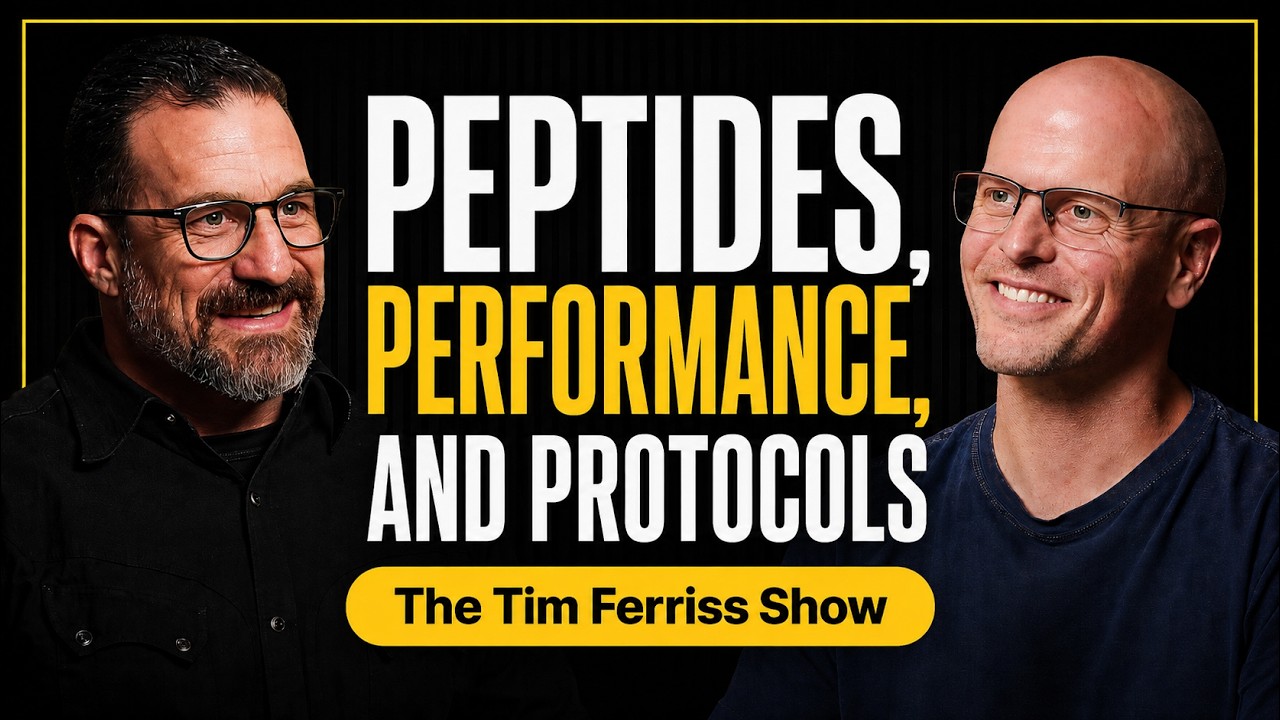 125 min
Dr. Andrew Huberman — Peptides, Performance, and Protocols
 112 min
The Random Show! Mortality, AI, Supplements, Rock Climbing, & More
 88 min
The Legendary Hollywood Power Broker — Guy Oseary on 36 Years of Managing Madonna, 26 IPOs, and More
Ask anything from this episode.
Save it, chat with it, and connect it to Claude or ChatGPT. Get cited answers from the actual content — and build your own knowledge base of every podcast and video you care about.
Get Started Free