Key Moments
Richard Schwartz — IFS, Psychedelic Experiences without Drugs, and More | The Tim Ferriss Show
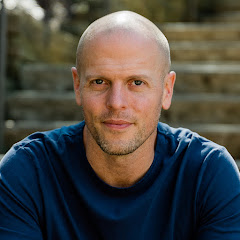 Tim Ferriss
Want to know something specific about what's covered?
We've already dissected every moment. Ask and we will deliver (with timestamps).
Key Moments
Richard Schwartz discusses Internal Family Systems (IFS) for inner peace, healing trauma, and managing emotions.
Key Insights
Internal Family Systems (IFS) views the mind as comprised of 'parts' with valuable intentions, not inherently pathological.
Trauma and attachment injuries can force these parts into protective roles, leading to symptoms and emotional burdens.
The 'Self' (capital S) is an innate, undamaged core of presence, curiosity, calm, confidence, and compassion within everyone.
IFS provides a framework for accessing the Self to understand and heal wounded 'exiled' parts and manage 'protector' parts.
The IFS model can facilitate psychedelic experiences by helping individuals understand and integrate their inner experiences.
IFS can be applied to various issues, including anxiety, anger, depression, and even suicidal ideation by treating these as manifestations of parts.
THE FOUNDATION OF INTERNAL FAMILY SYSTEMS
Richard Schwartz introduces Internal Family Systems (IFS) as a revolutionary approach to understanding the human psyche. He explains that the mind naturally consists of multiple 'parts,' each with unique roles and intentions, rather than being a singular entity. This perspective challenges traditional views that pathologize inner conflicts, positing instead that all parts, even those exhibiting challenging behaviors, arise from a protective or adaptive function, often stemming from early life experiences or trauma.
IDENTIFYING AND UNDERSTANDING INNER PARTS
IFS categorizes parts into 'exiles' and 'protectors.' Exiles are the young, vulnerable parts that carry the burdens of pain, fear, and shame from traumatic or distressing experiences. Protectors, in turn, develop to shield the individual from these painful exiles. These protectors are further divided into 'managers,' who strive to control the environment and prevent triggers, and 'firefighters,' who react intensely to douse overwhelming emotions when managers fail, often through addictive or extreme behaviors.
ACCESSING THE HEALING 'SELF'
A cornerstone of IFS is the concept of the 'Self,' which possesses inherent qualities of curiosity, calm, confidence, compassion, courage, clarity, creativity, and connectedness. Schwartz emphasizes that this Self is present in everyone, undamaged by experience, and holds the natural capacity for healing. Accessing the Self, often described as a state of inner leadership, is crucial for facilitating transformation within the internal system by providing a secure and compassionate base from which to engage with other parts.
THE PROCESS OF HEALING AND UNBURDENING
Healing in IFS involves the Self interacting with wounded exiles and understanding the protective roles of other parts. This often includes a process of witnessing the exile's pain with compassion, retrieving them from traumatic memories, and then unburdening them of the extreme emotions and beliefs they carry. This unburdening can be facilitated through various methods, like visualization or symbolic release, allowing the part to be freed from past contexts and integrate into the present moment.
IFS AS A MAP FOR PSYCHEDELIC EXPERIENCES
The conversation highlights the remarkable parallels between IFS and the experiences often facilitated by psychedelic substances. Schwartz suggests that IFS can serve as a 'map' to navigate the inner landscape revealed during psychedelic journeys, helping individuals understand and integrate their experiences. By providing a conceptual framework, IFS can prepare individuals for such experiences, support them through challenging internal material with the help of the Self, and aid in metabolizing profound insights gained during altered states of consciousness.
APPLICATIONS AND DAILY PRACTICE OF IFS
The applicability of IFS extends beyond trauma, offering tools for everyday challenges like anxiety. Richard Schwartz demonstrates this through a live exercise with Tim Ferriss, addressing anxiety by connecting with the underlying parts and ultimately the Self. He advocates for IFS as a daily practice, encouraging regular check-ins with one's inner parts to foster self-compassion and maintain internal harmony. This practice helps individuals manage their internal systems and build resilience.
ADDRESSING SEVERE DISTRESS AND SUICIDAL IDEATION
Schwartz explains how IFS can be applied to deeply distressing conditions, including suicidal ideation. He emphasizes that the suicidal impulse is often a part's extreme 'firefighter' response to overwhelming pain and a desire for it to stop. By identifying this part, validating its intention, and offering an alternative to ending suffering, IFS provides a path toward hope and healing. This approach reframes extreme states not as the entirety of the self, but as specific parts with specific, albeit misguided, protective aims.
IFS IN RELATIONSHIPS AND CONFLICT RESOLUTION
In relationships, conflicts often arise from 'protector wars,' where parts of each individual engage defensively or aggressively. IFS encourages a 'u-turn,' prompting individuals to shift from speaking 'from' a part to speaking 'for' a part from the Self. This allows for more compassionate communication, enabling partners to understand the underlying exiles being triggered and fostering empathy. Witnessing a partner engage in IFS work can further deepen relational understanding and healing.
RESOURCES FOR EXPLORING IFS
For those interested in learning more about IFS, Richard Schwartz directs listeners to the IFS Institute website (ifs-institute.com), which offers books, videos, and resources for both the general public and practitioners. He specifically mentions his own books, 'An Introduction to IFS' and 'You Are the One You've Been Waiting For,' as highly accessible starting points. He also recommends 'Self-Therapy' by Jay Early for a self-guided approach, while noting careful consideration regarding direct work with exiles.
Mentioned in This Episode
●Software & Apps
●Companies
●Organizations
●Books
●Drugs & Medications
●Concepts
●People Referenced
Common Questions
IFS views the mind as naturally multiple, composed of various sub-personalities or 'parts,' in addition to a core 'Self.' Unlike traditional approaches that might pathologize symptoms, IFS sees every part as having a positive intention, often seeking to protect, even through extreme behaviors. The goal is to access the 'Self' – an innate source of curiosity, calm, and compassion – to heal and unburden these parts. It explicitly is not limited to heavily traumatized patients or a psychotherapeutic context.
Topics
Mentioned in this video
A form of psychotherapy that views the mind as naturally multiple, composed of various 'parts' and a core 'Self'. It's evidence-based and widely used for trauma, offering a non-pathologizing and empowering perspective.
A therapeutic approach using MDMA, observed by Tim Ferriss to assist severe PTSD patients, often leading to spontaneous IFS-like processes.
A personal productivity method excellent for managing work-related tasks and open loops, with parallels drawn to IFS for emotional management.
The creator of the Getting Things Done (GTD) system, who has also been a guest on The Tim Ferriss Show.
A renowned psychologist, quoted by Tim Ferriss: 'The curious paradox is that when I accept myself just as I am, then I can change.'
Author of 'The Body Keeps the Score' and director of a renowned trauma center in Brookline, Massachusetts.
The guest on the podcast, a family therapist and academic who developed the Internal Family Systems (IFS) model, currently on the faculty of Harvard Medical School's psychiatry department.
A close friend of Tim Ferriss and a fellow survivor of sexual abuse, with whom Tim discussed his healing journey.
Author of the book 'Self-Therapy,' which provides a guide to the IFS process for laypersons.
A rabbi and former guest on the podcast, who recommended keeping a busy calendar to avoid depression.
A meditation teacher and author, quoted by Tim Ferriss: 'If your compassion does not include yourself, it is incomplete.'
A clinician, well-trained in IFS, who used MDMA with PTSD clients and observed them spontaneously engaging in IFS-like processes during sessions.
A clinician, well-trained in IFS, who co-led MDMA-assisted psychotherapy with combat veterans.
A former clinical instructor at Harvard Medical School and staff psychiatrist at Bessel van der Kolk's trauma center, who found IFS to be a huge paradigm shift due to its non-pathologizing nature.
Author of 'Radical Acceptance,' whose work is described as a very Buddhist mindfulness approach to self-compassion.
A psychologist known for his work in transpersonal psychology and altered states of consciousness, whose concept of innate healing intelligence is referenced.
A physician and author, known for his work on addiction, quoted for his inquiry 'ask not why the addiction but why the pain'.
Where Richard Schwartz began his career as a family therapist and academic, and where he discovered the concept of 'parts' in patients.
An organization for which Richard Schwartz and Frank Anderson developed a step-by-step IFS manual for therapists.
Richard Schwartz is currently on the faculty of its Department of Psychiatry.
An organization that conducted MDMA-assisted psychotherapy training, which Tim Ferriss experienced as an auditor.
A mattress company offering customized mattresses based on body type and sleep preferences. Tim Ferriss mentions sleeping on a Helix Midnight Luxe mattress for several years.
A company producing an all-in-one nutritional supplement. Tim Ferriss views it as nutritional insurance and has recommended it for over ten years.
A publisher of audio courses, including Richard Schwartz's 'Greater Than The Sum Of The Parts'.
An online publishing platform where an article titled 'Inside the Revolutionary Treatment That Could Change Psychotherapy Forever' discussed the story of Roxanne and the development of IFS.
A platform for small businesses to find and hire qualified candidates for job roles, offering a free first job post for new users.
The official website for Internal Family Systems, which offers resources like books, videos, and a therapist directory.
A book written by Jay Early that guides people through the IFS process, with a note of caution about its approach to exiles.
A book by Tara Brach, described as a Buddhist mindfulness approach to self-compassion, contrasting with IFS's more active approach.
One of Richard Schwartz's books for the general public about Internal Family Systems.
A classic book by Bessel van der Kolk, mentioned in the context of trauma treatment.
Another book by Richard Schwartz, focusing on relationships within the IFS framework.
The 'bible for therapists' for IFS, by Richard Schwartz, published recently.
More from Tim Ferriss
View all 703 summaries 70 min
Q&A with Tim — The Art of Male Friendship, Reinvention in The Age of AI, & More
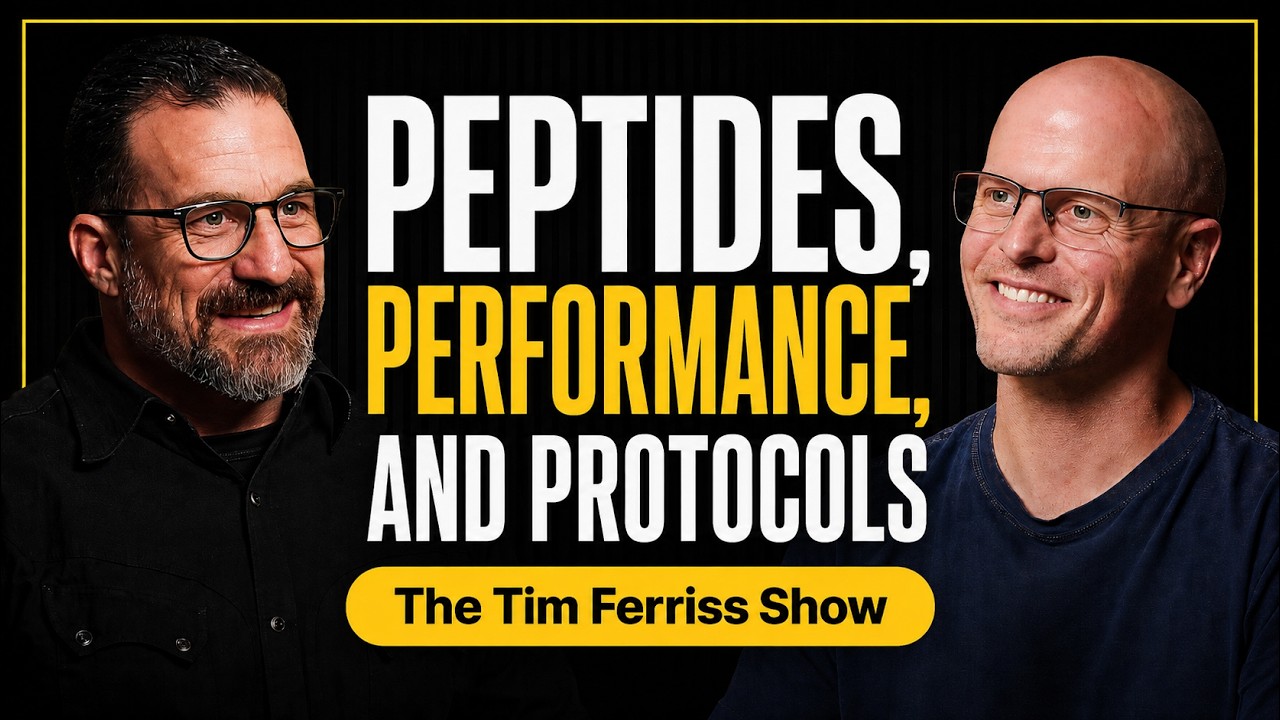 125 min
Dr. Andrew Huberman — Peptides, Performance, and Protocols
 112 min
The Random Show! Mortality, AI, Supplements, Rock Climbing, & More
 88 min
The Legendary Hollywood Power Broker — Guy Oseary on 36 Years of Managing Madonna, 26 IPOs, and More
Ask anything from this episode.
Save it, chat with it, and connect it to Claude or ChatGPT. Get cited answers from the actual content — and build your own knowledge base of every podcast and video you care about.
Get Started Free