Key Moments
Dr. Arthur De Vany Interview | The Tim Ferriss Show (Podcast)
 Tim Ferriss
Want to know something specific about what's covered?
We've already dissected every moment. Ask and we will deliver (with timestamps).
Key Moments
Aging is damage, not destiny. Focus on renewal via diet, exercise, and stress response.
Key Insights
Aging is viewed not as a programmed process, but as cumulative damage and failure of repair mechanisms.
Evolutionary principles suggest humans are designed for robustness and adaptation, thriving on variety and 'extreme events'.
Exercise, particularly eccentric (negative) training, is crucial for stem cell activation and muscle maintenance.
Dietary strategies focus on intermittent fasting and low insulin signaling to activate cellular repair pathways (autophagy, proteostasis).
The body possesses inherent self-repair mechanisms (like proteasomes and autophagy) that can be stimulated through specific behaviors.
A simple, clean lifestyle emphasizing whole foods, strategic fasting, and intense exercise is key to health and longevity.
ECONOMICS OF UNCERTAINTY AND EXTREME EVENTS
Dr. Arthur De Vany, an economist by training, applies principles of understanding decentralized mechanisms and spontaneous order to various aspects of life. He criticizes traditional economic models that focus on average outcomes, arguing that life, like extreme weather events and market dynamics, doesn't follow normal distributions. Instead, it's dominated by rare, high-impact events. This analytical framework, rooted in economics, informs his approach to understanding complex systems, including human biology and fitness.
EVOLUTIONARY FITNESS AS A FRAMEWORK
De Vany posits that human survival through extreme conditions like the Toba volcanic winter necessitated robust, adaptive individuals. Our large brains evolved as survival instruments, requiring a sophisticated brain-body signaling system. He uses the analogy of a sea squirt, which consumes its own brain when it settles down, to illustrate how disuse leads to degeneration. Maintaining physical and cognitive health requires continuous engagement and adaptation, echoing evolutionary pressures.
THE NON-PROGRAMMED NATURE OF AGING
Contrary to popular belief, De Vany argues that aging is not a programmed biological destiny but rather a result of accumulated damage and the failure of the body's inherent renewal and repair systems. He identifies key defensive pathways like autophagy, proteostasis, and stem cell proliferation as crucial for maintaining cellular integrity. The loss of function associated with aging is, in his view, a breakdown in these protective and regenerative processes, not an inevitable march dictated by genes.
ECCENTRIC EXERCISE AND STEM CELL ACTIVATION
De Vany emphasizes the importance of eccentric (negative) exercise, such as the lowering phase of a lift or downhill running. This type of training is particularly effective at doubling stem cell counts in muscles without necessarily exhausting them. The goal is to promote asymmetric differentiation, where one stem cell renews the niche and another participates in tissue repair. This targeted stimulation of fast-twitch muscle fibers is seen as vital for maintaining strength and function.
DIETARY STRATEGIES FOR CELLULAR RENEWAL
De Vany advocates for eating only twice a day, creating long intervals between meals to promote low insulin signaling. This metabolic state activates crucial defensive and repair pathways like autophagy and proteostasis. He stresses that calorie restriction is not the primary focus, but rather the timing of nutrient intake to allow the body's natural cleanup and repair mechanisms to function optimally. Overeating, especially of processed foods or excessive fats, can overload these systems.
THE ROLE OF MITOCHONDRIA AND PROTEIN QUALITY CONTROL
The discussion touches on mitochondrial density, noting that humans have relatively low density, especially in stem cell niches which favor a low-oxygen environment. High-intensity exercise, like sprinting, can improve mitochondrial quality, making them more efficient and less reliant on oxidation. Furthermore, De Vany highlights the critical role of proteostasis – the maintenance of protein quality control – which involves degrading damaged or misfolded proteins. A failure in this system contributes significantly to aging.
AVOIDING FADS AND COMMON PALEO MISCONCEPTIONS
De Vany critiques certain trends within the paleo community, particularly the excessive consumption of fat, which he warns can lead to fatty liver disease. He emphasizes variety, flavor, texture, and color in food choice over adherence to specific 'superfoods'. He also cautions against an evolutionary non-sequitur like the heavy reliance on coconut oil, suggesting a focus on what is sustainable and evolutionarily appropriate rather than trendy.
OPTIMIZING NEURAL HEALTH AND RESILIENCE
Brain health is linked to physical activity and controlled stress responses. De Vany suggests that exercise, particularly resistance training, helps produce neurotrophic factors and promotes neural plasticity. He also notes the importance of sleep for repair and synaptic pruning. For those struggling with rumination or depression, he recommends a combination of fasting, exercise, and exposure to novel stimuli to challenge and reset neural circuits, emphasizing healing the brain through physical means.
THE LIMITS OF HUMAN KNOWLEDGE AND EXPERIMENTALISM
Reflecting on the complexity of biological systems like the mTOR pathway, De Vany advocates for an experimentalist mindset rather than dogmatic adherence to current scientific understanding. He suggests that nature often possesses more wisdom than our current models. Living a simple, clean life, incorporating periods of fasting and exercise, and observing the body's feedback mechanisms are key to navigating these complexities and fostering health.
ARBITRAGE, FREEDOM, AND THE ECONOMICS OF CHOICE
De Vany concludes by highlighting the principle of arbitrage – the ability to trade alternatives and exploit price differences – as a fundamental concept in economics and a way to avoid making poor decisions. He extends this to the idea of freedom, particularly freedom of contract, venture, and exit, believing that participation and choice are essential. This principle of understanding options and making informed choices extends from markets to personal health decisions.
Mentioned in This Episode
●Supplements
●Products
●Software & Apps
●Companies
●Organizations
●Books
●Drugs & Medications
●Concepts
●People Referenced
Common Questions
Dr. Arthur De Vany is a professor emeritus of economics at UCI, who earned his PhD at UCLA. He is best known for his 'evolutionary fitness' approach to training and diet, which he has practiced for over 30 years and is considered a patriarch of the paleo movement. His approach emphasizes robust adaptability and resilience, influenced by insights from economics and extreme events.
Topics
Mentioned in this video
Tim Ferriss's own book, heavily influenced by concepts from Vagabonding.
A book by Rolf Potts that profoundly impacted Tim Ferriss's life and influenced The 4-Hour Workweek.
An audiobook by Neil Gaiman, recommended by Tim Ferriss as his favorite and one he listened to twice.
Another book by Nassim Nicholas Taleb, deemed marvelous by Art De Vany.
A book by Nassim Nicholas Taleb, used by Art De Vany in his economics class on uncertainty.
Art De Vany's book that explores extreme events in the movie industry, recommended for self-education on economics of extreme events.
A bead-like structure that runs across messenger RNA, transcribing long strings of proteins, likened to a universal Turing machine.
A protein complex involved in cell growth and proliferation; chronic activation is seen as detrimental, but intermittent activation is crucial for immunity and stress response.
Defensive pathways involved in aging, stimulated by low insulin signaling and promoting cellular repair.
New genes that flood into the brain during sleep, shrinking synapses proportionally and potentially aiding in clearing post-traumatic stress.
A theory describing a volcanic eruption that caused a 'volcanic winter,' leading to a human population bottleneck and favoring robust, adaptable individuals.
A marine invertebrate that consumes its own brain once it finds a permanent location, used as an analogy for the degeneration of the brain without physical activity.
The process of maintaining cellular protein quality, improved by muscle contraction and essential for neuronal health and preventing aging.
The process of consuming self-tissues, used in immune function and stem cell maintenance, peaking 4-6 hours post-exercise.
Defensive pathways involved in aging, also stimulated by low insulin signaling.
The idea that low doses of stressors can be beneficial, sometimes misapplied by those who want to keep stress responses perpetually active.
A barrel-shaped object in the cell that consumes damaged enzymes and proteins, essential for protein quality maintenance.
The idea that there is Darwinian competition among neurons and synapses, with sleep playing a role in pruning dysfunctional ones.
A survival hormone and protein kinase that can be turned on by muscle contraction, independent of insulin; overexpressing Akt in muscle can heal the liver.
Author and statistician known for his work on extreme events and 'wild distributions,' who also adopted Art De Vany's exercise philosophy.
Economist whose ideas on decentralized mechanisms resonated with Art De Vany.
Author of Vagabonding, which inspired Tim Ferriss's work.
Considered a patriarch of the paleo movement alongside Art De Vany.
Mathematician who coined the term 'fractal' and studied wild distributions, relevant to understanding movie industry revenue.
Actor mentioned as an example of a star whose career grosses still exhibit high variance, not a 'sure thing' in movie predictions.
Author who narrates his own audiobook, The Graveyard Book, with a soothing voice.
Guest on the podcast, an economist, paleo athlete, and patriarch of the paleo movement, known for his evolutionary fitness approach.
Art De Vany's inspiring undergraduate professor at UCLA who influenced his interest in economics and decentralized mechanisms.
Mentioned by the host as someone who also uses Melatonin regularly.
Known for his exercise approach that emphasizes slow descent during movements, which aligns with Art De Vany's principles.
Researcher from Berkeley whose group studies protein quality and stress response, integral to Art De Vany's understanding of cellular survival.
A mushroom ingredient in 4 Sigmatic products, also associated with cognitive benefits.
A mushroom ingredient in 4 Sigmatic products, noted for its grounding and earthy properties.
A supplement taken by Art De Vany for its protective and stress-resistant properties, not just as a sleep aid, often at higher doses (5-10mg).
More from Tim Ferriss
View all 703 summaries 70 min
Q&A with Tim — The Art of Male Friendship, Reinvention in The Age of AI, & More
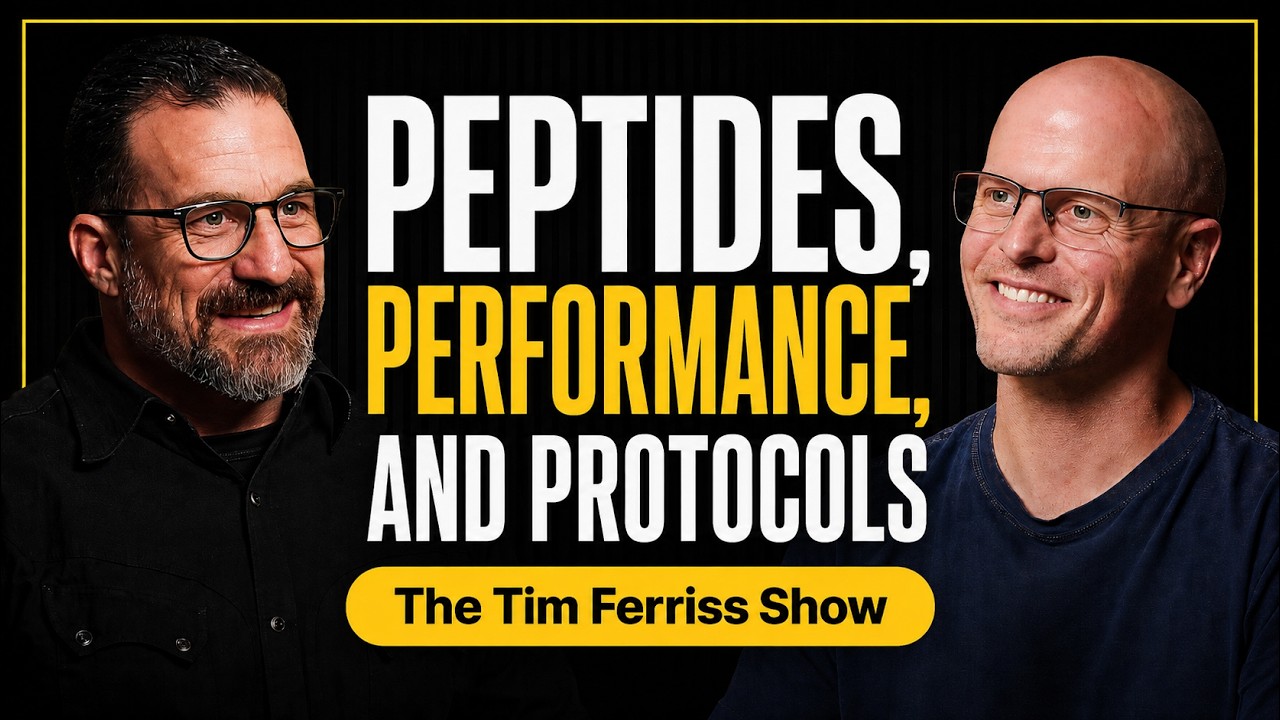 125 min
Dr. Andrew Huberman — Peptides, Performance, and Protocols
 112 min
The Random Show! Mortality, AI, Supplements, Rock Climbing, & More
 88 min
The Legendary Hollywood Power Broker — Guy Oseary on 36 Years of Managing Madonna, 26 IPOs, and More
Ask anything from this episode.
Save it, chat with it, and connect it to Claude or ChatGPT. Get cited answers from the actual content — and build your own knowledge base of every podcast and video you care about.
Get Started Free