Key Moments
378 ‒ Women’s health & performance: how training, nutrition, & hormones interact across life stages
 Peter Attia MD
Want to know something specific about what's covered?
We've already dissected every moment. Ask and we will deliver (with timestamps).
Key Moments
Women's health training & nutrition interact across life stages, impacting hormones, performance, and health span.
Key Insights
Early exercise and play establish strong foundations for bone, muscle, and cardiorespiratory health in girls.
The menstrual cycle significantly influences female athletic performance, recovery, and mental well-being.
Perimenopause and menopause bring metabolic and body composition changes, highlighting the need for consistent resistance training and adjusted nutrition.
Understanding and working with hormonal fluctuations throughout the menstrual cycle can optimize training and recovery.
Nourishing the body with adequate calories, protein, and essential fats is crucial, especially for active young women and athletes.
Consistent resistance training and high-intensity interval training (HIT) are paramount for maintaining muscle mass, metabolic flexibility, and power as women age.
The GLP-1 agonist drugs, while beneficial for weight loss, require careful attention to nutrient quality and resistance training to preserve muscle mass.
Hormone therapy, combined with lifestyle changes, can significantly improve symptoms and health span for women in perimenopause and menopause.
FOUNDATIONS OF HEALTH: EARLY LIFE EXERCISE AND DEVELOPMENT
The conversation begins by emphasizing that osteoporosis is a childhood disease, as women reach peak bone density around age 19. Early engagement in diverse physical activities, from play to structured sports, is crucial for girls to build a strong foundation for bone health, muscle development, and cardiorespiratory fitness. This early establishment makes it easier to maintain fitness throughout life. The introduction of menstruation can be a turning point for young female athletes, sometimes leading to sport withdrawal due to body changes and performance differences. Understanding and openly discussing the menstrual cycle's impact on performance, recovery, and mental health is vital, moving away from outdated 'exercise more, eat less' mentalities.
THE MENSTRUAL CYCLE'S INFLUENCE ON ATHLETIC PERFORMANCE
The impact of the menstrual cycle on women's health and performance is a key focus. Research indicates that while women can train at any point in their cycle, they often feel worse during certain phases, particularly the luteal phase, experiencing fatigue and bloating, which can affect recovery and soreness. However, data suggests women will still compete regardless of their cycle phase. The emphasis shifts to optimizing recovery and managing inflammation and protein breakdown, potentially with slightly different strategies during the follicular versus luteal phases. The early follicular phase (days 1-5) generally sees lower hormones, greater carbohydrate oxidation, and better performance, while the late follicular phase (days 7-14), leading to ovulation, is when women often feel their best and are most fertile, potentially allowing for peak performance and optimized recovery.
NUTRITION AND TRAINING STRATEGIES ACROSS THE CYCLE
Nutrition plays a critical role, especially for young female athletes. The focus should be on providing adequate fuel through nutrient-dense foods, emphasizing higher quality fats and essential fatty acids, particularly for caloric density. Strategies include choosing whole milk and yogurt over skim, and incorporating nuts and seeds. For young athletes, planning meals and snacks around training and school schedules is essential to meet caloric requirements, especially when appetite is blunted or GI distress is present. Carbohydrates are vital for active individuals, and the conversation around 'not eating as many carbs' is countered by their importance for energy and performance, especially in young females.
MIDLIFE CHANGES PERIMENOPAUSE, MENOPAUSE, AND METABOLISM
As women enter perimenopause and menopause, significant changes in metabolism, muscle size, muscle quality, and bone density occur. These changes are often most pronounced during perimenopause (late 30s to 50s), making lifestyle interventions particularly impactful. Consistent exercise, prioritizing intensity and resistance training, becomes critical to counteract these shifts. For women with limited time, a blend of resistance training (2-3 days/week) and aerobic exercise (including 1-2 high-intensity sessions) is recommended. The goal is to maintain muscle mass and improve metabolic flexibility, which can be influenced by hormonal changes and decreased estrogen levels.
THE ROLE OF RESISTANCE TRAINING AND HIGH-INTENSITY INTERVAL TRAINING
Resistance training is highlighted as a cornerstone for women's health throughout life, especially during menopause, to combat sarcopenia and maintain muscle quality. Given that only about 19% of women train resistance one day a week, there is significant room for improvement. High-intensity interval training (HIT) is also strongly advocated for its efficiency in improving V02 max, stimulating fat oxidation, and potentially increasing lean mass. For time-constrained individuals, a structured approach combining 30-minute whole-body resistance training sessions and 1-2 HIT cardio sessions per week can be highly effective. These intense sessions, even if short, provide a potent stimulus for metabolic improvement and muscle maintenance.
BODY COMPOSITION, WEIGHT LOSS, AND PHARMACEUTICAL AIDS
The distinction between weight loss and body composition is crucial; the focus should be on fat loss while preserving muscle mass. For women aiming to lose weight, particularly in midlife, a combination of a slight calorie deficit, adequate protein intake (around 1.6-2.2g/kg), and consistent resistance training is vital. The emergence of GLP-1 agonists offers a powerful tool for weight loss, but it necessitates a deliberate strategy to ensure muscle mass is preserved. This involves prioritizing nutrient-dense foods, maintaining protein intake, and engaging in progressive resistance training to counteract potential muscle loss, ensuring any weight lost is primarily fat.
COMBATING AGE-RELATED DECLINE: POWER, METABOLIC FLEXIBILITY, AND LONGEVITY
Maintaining muscle power, even as explosiveness naturally declines with age, is critical for preventing falls and preserving functional independence. While women may experience hormonal changes impacting inflammation and potentially muscle quality, consistent training, particularly resistance training and high-intensity work, can mitigate these effects. Understanding metabolic flexibility and how it can be optimized through exercise and nutrition, even with time constraints, is key for long-term health span. The data suggests that even in older age, significant gains in strength and muscle mass are achievable, underscoring the vital role of exercise across the lifespan.
Mentioned in This Episode
●Supplements
●Tools
●Organizations
●Drugs & Medications
●Studies Cited
●Concepts
●People Referenced
Women's Health & Performance: Training and Nutrition Guide
Practical takeaways from this episode
Do This
Avoid This
Common Questions
Intense exercise, particularly in sports like gymnastics and running, can delay estrogen onset and negatively impact bone density, leading to issues like spinal curves or scoliosis. The crucial period for building bone density is up to age 19, making early life training choices vital for long-term skeletal health.
Topics
Mentioned in this video
A researcher whose work on elite endurance athletes shows that volume alone doesn't maintain muscle size and quality; intensity matters.
A previous podcast guest who made a compelling argument against the 'window of opportunity' for hormone replacement therapy.
Peter Attia's friend who had a saying about the depth of knowledge.
A researcher from Australia whose group conducted a longitudinal study on perimenopause and postmenopause, including muscle biopsies.
A researcher whose mathematical model is used to understand the continuum of metabolic flexibility, not just an on/off switch.
A general method for measuring body composition, acknowledged for tracking changes.
A hormone whose levels slowly drift upwards during perimenopause, and whose day-5 blood measurement is considered the best test for tracking this transition.
A method for assessing muscle quality, related to MRI, used in Dr. Hagstrom's research.
A hormone whose levels are also looked at and can be somewhat helpful, but is challenged by the use of IUDs in tracking menstrual cycle changes.
A medical imaging technique used for assessing muscle quality, with data showing similar themes to PQCT.
A concept of eating when hungry, but noted to be challenged during exercise due to blunted responses and GI distress in women.
A marker for inflammation, possibly elevated in perimenopausal women not on hormones.
A spinal curve observed in athletes like high jumpers and gymnasts, influenced by early life activities and potentially acquired.
A hormone whose levels are measured in at-home urine analyses to track daily variation alongside estrogen and progesterone.
A type of fitness equipment mentioned by Peter Attia for controlled and safe power training.
A survey providing normative data for body composition, used to determine ideal body fat percentages.
A fitness program mentioned as a starting point for older adults to engage in group exercise.
More from Peter Attia MD
View all 333 summaries 135 min
381‒Alzheimer’s disease in women: how hormonal transitions impact the brain, new therapies, & more
 9 min
9 minIs Industrial Processing the Real Problem With Seed Oils? | Layne Norton, Ph.D.
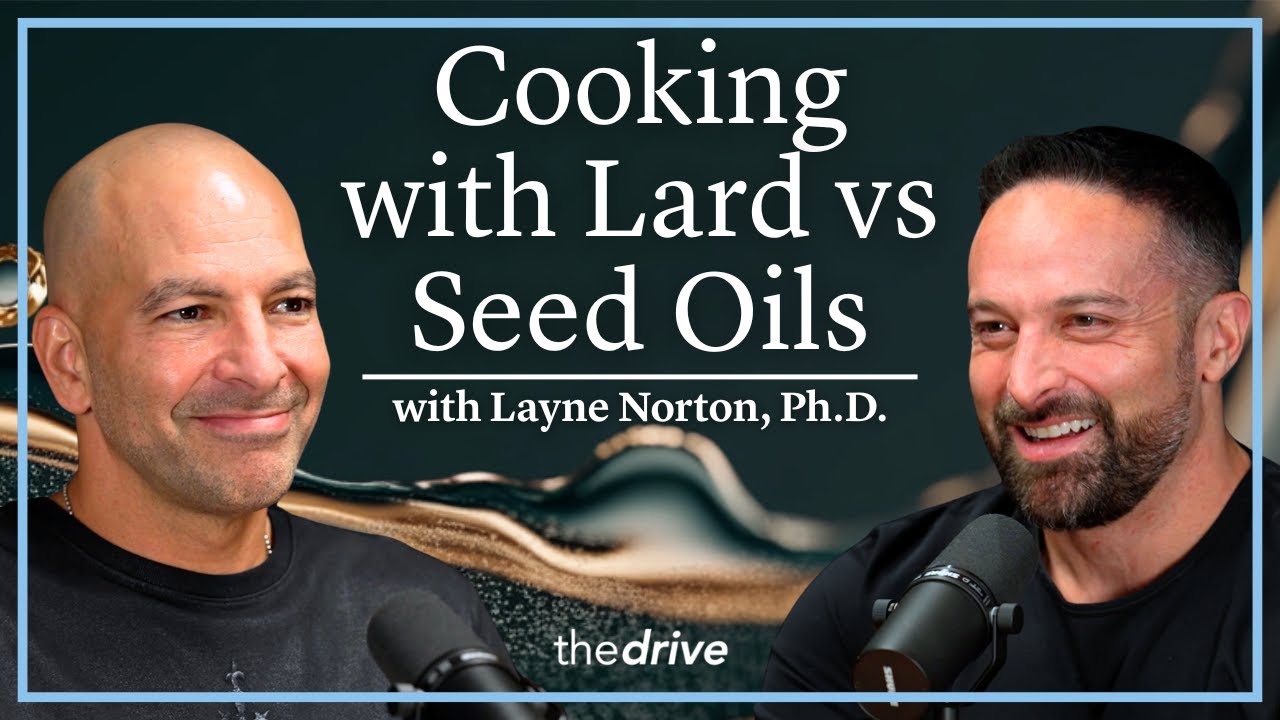 13 min
Cooking with Lard vs Seed Oils | Layne Norton, Ph.D.
 146 min
380 ‒ The seed oil debate: are they uniquely harmful relative to other dietary fats?
Ask anything from this episode.
Save it, chat with it, and connect it to Claude or ChatGPT. Get cited answers from the actual content — and build your own knowledge base of every podcast and video you care about.
Get Started Free