Key Moments
Marc Andreessen Interview (Full Episode) | The Tim Ferriss Show (Podcast)
 Tim Ferriss
Want to know something specific about what's covered?
We've already dissected every moment. Ask and we will deliver (with timestamps).
Key Moments
Marc Andreessen on strong opinions, investing, AI, crypto, and building the future.
Key Insights
Adopt a "strong opinions, weekly held" mindset for adaptability in a changing world.
Distinguish between good and great investments; focus on disruptive, non-consensus ideas.
The "nerd test" (what geeks do on nights/weekends) identifies emerging technological frontiers.
Existential AI fears are a recurrent human psychological pattern, not an imminent threat.
Job market churn is natural; focus on creating new opportunities rather than fearing displacement.
Price products appropriately, avoiding the 'too hungry to eat' trap of underpricing.
THE PHILOSOPHY OF STRONG OPINIONS, WEAKLY HELD
Marc Andreessen emphasizes the importance of developing strong convictions, particularly in entrepreneurship and investing, to deviate from conventional wisdom. However, he stresses the equally critical need to hold these opinions "weakly." This means being adaptable and willing to change one's mind when new facts emerge or the world evolves. He contrasts this with individuals who become rigidly attached to their views, leading to biases like confirmation bias. Andreessen admires hedge fund managers for their embrace of changing their minds, highlighting this flexibility as key to success in dynamic fields.
NAVIGATING ENTREPRENEURIAL DECISIONS AND INVESTING
The core challenge for founders and investors lies in knowing when to persevere and when to pivot. Andreessen acknowledges the common advice to "fail fast" but cautions against its overuse, advocating for success as the primary goal and advising against perpetual pivoting. Conversely, excessive determination can become stubbornness. He suggests that sound judgment, recognizing the difficulty of knowing counterfactuals, is crucial for making these critical decisions, emphasizing the importance of distinguishing between "good" and "great" investments, which often lie in contrarian, non-consensus ideas.
PARTNER MEETINGS AND STRESS-TESTING IDEAS
Venture capital firm Andreessen Horowitz operates with a unique approach to partner meetings. To avoid groupthink and ensure the exploration of truly groundbreaking ideas, any General Partner can greenlight a deal. However, this power is balanced by a rigorous stress-testing process. Colleagues are encouraged to "red team" ideas, challenging assumptions and playing devil's advocate. This "disagree and commit" culture, where even the proposer vigorously defends their idea against internal critique, is vital for making consequential, long-term investment decisions without stifling innovation.
LEARNING FROM HISTORY AND BIOGRAPHY
Andreessen advocates for studying history, particularly the period of technological upheaval from 1870-1930, and reading biographies of historical figures like Edison, Ford, and Rockefeller. He finds these narratives invaluable for understanding human nature and the process of innovation. By immersing oneself in the lives of these individuals before they became historical icons, one can gain relatable insights into their challenges, thought processes, and the timeless aspects of human ambition and behavior, providing templates for navigating present-day opportunities.
IDENTIFYING FUTURE FRONTIERS: THE 'NERD TEST'
Identifying the next wave of innovation often involves looking at what enthusiasts, or "nerds," are doing in their spare time. Andreessen suggests that emerging technologies like cryptocurrency, health hacking, robotics, and AI, which are gaining traction among hobbyists, represent significant future opportunities. He highlights AI advancements, particularly open-source frameworks like TensorFlow, and autonomous drones as examples of technologies becoming accessible and practical for individual creation, signaling a tipping point for widespread adoption and application.
DEMYSTIFYING AI AND JOB DISPLACEMENT
Andreessen dismisses fears of AI-driven existential threats as a recurring psychological pattern, drawing parallels to myths like Prometheus and Frankenstein. He argues that AI is a tool that will largely benefit humanity, much like past technologies. Regarding job displacement, he points out the massive churn in the economy, where millions of jobs are created and destroyed annually. He believes the economy can absorb changes like self-driving car technology without widespread, permanent unemployment, emphasizing the need to focus on fostering new opportunities rather than fearing inevitable technological shifts.
THE PRICE OF INNOVATION AND CHARGING ENOUGH
A critical mistake Andreessen observes in startups is underpricing their products. He criticizes the Silicon Valley conventional wisdom of extremely low pricing for volume. This leads to the "too hungry to eat" problem, where companies cannot afford the sales and marketing necessary to acquire customers. He advocates for "raising prices" as a fundamental strategy for viability and as a litmus test for product value. Charging appropriately not only ensures financial health but also signals confidence in the product's worth.
CHALLENGING 'BIG THINGS' AND EMERGENT TECHNOLOGIES
Andreessen discusses the ongoing debate in Silicon Valley about pursuing "moonshots" and large-scale challenges versus incremental innovations like social media platforms. While acknowledging the importance of disruptive technologies like the iPhone, he also champions the pursuit of grander ambitions, such as in AI, drones, and cryptocurrency. He believes that emerging technologies, driven by accessible tools and a growing willingness to tackle complex problems, offer immense potential for world-changing advancements beyond conventional applications.
INSIGHTS FROM THE WORLD OF CRYPTOCURRENCY
Andreessen highlights that cryptocurrency and blockchain represent a fundamental shift in distributed trust. He notes that discussions around money, a highly emotionally charged topic, often obscure the objective mechanics of these technologies. Despite skepticism from traditional institutions and the public, he observes that Bitcoin and similar systems continue to function, demonstrating their resilience and evolving persistence. Andreessen remains optimistic, with his firm continuing to invest in promising cryptocurrency ventures like Coinbase and companies like 21.
LESSONS ON BUILDING AND CAREER DEVELOPMENT
Inspired by Steve Martin's advice, "Be so good they can't ignore you," and the concept that "smart people should build things," Andreessen would teach aspiring entrepreneurs how to create. He advocates for a project-based, hands-on approach, emphasizing that most significant advancements can be achieved without permission. He also stresses the importance of studying the past and understanding that successful innovators are not inherently different from oneself, encouraging a proactive mindset focused on creation and self-improvement.
THE FUTURE OF DRONES AND RETAIL INNOVATION
Andreessen is particularly excited about the potential of autonomous consumer drones, like those being developed by Skydeal, which can navigate complex environments autonomously. He also sees vast opportunities in commercial drones within industries like insurance and infrastructure inspection, where they can significantly improve safety and efficiency. He foresees AI-powered drones integrating into daily life, from law enforcement to personal use, making tasks safer and more streamlined, eventually becoming indispensable tools that people wonder how they ever lived without.
ADVICE ON INVESTING AND PERSONAL GROWTH
When asked about advice for his younger self, Andreessen declines to engage in "replays," preferring to look forward. He draws inspiration from Joe Pike's philosophy of always moving forward. His advice to the audience is to "build new things" and, if opportunities are promising, to seek funding. He urges listeners to consider working for companies at the forefront of innovation, directing them to the Andreessen Horowitz website for job openings. He emphasizes continuous creation and contribution to the technological landscape.
Mentioned in This Episode
●Products
●Software & Apps
●Companies
●Books
●Concepts
●People Referenced
Mark Andreessen's Startup and Investment Wisdom
Practical takeaways from this episode
Do This
Avoid This
Common Questions
It means developing firm beliefs and convictions about a business or investment, but remaining open to changing your mind when new facts emerge or circumstances shift. This balances determination with flexibility, crucial for navigating evolving markets.
Topics
Mentioned in this video
Mentioned as an example of a company assertively entering the real estate industry.
Acquired Loudcloud for $1.6 billion.
Subject of a deconstruction episode on the Andreessen Horowitz podcast.
Used as an example to discuss the line between sensible innovation and overly ambitious projects.
Mark Andreessen's preferred platform for engagement; also known by his handle 'Pmarca'.
A platform for graphic design needs, used by Tim Ferriss for book cover prototypes and banner ads.
Mentioned as an example of a company assertively entering the transportation industry.
A company co-founded by Mark Andreessen, sold to Hewlett-Packard for $1.6 billion.
A company whose story loosely forms the basis for the TV show 'Halt and Catch Fire'.
Mentioned as an example of a company assertively entering the transportation industry.
An influential internet browser company co-founded by Mark Andreessen, later sold to AOL.
Acquired Netscape for $4.2 billion.
Mentioned as an example of a large industrial company that governments or research universities might tackle big challenges.
A favorite audiobook of all time, highly recommended by Tim Ferriss and something he wanted to listen to a second time.
A book by Tim Ferriss, influenced by Vagabonding, that became a significant work for him.
Considered the best book on management ever written, by Andrew S. Grove.
A recommended book by Andrew S. Grove on a topic Mark Andreessen favors.
An excellent book by Peter Thiel, recommended by Mark Andreessen.
A book that had a huge impact on Tim Ferriss's life and formed the basis for 'The 4-Hour Workweek'.
A book for which Tim Ferriss used 99 Designs for cover prototypes, becoming a New York Times bestseller.
A book by Ben Horowitz that includes an email exchange with Mark Andreessen about a premature strategy launch.
A biography of Thomas Edison.
Author of 'High Output Management' and 'Only the Paranoid Survive'.
Recommended to Tim Ferriss, representing historical figures whose archetypes remain relevant.
Mentioned as a historical figure whose biography is recommended and who is a hero to Brian Chesky.
Author of the best biography on Walt Disney.
Co-founder of Andreessen Horowitz and author of 'The Hard Thing About Hard Things'.
Mentioned as a historical figure whose biography is valuable for understanding innovation and business.
Along with Peter Thiel and Elon Musk, has provoked a conversation about 'moonshots' and big challenges.
Described as 'proto Silicon Valley' for his record of sustained innovation and commercialization efforts.
Former Stanford professor running healthcare initiatives at Andreessen Horowitz.
Author of Vagabonding, which significantly impacted Tim Ferriss's life and work.
Author of The Graveyard Book, an audiobook highly recommended by Tim Ferriss.
Co-founder of Mosaic, Netscape, Loudcloud, and general partner at Andreessen Horowitz. Considered a founding father of the modern internet.
Subject of a scene loosely based on him in 'Silicon Valley'; also known for the slogan 'We wanted flying cars, instead we got 140 characters'.
Mentioned as a historical figure whose biographies are valuable for understanding innovation and business.
Author of the biography on Ben Franklin, which humanized him and inspired Tim Ferriss.
Along with Peter Thiel and Larry Page, has provoked a conversation about 'moonshots' and big challenges, such as self-driving cars and Mars exploration.
A mentality about starting companies and investing, emphasizing strong conviction coupled with flexibility to change one's mind.
Used as a reference for stretching the limits of what can be achieved before facing consequences.
A problem encountered by struggling companies that don't charge enough for their product, hindering sales and marketing efforts.
A TV show that Mark Andreessen has watched the first season of; the sesame seed scene was a highlight.
A podcast recommended by Tim Ferriss, with a particularly enjoyed episode on deconstructing Amazon.
A TV show considered the best fictional portrayal of a tech startup, set during the birth of the PC.
Comic strip created by Charles Schultz, considered the longest continuous work of American art.
A TV show praised by Mark Andreessen as 'absolute genius'.
A show compared to 'Halt and Catch Fire' for its serious drama and focus on office and personal lives.
Supersonic passenger jet that is no longer in service, mentioned as an example of a lost technological advancement.
More from Tim Ferriss
View all 703 summaries 70 min
Q&A with Tim — The Art of Male Friendship, Reinvention in The Age of AI, & More
 125 min
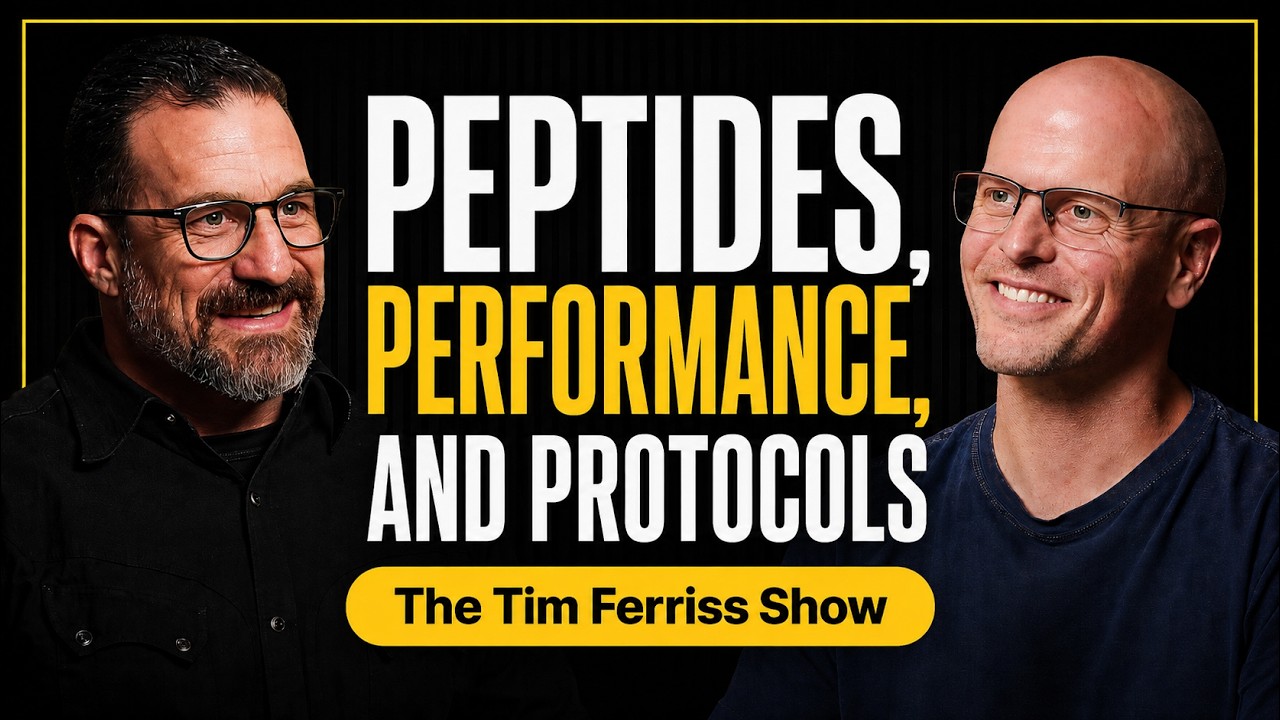
Dr. Andrew Huberman — Peptides, Performance, and Protocols
 112 min
The Random Show! Mortality, AI, Supplements, Rock Climbing, & More
 88 min
The Legendary Hollywood Power Broker — Guy Oseary on 36 Years of Managing Madonna, 26 IPOs, and More
Ask anything from this episode.
Save it, chat with it, and connect it to Claude or ChatGPT. Get cited answers from the actual content — and build your own knowledge base of every podcast and video you care about.
Get Started Free