Key Moments
Daniel Pink Interview | The Tim Ferriss Show (Podcast)
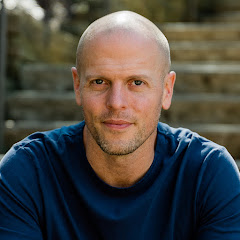 Tim Ferriss
Want to know something specific about what's covered?
We've already dissected every moment. Ask and we will deliver (with timestamps).
Key Moments
Daniel Pink discusses decision-making, timing, creativity, and finding meaning in work and life.
Key Insights
The principle of surrogacy suggests making decisions by researching others' experiences, a lesson learned from a regrettable law school choice.
Effective speechwriting involves intently observing audience reactions to gauge what resonates and what doesn't.
Writing is a process of discovery; one often writes to figure out what they think or want to say, not just to articulate pre-formed ideas.
Timing is crucial for cognitive performance, with 'peak' times best for analytical work, 'trough' for administrative tasks, and 'recovery' for creative brainstorming.
Authorship involves a deep commitment, often requiring readers to 'marry' an idea rather than just 'date' it.
The "assume positive intent" mindset can lead to better interactions and learning, contrasting with cynicism that often grows with age.
LEARNING FROM DECISION-MAKING AND RESEARCH
Daniel Pink emphasizes the principle of surrogacy: researching the experiences of others before making significant decisions. He learned this lesson the hard way after attending law school without fully understanding the profession or common pitfalls, which he categorizes as a "terrible decision." This experience, though ultimately leading to meeting his wife, underscored the importance of using others' outcomes as a guide. He advocates for intellectual humility and asking "What don't I know?" to identify blind spots and make more informed choices, a practice he applies to various life decisions, including his fellowship in Japan.
THE CRAFT OF COMMUNICATION AND AUDIENCE ENGAGEMENT
Pink's background as a speechwriter for political figures like Al Gore provided invaluable insights into audience engagement. He describes intently watching audience reactions during speeches, noting which lines landed and which fell flat, rather than solely focusing on the speaker. This observational skill, honed by analyzing how people respond to content, has profoundly influenced his own approach to writing and public speaking. He believes that real-time feedback from an audience is crucial for refining messages, a stark contrast to the delayed feedback from asynchronous mediums like books.
THE PROCESS OF WRITING AND IDEA GENERATION
Writing, for Pink, is often a process of discovery. He highlights the concept of "writing to figure it out," where the act of writing itself helps clarify thoughts and ideas, a revelation he had in college. He likens the commitment required for writing a book to marriage, a long-term endeavor demanding deep passion for the subject. This perspective informs his method of developing ideas: he generates many possibilities, revisits them periodically, and uses writing book proposals as a way to rigorously test and refine concepts, often realizing an idea is better suited for an article or not viable at all. This iterative approach filters out less promising concepts.
THE SCIENCE OF TIMING AND PERFORMANCE OPTIMIZATION
Pink's book "When" explores the scientific secrets of perfect timing, revealing that cognitive abilities fluctuate predictably throughout the day. He outlines a three-stage pattern: 'peak' for vigilance and analytical tasks, 'trough' (early afternoon) for administrative work, and 'recovery' for creative brainstorming. He notes that timing can explain a significant portion of performance variance. Pink advocates for strategically aligning tasks with these natural energy cycles to enhance productivity, suggesting that many organizations fail to consider this in scheduling meetings, leading to suboptimal outcomes.
MOTIVATIONAL INTERVIEWING AND AUTONOMOUS MOTIVATION
Drawing from therapeutic techniques, Pink discusses motivational interviewing as a method to surface a person's *own* reasons for action, rather than imposing external demands. By asking questions like "On a scale of one to ten, how ready are you?" and "Why didn't you pick a lower number?", individuals articulate their intrinsic motivations. This approach, applicable to parenting, management, and self-improvement, emphasizes empowering autonomous motivation over control, which often elicits only compliance or defiance. Pink suggests this technique can be powerfully applied to oneself for self-reflection and reinforcement of desired behaviors.
NAVIGATING CAREER PATHS AND PERSONAL GROWTH
Pink reflects on his unconventional career path, from law school to speechwriting and then to writing bestselling books. He shares personal experiences of perceived failures, like his law school detour and a TV show not getting renewed, emphasizing the lesson-learning process. He advocates for writing down specific lessons learned from setbacks to solidify understanding and avoid repeating mistakes. He also touches upon the importance of choosing projects you are deeply passionate about, as the creative process of writing a book is arduous and requires sustained engagement. He concludes that a mindset of "assume positive intent" fosters better human interactions and continuous learning.
Mentioned in This Episode
●Supplements
●Products
●Software & Apps
●Companies
●Organizations
●Books
●Concepts
●People Referenced
Common Questions
Daniel Pink initially went to law school without fully understanding what lawyers did or what law school entailed, a decision he later regretted as 'terrible' but formative. This experience taught him the 'principle of surrogacy'—to find people similar to himself who have made a decision and understand their experience before committing, a practice he now applies to all major life choices.
Topics
Mentioned in this video
One of the large enterprises mentioned by Tim Ferriss as a user of WeWork's services.
One of the large enterprises mentioned by Tim Ferriss as a user of WeWork's services.
A global network of workspaces that Tim Ferriss uses for his office in Austin. He praises its services, events, and dog-friendly locations.
A company known for its mushroom coffee and reishi mushroom elixir, which Tim Ferriss uses for sleep. They created a custom, sweetener-free version for him.
One of the large enterprises mentioned by Tim Ferriss as a user of WeWork's services, highlighting its appeal to big companies.
One of the large enterprises mentioned by Tim Ferriss as a user of WeWork's services.
A file hosting service mentioned by Daniel Pink as another tool he uses to store ideas.
One of the large enterprises mentioned by Tim Ferriss as a user of WeWork's services.
One of the large enterprises mentioned by Tim Ferriss as a user of WeWork's services.
An e-commerce company mentioned by Tim Ferriss as a place he orders items from, which are then shipped to his WeWork office. Also later mentioned for its 'working backwards' product development technique.
One of the large enterprises mentioned by Tim Ferriss as a user of WeWork's services.
One of the large enterprises mentioned by Tim Ferriss as a user of WeWork's services.
A restaurant in Montauk where Tim Ferriss used to work as a busboy, famously depicted in the TV show 'The Affair.'
Founding editor of Wired magazine, whom Tim Ferriss refers to as 'arguably the most interesting man in the world.' Kelly highly recommended Pink's 'Johnny Bunco.' Also a trusted advisor for Pink on book ideas.
The guest on the podcast, author of six provocative books, including 'When,' 'A Whole New Mind,' 'Drive,' and 'To Sell is Human.' He discusses his writing process and career trajectory.
Author of 'Bird by Bird,' a book Daniel Pink describes as one of the greatest and often gifts to others, for its writing advice.
Author of 'Man's Search for Meaning,' a profoundly important book for Daniel Pink.
First American to win the Nobel Prize in Literature, whose book 'It Can't Happen Here' is included in Daniel Pink's collection of dystopian literature.
An American author, educator, and executive director for the Stanford Technology Ventures Program at Stanford University. She developed the 'failure resume' technique.
Author of 'The War of Art,' a book Daniel Pink discovered in an airport and found profoundly inspiring, often gifting it to others.
An American novelist, whose book 'The Plot Against America' is included in Daniel Pink's collection of dystopian literature.
An American author, for whose science fiction book 'InfoMocracy' Daniel Pink mentions, though he mistakenly called him Elliot Pepper Calculus.
A scientific and educational organization, for which Daniel Pink did a TV show that was not renewed for a second season, despite its quality.
Where Daniel Pink went to have his own brain scanned to ensure the scientific accuracy of 'A Whole New Mind.'
The institution where Tina Seelig works and taught about the 'failure resume.'
The institution where Mike Pantalon developed Motivational Interviewing for addiction treatment.
Daniel Pink's #1 New York Times bestseller about sales and persuasion.
Daniel Pink's long-running New York Times bestseller, which argues that 'right-brain' abilities (artistry, empathy) are becoming more valuable in the economy.
Mark Twain's novel, which a college professor assigned to Daniel Pink, emphasizing that one rereads books differently at different points in life.
Steven Pressfield's book about overcoming creative resistance, which Daniel Pink highly recommends and often gifts, even having a sign on his desk to 'beat the resistance.'
Daniel Pink's book written in manga format, offering career advice. It was considered ahead of its time by Pink, but highly regarded by figures like Kevin Kelly.
Sinclair Lewis's dystopian novel, part of Daniel Pink's collection of dystopian books.
Tim Ferriss's book about building a business modeled on principles of efficiency, mentioned as a potential source of isolation due to its focus on digital connection.
Daniel Pink's newest book, a New York Times, Wall Street Journal, USA Today, Washington Post, and Publishers Weekly bestseller. It explores the science behind optimal timing for various activities.
A scholarly journal where Daniel Pink served as editor-in-chief, reflecting his early career in law.
George Orwell's allegorical novella, reread by Daniel Pink at different life stages, revealing different interpretations (e.g., organizational dysfunction rather than just the Soviet Union).
F. Scott Fitzgerald's novel, which Daniel Pink has reread at different points in his life, gaining new perspectives.
Tim Ferriss's book, which Daniel Pink has a dog-eared copy of and praises the title for being unique and easily conceived.
Margaret Atwood's dystopian novel, which Daniel Pink read for the first time recently and enjoyed, adding it to his stack of dystopian literature.
Anne Lamott's book, highly recommended and frequently gifted by Daniel Pink, offering wisdom on writing and life; its advice is often repeated in Pink's household.
Philip Roth's alternate history novel, part of Daniel Pink's collection of dystopian books.
Malka Older's science fiction novel (misattributed to Elliot Pepper Calculus by Daniel Pink), which is part of Pink's pile of dystopian works.
Viktor Frankl's book, described by Daniel Pink as a 'hugely important book' and one that Tim Ferriss intends to reread.
Arthur Miller's play, which Daniel Pink has seen multiple times, and his interpretation of it changed significantly after becoming a father and learning about mental illness.
A list of the 500 largest U.S. companies by total revenue. Mentioned to illustrate that over 10% of these companies use WeWork.
A therapeutic technique, discussed by Pink, that involves asking indirect questions to help individuals surface their own intrinsic motivation for change, rather than using control or demands.
Japanese comic format, which Daniel Pink attempted to broaden the reach of in the US with his book 'The Adventures of Johnny Bunco.'
A 1996 American romantic comedy-drama sports film, whose scene where the protagonist writes all night is referenced by Daniel Pink to describe the feeling of a productive writing flow for 'When.'
A weekly American magazine that focuses on celebrity and human-interest stories, used by Tim Ferriss as an example of a specific, targeted audience that a startup or book would aim for, rather than 'everyone.'
A TV show mentioned by Tim Ferriss, which often takes place at 'The Lobster Roll' restaurant in Montauk, where he used to work.
The city Tim Ferriss recently moved to from San Francisco. He describes feeling a gravitational pull to Austin for a long time due to its friendliness and warmth, and to escape the tech echo chamber.
The place where Tim Ferriss grew up, specifically Montauk in the Hamptons.
The city Tim Ferriss lived in for nearly 20 years before moving to Austin. He loved it but felt the experience had changed and he needed a new environment.
The region associated with the tech industry, which Tim Ferriss described as having an 'inescapable conversation of tech' and platitudes that he felt he was too caught up in, prompting his move to Austin.
A town in the Hamptons on Long Island, where Tim Ferriss was born and worked as a busboy at a restaurant called The Lobster Roll.
More from Tim Ferriss
View all 703 summaries 70 min
Q&A with Tim — The Art of Male Friendship, Reinvention in The Age of AI, & More
 125 min
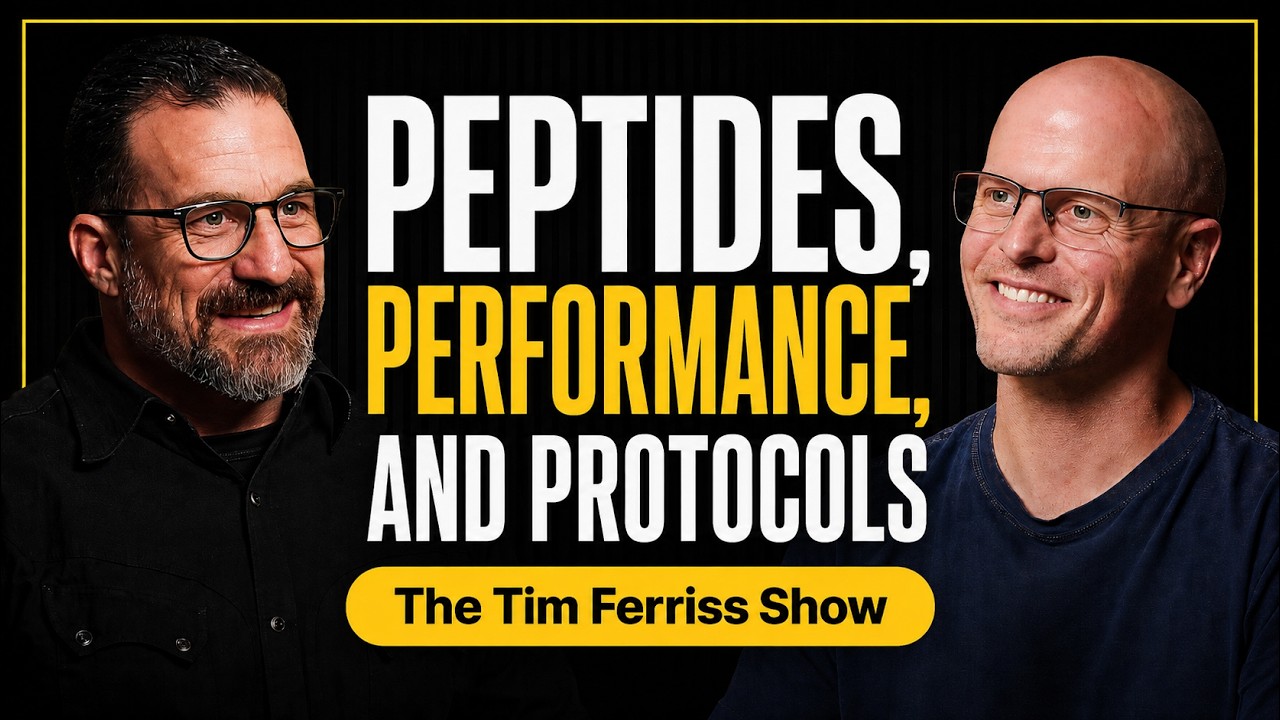
Dr. Andrew Huberman — Peptides, Performance, and Protocols
 112 min
The Random Show! Mortality, AI, Supplements, Rock Climbing, & More
 88 min
The Legendary Hollywood Power Broker — Guy Oseary on 36 Years of Managing Madonna, 26 IPOs, and More
Ask anything from this episode.
Save it, chat with it, and connect it to Claude or ChatGPT. Get cited answers from the actual content — and build your own knowledge base of every podcast and video you care about.
Get Started Free