Key Moments
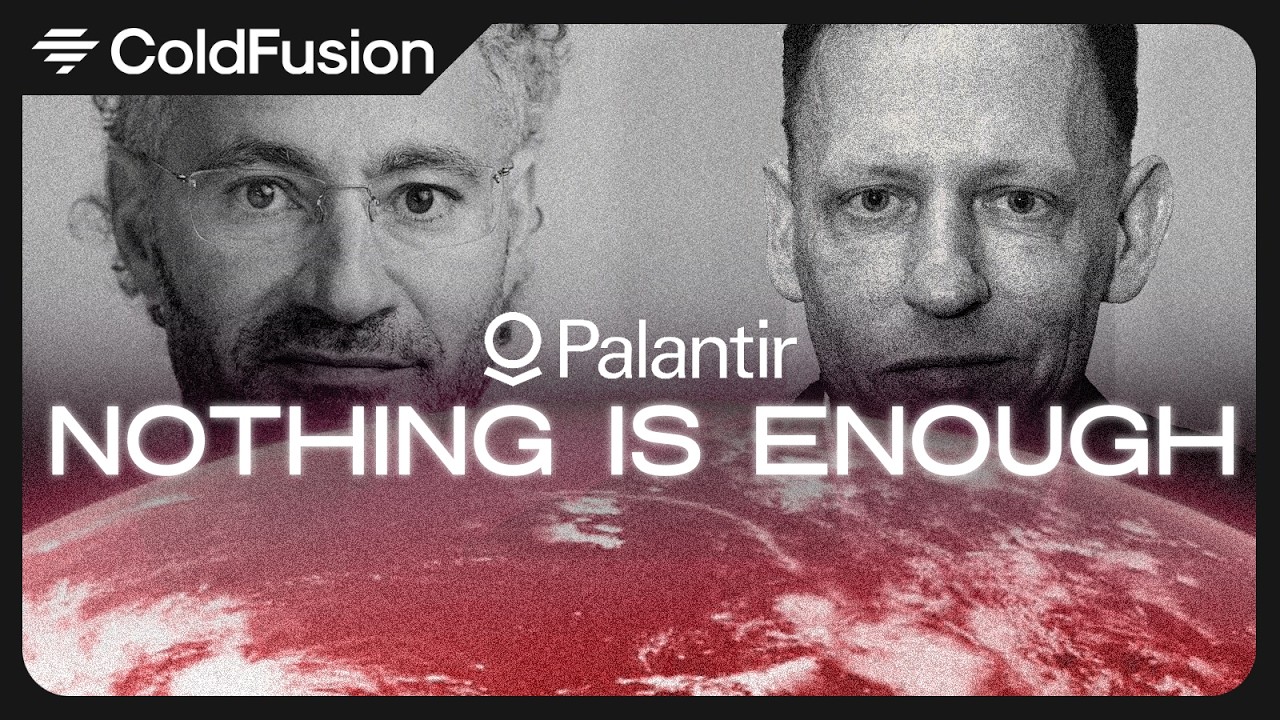
What Does Palantir Actually Want? (Re-upload)
 ColdFusion
Want to know something specific about what's covered?
We've already dissected every moment. Ask and we will deliver (with timestamps).
Key Moments
Palantir wants to be the default AI infrastructure for Western powers, openly admitting its software is used to kill and surveil, yet is simultaneously rebranding as a lifestyle brand.
Key Insights
Palantir's stock has surged over 1,400% from IPO to over $140, with a market cap of $330 billion, indicating significant financial success.
Palantir's Gotham platform integrates massive, disparate datasets (Medicare, IRS, travel, biometrics) for government agencies, enabling potential mass surveillance.
All six US military branches and three dozen federal agencies, along with UK, German, and Australian police, use Palantir, highlighting its deep integration into Western defense and intelligence.
Palantir CEO Alex Karp received $6.8 billion in compensation in 2024, the highest for any CEO of a publicly traded US company.
Palantir's "Manifesto" called for Western dominance, mandatory national service, and questioned vacant pluralism, leading to investor backlash and condemnation as "technofascism."
Despite its controversial public image and admitted use in "kill chains," Palantir is developing a lifestyle brand with merchandise and aiming to be "desirable."
Palantir's dual identity: From 'kill chains' to lifestyle brand
Palantir CEO Alex Karp openly acknowledges that his company's product is "used on occasion to kill people" and is instrumental in "kill chains" for warfare, yet simultaneously, the company is attempting to cultivate a lifestyle brand image. This includes an online merchandise store selling apparel with terms like "dominance" and "ontology," and an aspiration by their head of "Vibes" to be seen as "desirable." This stark contrast between admitting to facilitating lethal actions and marketing itself as a cool brand, complete with holiday messages from Karp, highlights the company's complex and controversial public facade. This rebranding effort is likened to trying to "make the Patriot Act after 9/11 seem cool and invogue," reflecting a new era where systems that once operated covertly now seek overt visibility and appeal.
The rise of an indispensable data infrastructure layer
Palantir has grown into a company valued at $330 billion, with its stock increasing over 1,400% since its 2020 IPO. This success is rooted in its ability to ingest, analyze, and unify vast, disparate datasets, making it indispensable for both the private sector and government entities. Thousands of corporations, from Wendy's to Ferrari's F1 team, use its Foundry platform for operations and data processing. More critically, government agencies and military branches worldwide rely on its Gotham platform, which is described as an "operating system for global decision-making." The company's strategy involves deep integration into client workflows, often with employees embedded directly with users, leading to "vendor lock-in" where switching becomes prohibitively complex and costly.
Gotham: The controversial platform enabling mass surveillance
While Palantir's Foundry platform serves commercial clients, its Gotham platform is at the heart of public controversy. Gotham is presented as an "operating system for global decision-making" but is primarily used by government agencies for war targeting, eliminating enemies, and domestic mass surveillance. The platform's core risk lies in its ability to centralize previously siloed data—including Medicare, IRS, immigration, health records, license plate data, and online history—into a unified, searchable system. This capability significantly lowers the cost of operating an authoritarian surveillance state, making it easier than ever to build profiles on individuals. All six U.S. military branches and three dozen federal agencies, alongside police forces in the UK, Germany, and Australia, utilize Palantir, underscoring its pervasive reach.
Project Maven and the automation of warfare
Palantir's involvement extends to highly criticized initiatives like Project Maven, an AI-driven program focused on identifying and selecting military targets for rapid destruction, often with minimal human oversight. This system, reportedly used in the initial stages of the Iran Wars and developed with partners like Anthropic, represents a significant step towards automated warfare. Palantir's role in creating targeting data for the Ukraine war, including the use of unmanned ground and aerial drones for capturing enemy positions without infantry losses, exemplifies this shift. CEO Alex Karp's personal deals, such as signing an agreement with the Israeli Defense Force in 2024 to supply automated targeting for the Gaza conflict, further solidify Palantir's position at the forefront of AI-enabled military operations.
Alex Karp: An eccentric leader with a 'hard power' ideology
Alex Karp, Palantir's co-founder and CEO, is a distinctive figure with a PhD in social theory, known for his unconventional style and provocative statements. He has shifted from being framed as a progressive counterweight to co-founder Peter Thiel to advocating strongly for "hard power," "Western dominance," and "civilizational struggle." Karp believes engineers have a moral duty to build weapons for the state and openly describes Palantir's products as a "kill chain," asserting that individuals uncomfortable with supporting the "legitimate efforts of America and its allies in the context of war" should not join the company. His significant compensation, totaling $6.8 billion in 2024 alone, places him as the highest-paid CEO and, along with Peter Thiel, he retains substantial voting control through class F shares, ensuring their enduring influence.
The Palantir Manifesto and its ideological underpinnings
In April 2025, Palantir's official executive account posted a "Manifesto" that resonated deeply with CEO Alex Karp's worldview and even caused its stock to drop due to investor apprehension. The manifesto argued that "some cultures have produced vital advances. Others remain dysfunctional and regressive," and that "the West must resist the shallow temptation of vacant and hollow pluralism." It also suggested the U.S. should consider mandatory national service and stressed that Silicon Valley must play a role in addressing violent crime. This ideological push, described by some as "technofascism" and "technofudalism," posits a vision where the West reasserts hard power through aggressive technological dominance, challenging conventional democratic norms and promoting a narrative of civilizational struggle.
The peril of unchecked data aggregation and algorithmic suspicion
The aggregation of vast amounts of personal data by Palantir's Gotham platform carries significant risks for civil liberties. Historically, government intelligence gathering has led to the targeting of activists and protesters. With Gotham, suspicion can arise not from specific evidence but from "patterns of data" defined by proprietary algorithms, potentially enabling the rapid and precise silencing of domestic dissent across nations using Palantir. Researchers caution that even with noble intentions, integrating such comprehensive data "significantly increases the risk of misuse," creating a "future moral hazard" where unchecked power can easily expand beyond its original scope, turning tools designed for national security into instruments for oppressing any opposition to the government.
The future: Operating system for power or a tool for darker ends?
Palantir's ultimate goal is to become the "default AI and data infrastructure layer for institutional power," essentially the "operating system" for governments, militaries, and major corporations, a vision articulated by its CTO. This ambition is met with concern from former employees who have urged the company to cease certain contracts due to the high risk of misuse. While Palantir maintains it is defending the West and modernizing government systems, its leaders' rhetoric and admitted capabilities raise serious ethical questions. The call for international treaties on autonomous weapons and independent audits for companies like Palantir suggests ongoing efforts to counter the potential for misuse, but the company's entrenched position and ideological drive mean its future impact remains a critical concern for democratic societies.
Mentioned in This Episode
●Software & Apps
●Companies
●Organizations
●Books
●Concepts
●People Referenced
Common Questions
Palantir is a software company that develops data analysis platforms like Gotham and Foundry. Gotham is used by government agencies for surveillance and military operations, while Foundry serves corporations for data processing and operations management.
Topics
Mentioned in this video
A home improvement retailer that uses Palantir's Foundry platform.
A department store chain that utilizes Palantir's Foundry platform.
A software company known for its data analysis platforms, Gotham and Foundry, which are used by government agencies and corporations. The company is controversial due to its involvement in surveillance and military applications.
A fast-food chain mentioned as a user of Palantir's Foundry platform for its global operations.
An automotive company whose F1 team uses Palantir's Foundry platform.
An aerospace corporation that utilizes Palantir's Foundry platform.
A sportswear and athletic apparel company that uses Palantir's Foundry platform.
A technology company that uses Palantir's Foundry platform.
A global financial services company that uses Palantir's Foundry platform.
An automotive company that uses Palantir's Foundry platform.
A multinational professional services network that uses Palantir's Foundry platform.
An online platform for learning to code, emphasizing building projects and problem-solving. It's presented as a sponsor of the video.
The CIA's venture capital firm that provided initial funding for Palantir.
A technology company offering data solutions that are alternatives to Palantir's services.
An automotive manufacturer that uses Palantir's Foundry platform.
An AI safety and research company that assisted in the development of the Project Maven system.
An automotive manufacturer that utilizes Palantir's Foundry platform.
A cloud-based data warehousing company mentioned as a competitor to Palantir.
A Japanese conglomerate that uses Palantir's Foundry platform.
The digital payments company co-founded by Peter Thiel, whose fraud detection software was an early inspiration for Palantir's technology.
A company offering a unified platform for data analytics and AI, mentioned as a competitor to Palantir.
A major airline that utilizes Palantir's Foundry platform.
CEO of Palantir, known for his unconventional views and statements regarding the company's role in defense and surveillance. He advocates for Western dominance and technological superiority.
Co-founder of Palantir, known for his involvement with PayPal and his controversial views on democracy and technology regulation.
A Belgian philosopher and scholar on AI ethics who described the Palantir Manifesto as 'technofascism in plain sight'.
Palantir's CTO, who stated the company's goal to become the US government's central operating system.
Palantir's Head of Vibes, who stated the company's ambition to become a lifestyle brand.
A researcher quoted on how Palantir's Gotham system can allow suspicion to stem from data patterns rather than specific evidence.
A professor at the University of Westminster who commented on how systems like Palantir's are becoming more visible and desirable.
A former Palantir employee who provided insights into the company's early practices, particularly its hands-on approach with clients.
CEO of various tech companies, mentioned as being seated next to Alex Karp at an AI regulation summit.
One of Palantir's main platforms, used by corporations in the private sector for global operations and real-time data processing. It's described as the more benign arm of the company.
Palantir's controversial platform used by government agencies for war targeting, killing enemies, and domestic mass surveillance. It's described as an operating system for global decision-making.
A platform mentioned as a user of Palantir's Foundry services.
A DARPA project focused on using AI for military target selection, described as a more rapid version of Palantir's Gotham for warfare.
Amazon Web Services, a cloud computing platform providing data solutions that compete with Palantir.
A multinational oil and gas company that utilizes Palantir's Foundry platform.
The Central Intelligence Agency, whose venture arm, In-Q-Tel, was an early investor in Palantir.
The military force of Israel, which signed a deal with Palantir for automated decision-making targets in the Gaza conflict.
The United Nations, whose Secretary General is urging a treaty to ban lethal autonomous weapons.
More from ColdFusion
View all 88 summaries 28 min
Why Building AI Data Centres Isn’t Working Anymore
 30 min
What Does Palantir Actually Want?
 24 min
YouTube is Already 20% AI Slop
 21 min
AI Music Scammer Gets Caught Then Hires Real Humans
Ask anything from this episode.
Save it, chat with it, and connect it to Claude or ChatGPT. Get cited answers from the actual content — and build your own knowledge base of every podcast and video you care about.
Get Started Free