Key Moments
Timeless Principles for Fast-Changing Times — Asymmetric Bets, Identity Diversification, and More
 Tim Ferriss
Key Moments
Automating tasks you shouldn't be doing is a waste of AI's potential; focus on defining what truly matters first. Diversifying your identity is key to navigating change.
Key Insights
The core principle is elimination: 'There is nothing more absurd than perfecting the doing of something that should not be done at all,' a quote attributed to Peter Drucker.
The 80/20 principle (Pareto Principle) should be applied to clients to focus on the few who provide high returns, rather than those with high demands and low yields.
AI can be used as a strategist by speaking to it like a board member or advisor, asking 'What should I do next?' for insights.
A 'mini-retirement' of two to four weeks is crucial for systemizing business processes and proving sustainability before taking extended time off.
Asymmetric bets involve limiting downside while maximizing upside potential, a strategy exemplified by Richard Branson's founding of Virgin Atlantic.
Diversifying your identity, much like diversifying an investment portfolio, prevents psychological collapse if one area (e.g., business success) falters.
Prioritize elimination over mere efficiency
The fundamental principle for thriving in a rapidly evolving world, especially with the advent of AI, is elimination. As Peter Drucker famously stated, 'There is nothing more absurd than perfecting the doing of something that should not be done at all.' AI, while a powerful accelerator, can amplify wasted effort if not applied strategically. Before automating or optimizing, one must rigorously define what truly matters and, consequently, what can be eliminated. This involves first understanding how you spend your time and then applying principles like the 80/20 rule to identify the high-impact activities and clients. Focusing on these 'vital few' is paramount, rather than getting bogged down in the 'trivial many.' Without this clear definition of desired outcomes, abstract pressures to grow a business can easily take over, leading to a focus on busyness rather than effectiveness.
Define your ideal life and target income
A crucial first step, as outlined in the '4-Hour Workweek' framework (Define, Eliminate, Automate, Liberate), is defining your ideal life. This involves a process called 'Dreamlining,' which helps set a concrete, tangible monthly income target based on your desired lifestyle. This target income then guides the identification of the 'vital few' activities that will lead to achieving it. Without such a clear target, individuals are susceptible to human biases that may have served us well historically but are detrimental in today's environment. This definition acts as a compass, ensuring that efforts are directed towards what truly moves the needle.
Leverage AI as a strategist, not just a task completer
AI tools, including large language models, should be viewed as strategic advisors rather than mere automation engines. By recording your work processes, AI can identify steps for automation. However, its true power lies in its potential as a strategist. Speaking to AI as you would a board member or a trusted advisor, asking nuanced questions like 'What should I do next?' or 'What could I aspire to in three to five years?', can yield remarkable insights. This strategic application helps in identifying transferable skills and developing a safety net for an uncertain future. Crucially, users should opt out of default settings that allow their information to train the model, focusing instead on leveraging the collective intelligence embedded within the AI. This provides an 'AI strategist in your pocket,' akin to having the world's most experienced driver available.
Embrace 'mini-retirements' for system building
To ensure business sustainability and personal freedom, taking 'mini-retirements'—even a week-long break—is essential. This period forces the establishment of robust systems, effective delegation, and automation of key processes. The goal is not just to step away but to create a business that can function without your constant intervention, enabling scaling from 50 to 100 or even 300 deals. Without such breaks, individuals can become the bottleneck, leading to burnout and an unsustainable business model. This process requires upfront effort and might initially seem daunting, but it's a critical investment in long-term resilience and growth. Exercises like 'fear-setting,' which involves identifying potential negative outcomes and planning mitigation strategies, can help overcome the anxiety associated with stepping away.
Asymmetric bets offer a powerful edge
The concept of 'asymmetric bets' is vital for navigating uncertainty. This involves making choices where the downside is severely limited, while the upside potential is significant. Richard Branson's approach to starting Virgin Atlantic exemplifies this; by negotiating extremely favorable terms with Boeing, including short-term leases and the option to resell planes, he minimized financial risk. Similarly, 'mini-retirements' are asymmetric bets. While they require effort to set up systems, the potential reward—a business that runs without you and scalable growth—far outweighs the upfront investment. Applying this mindset to life decisions can create significant margins for error and adaptability to unforeseen future events.
Diversify identity to avoid psychological fragility
In a world obsessed with optimization and expansion, it's crucial to question what should never be optimized. Efficiency, while valuable, can be a blunt instrument, leading to a false sense of progress and creating more work. The pursuit of efficiency can disconnect us from what truly matters. A key strategy to counteract this is identity diversification. Just as an investment portfolio is diversified to mitigate risk, one should diversify their sense of self. If your entire self-worth is tied to your business, any downturn can be devastating. Engaging in other activities, whether it's rock climbing, exercise, or a creative pursuit, provides alternative sources of progress and self-validation. This prevents a singular focus from becoming a psychological vulnerability. A clear understanding of your 'one priority' can guide these choices, but it’s the ability to shift focus and find value in multiple domains that builds true resilience.
Actionable steps for immediate impact
For immediate action, several practical steps can be taken. Booking a 'mini-retirement' is paramount, as it forces systemization. Utilizing tools like Freedom to block distracting websites and social media on your computer (not your phone) can reclaim significant productive time. Archiving old emails (older than three to six months) and identifying key contacts can streamline your inbox. Furthermore, treating your inbox not as a to-do list but as a communication tool is essential. Quick tasks (under two minutes) can be handled immediately, while longer ones should be moved to your calendar. These actions, manageable within a few hours, can significantly reduce friction and enhance focus.
Mentioned in This Episode
●Software & Apps
●Companies
●Organizations
●Books
●Concepts
●People Referenced
Timeless Principles for Fast-Changing Times
Practical takeaways from this episode
Do This
Avoid This
Common Questions
The core principle of elimination is to stop doing things that do not need to be done. As Peter Drucker suggested, there's nothing more absurd than mastering a task that shouldn't be done at all.
Topics
Mentioned in this video
Author of 'The Effective Executive', emphasizing the importance of doing the right things over doing things well.
Author of '4000 Weeks', a book discussed for its insights on priorities and the concept of 'single priority'.
A real estate agent from Garrett Realty Partners facing bottlenecks in his business operations.
Founding editor of Wired magazine, who practices 'poverty' by camping in his living room for a week annually.
Runs the company 'Levels' and has a system for managing email inboxes and tasks.
Spiritual teacher and author of 'Awareness', a book recommended for understanding the stories and beliefs that govern life.
Founder of Virgin Group, discussed for his approach to risk-taking and the importance of exercise for productivity.
Representative from Mogul Real Estate who asked a question about what should not be optimized.
Co-founder of Y Combinator, known for his essays on startups, including ideas on 'maker's schedule' and 'labels'.
A professional services network that independently verified Incogni's data removal metrics.
A startup accelerator that has funded companies like Dropbox, Reddit, and Airbnb.
An autonomous driving technology company, used as an analogy for the advanced capabilities of AI strategists.
A research laboratory focused on artificial intelligence, mentioned in the context of its large user base.
A payroll, benefits, and HR platform for small businesses.
An airline founded by Richard Branson, used as an example of minimizing downside risk in business ventures.
A real estate company whose representative, Jeremy Rove, is presented with a case study on overcoming bottlenecks.
A company run by Sam Corcos, which has a system for managing inbox and tasks.
A real estate company from Temecula, California, whose representative, Shoshana Haag, asked a question about optimization.
An aerospace company that negotiated a unique lease structure with Virgin Atlantic to minimize risk.
A book by Peter Drucker that stresses the importance of effectiveness (doing the right things) over efficiency.
A book by Anthony de Mello that helps readers become aware of the stories and beliefs shaping their lives.
A book by Oliver Burkeman that explores the limitations of time and the importance of focusing on a single priority.
A voice dictation tool used for speaking out thoughts and concerns, which can then be processed by AI.
A large language model used for processing dictated thoughts and providing strategic advice.
A large language model similar to ChatGPT, used for processing dictated thoughts and providing strategic advice.
An app that blocks distracting websites and social media to improve focus.
A software review platform where Gusto was ranked highly for customer satisfaction.
A service that automatically removes personal information from data broker websites to protect privacy.
More from Tim Ferriss
View all 708 summaries 74 min
Q&A with Tim — How to Get Unstuck, Resilience in Hard Times, Tools for Brain Health, and More
 62 min
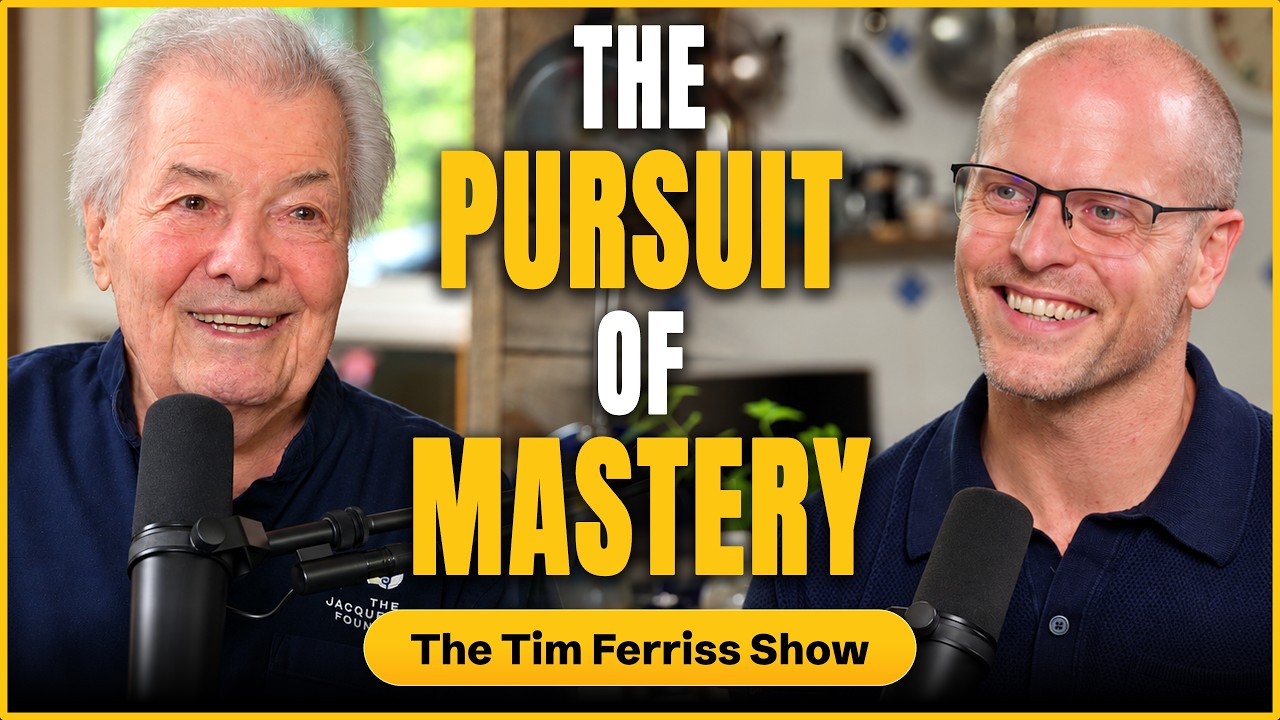
Legendary Chef Jacques Pépin — The Pursuit of Mastery, Meeting Julia Child, and More
 108 min
The Random Show — AI Super Assistants, Dream Engineering, Wizards, Supplements, and More!
 121 min
How to Legalize Medical Psychedelics in Your Country — Tania de Jong on Australia’s Breakthrough
Ask anything from this episode.
Save it, chat with it, and connect it to Claude or ChatGPT. Get cited answers from the actual content — and build your own knowledge base of every podcast and video you care about.
Get Started Free