Key Moments
The Henry Nowak Tragedy, Bernie's 50% on AI data Centers, & The Consequences Of Free Speech Bans
 Impact Theory
Want to know something specific about what's covered?
We've already dissected every moment. Ask and we will deliver (with timestamps).
Key Moments
Henry Nowak's death in UK custody sparked riots due to alleged anti-white policing, sparking debates on "anti-racism" and"hierarchy of victimhood" versus "colorblindness".
Key Insights
The death of Henry Nowak after being stabbed and then handcuffed by police, who allegedly dismissed his claims of being injured, triggered widespread riots in the UK.
Constantine Kissen's viral post highlights a perceived 'hierarchy of victimhood' where George Floyd received widespread outrage and support, while Henry Nowak, a white British citizen, faced official silence.
Bernie Sanders has proposed a bill to seize 50% of major AI companies, creating an AI sovereign wealth fund, which critics deem 'lunatic' and a 'parasitic' redistribution of wealth.
The discussion points to a growing cultural narrative, possibly Marxist in origin, that frames society in terms of "oppressors" and "oppressed" based on race, leading to societal derangement.
The video argues that while individual instances of racism exist and must be addressed, the core issue is a cultural shift towards ideological divides rather than race, exacerbated by social media.
Ukraine has been 'out-innovating' Russia in drone technology, conducting strikes on critical infrastructure and economic forums, escalating the conflict beyond initial expectations.
The Henry Nowak incident and the ensuing UK riots
The death of 18-year-old Henry Nowak, a British teenager, following a stabbing during an altercation, has ignited significant outrage and riots across the UK. The incident gained national attention after bodycam footage emerged showing police officers handcuffing Nowak as he repeatedly stated he was having trouble breathing and had been stabbed. The alleged failure of the police to immediately attend to his wounds, coupled with the perpetrator's claim of being a victim of a racist attack, created a volatile situation. The stabbing itself was carried out by Vicram Digua with a ceremonial blade, resulting in a fatal wound to Nowak's heart. Digua was later convicted of murder and sentenced to life imprisonment with a minimum of 21 years, but the policing conduct during the incident has become the focal point of public anger, leading to accusations of a two-tiered policing system and broader societal discontent.
Comparisons to George Floyd and accusations of anti-white bias
A central theme in the aftermath of Henry Nowak's death is the stark contrast drawn between the public and governmental response to his case and that of George Floyd. Critics, notably Constantine Kissen in a viral post, argue that Floyd's death, which occurred in the US, prompted a massive, almost immediate outpouring of sympathy, protests, and official acknowledgments (like politicians kneeling) in the UK. In contrast, Nowak's death, despite being a British citizen and the circumstances of his detainment, was met with relative official silence and a lack of public outcry. This perceived disparity has led to accusations of 'anti-white bias' and a 'hierarchy of victimhood' where white individuals are systematically devalued in victimhood narratives. The argument posits that a cultural shift, influenced by Marxist frameworks of oppressor/oppressed, has led to a situation where certain racial groups are automatically seen as victims, and others as oppressors, regardless of individual circumstances.
Bernie Sanders' proposal for 50% public ownership of AI companies
The discussion pivots to a controversial proposal by Senator Bernie Sanders to seize 50% of major AI companies like OpenAI, establishing an AI sovereign wealth fund. The rationale, according to Sanders, is to ensure the benefits of AI, framed as a new age of abundance, are shared by the public. However, this proposal has been met with strong criticism, with many labeling it as 'lunatic' and a form of 'communism' or 'parasitic' wealth redistribution. Critics argue that it disincentivizes innovation and punishes those who build and create value. The argument is made that human knowledge, which forms the basis of AI, is inherently free and should not be 'owned' or controlled in this manner. The failure rate of companies (94%) is highlighted to underscore the risk and effort involved in creation, contrasting with the government's role, which is seen by some as merely redistributive and not productive. The idea of "information wants to be free" is invoked, but the debate centers on whether this applies to the computationally processed and proprietary AI models derived from that information.
The role of ideology and "anti-racism" in societal division
A significant portion of the conversation delves into the cultural impact of ideological frameworks, particularly the concept of 'anti-racism' as a driver of division. The speaker suggests that what is labeled as 'anti-racism' has, in practice, become an obsession with race that leads to a two-tier society, treating people differently based on skin color. This is contrasted with the ideal of judging individuals by the 'content of their character,' as espoused by Martin Luther King Jr. The argument is made that a Marxist-influenced ideology, which categorizes people into 'oppressors' and 'oppressed,' and then maps this onto race, is not only destructive but also deranges society, leading to potential mass violence. The perceived "original sin" narrative placed upon white people, stemming from historical injustices like slavery, is seen as a major point of contention, creating resentment and a pushback that can manifest in "populist" movements.
Immigration and its societal impact
The complexities of immigration and its role in recent societal tensions are also addressed. The speaker posits that while unchecked immigration is a concern, the deeper issue lies in the failure of assimilation and the adoption of the host country's values. The economic drivers behind current immigration policies, even among conservative governments, are highlighted, suggesting that a low birth rate and the need to maintain economic output are key factors. The argument is made that if immigrants do not share the values of their new country, it creates a 'disaster waiting to happen.' The case of Henry Nowak is examined through this lens, questioning whether Digua, if born in the UK, is still considered an 'immigrant' or a product of failed assimilation, which complicates the use of immigration as a primary explanation for the incident.
Ukraine's drone technology and the escalating conflict
The ongoing conflict between Russia and Ukraine is discussed, with a focus on Ukraine's perceived technological advantage in drone warfare. Ukraine is reportedly 'out-innovating' Russia, employing drones for strikes on critical infrastructure, including oil refineries and economic forums. This escalating use of drone technology by Ukraine is seen as a significant development that challenges Russia's initial assumptions about the war's duration. The potential for a cornered Russia to escalate further, possibly by targeting NATO allies or retaliating against Europe, is raised as a serious concern, creating a destabilized global environment. The conversation briefly touches on the 'Manhattan Project' equivalent for Ukraine's engineers and the ongoing debate about whether this is a proxy war or a genuine struggle for Ukrainian self-determination.
Gaming industry debates: Character representation and consumer expectations
The discussion shifts to the video game industry, specifically the controversy around the new female protagonist in the God of War franchise. This has sparked debates about character representation, "wokeness," and consumer expectations. While some defend the choice as a natural progression of lore and a means to explore character development, others argue that it alienates the core demographic, particularly male players who prefer to embody attractive characters in power fantasies. The argument is presented that while individual instances of artistic expression are valid, a business aiming for mass appeal must consider its primary consumer base. The effectiveness of character design in selling games is debated, with some suggesting that making the character less conventionally attractive contributed to backlash and potentially lower sales, especially for a franchise reliant on its established male power fantasy. The debate also touches upon broader issues of whether the industry is prioritizing social agendas over market demands, and the impact of online discourse on sales figures.
The nature of free will and societal prosperity
The conversation touches on the philosophical concept of free will, with the speaker asserting that there is no scientific data supporting its existence and that human actions are ultimately governed by physics and biology. This leads into a broader discussion about societal prosperity, capitalism, and the role of government. The speaker criticizes wealth redistribution policies, arguing they undermine the incentives for innovation and creation. The success of capitalist systems is attributed to harnessing human selfishness as a driving force for progress, provided it is channeled through creating value for others. Historical examples like China's economic reforms are cited to show how embracing capitalist principles can lift populations out of poverty. The government's role is ideally to facilitate this process with gratitude and balanced policy, rather than to punish or over-regulate, as excessive taxation or burdensome policies can lead to economic decline.
Mentioned in This Episode
●Products
●Software & Apps
●Companies
●Organizations
●Books
●Concepts
●People Referenced
Common Questions
The riots in the UK were sparked by shocking body cam footage showing police negligence during Henry Noak's final moments after he was stabbed. The perception of a two-tiered policing system and anti-white bias, especially when contrasted with the government's response to George Floyd's death, fueled massive outrage.
Topics
Mentioned in this video
An 18-year-old British man who died after being stabbed by Vicram Digua, with police being accused of negligence during his final moments, sparking riots in the UK.
A commentator whose comparison of Britain's response to George Floyd versus Henry Noak went viral, highlighting perceived racial hierarchy in victimhood.
A black man whose death in the US sparked global protests and movements, including in the UK, leading to comparisons with the Henry Noak case regarding police and government responses.
A US senator who proposed a bill to seize 50% ownership of top American AI companies for the public through an AI sovereign wealth fund, a proposal critically viewed as "lunatic and communistic".
The 23-year-old who stabbed Henry Noak five times, resulting in a fatal heart wound, and was subsequently convicted of murder and sentenced to life with a minimum of 21 years.
The police officer involved in George Floyd's death, whose actions are contrasted with those of the police in the Henry Noak case, highlighting perceived double standards.
A civil rights leader whose vision of judging people by the content of their character is referenced as a past ideal, now contrasted with contemporary racial divisions.
A British political activist mentioned as capitalizing on the Henry Noak incident for recruitment and personal gain, similar to how tragedies are politicized.
An author known for his "anti-racist" ideas, which are interpreted as advocating preferential treatment for people of color and contributing to a backlash effect.
A South African anti-apartheid revolutionary and political leader whose philosophy of unity and reconciliation ('Long Walk to Freedom') is cited as a path forward from racial division.
A YouTuber investigating the Lego theft scandal where a company allegedly stole an old man's Lego collection, involving collusion with police and controversial investigative tactics.
An investor and business magnate whose quote about modern poor people living better than John D. Rockefeller is discussed, highlighting both the progress and misleading aspects of comparing economic well-being across eras.
Cited by Warren Buffett as the richest man in the world during his time, whose standard of living is compared to that of modern poor people to illustrate societal progress in medicine, education, and transportation.
A wealthy individual mentioned as an example of the kind of extreme wealth in the 'second gilded age' that can be infuriating to those struggling with debt and economic hardship.
A wealthy individual mentioned as an example of the kind of extreme wealth in the 'second gilded age' that can be infuriating to those struggling with debt and economic hardship.
A historical figure whose actions during World War II are discussed in terms of the 'horrific amoral things' he might have done for victory, raising questions about selectively focusing on positive historical narratives.
The US president who oversaw the end of slavery, his actions are described as not "pure" but part of a necessary narrative to inspire and motivate moral behavior.
A renowned author mentioned as an example of how even great writers can struggle with portraying characters outside their lived experience, specifically male authors writing female characters convincingly.
The Russian president, initially claiming the war against Ukraine was almost over, but now facing escalating drone strikes and potential retaliation against Ukraine's allies.
The co-founder of Impact Theory, whose different creative instincts for stories aimed at girls, focusing on emotion and empathy, proved more successful than the host's initial treatment.
The former US president mentioned for his past comments on the Russia-Ukraine conflict and later as an example of a political figure impacting perceptions.
An actress who played a strong female character (Sarah Connor in Terminator 2) and faced initial pushback for being 'too masculine' but was ultimately remembered as a 'dopeass heroine.'
An actress known for playing strong female characters, cited alongside Linda Hamilton as an example of a 'dopeass heroine' who was well-received over time.
An actor whose likeness in Cyberpunk 2077 DLC is contrasted with the altered appearances of female characters in other games, highlighting consistency in male character portrayal.
The country where the Henry Noak incident occurred, leading to widespread riots and discussions about racial bias and immigration policies.
A country that launched strikes against Russia in response to major attacks, showcasing innovation in drone technology and resisting an anticipated quick defeat.
A country that launched major attacks on Ukraine and is facing retaliatory drone strikes, leading to concerns about escalation.
Mentioned as an example of a country that experienced economic miracles, pulling hundreds of millions out of poverty by adopting capitalist principles and incentivizing wealth creation.
A country whose post-World War II stabilization and pivot away from communism involved controversial alliances, such as with the Yakuza, and whose current prime minister is grappling with immigration.
A UK political party, whose leader Robert Low gained significant attention for speeches addressing the rape gang investigation and advocating for stricter immigration policies.
A Democratic lobbying firm to which 40% of Black Lives Matter donations were allegedly given, indicating the politicization of the movement.
Allegedly involved with Bricks and Minifigs and the police in Utah, as part of the Lego theft scandal, leading to questions about influence and corruption.
A military alliance referenced in the context of Russia's potential actions forcing an Article 5 moment, where member states would have to decide on active engagement in Russia.
The Japanese mafia, which the US allegedly enlisted help from after World War II to stabilize Japan and counter communism, often through 'amoral things' like union busting.
A leading AI company whose IPO projections are cited as the motivation for Bernie Sanders' proposal to seize 50% of top AI companies.
A Lego retail company based in Utah, allegedly involved in the theft of a man's Lego collection and colluding with the police, potentially influenced by the Mormon church.
An online education platform for which the host is teaching a free class on building a company with AI on June 11th.
A popular gaming franchise that introduced a female lead character, sparking debate and backlash within the gaming community about 'woke' trends and character representation.
A video game character and franchise referenced to illustrate how a different lead character can still find success through good gameplay and story, even if not the original protagonist.
A game franchise that faced criticism for featuring a black samurai, with some attributing negative sales to 'woke' elements rather than game quality.
A manga/anime series cited as an example of niche content created for a specific demographic (young boys), with motivations (touching a breast) that wouldn't appeal to a wider audience.
A vampire show on HBO where the actress playing the female lead in the new God of War game previously starred.
A comic series developed by Impact Theory, where the host’s initial treatment was deemed 'terrible' by female collaborators, highlighting the importance of demographic-specific insights in creative direction.
A film referenced for its portrayal of a strong female lead (Linda Hamilton as Sarah Connor) who overcame initial criticism about masculinity to become an iconic heroine.
A video game referenced to argue that a game can still be successful and win awards despite controversy around its lead character (a lesbian woman), if the game's quality is high.
A framework that the host believes has been propagated through educational institutions, leading to a victim-oppressor paradigm that maps to race and generates societal violence.
The idea of AI that is freely accessible to everyone, allowing humans to leverage patterns in collective knowledge more efficiently, contrasting with calls for public ownership.
Discussed as a 'miracle' that funnels human selfishness into innovation and value creation, leading to societal prosperity, despite its potential for abuse and existing hybrid systems.
A philosophical system that the host is asked to compare his views to, particularly on free will, which he states he doesn't fully align with due to his deterministic view of physics.
Nelson Mandela's autobiography, recommended for understanding how to move forward together despite great injustice, especially in the context of racial conflict.
A book mentioned by the host about Tokyo's cultural transformation, raising questions about potentially amoral mechanisms used to achieve societal stability in Japan.
A fantasy novel mentioned as part of the popular romantic genre, often featuring highly attractive male characters.
A large fantasy romance series mentioned as another popular work within the genre of romantic novels that feature attractive male characters.
A video game mentioned for its realistic portrayal of Keanu Reeves in its DLC, contrasting with the alleged 'uglification' of female characters in other games like God of War.
A popular romantic novel mentioned as a massive seller in the female equivalent of 'porn' genre, where male characters are depicted as highly attractive.
A brand of building toys central to a theft scandal where an old man's valuable collection was allegedly stolen by Bricks and Minifigs, prompting a YouTuber's investigation.
Used as an example of how something can transition from a children's collectible to an investment asset, where emotional attachment drives spending and value goes up, even if partly due to inflation.
An advanced AI model suggested for use in criticizing the host's 'No Free Will' deep dive, but which he previously found uncompelling when testing with Claude.
An AI model previously used by the host to test his 'No Free Will' argument, which he found did not offer any compelling criticisms.
More from Tom Bilyeu
View all 117 summaries 117 min
Apple Is Trying to Kill OpenAI Right Before Its IPO
 153 min
US Hits Iranian Infrastructure. DSA Commits Treason? Spencer Pratt’s Bombshell Accusation
 56 min
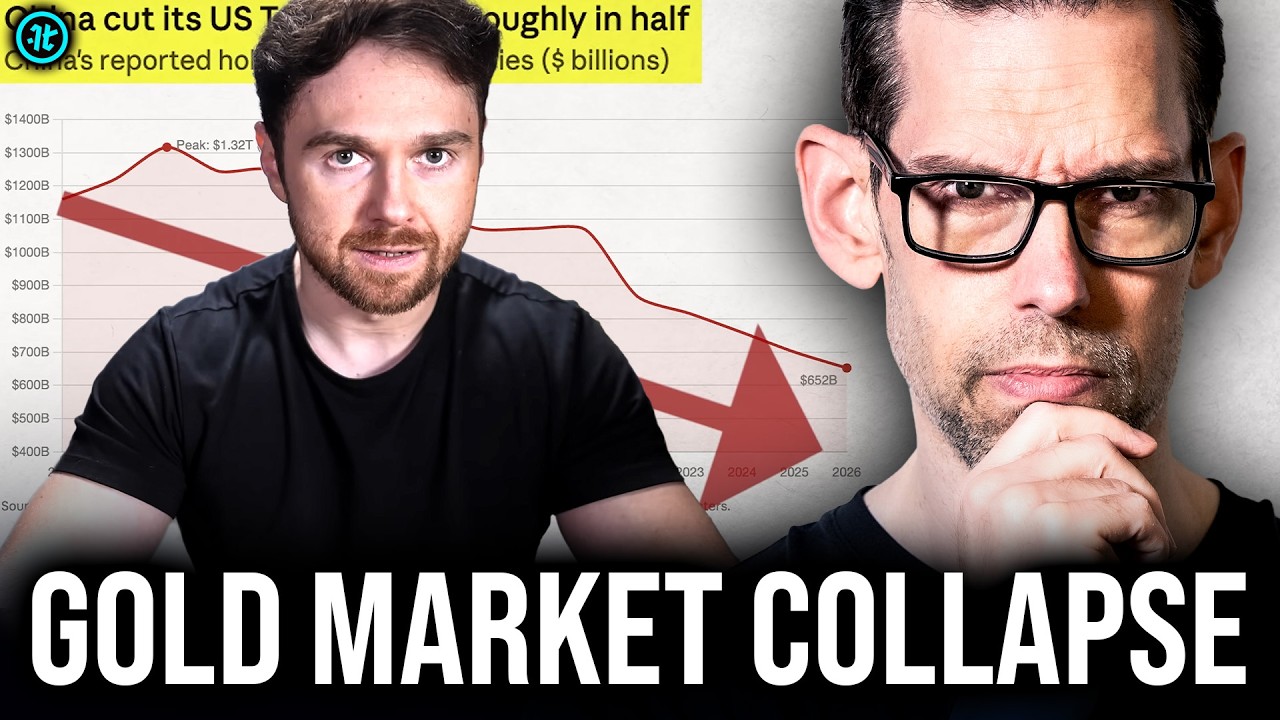
China Says They Shut Down Gold Trading To Protect You — That's Not Why — We Had To React
 101 min
Oil Explodes As Ceasefire Fails, Japan Bond Crisis Threatens US Debt, & Platner Ditched By Dems
Ask anything from this episode.
Save it, chat with it, and connect it to Claude or ChatGPT. Get cited answers from the actual content — and build your own knowledge base of every podcast and video you care about.
Get Started Free