Key Moments
Eric Weinstein: The State of American Science, Breakthrough Coverups, and the Danger of Physics
 All-In Podcast
Want to know something specific about what's covered?
We've already dissected every moment. Ask and we will deliver (with timestamps).
Key Moments
American science has stalled due to a "scientific precariat" that fears dissent, and a pivot away from risky, fundamental physics has potentially saved humanity from its own destructive capabilities.
Key Insights
American science risks losing its edge by focusing on incremental research instead of "bets no one else can afford to take on."
The "scientific precariat" system discourages dissent, as professors fear losing funding, jobs, or social standing for questioning consensus.
A shift away from fundamental physics, potentially driven by figures like Ed Witten in the early 1980s, may have inadvertently prevented the development of new, dangerous technologies.
The Mansfield Amendment (1969-1971) forced military funding of university research to have direct military purposes, damaging "blue sky" research.
The rise of peer review post-1965, initially for medical procedures, is argued to be a mechanism for enforcing consensus and hindering true innovation.
China is actively poaching Western scientists by offering better pay, prestige, and a form of freedom not available in the U.S.
The "scientific precariat" stifles bold inquiry
Eric Weinstein argues that American science is stagnating because it has created a "scientific precariat" – a system where researchers, particularly professors, cannot afford to challenge established consensus for fear of losing funding, tenure, or professional relationships. This environment discourages "cowboy science" and the pursuit of high-risk, high-reward research that is no longer being undertaken. The emphasis has shifted to incremental, low-variance research, which Weinstein finds depressing given the nation's capacity for bold, unaffordable bets. He contrasts this with the ideal of intellectual freedom where scientists should be able to question dogma, citing the COVID-19 pandemic as an example where a lack of skepticism around lockdowns was concerning. The system, Weinstein contends, pressures scientists into an "artificial agreement" rather than genuine scientific consensus, leading to a loss of America's unique advantage of rugged individualism and critical inquiry.
The "civil rights act" and "peer review" as barriers
Weinstein proposes radical reforms, including "blow[ing] a giant hole in the Civil Rights Act" and "kill[ing] peer review." He clarifies that "blowing a hole" in the Civil Rights Act doesn't mean abolishing it, but rather addressing how its letter is "arbitraged against the intent," creating a collectivist thinking that hinders the hyper-individualism essential for great work. The current HR-driven environment, he suggests, doesn't understand the culture of greatness. Similarly, he dismisses peer review as a "fake story" that emerged significantly only after 1965, coinciding with the Medicare Act and increased government funding in medical research. The argument is that peer review, initially adopted to prevent government oversight, evolved into a mechanism that enforces conformity and bureaucracy, rather than fostering true scientific advancement. He advocates for funding people, not just ideas, and argues that the current system, including grants with specific objectives and a focus on "lower beta" (predictable) outcomes, misses opportunities for high-risk, high-reward "crazy high beta bets" on individuals.
Physics potentially "drove off a cliff" in the early 1980s
A central, provocative claim is that theoretical physics, particularly around 1983-1984, took a wrong turn under the influence of key figures like Leonard Susskind, David Gross, and Edward Witten, moving away from fundamental questions about the physical world towards abstract concepts like string theory and AdS/CFT correspondence. Weinstein argues that this shift, while perhaps making physics "safe" and less likely to produce dangerous weaponry, has stalled progress in understanding fundamental forces and particles. He posits that this stagnation, while potentially saving humanity from its own destructive potential, has denied us advancements in "boom" (weaponry), "vroom" (energy), and "zoom" (propulsion, computation). He suggests that this redirection was not accidental, drawing a parallel to the historical redirection of chain reaction physics during the Manhattan Project through a "reference committee" that controlled access to research.
The Mansfield Amendment and the loss of "blue sky" research
The protest by MIT physicists against the Vietnam War in 1969 is identified as a critical turning point. This dissent led the government to question the reliability of physicists, resulting in actions like the separation of the MIT Instrument Laboratory into Draper Labs. Crucially, the Mansfield Amendment (1969-1971) stipulated that military funding for university research must have a "direct military express purpose." This ended the era of the military funding "blue sky" research, where scientists were trusted to pursue curiosity-driven projects that could later yield unexpected breakthroughs. The amendment forced research to become immediately applicable, stifling the kind of unfettered exploration that had previously driven scientific progress.
The potential for secret physics research and Renaissance Technologies
Weinstein speculates that if fundamental physics research is still advancing, it might be happening in a clandestine manner, similar to how the Manhattan Project operated. He points to Renaissance Technologies, a quantitative hedge fund, as a potential candidate. The firm's cover story—hiring exclusively from highly specialized fields like particle physics and differential geometry, and its close ties to Brookhaven National Laboratory and Stony Brook University—strikes Weinstein as suspicious. He notes the firm's exceptionally high, undisclosed returns and its closure to outside investors as analogous to historical secrecy in advanced scientific endeavors like the Manhattan Project and its "reference committee." He draws parallels to how public knowledge of advanced physics, like the Teller-Ulam design for thermonuclear weapons, has been managed, suggesting a precedent for controlled or hidden scientific breakthroughs.
The dual nature of scientific power: doom and opportunity
Weinstein emphasizes the profound power of scientific knowledge, capable of both immense destruction and incredible progress. He uses examples like the ease of making black powder or the discovery of the atom bomb's principles by piecing together declassified information to illustrate how accessible powerful science can be. He argues that the stagnation in physics has denied humanity advancements in "boom" (weaponry), "vroom" (energy), and "zoom" (propulsion/computation). However, he also acknowledges the terrifying potential of advanced science, such as the possibility of weapons that could disintegrate matter, or the implications of "multi-temporal adversaries" (time travelers). This dual nature suggests that the current scientific trajectory, while potentially safer from immediate self-destruction, is also limiting our potential for advancement and even survival beyond Earth.
The role of AI and the future of scientific discovery
Weinstein predicts that Artificial Intelligence, trained on both prestigious scientific journals and a "trash can corpus" of rejected or ridiculed ideas, will revolutionize scientific discovery. He believes AI will unearth the value in theories that were previously dismissed, potentially bypassing human biases and institutional inertia. He likens the current release of powerful AI models to commercial products to Hannibal Lecter being hired as a consultant, suggesting a dangerous lack of control. This potential for AI to process vast amounts of information, including suppressed or unconventional ideas, could lead to breakthroughs that radically alter our understanding of the universe, potentially opening doors to concepts like dark chemistry, new forms of matter, and advanced propulsion systems that transcend Einstein's speed limit.
UAPs, multi-temporal adversaries, and humanity's cosmic place
Weinstein's perspective on Unidentified Aerial Phenomena (UAPs) has shifted from skepticism to belief that "there's definitely something there." He attributes this to consistent reports from sober, intelligent individuals and historical intelligence documents linking UAPs to nuclear test sites, suggesting research into gravity shielding and anti-gravity. He theorizes that such phenomena, along with concepts like "multi-temporal adversaries" (time travelers), are possible if our understanding of spacetime, currently limited by Einstein's general relativity, is incomplete. He posits that gestures like "pinch to zoom" might hint at ways to manipulate spacetime and achieve faster-than-light travel. Ultimately, he believes that if humanity can develop such advanced propulsion, it could allow us to escape our solar system, which he views as an "escape room" with limited habitability. This capability, he argues, is crucial for long-term survival, as civilizations that reach a certain technological threshold, like developing nuclear weapons, may inadvertently signal their presence to more advanced extraterrestrial life.
Mentioned in This Episode
●Products
●Software & Apps
●Companies
●Organizations
●Books
●Concepts
●People Referenced
Common Questions
Eric Weinstein argues that American science is stalling due to a focus on incremental research and a lack of courageous, high-variance bets. He believes the U.S., as a rich, individualistic nation, should prioritize 'cowboy science'—high-risk, high-reward research that other nations cannot afford, leveraging freedom of inquiry as a geopolitical advantage.
Topics
Mentioned in this video
A 'hippie dippy charity' that received large amounts of money from DTRA, raising questions about covert operations.
Formed from the MIT Instrument Laboratory after government funding was moved outside the university system.
A 'middling university' that is historically world-class in subjects relevant to next-level physics, and has a relationship with Renaissance Technologies.
Its physics department walked out in protest of the Vietnam War, leading to significant changes in military funding for university research.
Questioned if anyone there would be interested in conversations about radical physics.
The institution James Watson was 'kicked out' of, despite having built it.
National Science Foundation, an organization Eric Weinstein hopes Jim O'Neill will join.
Office of Science and Technology Policy, an entity where Director Katzios works, involved in reforming American science.
Where Eric Weinstein co-chaired the Science and Engineering Workforce Project.
Mentioned as having a close relationship with Renaissance Technologies, adding to the suspicion of secret physics work.
National Institutes of Health, where Jay Bhattacharya is an old friend of Eric Weinstein.
Site of Fermi's Chicago Pile-1 experiment, proving the chain reaction.
The university where John Aristotle Phillips designed an atomic bomb as his junior thesis.
Defense Threat Reduction Agency, mentioned as providing money to EcoHealth Alliance.
Established a 'reference committee' in 1940 to censor papers on chain reaction physics, mirroring a potential secret science program today.
Questioned if anyone in its science and technology directorate would be interested in conversations about radical physics.
A billionaire with a background in quantum chromodynamics, an example of wealthy individuals with scientific backgrounds.
Co-proposer of the Pati-Salam model in the mid-1970s, which Eric Weinstein believes will be found to be the correct grand unification theory.
The 'magenta incident' under his rule is mentioned in relation to early quantum theory advancements in Italy.
His deceptive cover story of running a hedge fund is used as an analogy for how powerful entities use misleading narratives.
A Princeton student who designed an atomic bomb as his junior thesis, illustrating how dangerous knowledge can be independently acquired.
Described as a scientist who builds things that kill people, fitting the profile of a 'dangerous mind' that current physics departments might not accommodate.
A good friend of Eric Weinstein who specializes in algebraic geometry, highlighting the difficulty of communication even between adjacent fields of mathematics.
His health was discussed, drawing a parallel to Roosevelt's hidden condition during wartime.
A genius with detailed knowledge of pure mathematics who funded research, but even he didn't fully grasp certain advanced physics concepts.
Along with Leonard Susskind and Edward Witten, credited with driving physics in a new, less physical direction in 1983-84.
His song 'Who's Next?' is referenced to illustrate the coming multipolar world with nuclear proliferation.
His theory of general relativity is discussed, with Eric Weinstein arguing that humanity has been too long in 'Einstein's prison'.
Founder of Slack, whose story is used to illustrate backing the person, not the idea, in entrepreneurship.
Mentioned as hopefully coming into NSF from the Peter Thiel universe.
Discussed in the context of PhDs avoiding his administration due to perceived 'cooties', and the importance of engaging with political figures despite personal feelings.
Came up with the concept of the chain reaction.
Proven the chain reaction concept at the University of Chicago with Chicago Pile-1.
A physicist who advised John Aristotle Phillips on his atomic bomb design.
Praised as the 'only adult' focused on Mars and the Moon, motivating engineers despite his 'crazy' demeanor.
Credited alongside Einstein for the true beginning of general relativity in 1913, correcting the common attribution to Einstein alone.
A psychopath from Breaking Bad, reacting to Heisenberg's use of volatile compounds.
His work at the end of World War II is referenced as the last major proposal to reform American science.
Co-PI with Eric Weinstein on the Science and Engineering Workforce Project at Harvard.
Her voting percentage among scientists is contrasted with Trump's to show the political leanings of the scientific community.
Mathematician, physicist, economist, PhD in mathematical physics from Harvard, formerly with Thiel Capital, and podcast host.
Labeled a 'loser' by Eric Weinstein for calling Jay Bhattacharya a 'fringe epidemiologist'.
His physical condition during WWII was kept secret, drawing a parallel to Biden's health concerns.
Eric Weinstein gave a talk at his ARC conference, discussing the lack of reward for scientists who stood up against consensus.
The Unabomber, whose manifesto discussed over-socialization, is referenced in the context of scientific systems becoming saturated.
Creator of terrifying weapons, used to illustrate the historical power of physics.
The main character of Breaking Bad, used as a paradigm for dangerous scientific application.
Former Director of OSTP, discussed as someone trying to reform American science.
Used as an example of an entrepreneur who continuously reinvents his company, reinforcing the idea of backing the person.
Former White House science adviser, whose picture isn't on the wall due to being uncompromising and difficult to deal with.
Creator of terrifying weapons, used to illustrate the historical power of physics, specifically his work on thermonuclear weapon design.
A brilliant scientist mentioned as a type of character missing from modern scientific discourse.
Eric Weinstein identifies as a Democrat from the 'JFK school', implying a more individualistic and less 'woke' ideology.
Described as the 'smartest man in the world' but also accused of driving theoretical physics 'off a cliff' 42 years ago by focusing on string theory.
Hypothesized the neutron in 1911.
A brilliant scientist mentioned as a type of character missing from modern scientific discourse.
Senator from Montana, after whom the Mansfield Amendment was named.
Jim O'Neill is mentioned as coming from his 'universe', and Eric Weinstein discusses working for him and the professional repercussions.
Along with David Gross and Edward Witten, credited with driving physics in a new, less physical direction in 1983-84.
An old friend of Eric Weinstein, referred to as an MD and PhD in economics, who went against consensus with the Great Barrington Declaration.
A brilliant and irreverent scientist who wrote a genetic switch on phage lambda, seen as an example of a 'dangerous mind'.
Creator of terrifying weapons, used to illustrate the historical power of physics.
A journalist who broke the story of Los Alamos in 1944, whose account was initially dismissed as crazy, drawing a parallel to Eric Weinstein's own claims about Renaissance Technologies.
The individual who published the Teller-Ulam design, piecing it together from declassified information.
Described as an incredibly charismatic, brilliant, and uncompromising physicist, not swayed by string theory fads.
Creator of terrifying weapons, used to illustrate the historical power of physics.
Criticized for his role during the COVID-19 pandemic and alleged ties to bioweapons research.
Co-discoverer of DNA structure, who was 'kicked out' of Cold Spring Harbor, which he built, an example of how institutions treat great scientists.
A VC who backed Stewart Butterfield (Slack) when his initial project failed, demonstrating trust in the individual.
A dangerous but intelligent character from Silence of the Lambs, used as an analogy for AI models.
Eric Weinstein argues that it is 'wrong' and a 'prison', expecting new measurements of dark energy to break its equations.
The gene complex on the Y chromosome that largely determines male sex, used as an example of a radical scientific idea that can cause social friction.
The design for a thermonuclear weapon, whose publication was attempted to be blocked as 'restricted data'.
A field of physics whose current theories are questioned, with the idea that AI will uncover new approaches.
A grand unification model proposed in the mid-1970s, which Eric Weinstein believes is the correct first-order theory.
A theory within quantum gravity that Eric Weinstein suggests might be a 'red herring meant to distract us'.
Criticized as a 'fat' that Nima Arkani-Hamed didn't fully buy into, and later as the 'only game in town' that drove physics off a cliff.
A theorem mentioned in the context of why the cosmological constant term in general relativity is structured as it is.
Eric Weinstein, formerly a skeptic, now believes 'there's definitely something there', and links them to potential secret advanced physics.
Eric Weinstein's proposed mathematical framework and speculative unified field theory.
A historical scientific project that created powerful weapons, used as an example of science's impact and secrecy.
Home to the DESI instrument, which Eric Weinstein believes will generate data that breaks general relativity.
Mentioned as becoming very good at quantum theory with Fermi, linked to the 'magenta incident' under Mussolini.
Elon Musk's current focus, as Eric Weinstein notes, as a potentially habitable rock.
Used as an analogy for humanity as an uncontacted people, unaware of larger, more advanced civilizations.
Referred to as a chief geopolitical rival, but also as a place attracting scientists with promises of freedom and funding.
Referenced in the context of it being a place collecting 'too many number theorists', drawing a parallel to Stony Brook.
Discussed as a nation that, if the US fails, will lead to nuclear proliferation.
Described as a 'red herring' and 'macguffin' by Eric Weinstein, yet still a focus for Elon Musk's engineers.
The secret city of the Manhattan Project, whose existence was initially dismissed as crazy.
Its intelligence document from 1971 revealed gravity shielding research and UAP sightings near nuclear test sites.
Australia was a testing ground for its nuclear weapons, which were accompanied by UAP sightings.
The country that claims sovereignty over North Sentinel Island, used in an analogy about advanced civilizations and primitive ones.
Eric Weinstein provocatively suggests blowing a 'giant hole' in it to foster highly cohesive social units in science, arguing against HR interference in scientific collaboration.
One of the agreements signed in the 1970s, mentioned in the context of bioweapons.
Prohibited military funding of blue-sky research in universities unless it had a direct military purpose, which Eric Weinstein considers a disaster for science.
Cited as the beginning of peer review being 'retconned' into science, due to government becoming a major payer for medical procedures.
Referenced in a provocative analogy comparing AI's release to making soldier-launched nukes available.
A bioweapons treaty signed in the 1970s, discussed in relation to cryptic systems and covert operations.
A court case involving the publication of the Teller-Ulam design for a thermonuclear weapon, establishing the concept of 'restricted data'.
A financial advisory firm offering investment management, tax strategy, and estate planning.
Proposed as the leading candidate for a modern-day secret science program, due to its secretive nature, hiring practices, and relationships with academic/national labs.
An AI company, whose approach is compared to Hannibal Lecter as a dangerous but intelligent new 'employee'.
Used as a retail outlet in a provocative analogy about the widespread availability of dangerous weapons.
Renaissance Technologies' flagship hedge fund, known for its extremely high returns and being closed to outside money.
A prestige journal in mathematics, part of the corpus AI is currently trained on.
Referenced for the scene with Hannibal Lecter, used to illustrate the potential danger of AI.
A book published by Michael Kratsios that discusses science in America.
A book mentioned as containing instructions for making black powder, highlighting how dangerous knowledge can be widely accessible.
A prestige journal in mathematics, part of the corpus AI is currently trained on.
Mentioned as a prestige journal in biology, part of the corpus AI is currently trained on.
A scientific journal cited for a survey of 2,000 scientists and their political leanings.
Mentioned as a prestige journal in biology, part of the corpus AI is currently trained on.
A prestige journal in mathematics, part of the corpus AI is currently trained on.
Referenced for a scene where the protagonist uses chemistry for dangerous purposes, illustrating the leverage of scientific knowledge.
A story written by Ted Kaczynski about political correctness leading to disaster.
Referenced for its running gag about exaggerated claims, used to illustrate how cover stories can be easily exposed.
A film mentioned by the host to illustrate the idea that greatness often requires an unforgiving environment, not coddling.
More from All-In Podcast
View all 445 summaries 97 min
Nvidia's Historic Quarter, SaaS Comeback, Bessent vs Druck, America's Debt Crisis, Cancer Vaccine
 56 min
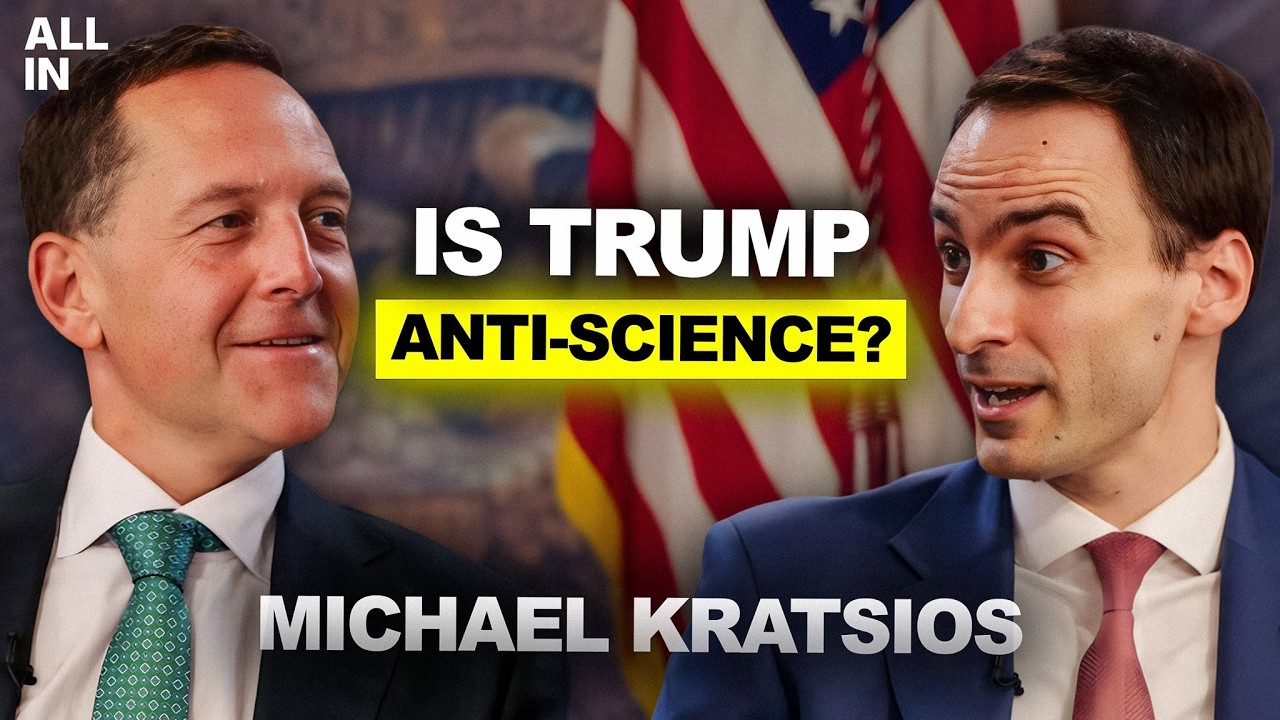
Inside Trump's Science Agenda: Anti-Science Claims, Fauci's Damage, DEI & China w/ Michael Kratsios
 91 min
Dario Defends Himself, Datacenter Panic, AI Doomer Trap, Senate Toss-Up
 56 min
Mass Surveillance, Police Misuse, and Who Controls Your Flock Cameras with Flock CEO, Garret Langley
Ask anything from this episode.
Save it, chat with it, and connect it to Claude or ChatGPT. Get cited answers from the actual content — and build your own knowledge base of every podcast and video you care about.
Get Started Free