Key Moments
Dustin Yellin on Making Art, Weaving Madness, and Forging Your Own Path | The Tim Ferriss Show
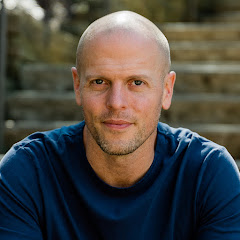 Tim Ferriss
Key Moments
Artist Dustin Yellin discusses art, experiences, and founding cultural center Pioneer Works.
Key Insights
Yellin's art, often 3D photo montages called "frozen cinema," explores consciousness and human fate within the Anthropocene.
His early life was marked by a non-traditional path, including dropping out of high school, hitchhiking, and intense psychedelic experiences.
He developed an entrepreneurial "hustle" from a young age, influenced by his single mother's resourcefulness.
Yellin founded Pioneer Works, a multidisciplinary cultural center, to foster community and inspire through arts and sciences.
He views his work and Pioneer Works as "social sculptures," aiming for obsolescence as a measure of success.
The "psychogeographies" are massive, layered glass artworks weighing thousands of pounds, intended as maps of consciousness.
EARLY LIFE AND UNCONVENTIONAL PATHWAYS
Dustin Yellin's journey began with a departure from traditional education, dropping out of high school to explore the world. His early experiences included hitchhiking through New Zealand and Thailand, often involving significant exploration of consciousness through psychedelics. This period, coupled with his mother's own resilient spirit and work ethic, instilled in him a deep sense of self-reliance and a unique perspective on reality. He also demonstrated an entrepreneurial drive from a young age, hustling various items and even busking as a breakdancer.
ENCOUNTERS WITH SCIENCE AND THE BIRTH OF AN ARTIST
A pivotal moment in Yellin's life was meeting a physicist in Colorado who introduced him to profound thinkers like Nikola Tesla and Buckminster Fuller. This exposure, combined with intense, guided psychedelic experiences involving ketamine and sensory deprivation, began to shape his artistic and philosophical outlook. These experiences, often described as out-of-body or consciousness-navigating visions, felt like they propelled him towards New York City, the perceived epicenter of artistic and intellectual endeavors.
MAKING IT IN NEW YORK AND THE ART OF HUSTLE
Upon arriving in New York in 1994, Yellin initially lived in a small rented room, enduring financial hardship while relentlessly creating art. He adopted a strategy of "hustling" his work, sometimes giving it away if it meant exposure to more people, believing art could spread like a 'plague.' This period was crucial for developing his artistic voice, learning from the people he met, and laying the groundwork for his eventual success, which was not immediate but accumulated over years of dedication.
PIONEER WORKS: A MULTIDISCIPLINARY CULTURAL CENTER
Driven by a desire for a space where artists, scientists, writers, and musicians could collaborate, Yellin founded Pioneer Works. This multidisciplinary cultural center in Red Hook, Brooklyn, aims to build community and create an open, inspired world. It functions as a learning center, museum, and community hub, hosting residencies and fostering interdisciplinary dialogue. Yellin views Pioneer Works itself as a 'social sculpture' and a testament to the power of collective dreams and collaborative efforts.
ARTISTIC STYLE AND THE "PSYCHOGEOGRAPHIES"
Yellin's signature art form involves intricate 3D photo montages embedded within laminated glass sheets, which he calls "frozen cinema." These works, such as the massive "psychogeographies," are composed of tens of thousands of found images, paintings, and drawings layered across numerous glass panes. Weighing thousands of pounds, these pieces create a unique visual experience that shifts depending on the viewer's perspective, offering complex narratives about consciousness, history, and humanity's place in the Anthropocene.
MITIGATING SYSTEM OVERLOAD AND EMBRACING THE BLANK SLATE
Yellin describes his constant struggle not with a lack of inspiration, but with 'system overload' due to the sheer vastness of information and possibility in existence. To manage this, he embraces drawing, spending time in nature, and cherishing relationships. He practices a mantra of having accomplished nothing, viewing each day as a blank slate full of potential for invention and creation. This mindset, coupled with a willingness to 'die for it' and a deep gratitude for luck, fuels his relentless pursuit of artistic and intellectual exploration.
THE BRIDGE PROJECT AND ENDING FOSSIL FUELS
Beyond his art and Pioneer Works, Yellin is conceptualizing 'The Bridge,' a monumental project to raise awareness about transitioning away from fossil fuels. This involves repurposing a supertanker into a monument, inviting visitors to explore its history and the future of energy. The project symbolizes humanity's liberation from fossil fuels, akin to pulling a boat over a mountain, and aims to inspire responsible stewardship of the planet through innovative energy solutions.
Mentioned in This Episode
●Products
●Software & Apps
●Companies
●Organizations
●Books
●Drugs & Medications
●Concepts
●People Referenced
Common Questions
Dustin Yellin dropped out of high school, hitchhiked through New Zealand and Australia, and had profound hallucinogenic experiences. These experiences, coupled with an obsession for science and art, led him to believe he could create anything, driving him to New York City in 1994, seeking freedom and a community of artists.
Topics
Mentioned in this video
A friend of Tim Ferriss who discussed the metaphorical river of hyper-rigidity versus chaos and serendipity on a previous podcast episode.
An American film director and editor known for films like 'Being There' and 'Harold and Maude', admired by Dustin Yellin.
An American theoretical cosmologist and a professor of physics and astronomy at Barnard College, described by Dustin Yellin as like a sister and crucial to Pioneer Works.
A medical doctor and friend of Tim Ferriss, serving as Zero's Chief Medical Officer, providing expert advice on fasting.
A British rock band whose music Dustin Yellin listened to while on hallucinogens and hitchhiking through New Zealand and Australia, experiencing his 'own Woodrock'.
An American architect, systems theorist, author, designer, inventor, and futurist, known for his comprehensive anticipatory design science, also an inspiration for Dustin Yellin through the physicist.
A Spanish painter, sculptor, printmaker, ceramicist, and theater designer, mentioned by Dustin Yellin as one of the few artists he knew about early in his career.
A friend of Dustin Yellin, quoted in a Vanity Fair piece about Dustin's anti-competitive nature and his love for other creators' egos.
An American film director, screenwriter, and producer, whose entire body of work Dustin Yellin recommends watching.
The artistic director of Pioneer Works, described by Dustin Yellin as like a brother, crucial to the success of the organization.
An artist, founder of Pioneer Works, known for his unique three-dimensional photo montages called psychogeographies or 'frozen cinema'. He dropped out of high school and hitchhiked globally before becoming an artist in New York.
A Canadian-American abstract painter, known for her minimalist grid-based works, referenced by Dustin Yellin when describing his early collages with dictionary pages.
A Serbian-American inventor, electrical engineer, mechanical engineer, and futurist best known for his contributions to the design of the modern alternating current (AC) electricity supply system, whose work on free energy inspired Dustin Yellin after meeting the physicist.
An American socialite, novelist, painter, and wife of F. Scott Fitzgerald. Dustin Yellin felt he needed to 'rescue' her during a mild psychotic break.
An English writer and philosopher known for 'The Doors of Perception', who discussed the mind as a 'reducing valve' that hallucinogens might widen.
A Russian novelist, short story writer, essayist, and journalist, shared as an early cultural lighthouse by Dustin Yellin's physicist mentor.
An American physician, neuroscientist, psychoanalyst, psychiatrist, writer, philosopher, and inventor known for his research on consciousness, which 'Altered States' was somewhat based on. He knew the scientist Dustin Yellin was working with.
An American novelist, widely regarded as one of the greatest American writers of the 20th century. Dustin Yellin was obsessed with him and 'Zelda Fitzgerald' during a mild psychotic break.
A German film director, screenwriter, documentarian, author, and opera director, whom Dustin Yellin admires as an amazing storyteller and frequently recommends his movies.
A Soviet filmmaker and theatre director who directed 'Stalker' and wrote 'Sculpting in Time', a book on filmmaking, both recommended by Dustin Yellin.
An American artist and sculptor, known for his shadow boxes and collages, inspiring Dustin Yellin's early resin boxes with objects.
A prolific writer behind BrainPickings.org, who suggested a question about the death of Dustin Yellin's mentor.
A friend of Tim Ferriss and creator of the Zero fasting app in 2016.
A Chilean poet-diplomat and politician, shared as an early cultural lighthouse by Dustin Yellin's physicist mentor.
An American actor, praised by Dustin Yellin for his performance in the film 'Altered States'.
An American artist, a leading figure in the pop art movement, mentioned by Dustin Yellin as one of the few artists he knew about early in his career.
A French artist, known for both his use of color and his fluid and original draughtsmanship, mentioned by Dustin Yellin as one of the few artists he knew about early in his career.
An American literary critic, who edited F. Scott Fitzgerald's 'The Crack-Up' essays.
The director of design at Pioneer Works, praised by Dustin Yellin for his talent and contribution.
An Armenian film director and screenwriter, director of 'The Color of Pomegranates', whose name Dustin Yellin finds hard to pronounce.
A 1982 West German epic adventure-drama film written and directed by Werner Herzog; one of Dustin Yellin's highly recommended films, serving as a metaphor for pushing through monumental challenges.
A 1993 Australian black comedy crime drama film, recommended by Dustin Yellin as a 'cool movie' that is really funny.
A 1982 documentary film directed by Les Blank, chronicling the chaotic and difficult production of Werner Herzog's 1982 film Fitzcarraldo.
A 1969 Soviet Armenian art film written and directed by Sergei Parajanov, recommended by Dustin Yellin.
A 2013 video by JAY-Z in which Dustin Yellin participated as a breakdancer, connecting back to his early busking days.
A 1971 American black comedy film directed by Hal Ashby, mentioned by Dustin Yellin.
A multinational professional services firm providing engineering, design, planning, project management, and consulting services, working with Dustin Yellin on 'The Bridge' project.
An automated investment service ('robo-advising') that manages globally diversified portfolios of ETFs, helps minimize fees, and lowers taxes for clients.
A British rock band whose music Dustin Yellin listened to while on hallucinogens and hitchhiking through New Zealand and Australia, experiencing his 'own Woodrock'.
A VPN service used and recommended by Tim Ferriss for securing data and accessing geo-restricted content.
A media organization known for its conferences and talks, which has featured Dustin Yellin and his work.
A prominent media organization that has featured Dustin Yellin and his work.
A New York City-based public art organization that supports artists' ambitious projects, and with whom Dustin Yellin has exhibited.
An international magazine specializing in contemporary art that has featured Dustin Yellin's work.
An art museum in Brooklyn, New York, where Dustin Yellin's art has been exhibited.
A 16.3-acre complex of buildings in the Lincoln Square neighborhood of Manhattan in New York City, where Dustin Yellin's art has been exhibited.
A multi-disciplinary cultural center in Red Hook, Brooklyn, founded by Dustin Yellin, focused on building community through arts and sciences. It started as a personal dream to bring together diverse creatives and scientists.
A magazine that has featured Dustin Yellin's work, including a quote about his anti-competitive nature.
The John F. Kennedy Center for the Performing Arts, where Dustin Yellin's art has been exhibited.
A museum dedicated to glass art and history, which has exhibited Dustin Yellin's layered glassworks.
A private art college from which Dustin Yellin holds an honorary doctor of humane letters degree. Also hosts the SCAD Museum of Art.
An art museum where Dustin Yellin's art has been exhibited, though Tim Ferriss notes he might mispronounce the name.
An art museum located in Tacoma, Washington, where Dustin Yellin's art has been exhibited.
One of the countries Dustin Yellin hitchhiked through after dropping out of high school.
Dustin Yellin's official website where his work, including psychogeographies, can be viewed.
Tim Ferriss's blog where additional content and photographs of Dustin Yellin's art are available.
A fasting app described as the world's most popular, offering personalized plans and health data.
The official website for Pioneer Works, the multi-disciplinary cultural center founded by Dustin Yellin.
A website that published a quote from Dustin Yellin about his daily mantra of having 'done nothing' to fuel continuous creation.
Maria Popova's website, known for its extensive and thoughtful discussions on various topics.
A collection of essays by F. Scott Fitzgerald, edited by Edmund Wilson, that Dustin Yellin was carrying during his psychotic break and was taken by the police.
A 1980 American science fiction horror film, mentioned by Dustin Yellin as being loosely based on John C. Lilly's life and having connections to the scientists he worked with.
A 1979 American satirical comedy-drama film directed by Hal Ashby, one of Dustin Yellin's favorite movies.
A book by Aldous Huxley that explores the effects of mescaline and the concept of the mind as a 'reducing valve'.
A book by Andrei Tarkovsky on filmmaking, highly recommended by Dustin Yellin.
A proposed geological epoch dating from the commencement of significant human impact on Earth's geology and ecosystems, often referenced in Dustin Yellin's work concerning the fate of human consciousness.
Dustin Yellin's unique form of three-dimensional photo montage where paint and images are embedded within laminated glass sheets, which he also calls 'frozen cinema'. These works typically depict complex narratives of human consciousness.
A traditional method of painting on the reverse side of glass, which influences Dustin Yellin's layered glassworks.
An American post-World War II art movement that Dustin Yellin unknowingly dabbled in with his early paintings in New York.
A collection of terracotta sculptures depicting the armies of Qin Shi Huang, the first Emperor of China. Dustin Yellin references them as an analogy for his psychogeographies which are a group of 120 human figures.
More from Tim Ferriss
View all 694 summaries 71 min
The Most Incredible Transformation I’ve Ever Seen — Jerzy Gregorek on Cerebral Palsy and Coaching
 34 min
PRISONER NO MORE: The True Story of Tae Jin Park
 89 min
From Food Stamps to the Super Bowl War Room — NFL Chief Security Officer Cathy Lanier
 55 min
From Dad’s Basement to Selling Two Companies — 4-Hour Workweek Success Story
Ask anything from this episode.
Save it, chat with it, and connect it to Claude or ChatGPT. Get cited answers from the actual content — and build your own knowledge base of every podcast and video you care about.
Get Started Free