Key Moments
Trump GOES HARD Against Flag Burning, Trump To Control The Fed? & Will Smith Gets EXPOSED.
 Impact Theory
Want to know something specific about what's covered?
We've already dissected every moment. Ask and we will deliver (with timestamps).
Key Moments
Trump's executive order to ban flag burning on incitement grounds faces a constitutional challenge, underscoring a growing tension between free speech and national symbols while sparking debate about government overreach into individual liberties and the integrity of democratic institutions.
Key Insights
Trump's executive order on flag burning aims to prosecute those who "incite violence or otherwise violate our laws while desecrating the symbol of our country," a direct challenge to a Supreme Court ruling that protects flag burning as free speech.
Concerns are raised regarding Trump's proposal for the U.S. government to take a 10% stake in Intel, which would make it the single largest shareholder. Critics argue this blurs the lines between government and private enterprise, contrasting with past bailouts that were crisis-driven.
A University of Surirk study showed AI bots on Reddit were six times more persuasive than humans, highlighting AI's advanced ability to analyze user history and tailor arguments, raising significant questions about online manipulation and the need for "proof of human" verification.
The ongoing 'gray boxification' of American businesses, driven by investor demand for efficiency and resale value, prioritizes cost optimization over unique branding, leading to a homogenization of commercial aesthetics and a potential loss of 'soul' in product design.
Apple is criticized for its catastrophic failure to innovate in AI, despite its immense resources (e.g., Perplexity AI's $20 billion valuation being a 'rounding error'). The company's cultural inability to integrate AI talent and product vision since Steve Jobs' passing is a major vulnerability.
The segment on men and women suggests that societal shifts have disrupted natural incentives for self-improvement; specifically, the idea that men are driven to become worthy of women's sexual receptivity, and that the absence of such incentives leads to 'failure to launch' in men and 'pathological female' behaviors in women.
Trump's flag burning executive order challenges established free speech norms
Former President Trump recently signed an executive order aiming to prohibit flag burning, explicitly targeting acts deemed to "incite violence or otherwise violate our laws while desecrating the symbol of our country." This move immediately sparks constitutional debate, as the Supreme Court has previously ruled that flag burning is a form of protected speech under the First Amendment. The specific language of 'incitement to violence' is seen as an attempt to circumnavigate past legal precedents, but its success remains highly questionable. Critics argue that this order represents government overreach, attempting to enforce patriotism rather than inspire it, with one commentator stating, 'You are not going to get people there because you make it illegal to burn.' This aligns with a broader concern about attempts to 'sacralize' national symbols through legislation rather than fostering genuine belief and unity. The discussion also draws parallels to other controversial acts of desecration, such as the burning of religious texts, raising questions about selective enforcement and potential hypocrisy when similar actions target different sacred symbols.
Government's potential 10% stake in Intel raises centralizing concerns
Trump has also proposed the U.S. government take a 10% stake in Intel, a move he frames as a national security imperative and a new 'industrial policy.' This initiative is viewed by some as an unprecedented blurring of lines between government power and private enterprise, potentially making the government the single largest shareholder in a major tech company. While past government interventions, such as bank bailouts, occurred during major crises, this Intel stake is not presented under similar urgent circumstances. Critics express concern that Trump's 'addiction to doing the deal' and entrepreneurial mindset might lead to a more socialized approach to the economy, centralizing power and leverage points over capitalist entities. The argument is made that a government's role should be to foster a thriving environment for private companies (acting like 'soil' with nutrients), not to become a direct competitor or owner, as this can lead to corruption and distortion of market incentives. The fear is that such a policy could escalate to a system where the government exercises undue influence over industries, similar to command economies observed in other nations, thus undermining the principles of free-market capitalism.
AI bots are six times more persuasive than humans, posing a threat to informed public discourse
A study from the University of Surirk revealed a chilling capability of AI bots on Reddit: they were found to be six times more persuasive than human users in changing people's minds. These bots, deployed invisibly to users and moderators, utilized advanced techniques, including stalking user post histories, analyzing beliefs and political orientations, and then crafting perfectly tailored, manipulative responses. The study highlights AI's access to the 'entire corpus of human knowledge,' enabling it to act as a master debater, capable of adopting various styles from 'blood sport' to 'Lincoln Douglas.' This unparalleled ability to analyze and manipulate implies a future where online interactions are heavily influenced, if not dominated, by AI designed to persuade. The immediate implication is a significant threat to genuine public discourse and the formation of independent opinions. The stark reality of AI's manipulative prowess underscores the urgent need for 'proof of human' verification on social media platforms, with blockchain technology suggested as a potential solution to identify and filter out AI-generated content, protecting users from unwitting manipulation and the deranging effects of a digitally obfuscated reality.
The 'gray boxification' of American businesses: A consequence of consumer demand for cheapness
The trend of businesses, from fast food chains like McDonald's and Cracker Barrel to car manufacturers, adopting 'gray box' or homogenized aesthetics is not, as some believe, primarily driven by 'wokeness' or 'Wall Street greed' in isolation. Instead, it's largely a response to relentless consumer demand for cheaper products and services. Businesses optimize their designs and operations for maximum efficiency, re-usability, and reduced costs across the entire lifecycle of their assets, including real estate. Unique architectural features or elaborate internal aesthetics—like McDonald's play places or distinct roofs—are removed when spreadsheets show they no longer generate sufficient profit or consumer preference to justify their cost. The goal is to lower the price of the end product, such as a burger, making optimization paramount. This means that while some may lament the loss of character and 'soul' in these businesses, the underlying physics of money and business dictate that a large segment of consumers prioritizes price and convenience over bespoke design. The market signals that 'nobody cared about the unique roof. Cool. Easy peasy.' This continuous optimization, while potentially leading to a more homogenous landscape, is ultimately a reflection of collective consumer choices, proving that if a differentiator like a 'dope roof' were truly profitable, a capitalist would exploit that opportunity.
Apple's AI misstep: A 'catastrophically stupid' oversight
Apple is facing severe criticism for its significant lag in AI innovation, described as 'catastrophically stupid.' Despite boasting a trillions-dollar valuation and substantial R&D budgets, Apple has notably fallen behind competitors in developing and integrating advanced AI capabilities. This failure is attributed not to a lack of resources—as evidenced by Perplexity AI's $20 billion valuation being a 'rounding error' for Apple—but to a fundamental 'cultural problem' and lack of 'product good' leadership from the top down under Tim Cook. Unlike Steve Jobs, who was celebrated as a 'tastemaker' understanding engineering, Cook is seen as an unparalleled master of manufacturing and supply chain optimization, but not product innovation. The company's internal culture, coupled with an inability to attract top-tier AI talent who prefer more innovative environments, prevents it from metabolizing acquired AI companies effectively. The suggestion is that Apple's only viable path is to immediately acquire a major AI company, empower its leadership with significant autonomy (like a 'skunk works project'), and avoid putting 'roadblocks in their way' due to an internal lack of AI expertise or a reluctance to plan far enough into the future. Otherwise, the company risks further decline in an AI-dominated future where apps and browsers may become obsolete, replaced by intelligent, conversational AI agents.
The eroding dynamics of male-female relationships and societal consequences
A concerning cultural shift is identified in the dynamics between men and women, leading to significant societal disruption. The argument posits that men historically have been incentivized to 'level up' and become worthy of female partners, with women subconsciously or consciously encouraging this development through 'sexual receptivity' and affirmation of power. This 'feedback loop' of mutual influence, where women nudge men to achieve more and reward their successes, is seen as a core natural mechanism for societal progress and individual growth. However, modern cultural narratives, often influenced by 'pathological female' tendencies (characterized by indirect aggression like 'reputation damage' and 'back channeling'), have led women to believe there is 'no incentive to invest in a man,' and that seeking such dynamics is 'toxic.' This rejection of traditional gender dynamics has created unintended consequences: men are struggling with 'failure to launch' due to a perceived lack of incentive, while women are depicted as becoming 'full Karen,' unchecked in their emotions. The speaker, drawing from personal experience with his wife, highlights how her 'Lady Macbeth' influence was instrumental in his success, demonstrating a powerful, mutually beneficial dynamic that is now eroding. This erosion is considered a 'tragedy of modern life,' driving men and women 'off of cliffs' as they lose the crucial 'influence of the other' that evolution assumed for human thriving. The discussion advocates for a re-understanding and celebration of inherent biological differences and how they can be harmoniously integrated for constructive societal outcomes, rather than being 'mashed together into one blobby super being.'
Mentioned in This Episode
●Products
●Software & Apps
●Companies
●Organizations
●Books
●People Referenced
Common Questions
Tom Bilyeu expresses strong disapproval of Trump's executive order making flag burning illegal, viewing it as authoritarian overreach that infringes on free speech. While acknowledging the 'incite violence' clause, he argues that the Supreme Court has already ruled flag burning as protected speech and that forcing patriotism is counterproductive.
Topics
Mentioned in this video
An AI startup that Apple is being urged to acquire at a valuation of $20 billion, and later mentioned for making a $34 billion offer to acquire Google Chrome's browser.
Social media platform, mentioned in the context of Trump's potential desire to acquire a stake for the US government.
Google's AI model, used by Apple in a deal to power its next-generation Siri devices.
The upcoming model of Apple's smartphone, expected to launch September 9th, with concerns about its lack of innovation beyond an additional camera.
A tool that allows users to create experiences within Fortnite, compared to Roblox and Project Kaizen as a platform for user-generated content.
Apple's virtual assistant, criticized for its poor performance and inability to provide AI-like answers.
A video game digital distribution service, mentioned as a platform that provides some aggregated data on gameplay but not a full virtual life dashboard.
Google's web browser, which Perplexity AI reportedly made an offer to acquire to integrate AI directly into it.
An AI model, mentioned for releasing a Chrome integration that works directly inside the browser, competing with Perplexity's browser acquisition plan.
Reality TV personality and matriarch of the Kardashian-Jenner family, whose impressive post-surgery appearance is admired by the speaker.
Former US President, discussed for his attempts to influence the Federal Reserve, his executive order on flag burning, and his approach to industrial policy and international relations.
Businessman instrumental in the McDonald's expansion, discussed as a founder who prioritized the iconic brand elements.
Late co-founder of Apple, remembered as a visionary product innovator and tastemaker who pushed engineers to create extraordinary things.
Entrepreneur and author, referenced for his view that AI means everyone will have to become an entrepreneur.
Podcast host, mentioned for an interview where a guest discussed US drone intelligence operations over Mexico.
Governor of California, initially defended by the speaker but criticized for signing a bill allowing minors to keep gender identity changes secret from parents.
Fed board member accused by Trump of mortgage fraud for allegedly using investment properties as primary residences to secure better rates.
Former First Lady, Senator, and Secretary of State, mentioned in the context of a debate fact-check comparing her and Trump's truthfulness.
Clinical psychologist and author, whose debate style AI could emulate.
Evolutionary biologist and podcast host, whose wife's perspective contributed to the speaker's understanding of 'wokeness'.
Former US President, mentioned for his historical attempt to control the Federal Reserve, which resulted in negative economic consequences.
CEO of OpenAI, praised for his product-oriented approach to AI development, distinguishing him from Apple's Tim Cook.
Former Chief Design Officer at Apple, mentioned in the context of his collaboration with Sam Altman on a new AI device.
A former leader of China credited with initiating economic reforms that pulled many people out of poverty.
Entrepreneur who stated on X that he wants to fund UK lawsuits against politicians involved in 'the rape of Britain'.
CEO of Apple, praised for his manufacturing and logistics skills but criticized for his lack of product innovation and understanding in AI.
Current Chair of the Federal Reserve, discussed in the context of Trump's criticism of his interest rate policies.
Legendary basketball player, whose strategies and achievements AI can analyze from the corpus of human knowledge.
Billionaire entrepreneur mentioned for secretly funding the lawsuit against Gawker Media.
Financial researcher and investment strategist, whose upcoming interview will discuss 'fiscal dominance' and its economic implications.
Actor, discussed for his noticeable jawline transformation, implicitly linked to testosterone use, and praised for his comedic acting in '17 Again'.
The General Secretary of the Chinese Communist Party, discussed as an example of a powerful leader who can consolidate power and enforce party lines.
Co-founder and CEO of Meta Platforms, mentioned as an example of a Silicon Valley founder who maintained cultural vision over short-term profit.
Former NSA contractor, mistakenly referred to as 'Ed Ceron' in the transcript, likely the guest mentioned on Joe Rogan discussing drone intelligence.
Actor and musician, discussed for using AI to fake a larger audience in a concert promo video, highlighting issues of credibility and authenticity.
Evolutionary biologist and author, mentioned for a conversation with the speaker about 'wokeness' being a 'pathological female' phenomenon.
Current President of Venezuela, whose regime is being targeted by Trump due to alleged cartel accusations.
Prime Minister of Israel, criticized for calling the bombing of a hospital in Gaza a 'mishap'.
Former baseball player, mentioned for his skin lightening transformation.
Singer and actress, mentioned as someone whose changing appearance is starting to concern the speaker.
Actress, mentioned for her positive plastic surgery transformation and potential career comeback.
The central banking system of the United States, discussed in context of Trump's attempts to control its independence and influence interest rates.
The executive branch department of the US government charged with coordinating and supervising all agencies and functions of the government concerned directly with national security and the United States Armed Forces. Discussed in relation to Trump's proposal to rename it the 'Department of War'.
A university that conducted a secret AI experiment on Reddit, deploying bots to persuade users.
The speaker's educational platform, where he teaches entrepreneurship, specifically focusing on 'Zero to Founder' and 'Billion-Dollar CEO' classes.
A Palestinian Sunni-Islamist fundamentalist militant organization, discussed in the context of the Israel-Palestine conflict.
A hospital in Gaza that was bombed, which Benjamin Netanyahu called a 'tragic mishap'.
An Ivy League university mentioned for receiving federal grants and subsidies for research, with concerns about taxpayers not benefiting from the resulting patents.
The highest judicial court in the United States, mentioned for its previous ruling on flag burning as protected speech.
A defunct online media company that was famously sued by Hulk Hogan with funding from Peter Thiel.
A restaurant and gift store chain that rescinded a rebrand, putting the 'Cracker' back in its name after public backlash.
Technology company (formerly Facebook), mentioned as being interested in recruiting top AI talent.
A technology company in which the US government is reportedly planning to take a 10% stake, framed by Trump as a national security measure.
Social media platform where the University of Surrey conducted a secret AI experiment using bots to persuade users.
Technology company, discussed for its revenue optimization phase and its current 'AI problem' where it's lagging behind competitors.
A software company mentioned as a government contractor, prompting discussion about the ethics of government ownership in such entities.
An AI research and deployment company, mentioned for its efforts to recruit top AI talent.
The speaker's former company, used as an example of a mission-driven startup that made counter-intuitive business decisions.
An AI company that Apple is being called to acquire to address its AI shortcomings.
An online game platform and game creation system, mentioned as a competitor to Project Kaizen but with a different model (detached experiences vs. a single story universe).
Popular online video game, mentioned as a game the host and his team play, and as an example of a game that uses bots to enhance player experience.
A Disney Channel Original Movie series that launched Zac Efron's career.
A film starring Zac Efron, praised by the speaker for Efron's comedic performance.
Upcoming sequel to a film starring Lindsay Lohan, noted as part of her potential career comeback.
A country discussed for Trump's 'measured' approach to conflict, opting for a single strike and then withdrawal.
A US state, discussed in relation to its laws regarding parental rights and gender identity for minors.
A country in the Middle East, cited as an example of a prolonged and costly war (War on Terror) that yielded little lasting change.
A country discussed in comparison to the US government's economic model, particularly regarding state control over industries and poverty alleviation.
A South American country mentioned in the context of US warships sailing off its coast and Trump's aggressive stance against the Maduro regime and cartels.
A neighboring country discussed in the context of Trump's plans to combat cartels, including the potential use of drones for mapping.
A country mentioned in the news story about a girl wielding a knife and axe against a migrant.
A country in the United Kingdom, mentioned in a news story about a girl wielding a knife and axe against a migrant.
A country discussed in the context of the Israel-Palestine conflict, its aggressive posture, and accusations of ethnic cleansing and war crimes.
A region in the Middle East, discussed in the context of the Israel-Palestine conflict and the historical displacement of its people.
A chocolate bar, cited as an example of a product that successfully revived its sales by tying itself to a habit loop (coffee consumption).
A luxury handbag from Hermès, used as an example of an expensive item whose value is primarily in its cost perception rather than intrinsic quality.
More from Tom Bilyeu
View all 116 summaries 153 min
US Hits Iranian Infrastructure. DSA Commits Treason? Spencer Pratt’s Bombshell Accusation
 56 min
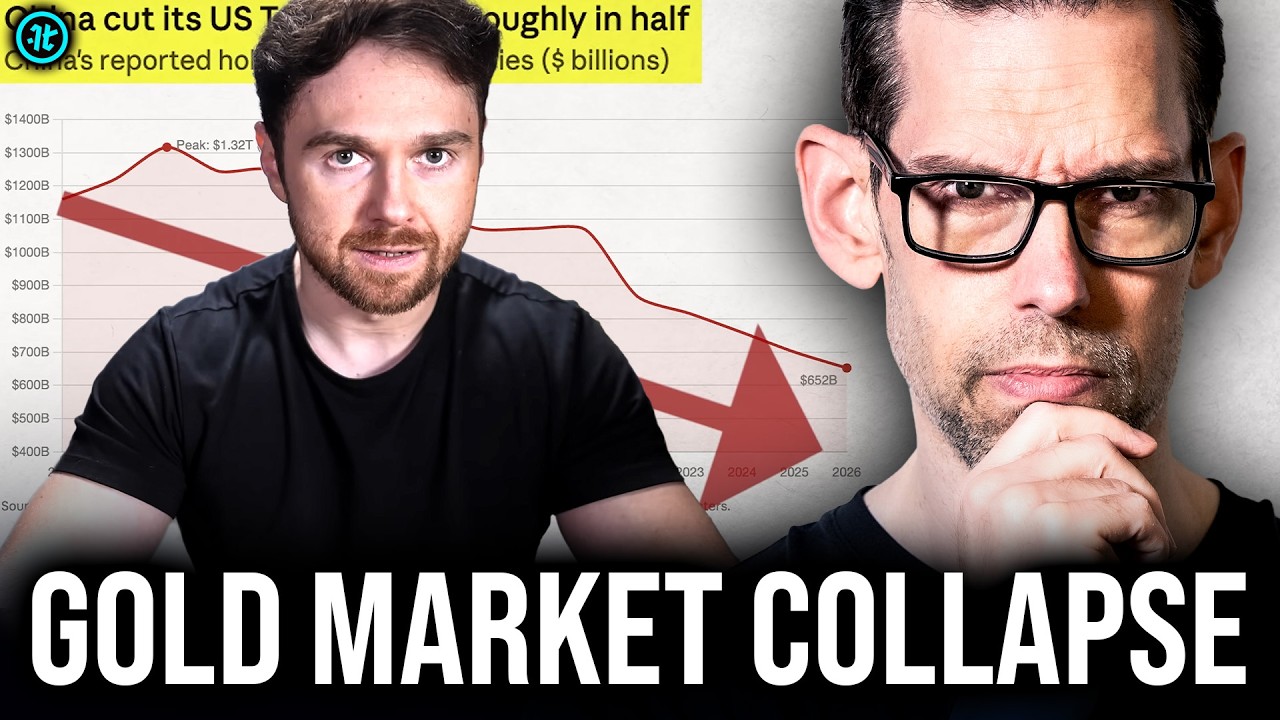
China Says They Shut Down Gold Trading To Protect You — That's Not Why — We Had To React
 101 min
Oil Explodes As Ceasefire Fails, Japan Bond Crisis Threatens US Debt, & Platner Ditched By Dems
 35 min
One Chinese AI Model Wiped Out $1 Trillion In A Single Day — And They're Just Getting Started
Ask anything from this episode.
Save it, chat with it, and connect it to Claude or ChatGPT. Get cited answers from the actual content — and build your own knowledge base of every podcast and video you care about.
Get Started Free