Key Moments
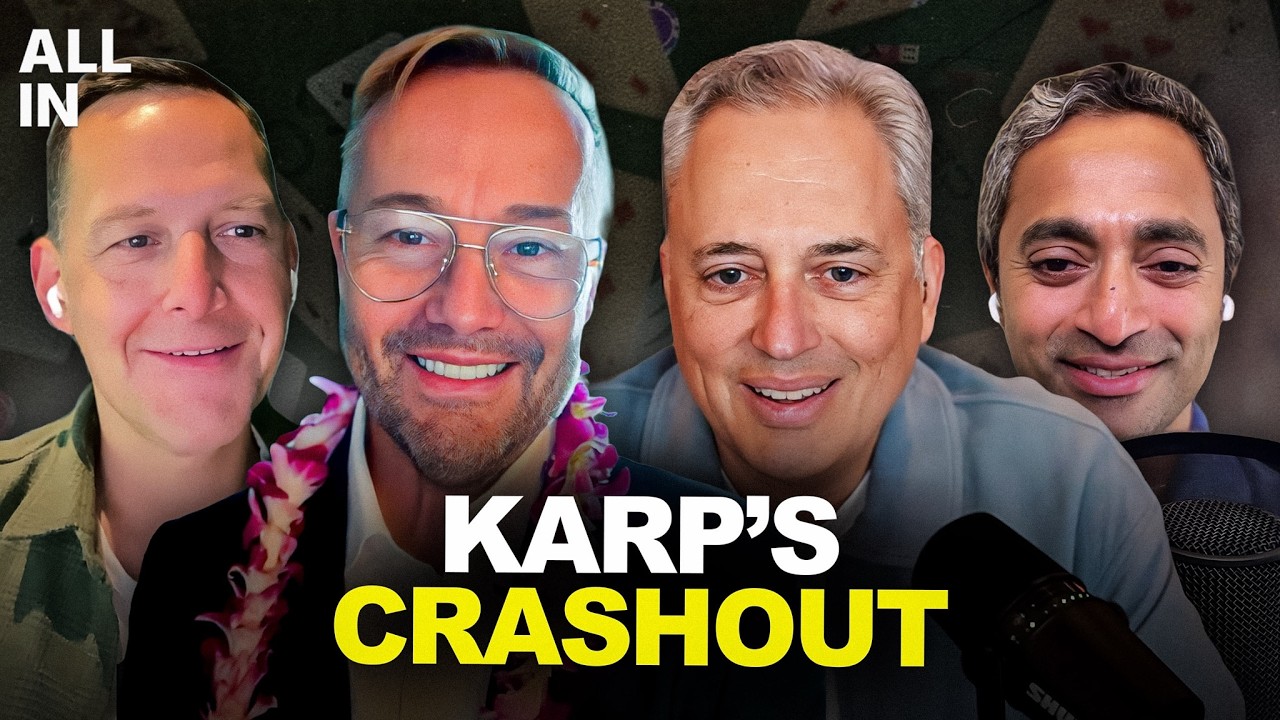
Red-pilled Billionaires, LA Fire Update, Newsom's Price Caps, TikTok Ban, Jobless MBAs
 All-In Podcast
Want to know something specific about what's covered?
We've already dissected every moment. Ask and we will deliver (with timestamps).
Key Moments
Founders discuss 'red-pilling', LA fires, TikTok ban, MBA hiring, and UFOs.
Key Insights
Mark Pincus shares his 'red-pilled' journey, emphasizing media distrust and authenticity in political views.
The LA wildfires reveal significant damage and spark debate on government intervention vs. free market in rebuilding.
A potential TikTok ban highlights national security concerns versus free speech and potential market repercussions.
A downturn in MBA hiring suggests a shift away from traditional career paths towards startups and riskier ventures.
The discussion on UFOs/UAPs explores curiosity about unexplained phenomena and potential technological breakthroughs.
Congestion pricing in NYC is presented as a successful measure to alleviate urban traffic and pollution.
MARK PINCUS'S POLITICAL EVOLUTION AND THE QUEST FOR AUTHENTICITY
Mark Pincus details his personal shift in political perspective, often referred to as being 'red-pilled.' This transformation began with questioning mainstream media narratives, particularly concerning portrayals of figures like Trump. Pincus highlights specific instances where he felt information was misrepresented, leading him to seek primary sources and re-evaluate his beliefs. This journey also involved personal reflection on authenticity, particularly after parting ways with his chief of staff, which allowed him to express his thoughts more freely on platforms like Twitter, connecting him with a new audience.
POLEMICS ON POLITICAL DIFFERENCES AND MAINTAINING RELATIONSHIPS
The podcast delves into the challenges of maintaining friendships amidst stark political disagreements, particularly referencing the dynamic between Mark Pincus and his friend Reed Hastings. Despite their opposing views in the last election cycle, their ability to communicate openly and respectfully, focusing on shared principles rather than political stances, is presented as a model for constructive dialogue. This conversation suggests that personal relationships can endure even significant ideological divides if a foundation of mutual respect and understanding is maintained.
LA WILDFIRES: REBUILDING EFFORTS AND ECONOMIC INTERVENTIONS
The severe wildfires in Los Angeles, causing extensive structural damage and displacement, become a focal point for discussing the complexities of disaster recovery. Governor Newsom's executive orders, including a ban on unsolicited offers to homeowners and a 90-day freeze on escalating prices for essential goods and services, are debated. While intended to protect vulnerable residents, concerns are raised that these price controls and regulatory hurdles could stifle the free market, deter necessary labor and materials, and ultimately slow the rebuilding process.
THE CONGESTION PRICING DEBATE AND THE FUTURE OF CITIES
New York City's implementation of congestion pricing is highlighted as a potentially successful model for managing urban traffic and pollution. The system charges drivers entering Manhattan during peak hours, with revenues directed towards public transportation improvements. This leads to a broader discussion on the decline of major cities, with San Francisco cited as an example suffering from poor management, crime, and a loss of its former appeal. The need for cities to innovate aggressively and attract residents by offering genuine value is emphasized.
TIKTOK BAN AND THE GEOPOLITICAL IMPLICATIONS OF TECH PLATFORMS
The potential ban on TikTok in the United States brings national security and data privacy concerns to the forefront. Arguments center on whether TikTok, owned by a Chinese company, poses a risk of state-sponsored spying and censorship, especially given the lack of reciprocal rights for US companies in China. The debate also addresses the unintended consequences, such as alienating a significant user base and potentially driving them to other, possibly less secure, platforms, while acknowledging the advanced technology developed by ByteDance.
THE MBA HIRING DOWNTURN AND THE FUTURE OF HIGHER EDUCATION
A notable decrease in MBA hiring from top business schools is discussed as a possible indicator of a broader shift in the economy and career aspirations. The traditional appeal of an MBA as a risk-reduction tool, guaranteeing high salaries and stable careers, is questioned in an era of AI, automation, and the rise of startups. The conversation suggests that the emphasis is moving towards skills-based learning, apprenticeships, and direct experience, potentially devaluing traditional higher education pathways and leading to a re-evaluation of the MBA's practical utility.
THE RISE OF AI AND ITS IMPACT ON MIDDLE MANAGEMENT AND EDUCATION
The increasing capabilities of AI are seen as a direct threat to middle management roles, which are often seen as administrative buffers. As AI systems become more sophisticated in decision-making and data analysis, the need for human oversight in these layers diminishes. This trend is linked to the decline in MBA hiring, as the skills that previously protected graduates from career volatility are becoming obsolete. The potential for AI to revolutionize research, education, and creative processes is explored, suggesting a future where personalized, self-directed learning is paramount.
UFOs AND UAPS: EXPLORING THE UNKNOWN AND THE LIMITS OF PHYSICS
The podcast touches upon the subject of Unidentified Aerial Phenomena (UAPs) and UFOs, with a guest sharing a personal anecdote about a former DOD contractor claiming to have encountered and classified such phenomena during war game simulations. While not explicitly endorsing belief, there is an expressed curiosity about the possibility of phenomena that challenge current understandings of physics. The discussion includes the Fermi Paradox and the intriguing possibility that advanced civilizations may have already visited Earth or that humanity is unique in its current stage of development.
Mentioned in This Episode
●Software & Apps
●Companies
●Organizations
●Books
●Drugs & Medications
●Concepts
●People Referenced
Common Questions
Mark Pincus's 'red pill' moment began in early 2023 when he started questioning mainstream media after reading Pirate Wires. It solidified in May 2024 after he watched a video of Trump's Charlottesville speech, realizing the media and politicians had misrepresented Trump's remarks. This led him to distrust mainstream narratives and openly support Trump.
Topics
Mentioned in this video
Sultan of Science, co-host of the All-In podcast, living a modern 1950s aesthetic lifestyle.
Chairman Dictator and co-host of the All-In podcast, recently in Florida for poker and family, anticipating a 'victory lap' related to political outcomes.
An oldest friend of the host, early investor in social media, founder of Zynga, and describes his 'red pill' moment transitioning political views.
An early investor, along with Reed Hoffman and Mark Pincus, in the first round of Facebook.
Cited as an example of a high-profile individual who was targeted by sophisticated state-sponsored attacks on his phone.
Cheif scientist or Nobel Prize winner for creation of the world's first nuclear reactor, Referenced for Fermi's Paradox, which questions the absence of evidence for extraterrestrial life.
Calling for a delay in the TikTok ban, suggesting a deal will likely be worked out to keep TikTok active in the US.
American far-right radio show host and conspiracy theorist, sarcastically mentioned in the context of being sympathetic to UFO stories.
A comedian/actor, envisioned by Mark Pincus as a potential narrator for a funny Netflix docuseries on UAPs.
A vocal political figure whose views diverged from Mark Pincus's 'red pill' moment.
Mark Pincus became vocal in his support for Trump after his 'red pill' moment, questioning mainstream media narratives, and believes Trump will be in office.
Mark Pincus and Reed Hoffman had lunch with Biden and wrote big checks a little over a year ago. Pincus shared observations about Biden's demeanor during a two-hour lunch.
A writer for PirateWires whose articles initially seemed 'a little crazy' to Mark Pincus but later proved to be early indicators of truth, contributing to Pincus's 'red pill' moment.
Referenced for his 'transformation' or 'more authentic self' public presentation, which Mark Pincus relates to, noting the shift towards authenticity in public figures.
Portrayed as the first to directly defend himself on Twitter, firing his PR team and engaging in long diatribes against negative press, which Mark Pincus notes 'worked'.
CEO of JP Morgan Chase, used as a comparative standard for mental acuity during discussions about President Biden's performance.
LA Mayor, criticized for alleged incompetence, creating a 'snitch hotline' for price gouging, and being out of the country during the LA fires, leading to calls for her recall.
California Governor, criticized for incompetent leadership, enacting executive orders on price gouging and unsolicited offers after the LA fires, and failing to address the state's issues effectively.
Former DA of San Francisco, whose recall by David Sacks and others is cited as an example of citizens' power to remove unqualified officials.
Successfully built the Pacific Palisades Village and deployed private resources (water trucks, firefighters) to protect it during the fires, contrasting with official response.
Republican entrepreneur and venture capitalist who started the recall movement against Chesa Boudin in San Francisco.
Mentioned as a location Chamath Palihapitiya was not at, despite being in Florida.
Site of a Trump speech that Mark Pincus investigated, finding that media had misrepresented Trump's comments, a key part of his 'red pill' moment.
Referenced by Governor Newsom as a place where people were taken advantage of after a disaster, used to justify his executive order on unsolicited real estate offers in LA.
Where LA Mayor Karen Bass was reportedly 'partying' and taking meetings during the Los Angeles fires, drawing criticism from the hosts.
Mark Pincus was an early investor in Facebook, and also was involved in buying patents that could have blocked the social media industry.
Mark Pincus's first social media investment, sending the initial $100,000 check.
Mentioned as a company that Mark Pincus and Reed Hoffman were worried could acquire the Six Degrees patents and block the social media industry.
Parent company of TikTok, facing a divestment deadline or a ban in the US due to national security concerns. Acknowledged for its technically talented employees and innovative algorithms.
A video social media app facing a potential ban in the US unless its parent company divests, due to national security concerns about Chinese spyware and influence.
Referenced as a company where Stanford students desire jobs. Also mentioned in the context of Deep Research, a product for generating reports.
TikTok's cloud provider, which would have to stop hosting services if the ban goes into effect.
Proposed as a potential home for TikTok's video content and creator graph if TikTok is banned, offering a safer American-governed platform.
Mentioned as an app that Pegasus spyware was able to attack, leading to state-sponsored attacks on phones.
A Chinese tech stock that Chamath Palihapitiya has been investing in, betting on a grand deal between the US and China.
A startup accelerator mentioned as a potential source of interesting jobs for MBAs, where they could join a founding team as a business person.
A consulting firm mentioned as a common destination for MBAs, now facing challenges due to AI's ability to perform research tasks.
Mark Pincus was an early investor in LinkedIn.
Mentioned as a company where Stanford students desire jobs, but which are becoming harder to get due to companies trying to get rid of middle management.
Mark Pincus was an early investor in Twitter.
Owns half of the Six Degrees patents, the other half owned by Mark Pincus.
Mentioned in the context of Elon Musk's early use of Twitter to correct stories after his time at PayPal.
A company tied to Elon Musk, where a negative New York Times report caused him to defend himself aggressively on Twitter.
One of the companies that would be forced to remove TikTok from its app stores if the ban goes through.
Reed Hoffman and Mark Pincus put the first money into Friendster, and later were concerned about it acquiring patents.
An AI tool with advanced voice capabilities, used as a 'personal tutor' to learn about various topics, suggesting a future where AI destroys the value of higher education.
An incredible paper describing TikTok's real-time, collisionless recommendation algorithm, showcasing the technical talent within ByteDance.
Spyware capable of reverse engineering and building imperceptible penetration attacks into apps like WhatsApp.
A Google product capable of generating million-dollar quality reports and updating them automatically, disrupting the consulting industry and MBA job market.
Mentioned as the platform where Deep Research can automatically refresh and update research reports.
AI software (Grok 2.0) that performs similar research to Deep Research, crawling web pages, asking follow-up questions, and citing sources, including tweets.
National Security Agency, likely briefed Congress on TikTok's security violations, leading to bipartisan support for the ban.
TikTok's only hope for blocking the ban, although arguments heard by Chamath Palihapitiya were not compelling for overturning the ban.
The Federal Bureau of Investigation, mentioned as the agency to call when dealing with state-sponsored phone attacks.
Mark Pincus's alma mater, where he observed a shift in student career expectations, moving from guaranteed high salaries to less certainty.
Referenced as a top business school experiencing a recent spike in MBA unemployment.
A consulting firm where many MBAs typically seek jobs, but which are now less accessible due to companies reducing middle management.
A documentary made by a friend of Mark Pincus, who later approached Pincus about a docuseries on UAPs.
Featured Mark Pincus on its front page after he publicly endorsed Trump two days before the election.
Mentioned in the context of reporting on Ukrainian soldiers with swastikas, initially dismissed by Mark Pincus, and later for misrepresenting Trump's Charlottesville speech.
Mark Pincus teaches a class at Stanford, observing shifts in student pronouns and feeling 'unshackled' to be his authentic self.
Federal Emergency Management Agency, which assesses disaster risk across the United States, showing growing risk on the Western Seaboard.
More from All-In Podcast
View all 430 summaries 103 min
More Trillion Dollar IPOs, Anthropic $3T, Zuck's Price War, China Ends Open Source?, Trump Accounts
 64 min
Open Source Wins, AGI Is Here, and Scorsese’s AI Toolkit with CEOs of Cerebras & Black Forest Labs
 103 min
AI Sovereignty Wars, Palantir-Nvidia Deal, SCOTUS Birthright Ruling, Newsom’s CA Budget Lie
 61 min
Nate Silver Predicts: Democrats Take the House, Newsom Is Fading & AOC Might Win It All in 2028
Ask anything from this episode.
Save it, chat with it, and connect it to Claude or ChatGPT. Get cited answers from the actual content — and build your own knowledge base of every podcast and video you care about.
Get Started Free