Key Moments
Matthew McConaughey and Aisha Tyler — The Tim Ferriss Show
 Tim Ferriss
Want to know something specific about what's covered?
We've already dissected every moment. Ask and we will deliver (with timestamps).
Key Moments
Celebrating 10 years and 1B downloads, Tim Ferriss highlights key lessons from McConaughey and Tyler.
Key Insights
Matthew McConaughey's pivotal moment: A book and his father's words inspired his acting career, emphasizing 'don't half-ass it.'
Aisha Tyler's "self-inflicted wounds" philosophy: embraces failure as a path to success, stressing the importance of starting and taking risks.
The power of saying "no": McConaughey's career pivot by rejecting romantic comedies led to more challenging, fulfilling roles.
Value of journaling: McConaughey uses his diary to track both successes and failures, identifying patterns for personal growth.
The art of going "downhill": McConaughey learned to enjoy success and not self-sabotage, knowing challenges will inevitably come.
Creative pursuit through adversity: Tyler's filmmaking journey demonstrates leveraging limited resources and embracing discomfort to achieve artistic goals.
MCCONAUGHEY'S FOUNDATIONAL LESSONS AND CAREER SHIFT
Matthew McConaughey recounts two pivotal childhood lessons: his parents' emphasis on resilience (marrying three times despite two divorces) and the prohibition of saying "I can't," which his father rephrased as "you're just having trouble." These principles instilled a drive to overcome obstacles and seek assistance when needed. His career path took a dramatic turn during college when he stumbled upon 'The Greatest Salesman in the World,' a book that provided the confidence to pursue film school instead of law. This decision was solidified by his father's approving words, 'Don't half-ass it,' a mantra that has guided his professional and personal life.
JOURNALING, GOALS, AND THE "ART OF RUNNING DOWNHILL"
McConaughey emphasizes the profound impact of his 35-year journaling habit. Initially a tool for processing distress, he intentionally shifted to documenting successes, finding patterns that helped him navigate future challenges. He revealed a list of ten life goals from 1992, including winning an Oscar and 'just keep living,' which he discovered he had subconsciously pursued and largely achieved. He also discusses the 'art of running downhill,' learning to embrace periods of effortless success without self-sabotage, recognizing that uphill battles are inevitable. His father's passing further solidified this perspective, flattening his view of the world and inspiring him to take more risks.
THE STRATEGIC "NO" AND CAREER UNBRANDING
Around 12-13 years prior to the interview, McConaughey made a deliberate decision to stop starring in romantic comedies, despite their financial security. He felt his work lacked vitality compared to his personal life, prompting him to seek more challenging roles. This "strategic no" initially led to a 20-month drought, which he and his wife, Camila, termed a "desert." During this period, substantial offers for rom-coms were rejected, signaling to Hollywood his serious commitment to rebranding. This extended absence, or "unbranding," allowed him to re-emerge as a "new good idea" and attract the dramatic roles that eventually led to critical acclaim, including 'Dallas Buyers Club' and 'True Detective.' He prioritized experiential roles over monetary gain.
AISHA TYLER'S PHILOSOPHY ON RISK AND FAILURE
Aisha Tyler's career journey is defined by her embrace of risk and failure, a concept central to her 'Self-Inflicted Wounds' segment and book. She believes that success often stems from actively engaging with and learning from mistakes, rather than avoiding them. Tyler's father played a significant role in shaping this mindset, instilling a 'walk it off' attitude that discouraged self-pity and encouraged self-sufficiency. This upbringing, coupled with her naturally optimistic disposition, taught her to view challenges as opportunities for growth and to prioritize effort and engagement over predetermined outcomes. She stresses that regret from inaction is more detrimental than failure from trying.
THE GRIT OF EARLY COMEDY AND “PRACTICAL TACTICAL” FILMMAKING
Tyler recounts the intense and competitive environment of early 90s stand-up comedy, describing how she would drive long distances to obscure venues to secure vital stage time. She emphasizes that consistent practice, even with little initial success, is crucial for honing one's craft. Her transition into filmmaking was equally 'practical tactical,' starting with short films and music videos, often self-funded and utilizing existing production crews from her television work. These early projects, like her first "abomination" of a short film, were essential learning experiences, teaching her about framing, editing, and articulating her vision, even when resources were scarce.
INNOVATION THROUGH DISCOMFORT AND "AXIS" AS A CASE STUDY
Tyler actively seeks discomfort and new challenges to avoid complacency. Her directorial debut, 'Axis,' a thriller shot in real-time within a car, exemplifies this approach. Facing traditional Hollywood's risk aversion, she crowdfunded the film for $200,000, embracing an aggressive 7-day shooting schedule. This intense process, while terrifying, fostered creativity and decisiveness, forcing her and her team to pivot constantly and learn on the fly. 'Axis' became a testament to what can be achieved with limited resources, a strong vision, and a willingness to operate outside conventional systems. The film's success, including awards and distribution, validated her 'aggressive' artistic philosophy.
WORKAHOLISM, SELF-ACCEPTANCE, AND THE POWER OF AUTHENTICITY
Tyler candidly admits to being a "pathological workaholic," constantly battling the urge for rest while fearing that overwork could stifle her creativity. She endeavors to apply the same aggression she uses in work to leisure, scheduling social engagement and rest time to maintain a balanced life. She believes that true artistic success comes from authenticity, from telling stories that are uniquely personal and truthful, rather than emulating others or chasing popular trends. Her work, like the advice she's given, is rooted in the conviction that the most impactful art is that which is genuine, even if it means initially limiting one's audience or taking an unconventional path.
REDEFINING SUCCESS AND EMBRACING THE UNCROWDED MARKET OF 'GREAT'
Both McConaughey and Tyler advocate for redefining success beyond external validation. McConaughey's acceptance of his father's passing led to a more courageous approach to life, while Tyler's experiences in a contracting comedy market taught her to cultivate her unique voice. They agree that true innovation and the most rewarding artistic endeavors arise when one is willing to, as the saying goes, 'be aggressively authentic.' This means challenging conventional wisdom, embracing the discomfort of the unknown, and understanding that the 'uncrowded market' is always 'great.' Ultimately, their stories underscore that personal growth and impactful creation stem from a willingness to take risks, learn from failures, and remain true to oneself.
Mentioned in This Episode
●Supplements
●Products
●Software & Apps
●Companies
●Organizations
●Books
●People Referenced
Common Questions
Matthew McConaughey credits 'The Greatest Salesman in the World' by Og Mandino as the most instrumental piece of literature in his life. Reading it during college gave him the confidence to change his career path from law to film, even against initial expectations.
Topics
Mentioned in this video
A TV show Aisha Tyler watches during her workouts.
A comedy show that was popular when Aisha Tyler started stand-up, representing a specific style of black comedy.
A TV show Aisha Tyler watches during her workouts.
A film mentioned as an example of an incredible creation with interesting origin stories.
A show Aisha Tyler recently watched on streaming services.
A documentary about a failed attempt to make a movie about 'Dune', highlighting learning from disaster.
The film that brought Matthew McConaughey major fame very quickly in 1996.
A CW's top-rated improv show Aisha Tyler hosts.
A show Aisha Tyler watches on streaming services during her workouts.
A thriller film directed by Aisha Tyler, crowdfunded, and shot in real-time in a car.
A podcast hosted by Aisha Tyler where she interviewed Tim Ferriss, contributing to his decision to start his own podcast.
A TV show Aisha Tyler watches during her workouts.
A show where Aisha Tyler shadowed in Ireland to learn about directing.
A hit television show Aisha Tyler stars in.
A channel that documented Matthew McConaughey's lifestyle in Malibu.
A film Matthew McConaughey starred in early in his career.
A movie mentioned by Tim Ferriss where Eric Bana trains his daughter.
Author of the quote 'Everything you want is on the other side of fear'.
A comedian mentioned as coming out of the alternative comedy movement in San Francisco.
Director of 'Dazed and Confused' who gave Matthew McConaughey a role that wasn't originally scripted.
Matthew McConaughey's agent at CAA who supported his decision to stop doing romantic comedies.
A comedian mentioned as coming out of the alternative comedy movement in San Francisco.
A friend of Matthew McConaughey who encouraged him to consider a career in storytelling.
The creator of the show 'Penny Dreadful', who invited Aisha Tyler to visit the set in Ireland.
Star of Criminal Minds, comedian, host of Whose Line Is It Anyway, award-winning director, best-selling author, activist, and co-founder of the premium Margarita brand Loop.
A writer mentioned by Tim Ferriss.
An actor from whom Matthew McConaughey took the baton as "romcom go-to guy".
Actor in 'What About Bob?'.
A lawyer who advised Matthew McConaughey about the 'non-deserving complex' that can affect successful people from humble beginnings.
A comedian mentioned as coming out of the alternative comedy movement in San Francisco.
Actor mentioned in the context of the movie Hannah.
Casting director for Dazed and Confused who Matthew McConaughey met at a bar, leading to his first acting role.
A famous, disciplined writer and comedian mentioned for his consistent writing habits.
A comedian who performed stand-up in strip clubs early in her career.
Creative musician who said that in order to create art, one must have a life.
A comedy club in San Francisco, still active, where a famous heckling incident involving a guitar comedian occurred.
A band Aisha Tyler spent a day with to create a music video, gaining directing experience.
Where Matthew McConaughey's friend Rob Bendler studied.
Element is their exclusive hydration partner.
A comedy club in San Francisco, still active.
Creative Artists Agency, where Matthew McConaughey's agent Jim Toth worked.
A band Aisha Tyler went on tour with to create a music video for them, gaining directing experience.
More from Tim Ferriss
View all 705 summaries 108 min
The Random Show — AI Super Assistants, Dream Engineering, Wizards, Supplements, and More!
 121 min
How to Legalize Medical Psychedelics in Your Country — Tania de Jong on Australia’s Breakthrough
 70 min
Q&A with Tim — The Art of Male Friendship, Reinvention in The Age of AI, & More
 125 min
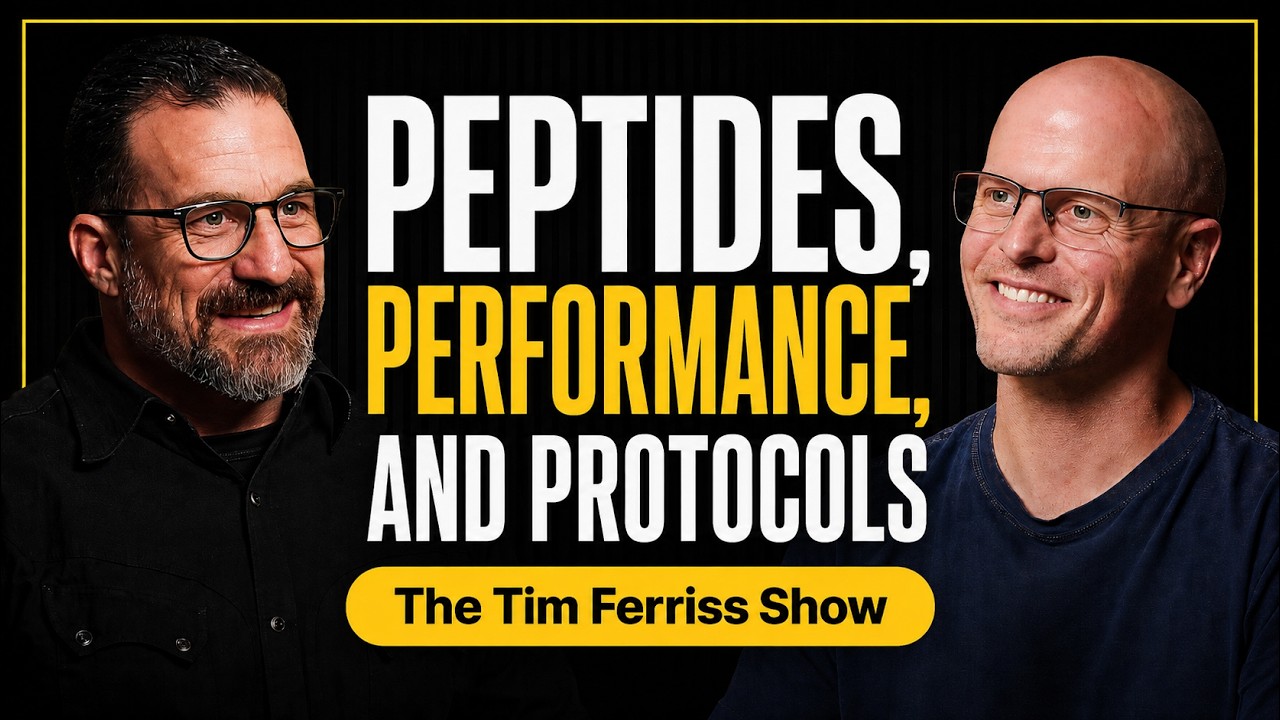
Dr. Andrew Huberman — Peptides, Performance, and Protocols
Ask anything from this episode.
Save it, chat with it, and connect it to Claude or ChatGPT. Get cited answers from the actual content — and build your own knowledge base of every podcast and video you care about.
Get Started Free