Key Moments
In conversation with President Trump
 All-In Podcast
Want to know something specific about what's covered?
We've already dissected every moment. Ask and we will deliver (with timestamps).
Key Moments
Trump discusses economy, foreign policy, border, and Ukraine, emphasizing deregulation, tax cuts, and energy independence.
Key Insights
Trump prioritizes deregulation and tax cuts over tariffs to stimulate economic growth.
He advocates for increased domestic energy production, including oil and nuclear power.
Trump expresses a desire for quick peace in Ukraine and opposes sending US troops to the conflict.
He believes the Abraham Accords were a successful peace initiative in the Middle East.
Trump supports states' rights on abortion and opposes a national ban.
He champions recruiting high-skilled immigrants for the US through Green Card incentives for college graduates.
ECONOMIC POLICY: REGULATION AND TAX CUTS
President Trump identified deregulation and tax cuts as his top priorities for stimulating the economy, aiming to lower business taxes further from the 21% achieved during his term. He emphasized that his administration's significant cutting of regulations was more impactful than tax cuts, enabling businesses to build and invest more freely. This approach, he argued, brought foreign capital back into the U.S. and led to record job creation.
ENERGY POLICY AND NATIONAL DEBT
Trump stressed the importance of increasing domestic energy production, particularly oil, to combat inflation and maintain self-sufficiency. He criticized current policies that restrict energy output and suggested that nuclear power, while potentially expensive to build in the U.S., is a necessary component of future energy needs, contrasting it with China's rapid nuclear expansion. Regarding national debt, he believes economic growth and efficiency in government spending, such as returning education funding to states, are key to managing the fiscal imbalance.
FOREIGN POLICY AND INTERNATIONAL RELATIONS
On foreign policy, Trump reiterated his commitment to brokering peace in Ukraine quickly and stated he would not send American troops to the conflict, differentiating the situation for European nations. He believes the war would not have happened under his presidency and attributes its occurrence partly to NATO expansion and inflation in oil prices. He also highlighted the success of the Abraham Accords in the Middle East and expressed concern over Iran's financial resurgence, which he attributes to the current administration's policies.
DOMESTIC ISSUES: BORDER SECURITY AND ABORTION
Trump defended his administration's efforts to build a wall along the U.S. border, criticizing the current administration's policies for creating an open border situation. He plans to secure the border more effectively upon re-election. Regarding abortion, he stated his opposition to a national ban, emphasizing that the issue should be decided at the state level, a position he aligns with his delivery on overturning Roe v. Wade.
RUSSIA, CHINA, AND US-CHINA RELATIONS
Trump suggested that the conflict in Ukraine was partly provoked by discussions of Ukraine joining NATO, a move he believes Russia would always oppose due to proximity. He views the current administration's rhetoric on NATO expansion as inflammatory. Concerning China, he doesn't see war as inevitable, stating he knows President Xi well and believes peaceful competition is possible with the right leadership, criticizing the current president for perceived weakness and conflicts of interest.
GOVERNMENTAL REFORMS AND 'DEEP STATE'
Trump expressed his intention to reduce the size and scope of federal agencies, citing the Department of Education as an example of successful decentralization to states. He also touched upon trust in government institutions and transparency, mentioning his past decision to release JFK files and his skepticism of figures like Dr. Fauci. He believes in dismantling bureaucratic overreach and empowering individuals and states.
IMMIGRATION AND HIGH-SKILLED TALENT
Addressing the tech industry's concerns, Trump promised to implement policies that allow college graduates to obtain Green Cards automatically, enabling them to stay and contribute to the U.S. economy. He believes this would retain top talent, foster innovation, and boost competitiveness, highlighting the loss of brilliant minds to other countries under current policies.
THE POTENTIAL FOR A NATIONAL ABORTION BAN
When questioned about a national abortion ban, Trump clarified that he does not support one, as the issue has been returned to the states. He believes this is the correct legal and moral approach, allowing states to decide based on the will of their voters, and he respects the outcomes of state-level referendums.
FOREIGN POLICY DECISIONS AND THE MIDDLE EAST
Trump recounted that the attack on Israel would not have occurred under his presidency, as Iran was financially constrained and seeking a deal. He regrets that the current administration did not leverage this position. He emphasized his primary goal was preventing Iran from obtaining nuclear weapons and believed a deal was achievable, which would have stabilized the Middle East and potentially included Iran in the Abraham Accords.
CRIME AND LAW ENFORCEMENT IN CITIES
Trump linked rising crime rates in major cities to Democratic leadership and policies such as no-cash bail and restrictions on police. He described phenomena like large-scale retail theft and the securitization of drugstores as indicative of declining quality of life and a breakdown of order, arguing that empowering law enforcement is crucial to reversing these trends.
DE-DOLLARIZATION AND GLOBAL ECONOMIC STANDING
The podcast highlighted concerns about de-dollarization, with countries like Saudi Arabia considering transactions in currencies other than the U.S. dollar. Trump expressed alarm at this trend, viewing it as a significant loss of power for the United States and a potential threat to its economic standing. He believes strong economic policies and tariffs can help maintain U.S. influence.
GOVERNMENT SPENDING AND BUREAUCRATIC EFFICIENCY
Trump identified government inefficiency and wasteful spending as major issues, particularly pointing to the Department of Education as an area for significant reform. His plan involves returning significant responsibilities and funding to the states. He believes this approach will save taxpayer money and improve outcomes across various sectors, including education and environmental regulation, by reducing federal bureaucracy.
CONTROVERSIES AND TRANSPARENCY: JFK FILES AND FAUCI
Trump discussed the release of classified information, including the JFK files, emphasizing a commitment to transparency. He suggested that while he had influences suggesting against releasing all documents, he ultimately supported their disclosure. His skepticism towards figures like Dr. Fauci and his response to questions about government funding of certain research indicated a distrust of established institutions and a belief in greater public access to information.
RECRUITING GLOBAL TALENT AND H-1B VISAS
In response to questions from the tech industry, Trump affirmed his support for increasing opportunities for highly skilled workers. He advocated for granting Green Cards to graduates of American universities, aiming to retain top talent and foster innovation. This policy is intended to bolster U.S. competitiveness and prevent the loss of brilliant minds to other nations.
Mentioned in This Episode
●Software & Apps
●Companies
●Organizations
●Books
●Concepts
●People Referenced
President Trump's Policy Priorities: Key Takeaways
Practical takeaways from this episode
Do This
Avoid This
Common Questions
Donald Trump's top priorities would include reducing regulation and taxes, cutting government spending, and re-energizing the economy. He emphasizes deregulation as being more impactful than tax cuts for fostering business growth.
Topics
Mentioned in this video
One of the hosts of the All-In podcast who participated in the conversation and asked questions.
Economist whose tweet about stagflation caused by tax cuts and tariffs was discussed. Trump respects his economic insights.
Former Speaker of the House. Trump references a past debate where Biden 'destroyed' Ryan, suggesting Biden should not be underestimated.
Former FBI Deputy Director, mentioned as someone Trump fired.
The guest on the podcast, discussing his past policies, potential future plans, and views on various domestic and foreign policy issues.
Mentioned as a group that Iran allegedly funded, contributing to the October 7th attack.
President of China, whom Trump claims to know well. Trump attributes the spread of COVID-19 to China and expresses concerns about US-China relations under Biden.
Former NIAID director. Trump expresses distrust, stating he didn't rely on Fauci and overrode him on travel restrictions from China. Discussion around funding gain-of-function research is also mentioned.
North Korean leader. Trump mentions solving the nuclear problem and engaging with him, highlighting a moment of step-over into the DMZ as a diplomatic tactic.
Mentioned for advocating for abortion even after birth, which Trump labels as radical.
Current US President. Trump repeatedly criticizes Biden's policies on the economy, energy, immigration, and foreign affairs, accusing him of weakness and incompetence.
Cited as an example of a city experiencing crime waves and a declining quality of life.
Mentioned as a country willing to use currencies other than the dollar, indicating a shift in global financial dynamics.
Mentioned in relation to the conflict in Ukraine and its perceived actions against Ukraine.
Referenced for its state-level referendum on abortion, which Trump noted was more liberal than some expected.
Referenced for its state-level referendum on abortion, which Trump noted was more liberal than some expected.
Mentioned as an example of a Democrat-run city facing issues with crime, particularly in retail and drugstores, and high taxes.
Cited as an example of a Democrat-run city experiencing high crime and declining quality of life.
Discussed in terms of trade, economic competition, AI electricity needs, and nuclear reactor construction. Trump expressed distrust due to COVID-19 origins.
Discussed extensively in the context of the ongoing war, its causes (NATO expansion), US aid, and potential peace deals. Trump stated it would not have happened under his presidency.
Discussed in the context of its financial state before the October 7th attack, its potential to acquire nuclear weapons, and its role in funding terrorist groups. Trump claims the attack would not have happened if he were president.
Referenced for its state-level referendum on abortion, which Trump noted had a different outcome than in Ohio or Kansas.
Mentioned in the context of trade deficits and reciprocal trade policies.
Mentioned as a group that Iran allegedly funded, contributing to the October 7th attack.
Expansion of NATO, particularly regarding Ukraine, is discussed as a primary cause of the war. Trump suggests taking expansion off the table for peace.
Mentioned as the potential origin of COVID-19, with Trump suggesting it escaped from the lab.
Trump criticizes WHO for its handling of COVID-19 and its financial reliance on China compared to the US, detailing his decision to withdraw and subsequent return.
Mentioned in the context of the JFK files, with Trump suggesting they were likely behind the push not to release all documents.
Former FBI Director James Comey, whom Trump fired, is described as 'terrible'.
Mentioned as one of the top schools from which graduates should automatically be eligible for a green card.
The current US presidential administration, which Trump criticizes for its impact on businesses, economy, and crime.
Mentioned as the body that overturned Roe v. Wade, with Trump emphasizing his role in appointing three justices.
Mentioned as one of the top schools from which graduates should automatically be eligible for a green card.
The overturning of Roe v. Wade is highlighted as a fulfilled promise to Trump's base, achieved through Supreme Court appointments, and is now a states' rights issue.
Trump highlights pulling out of the Paris Accord as a move to protect US economic interests from unfair financial burdens.
Trump's tax cuts are compared favorably to the Reagan tax cuts, which he claims were the biggest in history.
Mentioned as an example of escalating infrastructure repair costs compared to construction costs decades prior and to China's high-speed rail projects.
Mentioned in the intro as something the fans have 'gone crazy with', likely referring to AI or a related product associated with the SpaceX hosts.
More from All-In Podcast
View all 442 summaries 91 min
Dario Defends Himself, Datacenter Panic, AI Doomer Trap, Senate Toss-Up
 56 min
Mass Surveillance, Police Misuse, and Who Controls Your Flock Cameras with Flock CEO, Garret Langley
 100 min
Anthropic's $2T IPO, Zuck's AI Manifesto, Nvidia's $500B AI Bet, Grok's Comeback
 72 min
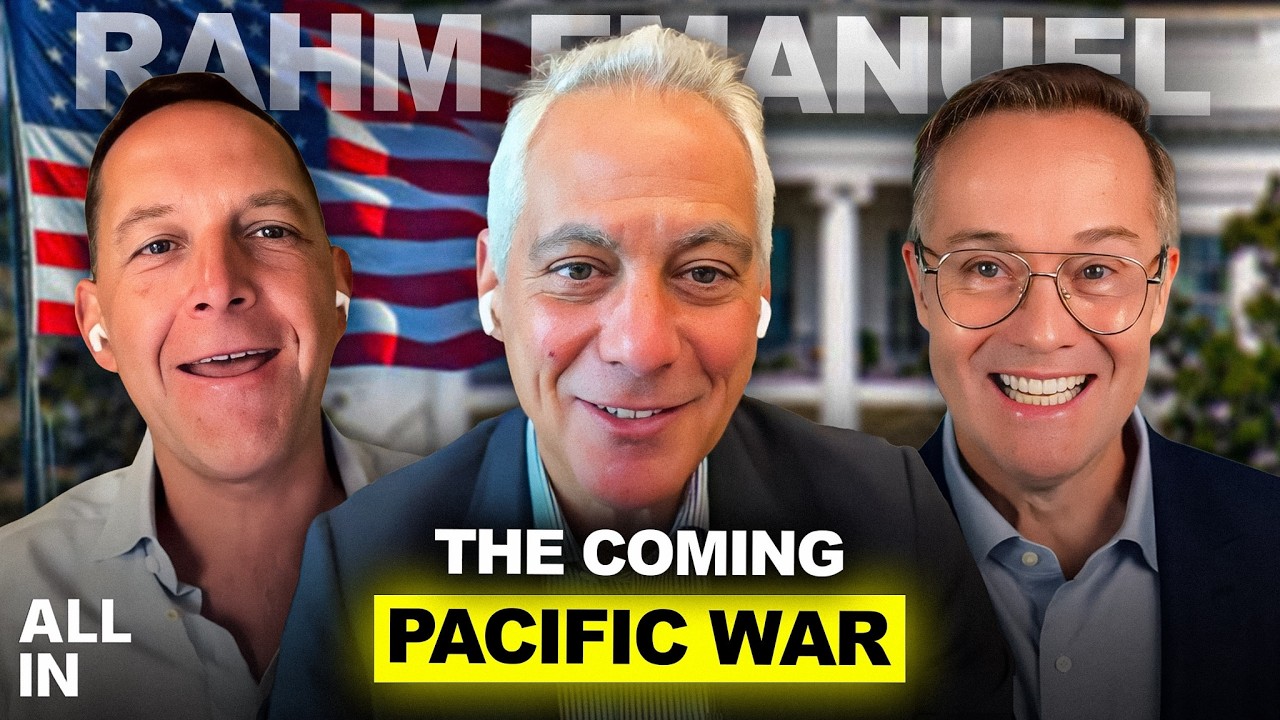
Rahm Emanuel: Trump's Foreign Policy, China, Europe's Decline, Immigration & DSA vs Democrats
Ask anything from this episode.
Save it, chat with it, and connect it to Claude or ChatGPT. Get cited answers from the actual content — and build your own knowledge base of every podcast and video you care about.
Get Started Free