Key Moments
Anthropic's $2T IPO, Zuck's AI Manifesto, Nvidia's $500B AI Bet, Grok's Comeback
 All-In Podcast
Want to know something specific about what's covered?
We've already dissected every moment. Ask and we will deliver (with timestamps).
Key Moments
Anthropic is reportedly targeting a $2T IPO on exceptional revenue growth, but its market share is threatened by open-source models and competitors like Grok, raising questions about long-term sustainability.
Key Insights
Anthropic is reportedly targeting a $2 trillion IPO with an annualized revenue run rate expected between $100 billion and $120 billion by the end of the year, representing a 10x year-over-year revenue growth.
Mark Zuckerberg's manifesto advocates for a positive AI future through open-source models, free agents for everyone, and decentralized AI, contrasting with a centralized power structure.
Nvidia is partnering with financial giants like Goldman Sachs and BlackRock to raise $500 billion in AI compute financing, treating GPUs as a financable asset class.
Despite its rapid growth, Anthropic is reportedly losing market share on a percentage basis to OpenAI, open-source models, and Grok, though the overall AI market is expanding significantly.
The debate around AI safety and control highlights a fundamental difference between entities like Anthropic (believing the technology is too dangerous to distribute) and figures like Zuckerberg and Elon Musk (believing it's too dangerous to centralize).
The New Jersey and New York AGs are suing Amazon over its use of subcontracted drivers (DSPs), arguing it's a way to shield itself from accountability and labor obligations, a move that could increase delivery costs.
Anthropic's ambitious IPO plans amid rapid growth and competitive pressure
The discussion opens with breaking news about Anthropic reportedly targeting a staggering $2 trillion IPO, a valuation that would surpass SpaceX's record. This ambition is fueled by an extraordinary revenue ramp, with an annualized run rate projected to reach between $100 billion and $120 billion by year-end, marking a tenfold increase year-over-year. This growth is unprecedented in Silicon Valley, with Anthropic reportedly achieving this 10x growth for the past three consecutive years. However, despite this phenomenal expansion, there's a nuanced view that Anthropic might be losing market share on a percentage basis to competitors like OpenAI, open-source models, and Elon Musk's Grok. The argument is that the overall AI pie is growing so rapidly that even a shrinking market share translates to significant absolute growth. The acquisition of AI startup DART for $6 billion, focused on improving chip efficiency for AI training and inference, is seen as a move to further solidify their position. A key point of discussion is whether this revenue growth can be sustained, especially as other players become more effective at capturing market share. The potential for Anthropic to reach a trillion dollars in Annual Recurring Revenue (ARR) by the end of next year, if current growth rates continue, highlights the immense demand but also raises questions about physical constraints like compute and energy.
Zuckerberg's open-source manifesto and the decentralization of AI
Mark Zuckerberg's 6,500-word essay, 'The future is for everyone,' is presented as a significant pivot, aligning Meta with an open-source AI future. He champions the idea of providing free, open-source models, creating an agent for every individual, and offering universal access to AI tutors, embodying an 'abundance' philosophy. Zuckerberg directly challenges the prevailing 'doomer' narrative, particularly from entities like Anthropic and the effective altruism movement, questioning why they are so eager to build a future they deem dystopian. He posits that extreme concentration of power in AI is inherently problematic and historically leads to negative outcomes, advocating instead for decentralization and a balance of power. This aligns with the 'All-In' podcast's consistent theme of supporting decentralized outcomes and open models, contrasting with a centralized, controlled AI future. Zuckerberg's direct engagement on platforms like X, writing his own missives, is also highlighted as a mature and powerful way for leaders to communicate their vision directly.
The critical role of infrastructure and energy in AI's exponential growth
The conversation delves into the significant supply-side constraints for AI, particularly focusing on the physical infrastructure required for data centers. Building these centers is described as a monumental task involving orchestrating thousands of people in remote, challenging environments, dealing with 'atoms, not bits.' The discussion touches upon the bottleneck of turbine blades for power generation, with a notable increase in production capacity and a shift towards utilizing repurposed jet engines for turbines to power data centers, illustrating capitalism's ability to innovate under demand. Companies like Caterpillar, Cummins, and Siemens Energy are all expanding capacity. Political and regulatory hurdles, such as Texas's proposed energy audit, are mentioned as potential slowdowns. The narrative around data center water usage is debunked as a hoax, with emphasis on recirculating water and the revitalizing economic impact data centers have on small towns. The crucial role of natural gas in powering new data centers in the short term is acknowledged, though solar and other clean energy sources are seen as future solutions. The sheer energy efficiency of human brains is contrasted with the power demands of AI, suggesting a long-term need for sustainable energy solutions.
Grok's rapid ascent and the challenge to AI frontier labs
Elon Musk's XAI is making significant strides, with the launch of Grok 4.6, which benchmarks suggest is competitive with or even superior to leading frontier models like Claude Opus and Fable 5, at a lower cost. This is seen as a disruptive force in the AI market, challenging the perceived duopoly of Anthropic and OpenAI. The rapid improvement is attributed to Musk bringing in 'aces' from SpaceX and reshuffling XAI's management, alongside acquisitions like Cursor. Grok 4.7, a larger and potentially more capable model, is expected soon. Grokbot, designed for personalization and democratization of AI, is also highlighted as a key development, mirroring Zuckerberg's vision of AI agents for everyone. This surge in performance and affordability positions Grok as a serious contender, potentially altering the competitive landscape and creating tension for established players like Anthropic, especially given Musk's ability to leverage SpaceX's vast compute infrastructure.
Nvidia's $500 billion financing play and the securitization of AI compute
Nvidia is revolutionizing AI infrastructure financing by partnering with major financial institutions like Goldman Sachs and BlackRock to raise $500 billion. The initiative treats Nvidia's GPU compute as a financable asset class, similar to mortgage-backed securities. This allows companies to borrow money to acquire Nvidia systems, generate revenue by renting out compute power, and use those cash flows to repay loans. Nvidia acts as a matchmaker, providing residual value guarantees on GPUs, which are expected to retain value for years, thereby lowering financing costs. This move aims to alleviate financial constraints on AI buildouts, enabling larger-scale infrastructure deployment. The parallel with airplane financing, where the asset itself provides security, is drawn. While potential risks like a 'glut of compute' or an 'overbuild' exist, the inherent difficulties in building data centers and the growing demand are seen as mitigating factors. Nvidia's role is likened to a 'central bank of AI,' facilitating capital flow into the industry.
The Amazon DSP controversy: Accountability vs. efficiency
A significant legal and political battle is brewing around Amazon's use of Delivery Service Partners (DSPs) for its last-mile delivery operations. New Jersey's Attorney General and New York City Mayor Eric Adams are suing Amazon, arguing that the DSP model is a way for the e-commerce giant to avoid accountability for its drivers, labor obligations, and potential liabilities, especially following tragic accidents. Critics, including Adams, frame it as 'exploitative subcontracting' that insulates Amazon from responsibility. Amazon, however, contends that this model allows for rapid scaling, flexibility, and lower delivery costs, potentially saving consumers hundreds of dollars annually. They also argue that it supports thousands of jobs and small contracting businesses. The debate highlights a tension between maximizing corporate efficiency and ensuring worker welfare and corporate accountability, with calls for Amazon to treat these drivers as direct employees. The potential for increased delivery costs and job risks is a counterargument to mandating direct employment.
Open source as a 'godsend' for software and the debate on AI distribution
The rise of open-source AI models is framed as a 'godsend' for the American software industry, particularly in light of the struggles seen in the public markets, exemplified by Workday's stock performance and a potential private equity buyout. The argument is that open-source models, being significantly cheaper (up to 90% less expensive than proprietary models like Claude Opus), are fostering competition and innovation. This competition is seen as beneficial for corporate America, which has a history of adopting open-source solutions. The core philosophical debate revolves around whether AI is too dangerous to distribute (Anthropic's view) or too dangerous to centralize (Zuckerberg/Musk's view). The consensus among the 'All-In' hosts leans towards decentralization and distribution, with open source playing a crucial role in empowering individuals and preventing a few dominant entities from controlling the technology. This is seen as vital for American competitiveness against global rivals like China.
The economic case for AI: Tokens as a new essential spend
The discussion posits that AI tokens are not subsidized but are becoming a fundamental and profitable part of the economy. The projection is that corporations and individuals will spend 5-10% of employee salaries on AI tokens to enhance efficiency, analogous to current spending on SaaS software and computing devices. This could translate to trillions of dollars in annual AI spend globally, with a significant portion within the U.S. alone. The profitability of open-source tokens and leading proprietary models like those from Anthropic, OpenAI, and SpaceX is emphasized, countering the arguments of some macro and value investors who view AI as a bubble built on subsidized tokens. The upcoming Anthropic IPO and its quarterly earnings are seen as a critical signal for the market, providing transparency on demand and profitability, which could dispel the notion of AI being an unsustainable bubble.
Mentioned in This Episode
●Products
●Software & Apps
●Companies
●Organizations
●Books
●Concepts
●People Referenced
Common Questions
Anthropic's annualized run rate is projected to be between $100 and $120 billion by year-end, with a targeted IPO valuation of $2 trillion, indicating an extraordinary revenue ramp unprecedented in Silicon Valley.
Topics
Mentioned in this video
Former Mayor of Chicago, White House Chief of Staff, and Ambassador to Japan; discussed as a moderate Democrat.
Actor, used as a comparison to Mark Zuckerberg's current public persona.
Mayor of New York City, referred to as 'Zoron Mandami', who is supporting lawsuits against Amazon's labor practices.
Guest on the All-In podcast, provides insights on investment and tech trends, particularly regarding AI and infrastructure.
CEO of Meta, who published a 6,500-word essay titled 'The Future is for Everyone: The Path to a Positive AI Future', advocating for open-source AI and decentralization.
Investor and fifth 'bestie' mentioned on the podcast, who signaled Anthropic's IPO would happen soon.
CEO of Anthropic, described as having a 'maximalist vision' for Anthropic and advocating for AI regulation.
Co-host of the All-In podcast and investor, discusses current events and tech trends.
American football coach, quoted for his 'on to Cincinnati' phrase.
CEO of SpaceX and xAI, noted for his 'evil detector' and belief in open-source AI, also building a solar manufacturing plant.
Author of 'The Vision of the Anointed', a book about intellectuals' belief in their ability to engineer society.
Technology entrepreneur and investor, mentioned having a meeting with Biden officials regarding AI regulation.
CEO of Palo Alto Networks, mentioned as a public figure who has started tweeting and going long-form on X.
CEO of NVIDIA, referred to as 'Jensen', mentioned for his vision for AI factory compute and opening an X account.
Actor who portrayed Mark Zuckerberg in 'The Social Network', used as a comparison to Zuckerberg's earlier public persona.
Theoretical physicist and scientific director of the Manhattan Project.
Former CEO of Starbucks, praised for his approach to employee wages and benefits.
CEO of Amazon, suggested to proactively address labor concerns regarding DSPs.
AI startup Anthropic is in talks to acquire for $6 billion, known for software that lowers AI training and inference costs.
An AI compute cluster used by Elon Musk, from which compute was rented to Anthropic.
Satellite internet constellation operated by SpaceX, discussed for its potential in distributed computing and small cells.
Federal Aviation Administration, used as an analogy for AI regulation, noting its slow approval processes.
News publication that reported on Anthropic's targeted $2 trillion IPO.
Political party mentioned for an active anti-AI and anti-data center campaign.
Democratic Socialists of America, highlighted as a contrasting political force within the Democratic party.
Democratic National Committee, mentioned in context of political shifts within the Democratic party.
Manufacturing company mentioned as expanding capacity for power generation components.
The current US presidential administration, whose officials were discussed in relation to AI regulation.
Food and Drug Administration, used as an analogy for AI regulation, noting its slow approval processes for new medicines.
Enterprise cloud applications provider, rumored to be acquired by Silver Lake, showing a resurgence in private equity interest in software.
An AI model, compared to Anthropic's more advanced checkpoints.
AI coding assistant that Elon Musk acquired, contributing to Grok's advanced capabilities.
Open-source AI model, mentioned for being significantly cheaper than proprietary models like Claude Opus.
AI model developed by xAI, noted for catching up quickly to Anthropic's top model and competing effectively.
Anthropic's flagship AI model, considered a leader in enterprise applications.
Web application framework, its creator DHH gave positive feedback on Grok.
AI bot developed by xAI, noted for its potential in personalization and democratizing AI.
An AI bot, mentioned as an example of personalized AI bots.
An AI bot, mentioned as an example of personalized AI bots.
Power solutions company mentioned as expanding capacity for power generation components.
Private equity firm rumored to be buying Workday, signaling renewed interest in software acquisitions.
Data and AI company, its evaluation used to validate Grok's performance benchmarks.
Self-driving car company, used as an example of other businesses.
Elon Musk's aerospace company, mentioned in relation to its record-setting IPO and its role in AI compute.
AI company targeting a $2 trillion IPO, experiencing extraordinary revenue growth, and competing with OpenAI and Grok.
Prediction market platform that indicated a high probability of Anthropic's IPO this year.
AI research and deployment company, mentioned as a competitor to Anthropic and for its accelerating growth in coding.
Drone delivery service, mentioned as an example of other businesses in the world beyond Anthropic's maximalist vision.
Ride-sharing company, used as an example of other businesses and later discussed in the context of independent contractors.
Energy technology company mentioned as expanding capacity for power generation components.
Cybersecurity company whose CEO, Nikesh Arora, has become active on X.
E-commerce and cloud computing giant, discussed for its use of Delivery Service Partners (DSPs) and associated labor lawsuits.
Coffee company whose former CEO, Howard Schultz, is cited as an example of good labor practices.
Elon Musk's AI company, developer of Grok, noted for its rapid progress and competitive AI models.
Software company co-founded by DHH, mentioned in relation to his positive comments on Grok.
An AI bot, mentioned as an example of personalized AI bots.
Company known for acquiring software businesses and implementing AI-first strategies to boost revenue and reduce headcount.
State whose Governor Abbott announced an energy audit for data centers, also home to Elon Musk's new solar plant.
Geographical region mentioned in context of resource extraction and building infrastructure.
Country where Rahm Emanuel served as ambassador, contributing to his foreign relations expertise.
A dying town that was revitalized by the construction of a data center.
State whose Attorney General sued Amazon over its labor practices with DSPs.
City whose mayor joined the lawsuit against Amazon's labor practices.
More from All-In Podcast
View all 440 summaries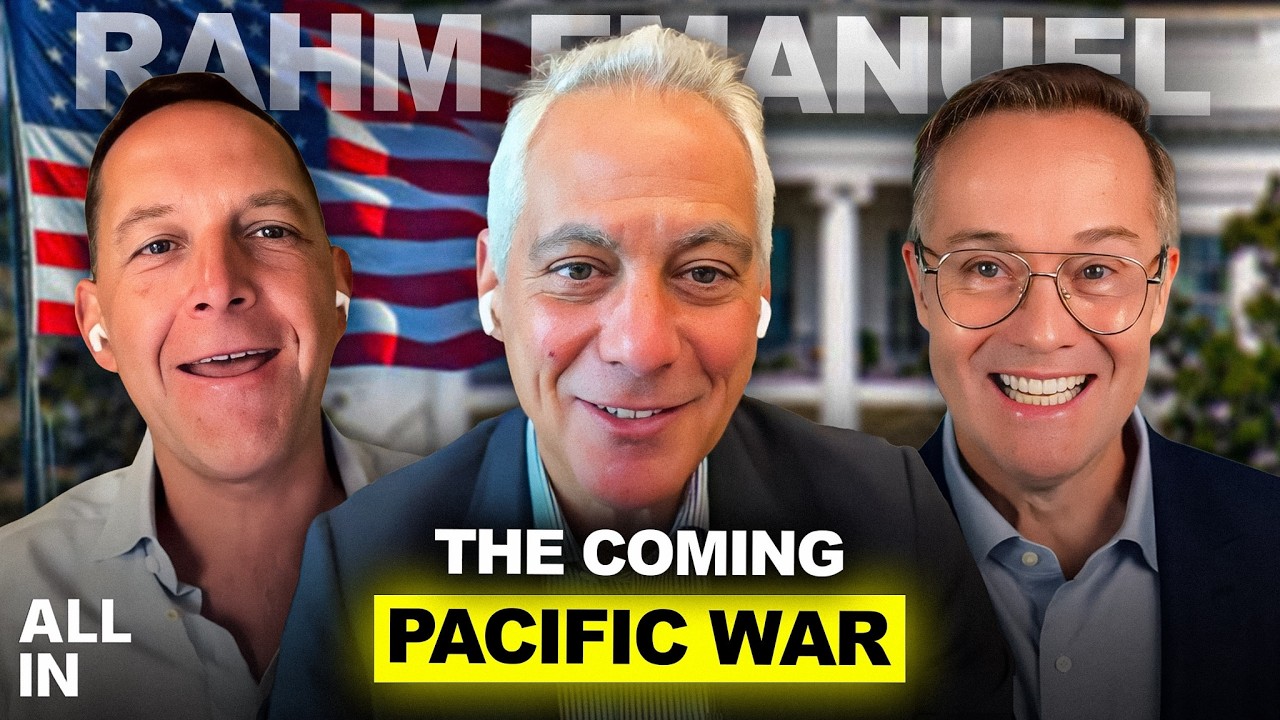 72 min
Rahm Emanuel: Trump's Foreign Policy, China, Europe's Decline, Immigration & DSA vs Democrats
 76 min
Google’s AI Brain Drain, SpaceX's Huge Quarter, Airtable’s 90% Collapse, US Data Fuels China AI
 49 min
China Outbuilds America 230-to-1. Saronic Has a Plan
 97 min
Chip Stocks Crash, $20B Fund Margin Called, Frontier Labs: SLOW DOWN AI, Mamdani's Grocery Stores
Ask anything from this episode.
Save it, chat with it, and connect it to Claude or ChatGPT. Get cited answers from the actual content — and build your own knowledge base of every podcast and video you care about.
Get Started Free