Key Moments
Ian Goodfellow: Generative Adversarial Networks (GANs) | Lex Fridman Podcast #19
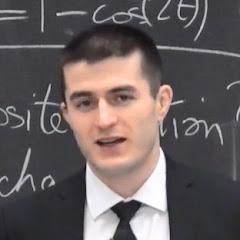 Lex Fridman
Key Moments
Ian Goodfellow discusses GANs, deep learning limitations, and the future of AI.
Key Insights
Deep learning's main limitation is its heavy reliance on large amounts of labeled data.
Deep learning models can be viewed as multi-step programs rather than solely representation learners.
Generative Adversarial Networks (GANs) consist of a generator and discriminator competing to produce realistic data.
Adversarial examples highlight security vulnerabilities but also offer tools for improving model robustness.
While backpropagation is effective, alternative training algorithms may be needed for future AI advancements.
The integration of multimodal data and novel interaction environments are crucial for AGI development.
THE LIMITATIONS AND EVOLUTION OF DEEP LEARNING
Ian Goodfellow identifies a primary limitation of deep learning: its substantial requirement for labeled data, though unsupervised and semi-supervised methods can mitigate this. He posits that deep learning is best understood as a component within larger AI systems, akin to a function estimator. The evolution from shallow learning, where operations occur in parallel, to deep learning emphasizes the sequential nature of computations within neural networks, conceptualizing them as multi-step programs rather than simply hierarchical representation learners. This perspective suggests that adding layers allows for more iterative refinement of understanding, akin to a continuous reasoning process.
THE PROMISE OF ARTIFICIAL GENERAL INTELLIGENCE
The conversation touches upon the possibility of artificial cognition and consciousness emerging from current architectures, particularly in the practical sense of self-awareness and planning. While defining consciousness remains challenging, particularly concerning subjective experience (qualia), self-awareness demonstrated by reinforcement learning agents interacting with their environment is seen as a step towards more advanced AI. Goodfellow expresses optimism that increased computation and diverse, integrated (multimodal) data will lead to significant advances, potentially bridging the gap from limited AI capabilities to something echoing human-level cognition.
THE ROLE AND IMPACT OF ADVERSARIAL EXAMPLES
Adversarial examples, initially viewed as revealing fundamental flaws in machine learning, are now primarily considered security liabilities. While they can serve as a tool for improving system performance, a trade-off often exists between robustness to adversarial attacks and accuracy on clean data. These examples force models to confront worst-case scenarios, a concept familiar in engineering. Their application extends to critical domains like finance and speech recognition, where malicious manipulation of AI systems poses significant risks, necessitating defenses against adversarial perturbations.
GENERATIVE ADVERSARIAL NETWORKS (GANS): A REVOLUTION IN GENERATION
Generative Adversarial Networks (GANs) are a type of generative model focused on creating new, realistic data samples. They operate through a two-player game: a generator that produces output (e.g., images) and a discriminator that distinguishes between real and generated data. As they compete, the generator learns to produce increasingly convincing fakes, while the discriminator hones its detection skills. The theoretical ideal is a Nash equilibrium where the generator perfectly mimics the data distribution, rendering the discriminator unable to differentiate. This competition drives the generation of highly realistic outputs, analogous to human imagination.
THE HISTORY AND DIVERSIFICATION OF GANS
The initial GAN paper in 2014 demonstrated basic functionality, with early samples being crude. Significant advancements followed, including LAPGAN for high-resolution images and DCGAN (Deep Convolutional GAN), which provided a robust architectural recipe. GANs have since diversified, enabling applications beyond image generation, such as semi-supervised learning, where GAN discriminators can be repurposed as classifiers using significantly fewer labeled examples. This includes work like DeepMind's BigGAN and subsequent research from ETH Zurich that has achieved performance comparable to fully supervised models with limited labeled data.
EXPLORING NEW FRONTIERS IN AI: FAIRNESS, SECURITY, AND INTERPRETABILITY
Goodfellow highlights several areas ripe for rapid development: fairness and interpretability, for which precise definitions are still emerging. He emphasizes the need for measurable concepts in interpretability, drawing parallels to the impact of differential privacy. In terms of security, robustness against adversarial examples is paramount, especially as AI systems become more integrated into critical infrastructure. The development of dynamic models that change with each prediction is suggested as a strategy to counter adversaries who exploit static vulnerabilities, maintaining a degree of unpredictability and enhancing system security.
THE PATH TO HUMAN-LEVEL INTELLIGENCE AND TESTING IT
Achieving human-level intelligence (AGI) requires diverse learning environments and substantial computation, enabling agents to accumulate a wide range of experiences. Goodfellow believes AGI won't arise solely from fixed datasets or theoretical contemplation but necessitates dynamic interaction. A compelling test for intelligence would be an agent capable of autonomously handling complex pipelines, such as downloading and processing data to train a model, without extensive human engineering. This concept aligns with advancements in AutoML and suggests that true AI understanding would manifest in such self-sufficiency and task completion.
Mentioned in This Episode
●Software & Apps
●Companies
●Organizations
●Books
●Studies Cited
●Concepts
●People Referenced
Common Questions
Deep learning models currently require large amounts of data, especially labeled data. They also need a lot of computational experience, unlike humans who learn more efficiently from fewer experiences.
Topics
Mentioned in this video
A type of neural network augmented with external memory cells, capable of updating memory with facts quickly.
Deep Convolutional Generative Adversarial Network, a foundational GAN recipe that significantly improved the generation of realistic images, particularly faces.
A GAN architecture developed at Facebook AI Research that achieved high-resolution photo generation by progressively upscaling images.
A type of machine learning algorithm that was common before deep learning, characterized by operations done in parallel rather than in series.
An optimization algorithm that could potentially be used to train deep learning models, rather than gradient descent.
A type of GAN used for image-to-image translation, like converting horses to zebras or day photos to night photos.
A type of neural network model that can be trained without backpropagation, though generating samples is complex.
An example of a system that uses deep learning as a submodule, specifically for estimating value functions in reinforcement learning.
A software library used for machine learning, represented as a graph of computations.
Long Short-Term Memory networks, designed for handling sequential data but still not fully replicating human short-term memory.
An autoregressive model used for generating images by predicting the probability of each pixel given the preceding ones.
A large-scale GAN project from DeepMind, known for generating high-quality images, particularly from the ImageNet dataset.
A type of deep learning architecture that updates a representation multiple times, analogous to a multi-step program.
A broad field of AI that involves learning from data. Deep learning is a subset of machine learning.
A type of machine learning that trains agents through experience, often using deep learning modules for estimation.
An approach to domain adaptation that uses a GAN-like structure to train feature extractors that are invariant across different domains.
A subfield of machine learning concerned with learning how to represent data. Deep learning is a subset of representation learning.
A type of deep learning model that was popular around 2006, with layers thought to learn different levels of abstraction.
An optimization technique that uses Gaussian processes to predict parameter performance, useful for hyperparameter optimization.
A subfield of machine learning that uses multi-step programs (neural networks) to learn from data, requiring significant data and computation.
A mathematical framework for quantifying privacy guarantees, enabling the design of algorithms that protect individual data.
One of Ian Goodfellow's PhD advisors at the University of Montreal.
Proposed the Turing Test as a benchmark for intelligence, using natural conversation as a metric.
Associated with research on training GANs using differential privacy to create synthetic, privacy-preserving data.
Associated with research on fairness in machine learning and developing models incapable of using sensitive variables.
One of Ian Goodfellow's PhD advisors at the University of Montreal.
Coined the term Generative Adversarial Networks (GANs) and author of the textbook 'Deep Learning'. Currently Director of Machine Learning at Apple.
Host of the Artificial Intelligence Podcast and interviewer of Ian Goodfellow.
Researcher known for unsupervised GANs, including work on transforming day photos into night photos.
A key figure in the development of differential privacy, with concepts that have had a significant impact on the field.
A research paper demonstrating that convolutional network architectures inherently capture structure in images, suggesting learning might not be solely responsible for this capability.
An early research paper (circa 2016) demonstrating that adversarial examples could be embedded in audio to fool speech recognition systems into executing unintended commands.
More from Lex Fridman
View all 549 summaries 259 min
FFmpeg: The Incredible Technology Behind Video on the Internet | Lex Fridman Podcast #496
 124 min
Vikings, Ragnar, Berserkers, Valhalla & the Warriors of the Viking Age | Lex Fridman Podcast #495
 146 min
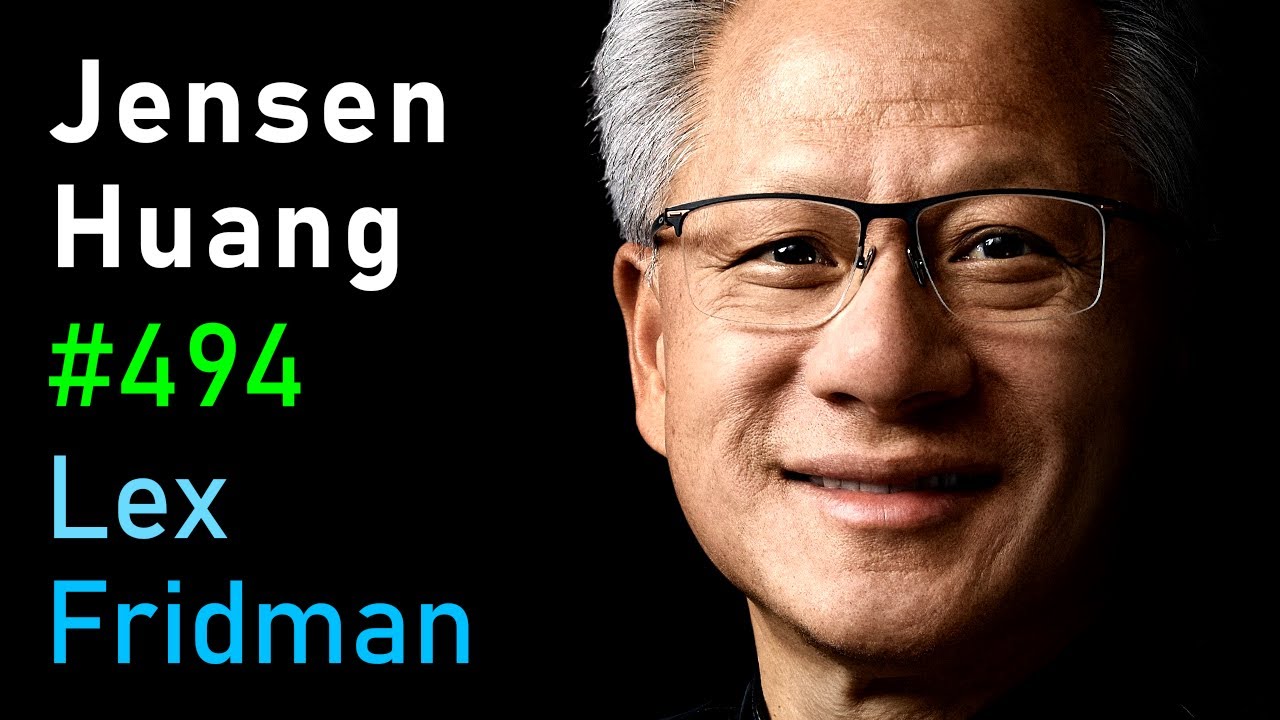
Jensen Huang: NVIDIA - The $4 Trillion Company & the AI Revolution | Lex Fridman Podcast #494
 311 min
Jeff Kaplan: World of Warcraft, Overwatch, Blizzard, and Future of Gaming | Lex Fridman Podcast #493
Ask anything from this episode.
Save it, chat with it, and connect it to Claude or ChatGPT. Get cited answers from the actual content — and build your own knowledge base of every podcast and video you care about.
Get Started Free