Key Moments
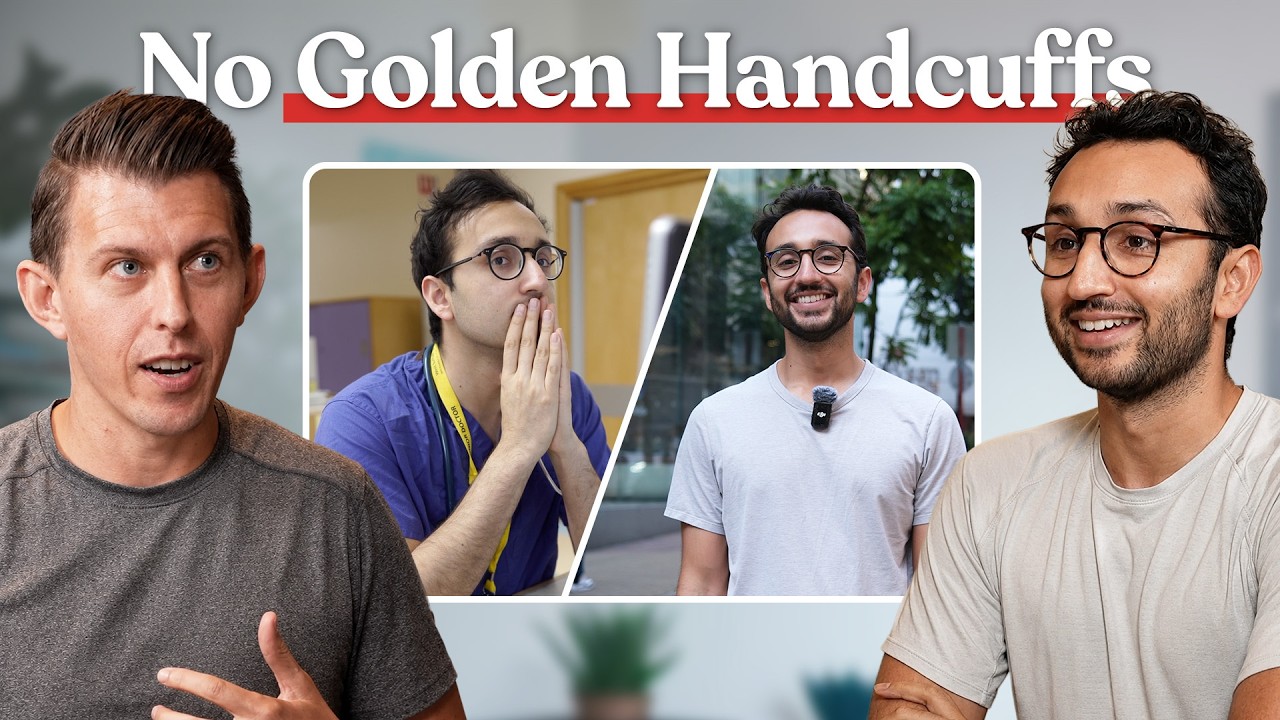
How to Make Work Optional - The Freedom Profile Matrix
 Ali Abdaal
Want to know something specific about what's covered?
We've already dissected every moment. Ask and we will deliver (with timestamps).
Key Moments
You can make your job optional by reducing expenses or increasing income, but the real path is to focus on a 'high freedom profile' job or business that offers fun, flexibility, fulfillment, and finances.
Key Insights
The primary reason a job isn't optional is the presence of expenses, necessitating income greater than expenditure.
A 'freedom profile' can be assessed by rating a job or business on a scale of 1-10 for fun, flexibility, fulfillment, and finances.
Starting a business, while often a '925 for a 24/7' trade-off, offers more control and potential for higher income compared to traditional employment.
Passive income from assets, such as rental properties or stocks, can gradually replace income from work, making jobs and businesses optional.
Work that you would do even without financial need (the 'vibes' work) is key to long-term fulfillment and can be pursued through business or high-freedom jobs.
Learning a new skill, whether through self-study or paid courses/coaching, is crucial for business success, and the value of formal education like MBAs or PhDs is increasingly debated.
The core reason your job isn't optional: expenses
The fundamental reason most people are tied to their jobs is the necessity of covering expenses like rent, food, and bills. If monthly expenses exceed income, individuals fall into debt, making their employment non-negotiable. The ideal scenario is income exceeding expenses, with the surplus ideally allocated to investments or discretionary spending. However, the core problem often lies within the expense category. While reducing expenses to zero, like becoming a monk, would make a job truly optional, most people seek to maintain a certain lifestyle. This leads to the alternative: increasing income to cover desired expenditures without needing a traditional job.
Reframing the problem: it's about job characteristics, not just the job itself
Ali Abdaal proposes that the issue isn't necessarily having a 'job' but rather the specific characteristics of that job, which he terms the 'freedom profile.' This profile is defined by four key elements: fun, flexibility, fulfillment, and finances. If a job offers a low balance of these four Fs, individuals will likely seek alternatives. Conversely, a job with a high freedom profile, offering ample levels of these elements, would likely be one people would choose to stay in, even if it weren't financially necessary. The assessment involves rating each of these Fs on a scale, typically out of 10, to diagnose personal satisfaction and identify areas for improvement.
The Freedom Profile Matrix: evaluating jobs and businesses
The 'freedom profile' framework helps individuals evaluate their current work situation. For example, a remote software developer earning a high salary (finances: 10/10) with significant flexibility (10/10) and enjoyment from coding (fun: high) might still lack fulfillment if they don't believe in the company's product (fulfillment: moderate). This would represent a generally good, though not perfect, freedom profile. In contrast, a corporate lawyer working 16-hour days might have excellent finances (10/10) but suffer from extremely low flexibility (1/10) and fulfillment (1/10), resulting in a poor freedom profile. The goal is to find or create a work situation that aligns with one's personal priorities across these four Fs, leading to a subjective 'good' or 'bad' freedom profile.
Exploring business ownership for a better freedom profile
While jobs are typically working for someone else, starting a business—whether freelance, an agency, or a product-based venture—puts you in control. However, not all businesses offer a good freedom profile. A factory owner, for instance, might face low fun, flexibility, and fulfillment, with tight finances due to competition. In contrast, a freelance web designer can achieve a high freedom profile by charging significant fees ($15,000-$50,000 per website), enjoying the creative process, having complete flexibility, and finding fulfillment by choosing clients aligned with their values (e.g., education or nonprofits). While this might mean slightly lower immediate finances compared to a high-paying corporate job, the overall balance across the four Fs can be significantly better.
The income-asset equation: building passive income
Beyond active income from jobs or businesses, passive income generated from assets is crucial for making work optional. Assets are defined as anything that puts money into your pocket, such as rental properties generating income, or stocks and shares providing dividends and capital appreciation. The core equation involves using income from work to cover expenses, generating a profit. This profit is then invested into assets. Over time, as assets grow, the income they generate can increasingly replace income from active work, reducing the reliance on a job or business. This shifts the income equation more towards assets and less towards work, ultimately making work optional.
Work is optional, not necessarily undesirable
Making work optional doesn't mean stopping work entirely. Humans often need purpose and engagement to flourish, as evidenced by the decline in well-being associated with premature retirement. The ideal is to reach a point where work is optional because one has sufficient assets, or where the work itself is so enjoyable ('vibes') that one would do it regardless of financial need. Authors like Brandon Sanderson, who continues to write prolifically despite financial freedom, exemplify this. The aim is to increase the proportion of work that falls into the 'would do anyway' category and minimize the work done solely for financial necessity.
Entrepreneurship as a path to control and skill development
Starting a business, even if it means trading a '9-to-5' for a '24/7' schedule, offers greater control and a steeper learning curve than traditional employment. While stressful, successful entrepreneurship often prevents a return to traditional jobs. The key difference lies in taking direct responsibility for income generation. The hardest part of business is often selling, a skill rarely honed in conventional jobs. Developing sales skills through entrepreneurship makes individuals more valuable even if they later return to employment. There are two main paths to starting a business: the DIY approach, leveraging free online resources, or seeking help through courses, coaching, or communities, with the latter often accelerating progress.
The evolving landscape of education and skill acquisition
The perceived value of traditional education versus online learning is shifting. While some view online courses and coaching as scams, this perspective is often overly simplistic. Formal education like MBAs or PhDs, once seen as essential, is now sometimes viewed as a sign of low ambition or irrelevant by certain industries. Conversely, online courses, books, and mentorship programs offer valuable, often more practical, skills. The key is to approach any form of education with open eyes, critically evaluating the provider and the specific value proposition, rather than dismissing entire industries based on isolated negative experiences. Ultimately, the goal is to acquire the skills and build the assets needed to make work optional, on one's own terms.
Mentioned in This Episode
●Software & Apps
●Companies
●Organizations
●Books
●People Referenced
Common Questions
The primary reason people need a job is to cover their expenses, such as rent, food, and bills. Without sufficient income to meet these expenses, individuals risk falling into debt.
Topics
Mentioned in this video
Mentioned as an example of someone with a high-freedom job involving music recording and touring.
Cited as an example of a successful author who continues to write because he loves it, even though work is optional for him financially.
Mentioned as a source of free business education content on YouTube.
Mentioned as a source of free business education content on YouTube.
Mentioned as a source of free business education content on YouTube.
A person whose mastermind group the speaker paid $60,000 to join, highlighting its value for entrepreneurs.
Founder of Nike, mentioned as an example of a business leader whose book offers valuable lessons, and not a scam.
An online investing platform that the speaker and his wife have used for years, highlighted for its user-friendly interface, fractional shares, and auto-invest features.
Mentioned as an example of a company whose stocks can be invested in, and as a potential employer the speaker might consider if he stopped his own business.
Mentioned as an example of a company whose stocks can be invested in.
Mentioned as a type of company the speaker might consider working for if he stopped his own business, due to its scale and mission.
Mentioned as a type of company the speaker might consider working for if he stopped his own business, due to its scale and mission.
Mentioned as a type of company the speaker might consider working for if he stopped his own business, due to its scale and mission.
Mentioned as one of the world's most valuable companies, founded by Phil Knight, whose business lessons can be learned from his book.
Mentioned as an example of a company where an MBA might be beneficial for executive roles, though this is contrasted with startup hiring practices.
Mentioned as an AI that can provide reasonable advice for starting a business.
A course offered by the speaker on how to start a YouTube channel, which provides a roadmap for success.
Mentioned as an AI that can provide reasonable advice for starting a business.
Mentioned as an online course platform where the speaker learned to play guitar.
More from Ali Abdaal
View all 195 summaries 119 min
The Dark Side Of Getting Rich On Youtube
 78 min
How to Quit Your Job (and Find Work You Actually Love)
 89 min
If You Want to Make Money From YouTube, Do This (Case Study)
 25 min
stop waiting, just hit record
Ask anything from this episode.
Save it, chat with it, and connect it to Claude or ChatGPT. Get cited answers from the actual content — and build your own knowledge base of every podcast and video you care about.
Get Started Free