Key Moments
Gender Apartheid and the Future of Iran: A Conversation with Alinejad and Mohammed (Episode #370)
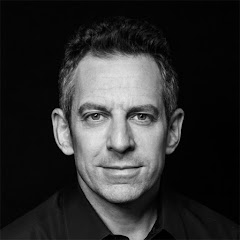 Sam Harris
Want to know something specific about what's covered?
We've already dissected every moment. Ask and we will deliver (with timestamps).
Key Moments
Iran faces gender apartheid; Western feminists are hypocritical; US policy is weak against the regime.
Key Insights
The Iranian regime enforces gender apartheid, oppressing women through laws like compulsory hijab and the morality police.
Many Western feminists exhibit hypocrisy by downplaying or misinterpreting the oppression of women in Iran, prioritizing political agendas over human rights.
US policy towards Iran is criticized as ineffectual, lacking strong deterrence and failing to adequately support dissidents or pressure the regime.
There's a significant disconnect between the Iranian regime's ideology and the sentiment of the Iranian population, especially the youth, who largely reject the theocracy.
The 'My Stealthy Freedom' campaign and 'United Against Gender Apartheid' are key initiatives challenging the regime's oppression.
Western countries are criticized for failing to vet immigrants properly, allowing individuals connected to the Iranian regime to operate freely within their borders.
THE NATURE AND IMPACT OF GENDER APARTHEID IN IRAN
The conversation highlights the severe reality of gender apartheid in Iran, where the regime enforces oppressive laws, most notably the compulsory hijab, enforced by a morality police. This system systematically subordinates women, restricting their freedoms in public and private life, including prohibitions on dancing, singing solo, and even obtaining passports without male permission. The guests emphasize that this is not merely about a piece of cloth but a fundamental pillar of a religious dictatorship and a tool for controlling society, with women's bodies being used to inscribe the regime's ideology.
HYPOCRISY OF WESTERN FEMINISM AND POLITICAL AGENDAS
A significant portion of the discussion criticizes the perceived hypocrisy of some Western feminists and activists who, influenced by political agendas, fail to recognize or condemn the oppression of women in Iran. These individuals are accused of misinterpreting the hijab as empowering or a cultural norm, and of prioritizing complex political alliances over the basic human rights of Iranian women. This selective outrage is seen as emboldening the Iranian regime and betraying the very principles feminism should uphold, especially when compared to their reactions to other geopolitical issues.
INEFFECTIVENESS OF U.S. AND WESTERN POLICY TOWARDS IRAN
The U.S. government's policy towards Iran is broadly characterized as a failure of deterrence, marked by a lack of decisive action. Despite Iran's documented support for terrorism, direct attacks on allies, and targeting of dissidents abroad, Western nations are seen as hesitant to take strong measures. Sanctions are often ineffective due to poor enforcement and evasion, and a lack of a clear, unified strategy from democratic countries is highlighted. This perceived weakness emboldens the regime and disappoints Iranian dissidents who seek genuine international support.
THE DISCONNECT BETWEEN THE IRANIAN PEOPLE AND THE REGIME
A crucial insight is the vast chasm between the ruling Islamic Republic and the Iranian population, particularly the youth. While the regime promotes slogans like 'Death to America,' the younger generation actively chants against the Islamic Republic, demonstrating a rejection of its ideology and isolationist policies. Election turnouts are low, and evidence suggests a deep dissatisfaction with the regime, indicating that the population's sentiment does not align with the theocracy's radical stance, making the regime's legitimacy questionable even among its past supporters.
CHALLENGES TO THE REGIME: CAMPAIGNS AND ACTIVISM
Initiatives like Masih Alinejad's 'My Stealthy Freedom' campaign and the new 'United Against Gender Apartheid' movement are central to the struggle. These campaigns leverage social media to expose the regime's oppression, encourage civil disobedience, and gather testimonies for international legal action. The term 'gender apartheid' is strategically used to draw parallels with historical struggles against oppression and to galvanize international support, aiming to criminalize such regimes and bring perpetrators to justice.
IMMIGRATION, ISLAMISM, AND WESTERN VULNERABILITIES
The conversation touches upon the perceived failures in immigration policies in Western countries, citing examples from the UK and Canada, where individuals with ties to the Iranian regime or extremist ideologies have allegedly been allowed entry without adequate vetting. This is seen as a failure of political correctness, creating platforms for dangerous ideologies and posing security risks. The presence of regime officials and supporters teaching at Western universities is highlighted as a symptom of this problem, where pragmatic security concerns are overridden by a drive for diversity and political correctness.
SOLIDARITY AND THE NEED FOR EFFECTIVE MESSAGING
The importance of solidarity among democratic nations and effective messaging is repeatedly stressed. The speakers call for unified action against authoritarian regimes, analogous to the fight against apartheid in South Africa, and for clear condemnation of human rights abuses. They lament the lack of strong reactions from Western governments and institutions to events like assassination plots against dissidents or the widespread human rights violations in Iran and Afghanistan, emphasizing that terrorists and oppressive regimes only understand pressure and solidarity, not appeasement.
THE DISTINCTIVENESS OF PERSIAN IDENTITY AND JEWISH ALLIES
The unique cultural identity of Iranians, rooted in their Persian heritage rather than a colonized Arab identity often associated with some Muslim-majority nations, is presented as a key factor in their resistance. Persian Jews are noted as particularly understanding of the threat posed by the Islamic Republic, having been among its earliest victims. Their historical struggle and the broader Iranian diaspora's condemnation of Hamas and support for victims of terrorism (like Jewish women on October 7th) are presented as evidence of a progressive, anti-theocratic sentiment within Iran.
Mentioned in This Episode
●Software & Apps
●Organizations
●Books
●Concepts
●People Referenced
Common Questions
Gender apartheid refers to systemic discrimination and oppression based on gender. In the context of Iran, it describes the regime's policies that severely limit the rights and freedoms of women, treating them as second-class citizens.
Topics
Mentioned in this video
Mentioned as the group to which Yasmin Muhammad's ex-husband belonged.
Mentioned concerning US presidential administrations and their foreign policy decisions regarding Iran.
Mentioned in relation to female politicians wearing hijabs in Iran, a practice used by the regime for legitimization.
Mentioned as a platform perceived to unite dictators, and where calls are made to expand the definition of apartheid.
A nonprofit charity founded by Yasmin Muhammad that provides mental health support for freethinkers in Muslim-majority countries.
Masi Alinejad was elected president of this organization.
Iranian regime's enforcers who target women for not adhering to dress codes, discussed as a symbol of oppression.
Mentioned in relation to calls for criminalizing gender apartheid and the Council's perceived ineffectiveness.
Mentioned as an example of Islamic ideology and extremism.
Russian paramilitary group listed as a terrorist entity, compared to the IRGC.
Mentioned as being influenced by the Islamic Republic's agencies.
Mentioned concerning visa policies and the alleged harboring of individuals linked to the Islamic Republic.
The Iranian regime, the primary target of criticism for its oppressive policies and human rights violations.
The Islamic Revolutionary Guard Corps, criticized for human rights abuses and security concerns.
Provided free access to versions of Yasmin Muhammad's book in Arabic, Farsi, Urdu, and Indonesian.
Mentioned as a group funded by Iran as part of proxy wars.
International Criminal Court, where activists hope to bring cases against the Iranian regime for crimes against humanity and gender apartheid.
Masi Alinejad's campaign against compulsory veiling, a platform for supporting her work.
An institution where a former Islamic Republic official teaches, identified as a terrorist.
Mentioned in the UK context, where members are perceived to be modifying procedures due to threats from extremists.
Mentioned as a group whose activities were preceded by Qasem Soleimani's history in Syria.
Egypt's official name, used by Yasmin Muhammad to illustrate the loss of distinct cultural identity due to Arabization.
Mentioned in the context of media reporting and potential bias.
Named Masi Alinejad one of its 'Women of the Year' in 2023.
A campaign launched by Masi Alinejad in 2014 for women's rights in the Muslim world and against compulsory veiling.
Funded by Iran and mentioned as a proxy group involved in conflict.
Informed Masi Alinejad about kidnapping and assassination plots against her.
A new campaign launched by women of Iran and Afghanistan aiming to gather testimonies and hold the Islamic Republic accountable.
Mentioned in contrast to CNN regarding media coverage of figures associated with the Iranian government.
A news platform that interviews figures associated with the Iranian government, contrasted with the New York Times' actions.
A publication mentioned as a benchmark for journalistic pay rates; the host offers to fund journalism at a higher rate.
Observed a moment of silence following Ebrahim Raisi's death, which the guest found problematic.
Awarded to Narges Mohammadi, who is currently imprisoned.
The desired form of government for Iran, contrasted with the current theocracy, and linked to the need for international support.
Discussed as a primary symbol of oppression and a tool used by the Iranian regime to control society.
An ally of Iran, providing weapons and technology to authoritarian regimes.
The United States, discussed in terms of its foreign policy, domestic politics, and international standing.
Mentioned in contrast to Persian identity, suggesting potentially greater support for theocracy in that region.
An ally of Iran, mentioned in the context of providing weapons and technology to authoritarian regimes.
Context for the condemnation of Jamal Khashoggi's murder, used for comparison with Western responses to Iran.
The central topic of discussion, focusing on gender apartheid, the ruling regime, and popular sentiment.
Mentioned in the context of Iran's direct attacks and proxy wars.
The ruling regime of Iran, consistently criticized for its human rights abuses, gender apartheid, and support for terrorism.
Used as a comparison for a potential future for Iran if the current regime remains, highlighting chaos and destruction.
Mentioned in the context of gender apartheid and the struggles of women and girls.
Mentioned in the context of the ongoing war and Iran's involvement.
Used as an example of concerning levels of islamism and the government's perceived inability to address the issue.
Used as a comparison for a potential future for Iran if the current regime remains, highlighting chaos and destruction.
Discussed for its immigration policies and the alleged welcoming of individuals linked to Iran's Revolutionary Guards.
Host of the Making Sense podcast, discussing his new Substack venture and the topic of gender apartheid in Iran.
One of the groups funded by Iran, mentioned as part of Iran's proxy wars.
His murder by Saudi Arabia was used as an example of Western condemnation of certain regimes, contrasted with their silence on Iran.
The former President of Iran, whose death in a helicopter crash was met with celebration by some Iranians.
Mentioned as a figure who has become a hero to younger generations via platforms like TikTok, highlighting dangerous trends.
Husband of Amal Clooney, mentioned in relation to her humanitarian advocacy.
Mentioned as a figure who was invited to support the My Stealthy Freedom campaign but did not, and later expressed support for the people of Iran.
Nobel Peace Prize winner imprisoned in Iran, urging Western activists to support taking the regime to the International Criminal Court.
Mentioned for a closing essay on gender apartheid, recommended by Sam Harris.
Mentioned as a leader of the Women's March on Washington, criticized for her stance on the hijab and perceived hypocrisy.
The Syrian regime leader, whose opponents were attacked by Qasem Soleimani.
A Yazidi woman and Nobel Peace Prize laureate, mentioned as being represented by Amal Clooney in legal action.
Humanitarian lawyer, called upon to join the women of Iran in their struggle against the gender apartheid regime.
Supreme Leader of Iran, mentioned in relation to a fatwa for assassination plots against dissidents.
A symbol of the 2009 Green Movement in Iran, her death during protests was widely publicized; her family faced visa issues with Canada.
Former Iranian Foreign Minister, mentioned as a reformist figure, but viewed by the guest as part of the Islamic Republic's narrative.
More from Sam Harris
View all 302 summaries 27 min
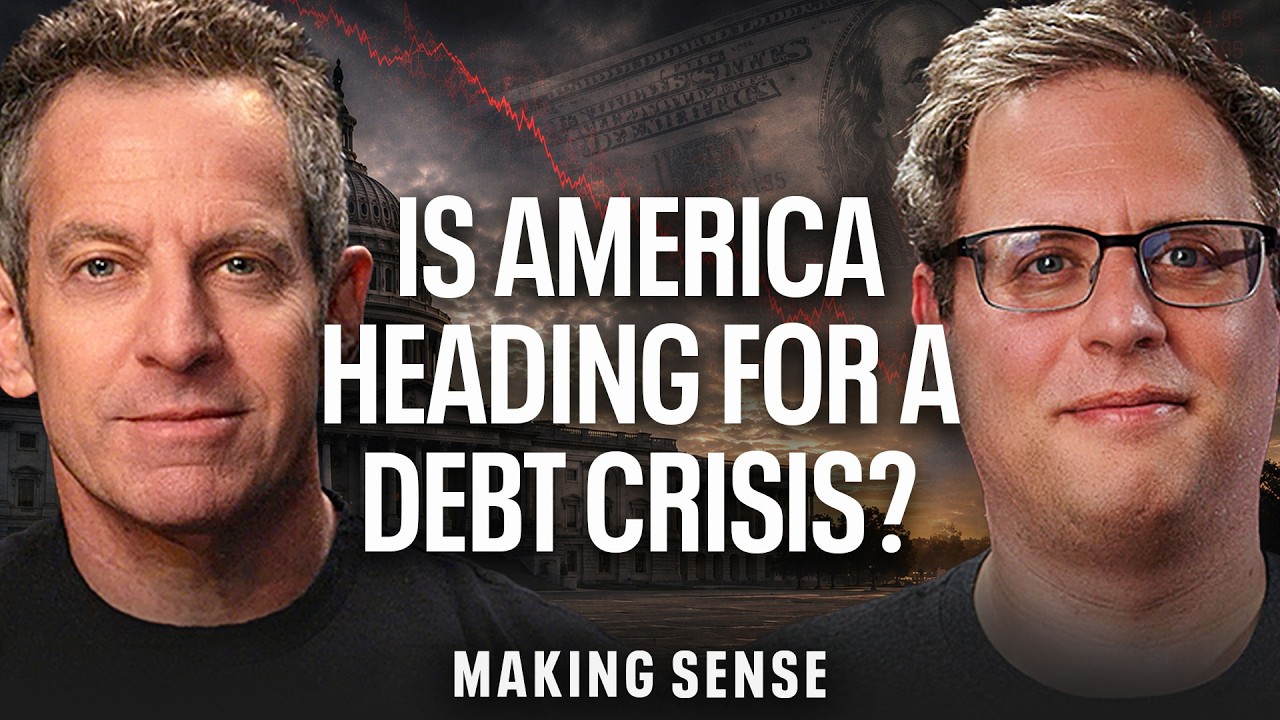
Is America Heading for a Debt Crisis? An Economist Explains
 27 min
Is America Heading for a Debt Crisis? An Economist Explains
 34 min
Is Psychedelic Therapy Ready for FDA Approval?
 26 min
You Lose Interest the Moment You Realize It's AI
Ask anything from this episode.
Save it, chat with it, and connect it to Claude or ChatGPT. Get cited answers from the actual content — and build your own knowledge base of every podcast and video you care about.
Get Started Free