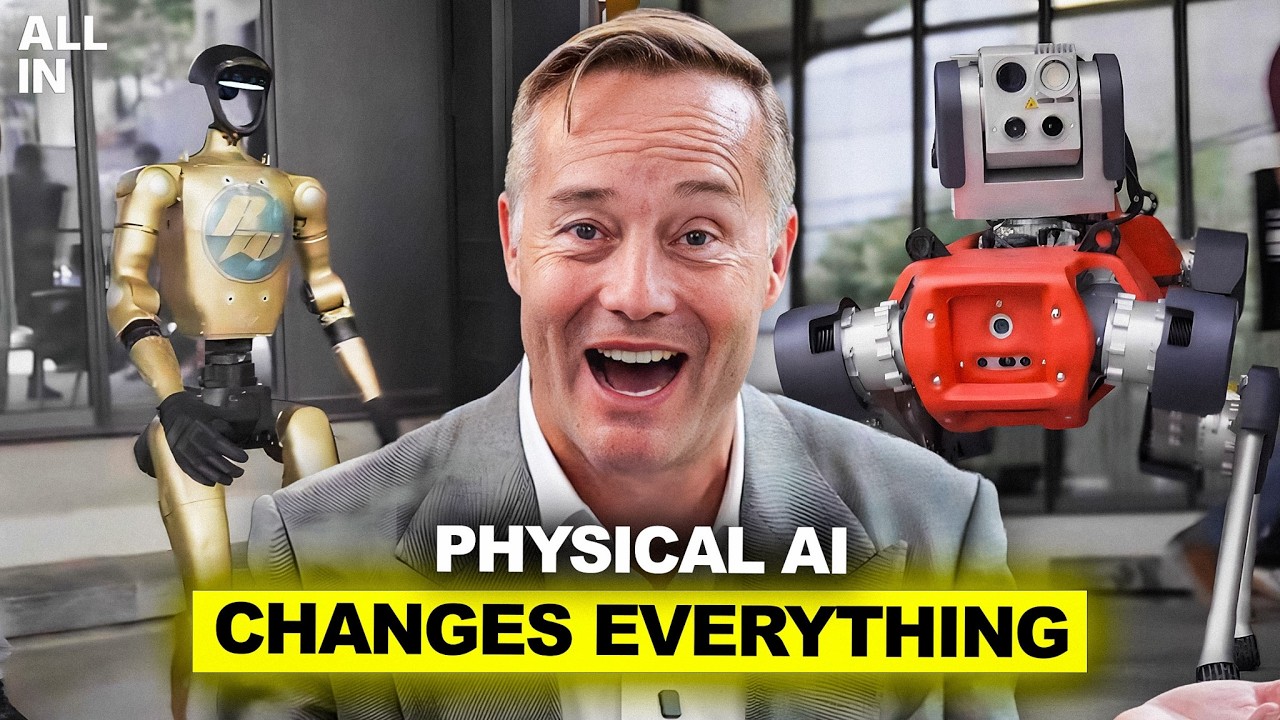
Epstein Files Flop, State of the Market, Autonomous Robots, Trump's Gold Card, Friedberg on Jeopardy

Key Moments
Epstein files disappoint, robots advance rapidly, market faces uncertainty, and Trump explores 'golden visas'.
Key Insights
The initial release of Epstein files was underwhelming, raising questions about the FBI's transparency and document handling.
Significant advancements in autonomous robots, particularly humanoid ones, are occurring rapidly, with timelines accelerated, though practical dexterity remains a challenge.
The current market is showing signs of compression, with AI companies growing exceptionally fast, but overall economic indicators suggest potential slowdown and correction.
Trump's proposal for a 'golden visa' program, selling US residency for $5 million, aims to attract foreign investment and potentially bypass existing immigration pathways.
The debate around accredited investor laws highlights a tension between protecting less sophisticated investors and enabling broader access to private market opportunities for wealth creation.
The US Postal Service is facing significant financial challenges, prompting discussions about restructuring, privatization, and leveraging its infrastructure for data collection.
EPSTEIN FILES REVEAL DISAPPOINTMENT AND QUESTIONS OF TRANSPARENCY
The initial release of documents related to Jeffrey Epstein has fallen short of expectations, with a significant portion of the files reportedly still withheld. The discussion highlights concerns about the FBI's process, particularly the alleged non-disclosure of thousands of pages of documents to investigative chains of command. Questions arose regarding whether withholding information is permissible under any circumstances, even from superiors, and the potential reasons for such actions, including ongoing investigations or informant protection. The overall sentiment is one of anticipation for the full files, while acknowledging that the immediate release has not satisfied public or official curiosity.
CELEBRITY JEOPARDY AND A TEST OF NERVES
David Friedberg shared his experience on Celebrity Jeopardy!, detailing the intense pressure and unexpected challenges of the game show format. Despite initial anxieties and an unusual personal connection to a category on African geography, Friedberg performed exceptionally well, even securing a win. He described the difficulty of the buzzer system, the mental strain of performing under pressure, and the humorous yet embarrassing moments like missing a straightforward 'Hoosiers' question. His participation raised funds for the Humane Society United States, adding a charitable dimension to his televised appearance.
THE RAPID ASCENSION OF AUTONOMOUS ROBOTS AND AI
The panel discussed the accelerated timelines for autonomous robots, particularly humanoid models, with companies like Figure AI pushing their home beta testing up by two years. While impressive, the current limitations of robot dexterity and generalized AI models were noted. The ability of robots to communicate semantically and collaborate is a key breakthrough, but physical limitations in actuators mean tasks like sorting groceries or handling delicate items are still challenging. Predictions range from a few years to a decade for widespread adoption in middle-class households, contingent on overcoming these physical and computational hurdles.
STRIPE'S ECOSYSTEM STRENGTH AND THE AI REVOLUTION IN SAS
A comparison between Stripe and Adyen revealed Stripe's impressive growth and its valuable ecosystem of additional products beyond core payments, such as its billing product generating significant ARR. The rapid growth of AI companies, reaching $5 million in annualized revenue in 24 months compared to 37 months for average SaaS companies, highlights AI's transformative impact on efficiency and revenue generation. This trend suggests a potential solution to economic slowdowns, with clear ROI and cost savings making AI adoption a straightforward sale, though challenges remain in regulated environments due to potential hallucinations.
MARKET UNCERTAINTY, TARIFFS, AND THE POTENTIAL FOR AUSTERITY
The market is experiencing a complex mix of positive indicators like low unemployment and the rapid growth of AI, alongside concerns about inflation, potential tariffs, and government spending. The 'Max 7' stocks are showing compression, suggesting a potential end to their outperformance. The bond market seems to be pricing in the effectiveness of proposed austerity measures and tariffs, leading to lower bond yields. This situation draws parallels to the UK's austerity period, which led to Brexit, raising questions about the potential for public dissatisfaction and populist reactions in the U.S. if austerity measures are prolonged.
TRUMP'S 'GOLDEN VISA' AND THE ACCREDITED INVESTOR DEBATE
Donald Trump's 'golden visa' proposal involves selling U.S. residency for $5 million, aiming to channel foreign investment and streamline immigration for wealthy individuals. This is contrasted with the existing E5 program. The discussion then shifted to the concept of accredited investors, with arguments for and against lowering the barriers. Proponents suggest a new test could unlock access for more people to invest in private markets, fostering upward mobility and entrepreneurship, while critics warn of increased scams and predatory practices, advocating for safer, diversified investments like S&P 500 index funds.
THE FUTURE OF THE US POSTAL SERVICE AND MEDIA LANDSCAPE
The U.S. Postal Service is grappling with significant financial losses, leading to discussions about its leadership and potential integration into the Commerce Department. Ideas range from making it a private market entity to optimizing its infrastructure for data collection. Simultaneously, Jeff Bezos is signaling a more involved approach at The Washington Post, focusing on free markets and personal liberties. This direction is seen by some as potentially polarizing and uncharacteristic of a free speech advocate, while others view it as a necessary stance to establish a clear editorial identity in a crowded media landscape.
Mentioned in This Episode
●Supplements
●Products
●Software & Apps
●Tools
●Companies
●Organizations
●Books
●Concepts
●People Referenced
Stripe vs. Adyen Comparison
Data extracted from this episode
| Metric | Adyen | Stripe |
|---|---|---|
| Processing Volume | 1.34 Trillion | 1.4 Trillion |
| Growth Rate | 33% | 38% |
| Valuation (Adyen Public) | 56 Billion | 91.5 Billion (Private Market Premium) |
| Employee Count | 4,300 | 8,000+ |
| Profitability | 1 Billion EBITDA | Higher Margin |
Common Questions
A letter was sent to Director Patel stating that the FBI failed to disclose thousands of pages of documents related to the Jeffrey Epstein investigation, despite repeated requests. The FBI will reportedly deliver the files by a specific deadline.
Topics
Mentioned in this video
Subject of a document release controversy involving the FBI.
Mentioned as the sender of a letter regarding Epstein files.
Accused of withholding thousands of pages of documents related to the Jeffrey Epstein investigation.
Participated in Celebrity Jeopardy and discussed his performance and the show's format.
David Friedberg's recent appearance on the show, where he performed well despite initial nerves.
A question on African geography featured in Celebrity Jeopardy, correctly answered by David Friedberg.
Co-host of the podcast, discussed his Twitter reply strategy and offered advice to David Friedberg for Jeopardy.
Host of Jeopardy, mentioned in the context of the buzzer timing mechanics.
A sports movie question from Jeopardy that David Friedberg missed, leading to teasing from his co-hosts.
The charity that David Friedberg was playing for on Celebrity Jeopardy.
CEO and founder of Figure, announced accelerated timelines for beta testing home robots.
Company developing humanoid robots with accelerated timelines for home beta testing.
Had a previous deal with Figure for AI models, which was publicly cancelled.
A 90s company that made scooter-like balancing systems and is now making robots, including lawnmowers.
Mentioned as an example of a single-purpose domestic robot, compared to more advanced humanoid robots.
Referred to in the context of technological revolutions and their impact on the economy and individual efficiency.
Mentioned as one of the tech companies driving market performance.
A payment processing company whose performance, ecosystem, and valuation were compared to Adyen.
A competitor to Stripe in payment processing, discussed in terms of volume, growth, and valuation.
A stablecoin mentioned with its market cap and a note about its 'shaky history'.
A stablecoin mentioned with its market cap and rapid growth since its inception.
The stock market index's performance at the start of the year and its composition, particularly the dominance of the 'Mag 7'.
The tech-heavy stock index's performance at the start of the year.
The performance of the Dow index at the start of the year.
The group of top technology stocks (Apple, Microsoft, Google, Amazon, Nvidia, Meta, Tesla) whose performance significantly impacts market indices.
Mentioned as an example of a company where early participants could have achieved significant success.
Experienced a decline in the last month, despite a 'Trump bump'.
Referred to in the context of economic austerity and its popularity.
Mentioned for cutting interest rates in September and December, coinciding with modest inflation growth.
His camp's economic outlook is referenced for its cautious perspective.
Used as a historical example of a release valve for public dissatisfaction during austerity, drawing parallels to potential US scenarios.
Mentioned in relation to voter demographics and political coalitions.
Body that sets index rules, mentioned in the context of rule changes benefiting large companies.
Mentioned as a potential figure to call for increased regulation following market issues.
Mentioned as a platform that could offer its network participants shares.
Mentioned in the context of drivers potentially investing in shares and as a platform that could offer equity.
Discussed in terms of its financial losses, proposed leadership changes, and potential for data collection.
The department to which the US Postal Service might be placed under control.
Had an interview suggesting the Postal Service could collect census data.
An existing visa program for non-citizens that is proposed to be replaced by Trump's 'Golden Visa'.
Mentioned as an example of a platform where people gamble, contrasted with investing in startups.
Reportedly has significant underutilized office space, suggesting potential for real estate optimization.
Jason Calacanis discusses his strategy for handling replies on the platform.
Know Your Customer regulations potentially affecting the 'Golden Visa' program's implementation.
Publication whose perspective on the economy is analyzed in relation to political alignment.
His previous 'rant' is referenced in the context of market analysis.
Companies with more lax regulations compared to public companies, a key point in the debate on accredited investing.
Month when CPI bottomed out around 2.4%, just before the election.
Recommended as a safe and proven investment strategy, though their current composition is questioned.
Mentioned as a practice used by large companies to influence S&P index rules.
An industry where AI could help in design, but tolerance errors could have catastrophic consequences.
Risks faced by unsophisticated investors entering new markets, particularly involving misleading pitches.
The methods employed by political actors to achieve their goals, often involving coalition building and appealing to specific voter groups.
Ongoing discussions and disagreements about the best approaches to managing an economy.
Economic and social ideas emphasizing minimal government intervention and voluntary exchange.
Specific percentage goals for inflation, such as the 2% target for the CPI.
Not explicitly mentioned, but relevant to global economic discussions and development.
The ability of individuals to improve their socioeconomic status, discussed in the context of investment access.
The tendency of media outlets to favor certain political viewpoints or perspectives.
The prize money awarded in Celebrity Jeopardy, with a portion going to the winner's charity.
The direct exchange of information between machines or robots, a key advancement in automation.
Changes made to previously reported economic statistics, often due to inaccuracies or updated information.
Markets for investing in non-publicly traded companies, with inherent risks for new investors.
Openness and accountability in government operations, discussed in relation to the FBI's handling of information.
Lack of clarity or predictability regarding government policies, which can affect market confidence and investment.
Making changes to The Washington Post's editorial page, focusing on free markets and personal liberties.
Mentioned in the context of sports betting and learning about entrepreneurship.
Mentioned as a way many people hold assets, contributing to the idea of broader asset ownership.
Congressional Budget Office economists whose projections are considered conservative regarding tax cut impacts.
Mentioned as part of the 'Mag 7' whose stock performance is tracked.
Mentioned in the context of Brexit as a political entity the UK left.
Traditional software solutions are being challenged by AI due to clearer ROI and cost savings.
A trade policy tool discussed as a potential lever for the Trump administration, with significant economic implications.
Major shifts like the internet and AI that significantly impact the economy and efficiency.
Assets held outside one's home country, with specific tax implications discussed regarding the 'Golden Visa'.
Individuals who rely on their own judgment and perspective, potentially underserved in the current media landscape.
The overall attitude of investors towards a market or asset, influencing prices and investment decisions.
Government measures to remove non-citizens from the country, with numbers discussed in relation to their economic impact.
Measures taken by central banks, like interest rate cuts, that influence the economy.
Advancements in science and technology that drive economic and societal change.
Shared values and beliefs that define the nation, discussed in relation to populism and political division.
Understanding investment principles and strategies, crucial for making informed financial decisions.
The freedom for individuals to select products and services, discussed in relation to opt-in postal mail and investment options.
The public's interest in sensational or private details, contrasted with motives for prosecution or cancellation.
The ability of AI systems to understand and process meaning in data, crucial for multi-robot collaboration.
An investment strategy that spreads risk across various assets, contrasted with concentrated bets.
Government actions and decisions aimed at influencing the economy.
The act of deliberately not disclosing information, a criticism leveled against the FBI regarding the Epstein files.
Estimates of future government revenue and spending, subject to debate and varying assumptions.
The soundness and resilience of financial markets and institutions, influenced by policy and economic conditions.
Its editorial direction is changing under Jeff Bezos, focusing on free markets and personal liberties.
Potential hurdles for bringing 'grey money' into the light through the 'Golden Visa' program.
Implicitly referenced as the hub of venture capital and startup culture.
Economic policy of reducing government spending, discussed in the context of US fiscal policy and potential public reaction.
A pillar that The Washington Post will focus on under Jeff Bezos's new editorial direction.
Crucial for the advancement of robots, with discussions on their current limitations and future potential.
Global infrastructure of stablecoins is rising, with governments in India, Brazil, and the US embracing them.
The government's use of spending and taxation, heavily debated in the context of Trump's potential policies.
Government actions to reduce expenditure, a key element in fiscal policy discussions.
One of the major asset classes discussed in relation to political power and economic strategy.
Investment in private companies, discussed as an opportunity for the wealthy but often inaccessible to the general public.
The potential for AI to drive economic growth by increasing efficiency and generating revenue, addressing economic issues.
The efforts by candidates to win elections, often involving promises and policy proposals.
The degree to which market prices reflect all available information, discussed in relation to data collection and AI.
The total amount of money owed by a country's government, discussed as a debt spiral.
Revenue streams for newspapers, discussed in context of the internet's impact on traditional media.
The production of material for media and online platforms, a key aspect of the digital landscape.
The network of resources, talent, and capital supporting new businesses.
Investments in privately held companies, a domain often restricted to sophisticated investors.
The increasing interconnectedness of economies worldwide, affected by trade policies.
The way humans interact with machines, relevant to remote control and AI integration.
Strategies employed by political groups to maintain their influence and electoral success.
Sectors with strict laws and oversight, such as healthcare and finance, where AI errors have significant consequences.
Periodic patterns of investment activity in startups, often characterized by booms and busts.
Rules governing how income earned outside one's country is taxed, relevant to international investors and the 'Golden Visa'.
The process by which a company earns income, discussed in relation to AI's impact on SaaS.
The capital required to launch and grow new businesses, often sourced from venture capital and angel investors.
The overall welfare and prosperity of a population, influenced by economic and political factors.
His approach to X (formerly Twitter) is contrasted with The Washington Post's editorial changes.
Mentioned as a company that benefited greatly from the internet revolution, rewarding employees and stockholders.
Described as how the fans have taken to something, leading to widespread engagement.
A personal rule suggested for observing the immediate impact of Trump's 'spicy' statements.
A platform where bets can be placed on the number of 'golden cards' Trump will sell.
Office of Foreign Assets Control regulations that might impact the 'Golden Visa' program.
The prominent center for venture capital and tech startups, discussed in the context of investment performance.
An analogy for Elon Musk's approach to content on X, contrasting with The Washington Post's editorial changes.
A metric used to measure the revenue from subscription-based products, like Stripe's billing product.
A significant risk when using AI in regulated environments, where errors can have severe consequences.
The driving force behind political strategy and coalition building, discussed in relation to election outcomes.
The strategic process of distributing financial resources, which becomes more sophisticated with greater education and experience.
The idea of serving the greater good, contrasted with the focus on constituent-specific benefits in government.
Self-driving vehicles, grouped with drones and robots as key areas of accelerated technological development.
The body of laws governing taxation, subject to potential changes under a new administration.
Government rules and procedures related to admission of foreign nationals, discussed in relation to 'Golden Visas' and deportations.
Principles guiding news reporting and opinion presentation, discussed in relation to The Washington Post's editorial direction.
Approaches to allocating capital, debated between safe index funds and riskier startup investments.
Widespread unhappiness with government policies or performance, potentially leading to political change.
Projections and discussions about the development and application of robots in the coming years.
The forces that influence supply, demand, and pricing in markets.
Significant changes in the organization and functioning of an economy.
Documents released by individuals who expose wrongdoing, mentioned in comparison to the Epstein file situation.
A recurring prediction in the tech industry about widespread robot adoption, discussed with a sense of 'this time it's different'.
The integration of AI tools into daily work processes to enhance productivity and efficiency.
Data that is accessible to the general public, relevant to market efficiency.
The absence of significant political upheaval or unrest, impacting long-term economic outlook.
The process of making documents public, a key issue in the Epstein files controversy.
The major groups competing for political power, with different approaches to economic and social issues.
Tools or processes used to sift through and organize information, relevant to social media content curation.
Mentioned in relation to controversial content appearing on X.
Mentioned as a cable news channel that, like others, has a distinct point of view.
Used to describe the serendipitous nature of David Friedberg's knowledge of African geography for Jeopardy.
Period when the US tax structure shifted from tariffs to income tax.
The idea of upward mobility and opportunity, discussed as potentially lost for many Americans.
Economic data that the US Postal Service could potentially collect more accurately.
A principle that The Washington Post will focus on under Jeff Bezos's new editorial direction.
The mechanical components of robots, discussed in terms of their current limitations in dexterity.
A key component in autonomous systems like robots and vehicles, which has seen accelerated development.
Materials necessary for robot manufacturing, raising questions about sourcing.
A socioeconomic group whose political alignment and economic concerns are central to coalition strategies.
A phenomenon where worker compensation does not keep pace with productivity or inflation.
Not explicitly mentioned, but relevant to the taxation of investment profits.
The environment where assets are traded, influenced by economic data, policy decisions, and investor sentiment.
The operational network and infrastructure of the postal service, discussed for potential optimization and asset redeployment.
Laws designed to protect investors and ensure market integrity, discussed in the context of private vs. public markets.
Not explicitly mentioned, but implied in discussions about market corrections and overvaluation.
The expenses associated with international commerce, potentially increased by tariffs.
Strategies for identifying, assessing, and mitigating potential risks in investments and business.
Technology that operates independently, including robots, drones, and vehicles.
Potential risks to a country's safety and interests, used as a justification for withholding information.
The legal process of bringing charges against individuals for alleged offenses.
Official documentation granting permanent residency in the US, contrasted with the proposed 'Golden Visa'.
The degree to which government policies achieve their intended economic outcomes.
How companies build and maintain their public image and customer loyalty, relevant to Stripe's market position.
Mentioned as a popular figure, contrasted with the potential for political figures to sell 'Golden Visas'.
Questioned in relation to the FBI's handling of the Epstein files, suggesting a potential cover-up.
A potential communication method for remote-controlled bulldozers in dangerous environments.
A large company facing challenges with renewal cycles, highlighting customer frustration with the software industry.
Cited as an example of a technological revolution that made the populace more efficient.
Companies whose stocks are traded on public exchanges, contrasted with private companies.
The country whose economy, politics, and immigration policies are heavily discussed throughout the podcast.
A location where remote-controlled bulldozers could be used to create fire paths.
The primary locale of The Washington Post's readership and the center of political activity discussed.
Discussed as a goal that could be enhanced by allowing more individuals access to startup investing.
The future of domestic robots, with discussions on capabilities, cost, and timelines for adoption.
A group often aligned with innovation and business interests, forming part of a political coalition.
A key driver of economic growth and innovation, currently experiencing high levels of activity.
Taxation on income earned worldwide, a characteristic of a true green card contrasted with the proposed 'Golden Visa'.
A key offering within the Stripe ecosystem, generating substantial annual recurring revenue.
The practice of managing assets, complex for individuals seeking to invest in private markets.
The diplomatic and political interactions between countries.
Individuals engaged in short-term or freelance work, part of the gig economy.
Firms that invest in startups, discussed for their performance relative to public market indices.
The returns generated by investments, compared across different asset classes and strategies.
The effects of economic and political trends on society as a whole.
Organizing one's financial resources to achieve future goals, including investment and asset management.
The practice of withdrawing support for public figures or companies after they have done or said something considered objectionable.
A feeling of powerlessness among segments of the population regarding economic opportunity and societal progress.
A system of government where power is divided between a central authority and constituent political units.
A theory discussed in relation to political power, economic strategy, and potential societal shifts.
Mentioned as a platform where people might invest, alongside an argument for allowing investment in private markets.
The podcast where this discussion is taking place.
A potential communication method for remote-controlled bulldozers in dangerous environments.
An AI product for coding that provides reliable outputs, contrasting with AI applications in regulated industries.
A data provider whose report on Stripe and Adyen is discussed.
His previous 'rant' is referenced in the context of market analysis.
Mentioned as a bank that could potentially assist clients with 'Golden Visa' related assets.
Mentioned in the context of potential hidden billionaires.
A state bordering Washington D.C., mentioned as part of The Washington Post's readership.
Consumer-level robots that are starting to appear on residential lawns.
The rapid growth and efficiency of AI companies in achieving revenue milestones are highlighted.
A regulated field where AI hallucinations can lead to serious patient record errors.
Proposed economic policy by potential Trump administration, affecting growth, inflation, and deficits.
A demographic group identified as a key component of political coalitions, often asset-light.
Used to describe the perceived 'rigged game' of the economy, where only a few can place bets while others work in the casino.
Not explicitly mentioned, but relevant to the discussion of asset returns.
The proposed spending and revenue plans by the House and Senate, analyzed for their fiscal impact.
The process of managing user-generated content on platforms like X, with challenges in curation and filtering.
The power of news and opinion outlets to shape public perception and political discourse.
Not explicitly mentioned, but relates to international trade policy and government economic leverage.
Not explicitly mentioned, but relates to how large companies influence regulatory bodies like S&P.
Ensuring access to financial services and investment opportunities for all segments of society.
Predictions and analyses of the future state of the world economy.
Giving individuals the tools and knowledge to manage their finances effectively and build wealth.
The accelerated pace at which AI companies are reaching revenue milestones compared to traditional SaaS.
Automation systems designed for a single task or function, contrasted with general-purpose robots.
A market phenomenon where predatory practices target and take advantage of less sophisticated participants.
An individual's position in society based on income, education, and occupation, discussed in relation to mobility.
How investors make decisions, influenced by market sentiment, risk assessment, and education.
The ability for individuals from other countries to invest or conduct business in a specific market, like the US.
The ability for businesses and capital to enter and operate within specific markets.
The study of relationships and connections within social networks, relevant to following accounts on platforms like X.
Mentioned as a platform people use, with a suggestion that they could also use it to invest in startups.
The network where Howard Schultz gave an interview about the US Postal Service.
Used as a benchmark to compare the performance of venture capital firms investing in private assets.
The regulatory body whose laws are discussed in the context of public vs. private company investments.
Analyzed in terms of voter demographics and their impact on election outcomes and political power.
The fundamental nature of financial transactions and stablecoin infrastructure discussed in relation to Stripe's potential business.
The founding of new businesses, seen as a potential avenue for upward mobility through investment.
Work characterized by short-term contracts or freelance work, relevant to platforms like Uber and DoorDash.
The division of political attitudes into opposing extremes, discussed in relation to media and voter coalitions.
Actions taken by central banks to manage money supply and credit conditions, relevant to interest rates and inflation.
The network of organizations and individuals involved in creating and adopting new technologies.
Online offerings and platforms, discussed in their impact on traditional media and communication.
Not explicitly mentioned, but relevant to US trade policy.
Individuals who possess assets like stocks and real estate, whose interests may be impacted by political strategies.
Statistical data relating to the population and population segments, crucial for understanding voter behavior and market trends.
The overall system for trading financial assets, discussed in relation to accessibility and regulation.
The incorporation of AI into various products and services, discussed in robotics and software.
The drive and willingness to start and grow new businesses.
The hierarchical structure within organizations, relevant to authority and decision-making.
The physical capability and precision of robots in manipulating objects and performing tasks.
The practice of organizing and handling financial resources for individual benefit.
Major technology corporations like Google and Apple that have experienced significant growth and reshaped industries.
A popular game show discussed in detail due to David Friedberg's participation.
Mentioned as a type of financial instrument that accredited investors might understand.
Discussed in relation to the success rates of startups and the potential risks for unsophisticated investors.
Mentioned regarding the FBI document handling controversy. (Hypothetical based on context, not explicitly stated, but implied by 'NY field office').
Laws governing public company investments, contrasted with less strict regulations for private companies.
Mentioned as an example of a country from which wealthy individuals might seek a US 'Golden Visa'.
Period when the US was largely tariff-driven for federal revenue.
A financial rule of thumb mentioned regarding compounding interest, which is the primary lesson learned from safe index investing.
The core business of Stripe and Adyen, with detailed comparison of their metrics.
The components responsible for a robot's movement and physical interaction, discussed in terms of dexterity limitations.
Providing knowledge and skills to investors to enable informed decisions, especially in less regulated markets.
The gap between the rich and poor, discussed as a factor contributing to populism and social dissatisfaction.
The flow of capital and financial markets across borders.
The acceptance of government authority by its citizens, influenced by policy outcomes and public perception.
Rules governing financial markets to ensure fairness and protect investors.
Developing long-term plans to achieve objectives, relevant to both business and political strategy.
The market price of assets like stocks and real estate, which can be influenced by government policy.
Robots designed to perform a wide range of tasks, considered ambitious and technically challenging to develop.
The total value of a company's outstanding shares, relevant to index composition.
The duty of elected officials to advocate for the interests of their voters.
How individuals interact with products and services, a focus for platforms like X.
The software as a service market, compared to AI companies in terms of time to achieve significant revenue.
Anti-Money Laundering regulations potentially affecting the 'Golden Visa' program's implementation.
Its long-term interest and the lack of focus on it by elected officials is highlighted as an unfortunate circumstance.
Noted for its stock performance as part of the 'Mag 7'.
Mentioned as part of the 'Mag 7' whose stock performance is tracked.
The location of the FBI field office mentioned in relation to the Epstein files.
Mentioned in relation to governments embracing stablecoins.
Mentioned as a city where self-driving lawnmowers have been spotted.
Heavy machinery like bulldozers that can be operated remotely, including with AI.
People who own few assets, a key cohort in political coalition building.
The exchange of meaningful information between AI models or robots, a crucial breakthrough for advanced automation.
The business of facilitating financial transactions across borders, where Stripe and Adyen compete.
The evolving landscape of employment due to automation, AI, and economic shifts.
How individuals view the equity and justice within economic and political systems.
Employees of the United States Postal Service, whose employment situation is discussed during proposed changes.
Not explicitly mentioned, but relevant to discussions on tariffs and global commerce.
The impact of new technologies on existing industries and markets.
Custom-developed AI models by companies like Figure, as opposed to open-source or third-party solutions.
Technology that enables computers to interpret and understand visual information, essential for robotics and autonomous systems.
The professional management of financial assets on behalf of clients.
The specific needs and desires of voters that elected officials aim to fulfill.
The right to live in the US indefinitely, a benefit of obtaining a green card or similar visa.
The process by which governments raise funds by issuing debt, impacting national debt levels.
Real estate owned by government agencies, discussed in the context of underutilization and potential sale of USPS buildings.
A platform mentioned for accessing the stock market and its potential for average returns.
A type of debt that can be converted into equity, discussed in the context of startup investing.
Mentioned in relation to governments embracing stablecoins and as a source of potential wealthy individuals for the 'Golden Visa'.
A generational theory referencing a cyclical view of history, relevant to the discussion on political and social trends.
Discussed as a factor in political strategy and the potential consequences for asset owners in an austerity-driven environment.
A proposed destination for underutilized USPS buildings to redeploy assets.
The suite of products and services built around Stripe's core payment processing, considered underappreciated.
Stocks and real estate, whose potential downturn is discussed as a strategy for cementing political power through austerity.
Has not seen significant increases despite technological revolutions, leading to wage suppression.
Abbreviation for the Securities and Exchange Commission, mentioned in relation to securities laws.
Top AI companies are achieving revenue milestones much faster than average SaaS companies.
The effects of technology and policies on society, discussed in relation to AI, robots, and economic changes.
Government regulations on international trade, including tariffs and agreements.
The adoption of digital technologies to improve business processes and customer experiences.
Investment accounts like 401ks, which represent a form of asset ownership for many individuals.
Expenditure by the state, a key component of fiscal policy and economic stimulus.
Conflicts arising from protectionist trade policies like tariffs.
Expenditure by households, a key driver of economic growth, influenced by factors like unemployment and confidence.
The percentage of the labor force that is jobless and seeking employment, currently at historic lows.
Debt owed by national governments, a major concern in fiscal policy discussions.
Government decisions regarding taxes, a key factor influencing economic growth and revenue.
The state of balance and predictability in the world economy, affected by policy and market events.
Legal processes that are still active, which can affect the disclosure of related information.
Teaching individuals about how financial markets operate and how to invest wisely.
The legal status of being a citizen of the United States, attainable through various means, including proposed investment programs.
Government schemes that allow foreign nationals to enter and reside in a country for specific purposes.
The evolving media landscape and how traditional news organizations adapt to digital platforms and changing consumption habits.
The speed and extent to which new technologies or products are taken up by consumers or businesses.
Site of a recent discussion about political coalitions and voter demographics.
Mentioned as a region from which wealthy individuals might seek a US 'Golden Visa'.
Mentioned in the context of potential hidden billionaires and 'oligarchs'.
A state bordering Washington D.C., mentioned as part of The Washington Post's readership.
Month when the Fed cut rates by 25 basis points.
Decade when the company Segway was popular.
Period when the US income tax was first introduced.
The sector driving much of the current economic and technological innovation, particularly AI.
A core tenet discussed in relation to Jeff Bezos's changes at The Washington Post and Elon Musk's approach on X.
Referring to the political and media circles around Washington D.C., a target audience for The Washington Post's influence.
The gap between government spending and revenue, a major concern in fiscal policy debates.
Companies whose shares are traded on public exchanges, subject to specific regulations.
Pricing for mail services, with proposals to increase rates charged to advertisers and marketers.
The ideal of neutral and unbiased reporting, contrasted with the reality of opinionated news.
Government spending intended to boost the economy, contrasted with austerity measures.
The percentage of eligible voters who participate in an election, influenced by political engagement and perceived stakes.
Not explicitly mentioned, but relevant to the discussion of asset ownership and accessibility in the real estate market.
Not explicitly mentioned, but relevant to global economic discussions and policy recommendations.
The patterns and reasons behind how people vote, analyzed in terms of demographics and political alignment.
The movement of assets between generations or individuals, influenced by economic policies and market dynamics.
The interactions between countries regarding trade, affected by tariffs and other policies.
International relations and events that influence economies and markets.
Confidence in institutions like the FBI and the government, affected by transparency and accountability.
A category on Jeopardy related to the geography of Africa, which David Friedberg correctly answered.
How effectively a company utilizes its resources to produce goods or services.
The tax treatment of assets held or earnings generated outside one's home country.
Benchmarks representing the performance of publicly traded stocks, such as the S&P 500.
The increasing interdependence of national economies through trade, investment, and technology.
Scenarios or conditions that allow for the creation and growth of businesses.
More from All-In Podcast
View all 121 summaries
64 min“This is Bibi’s War” - Harvard’s Graham Allison on the Influences and Endgame of the Iran War
48 minExiled Iranian Prince Reza Pahlavi: Transition Plan and the Fight for Iran's Freedom
2 minPentagon Insider Reveals the “Holy Sh*t Moment” That Caused the Anthropic Fallout
2 minAnthropic vs The Pentagon
Found this useful? Build your knowledge library
Get AI-powered summaries of any YouTube video, podcast, or article in seconds. Save them to your personal pods and access them anytime.
Try Summify free