Key Moments
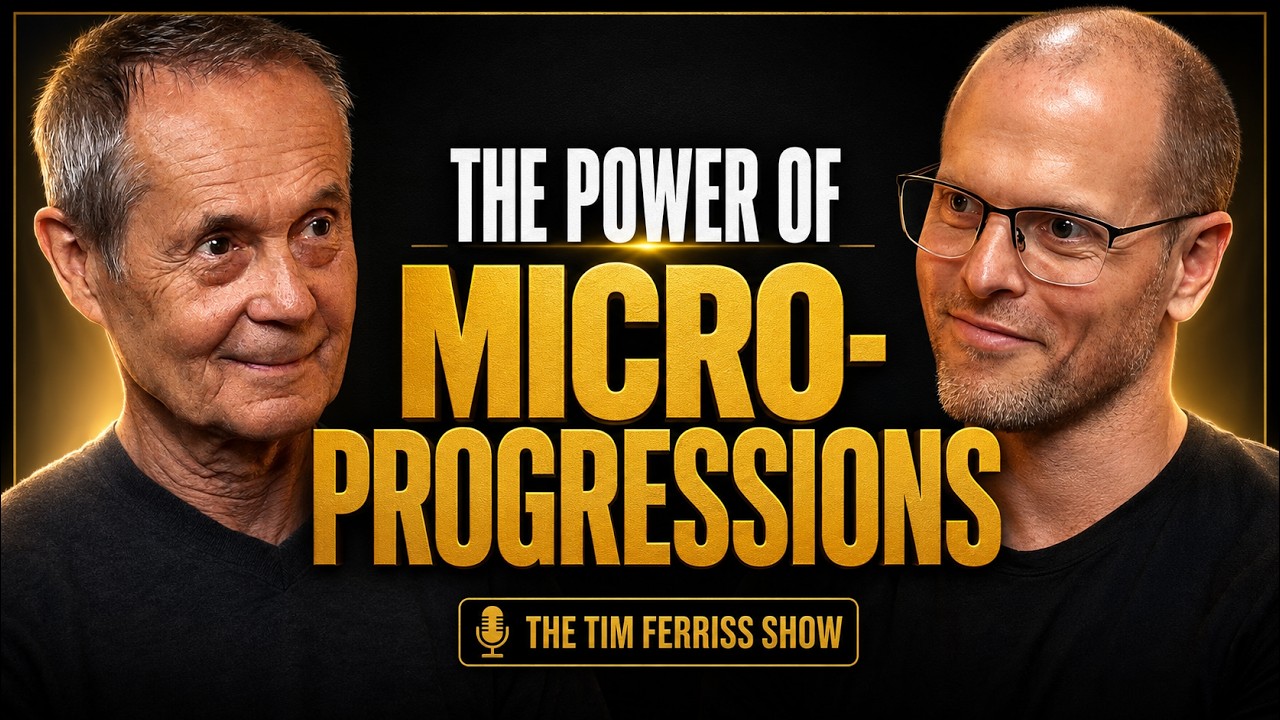
Dave Elitch — How to Get Out of Your Own Way | The Tim Ferriss Show (Podcast)
 Tim Ferriss
Want to know something specific about what's covered?
We've already dissected every moment. Ask and we will deliver (with timestamps).
Key Moments
Drummer Dave Elitch shares insights on mastery, mindset, and avoiding self-sabotage.
Key Insights
Mastery requires slowing down and deliberate repetition, not rushing.
Mental preparedness, including breathwork and mindfulness, is crucial for performance.
External media and technology shape our perception and artistic output.
Diversifying identity and income streams allows for creative selectivity and control.
Overcoming self-imposed blocks and mental fallacies is key to professional and personal growth.
The interconnectedness of disciplines reveals universal principles for success.
THE PHILOSOPHY OF SLOWING DOWN
Dave Elitch emphasizes the core principle of "slow down and do it again," highlighting that true learning and mastery stem from deliberate practice and repetition rather than haste. He explains that rushing hinders the brain's ability to process physical movements, leading to ingrained inefficiencies. This philosophy extends beyond drumming, asserting that a thoughtful, unhurried approach is fundamental to acquiring any skill effectively.
MENTAL PREPAREDNESS AND ATHLETICISM
Elitch likens a performer's preparation to that of an athlete, stressing the importance of physical warm-ups like jump-roping to get the blood flowing and mentally prepare. He advocates for mindfulness practices, such as using Sam Harris's guided meditations, to manage anxiety and achieve a focused state. This mental conditioning allows performers to access an embedded, automatic state, crucial for high-pressure situations where conscious overthinking can lead to errors.
THE MEDIUM IS THE MESSAGE
Drawing on Marshall McLuhan's theories, Elitch discusses how the medium through which information is delivered often has a greater impact than the content itself. He uses examples like Auto-Tune and 'beat detective' software in music production, explaining how these technological tools have fundamentally altered artistic creation and audience perception. This manipulation can lead to a homogenization of sound and a disconnect from authentic expression.
NAVIGATING BURNOUT AND DIVERSIFICATION
Elitch shares his experience of hitting a career wall due to relentless touring and pressure, finding solace and inspiration in visual art. He advocates for diversifying one's identity and income streams, noting how this enables greater selectivity in professional choices. This approach, exemplified by figures like Arnold Schwarzenegger who built financial security before acting, prevents desperation and allows artists to pursue more deliberate, fulfilling paths.
THE INNER GAME AND OVERCOMING PLATEAUS
Inspired by Timothy Gallwey's 'The Inner Game of Tennis,' Elitch explores the concept of the internal dialogue between our analytical 'self-one' and our subconscious 'self-two.' He explains how calming the critical self-talk allows the more automatic, intuitive self to take over, leading to effortless performance. This principle helps performers overcome mental blocks and plateaus by focusing on external sensory cues rather than internal judgment.
INTERCONNECTEDNESS AND TRANSFERABLE SKILLS
A recurring theme is the surprising overlap and transferability of skills and philosophies across different disciplines. Elitch highlights how principles from drumming, public speaking, sports psychology (like Andre Agassi's mental approach), and meditation share foundational concepts. This acknowledgment of interconnectedness reinforces the idea that individuals can leverage meta-skills, developed in one area, to excel in entirely new fields.
THE VALUE OF PATIENCE AND EFFICIENCY
Elitch, through his teaching and playing, imparts the virtue of patience, particularly with oneself and the learning process. He contrasts this with the common trap of rushing through technical development, which can lead to physical injury and limited artistic vocabulary. True efficiency, he suggests, comes from understanding biomechanics and allowing skills to develop organically, as seen in mastering instruments like the violin or saxophone.
REFRAMING FAILURE AND DISAPPOINTMENT
Discussing past disappointments, such as not getting a gig, Elitch emphasizes the importance of viewing these events as opportunities for growth rather than definitive failures. He notes that a rejected opportunity might actually be a blessing if it steers one away from an ill-fitting situation. This positive reframing, combined with experience and external successes, allows individuals to navigate setbacks constructively.
THE PSYCHOLOGY OF MEDIA AND CONSUMERISM
Elitch delves into the societal impact of media and marketing, referencing Edward Bernays and the concept of manufacturing consent. He explains how consumerism is engineered to fulfill psychological voids, influencing individual choices and collective behavior. Awareness of these manipulative tactics can empower individuals to question their desires and make more autonomous decisions.
IDENTIFYING AND UNLEARNING HABITS
Through his therapy work, Elitch has learned to identify and unlearn ingrained negative patterns, such as his tendency to 'police' minor social infractions. He recognizes these behaviors as learned needs for control, often stemming from external influences. This self-awareness is a crucial step in developing healthier emotional responses and personal interactions.
THE IMPORTANCE OF PHYSICAL AND MENTAL WELL-BEING
The conversation touches upon the physical toll that demanding careers can take, as well as the psychological strain. Elitch's approach to drumming as an athletic endeavor and his emphasis on breathwork and mindfulness underscore the symbiosis between physical and mental health. Prioritizing well-being is presented not as a luxury, but as a necessity for sustained performance and fulfillment.
MODERN WORK AND THE SEARCH FOR MEANING
Elitch and Ferriss discuss the modern challenges of finding meaning in work, especially when a career path becomes routine. The initial excitement of achieving goals can wane, leading to a search for new motivations. This often involves exploring creative outlets, developing new skills, or re-evaluating one's purpose beyond professional accolades.
SELECTIVE EFFORT AND THE POWER OF 'NO'
By diversifying his professional life, Elitch has gained the ability to be selective about his engagements. This allows him to decline opportunities that might be detrimental to his well-being or creative integrity. The ability to say 'no' is presented as a powerful tool for maintaining focus and pursuing work that truly resonates.
ABLIQUE APPROACH TO CREATIVITY
Elitch champions 'oblique strategies' from Brian Eno and Peter Schmidt, cards offering minimalist prompts to break creative blocks. He uses them to jolt himself out of predictable patterns, encouraging unconventional approaches. This idea of finding inspiration through indirect means highlights a broader philosophy of embracing curiosity and the unexpected in creative pursuits.
FINDING CLARITY THROUGH THERAPY
Elitch highlights the profound benefits he's derived from therapy, initially to address recurring relationship issues. He stresses the importance of finding a qualified therapist with whom one connects. Consistent sessions, even when things seem stable, can unlock paradigm shifts and lead to significant personal growth, transforming one's worldview and self-understanding.
Mentioned in This Episode
●Products
●Software & Apps
●Companies
●Organizations
●Books
●Concepts
●People Referenced
Dave Elitch's Principles for Skill Development & Well-being
Practical takeaways from this episode
Do This
Avoid This
Common Questions
Dave Elitch's philosophy, emblazoned on his t-shirt, emphasizes the importance of approaching learning slowly and with repetition. Rushing through new skills, especially physically demanding ones like drumming, prevents the brain from understanding what the body is doing, hindering muscle memory and true mastery. The 'do it again' part highlights the sheer amount of repetition needed to solidify new skills.
Topics
Mentioned in this video
Super famous musician and pioneer of ambient music (e.g., 'Music for Airports'), co-creator of 'Oblique Strategies'. Praised for his brilliance and interesting approach to music.
Drummer for The 1975 who Dave Elitch taught technique to. George broke his collarbone, leading Dave to fill in for him on tour.
Graphic designer who collaborated with Marshall McLuhan on 'The Medium Is The Massage.'
Author of 'Ready Player One', mentioned as having written a book that captured Spielberg's attention.
A well-known relationship coach and therapist, mentioned as someone even other relationship coaches might seek advice from.
Actor in 'Taxi Driver', incorrectly referenced as starring in 'Taxi' with Al Pacino.
Actress and musician Dave Elitch has worked with.
Comedian who has a humorous bit about 'The Secret' and vision boards, including putting a microwave on her vision board.
Roman philosopher and author of 'The Tao of Seneca'.
Comedian and student of Dave Elitch, who has also appeared on Tim Ferriss's podcast. Dave describes him as brilliant and enjoys discussing the overlap between drumming and comedy with him.
A great drummer in the UK who filled in for The 1975 after Dave Elitch's temporary stint, ensuring the band maintained its characteristic sound.
Author of 'Wild' and podcast host, known for her unusual habit of reassembling sandwiches for uniform bites.
Musician whose success is attributed to creating 'real music', contrasted with highly produced, auto-tuned works.
Slovakian philosopher cited for his quote about humans being the only animals for whom existence is a problem to be solved, and his observation about consumerism leading to permanent change.
World-class drummer, educator, and guest on The Tim Ferriss Show. Known for his work with The Mars Volta and as a 'drumming whisperer'.
Tennis player and author of 'Open', whose autobiography is highly recommended by Dave Elitch for its insights into psychological warfare in sports performance.
Author of 'Facing Love Addiction' and a therapist whose books are recommended by Dave Elitch's own therapist.
Chess prodigy and martial artist, known as the basis for 'Searching for Bobby Fischer' and author of 'The Art of Learning'. Dave Elitch recommends his book to all his students.
Author of 'The Inner Game of Tennis', whose principles align with Zen Buddhism and apply to various disciplines beyond tennis.
Author of 'Generation X' and a visual artist, recommended by Dave Elitch for his social commentary and inspiring creativity. He is rumored to work at Google.
Artist Dave Elitch has worked with.
BBC documentary filmmaker whose works 'The Century of the Self' and 'HyperNormalisation' profoundly influenced Dave Elitch's worldview.
Drummer for The Smashing Pumpkins and a friend of Dave Elitch. They discussed the challenges of reaching career goals and feeling 'well, duh, of course I did it' mentality.
Author of 'The Graveyard Book', whose audiobook narration is specifically praised.
The singer for The 1975, who told Dave Elitch that his drumming, while good, sounded like 'The 1975 with Dave Elitch,' prompting Dave to reframe the feedback as a compliment.
Best-selling author who recommended 'Nonviolent Communication' to Tim Ferriss.
Social and media theorist from the 1950s-60s, author of 'The Medium Is The Massage/Message'. Dave Elitch finds his predictive ability regarding media consumption decades ahead of his time.
Artist (musician) a drummer Dave Elitch worked with had previously played for, who experienced brain issues controlling his foot due to tour monotony.
Artist Dave Elitch has worked with.
Pop artist Dave Elitch has worked with, involving massive stage productions and demanding the same notation be played consistently.
Arnold Schwarzenegger's friend and business partner in a brick-laying business.
Legendary drummer for Led Zeppelin, mentioned as an inspiration for many drummers, including Bill Burr.
Neuroscientist and author known for his guided meditation exercises. Dave Elitch credits his meditations with helping him relearn how to breathe and manage anxiety.
Sigmund Freud's nephew, who pioneered propaganda and public relations tactics, using subconscious theories to control human behavior through consumerism. Credited with shaping modern American society and the idea of buying products to express oneself.
Actor mentioned as an example of the desired type of actor during Arnold Schwarzenegger's early career, contrasting with Schwarzenegger's physique.
Mentioned as an example of someone who diversified his identity and income (real estate, mail-order, brick laying) before achieving film success, allowing him to be selective in his career path.
Actor starring in the film 'St. Vincent,' which Dave Elitch worked on.
Author of 'Nonviolent Communication,' recommended by Neil Strauss.
His theories on the subconscious were taken by his nephew, Edward Bernays, to develop modern propaganda and PR techniques. Bernays also made Freud famous.
Co-creator of 'Oblique Strategies' alongside Brian Eno.
Expert in human movement and a previous podcast guest, known for emphasizing the importance of breathing in physical positions.
Author of 'Mindfulness', a book Tim Ferriss is currently reading and highly recommends.
Comedian known for his yelling style. Dave Elitch advised Bill Burr not to imitate Kinison, but to find his own distinct comedic voice, similar to finding a unique drumming sound.
The Buddhist equivalent of the devil, who tempts people with his three daughters, referenced in the name of Dave Elitch's band 'Daughters of Mara'.
A philosophy that Dave Elitch found difficult to define until reading 'The Inner Game of Tennis', which applies its principles to skill development.
A collection of letters by Seneca the Younger, described as Tim Ferriss's favorite compilation of letters and a highly recommended book.
Book by Josh Waitzkin, highly recommended by Dave Elitch to all his students for its valuable concepts on mastering skills.
A phenomenal autobiography by Andre Agassi, highly recommended by Dave Elitch for its insights into sports psychology and dealing with pressure, even for non-tennis fans.
A book mentioned by Tim Ferriss as one he is reading and finding very interesting.
A book mentioned as being regularly recommended by Dave Elitch's therapist, indicating its significance in understanding relationship issues.
A book by Ernest Cline, recommended for its fantastic writing and for inspiring a major film by Spielberg.
A book by Marshall McLuhan and Quentin Fiore, originally titled 'The Medium Is The Message' but humorously misprinted. It explores how the medium of information delivery is more impactful than the content itself.
A book by Timothy Gallwey, published in 1974, which profoundly influenced Dave Elitch's understanding of Zen Buddhism and calming the 'critical self' (Self 1) to allow subconscious action (Self 2).
A Dr. Seuss book humorously mentioned by Tim Ferriss as part of the many books Dave Elitch might recommend.
A fiction book by Neil Gaiman, recommended as a way to convert non-fiction readers into fiction lovers.
A book by Marshall Rosenberg with a peace sign on the cover, recommended by Neil Strauss.
A book by Douglas Coupland, praised as great social commentary from the early 90s, and the origin of the 'Generation X' term.
A book written by Cheryl Strayed, an excellent author and podcast host.
A popular self-help book that Maria Bamford humorously references in her comedy about manifesting desires.
A book and movie based on Josh Waitzkin's life as a chess prodigy.
A classic book that Dave Elitch frequently recommends, which applies Zen principles to mastering a skill.
A company where Douglas Coupland is rumored to work, described as gathering interesting, eclectic individuals.
Rock band whose legendary drummer, John Bonham, is an inspiration to many, including Bill Burr.
The company that bought out EMI, which led to the demise of Dave Elitch's band, Daughters of Mara.
A service providing audiobooks, including bestsellers, how-to guides, and memoirs. Praised for its wide selection, audiobook exchanges, rollover credits, and permanent library ownership.
A drum kit brand, specifically an early seventies green Sparkle Ludwig Kit with a giant 26-inch bass drum, used by Bill Burr when first studying with Dave Elitch.
A record label that owned Virgin Capitol Records and was bought out by Terra Firma, leading to the end of Daughters of Mara.
An animated film Dave Elitch worked on, composing film scores through sight-reading.
A BBC documentary series by Adam Curtis that explores the history of public relations and how psychological theories shaped consumerism and politics, starting with Edward Bernays.
A movie starring Bill Murray that Dave Elitch worked on, composing film scores through sight-reading.
A film Dave Elitch composed a score for.
A film mentioned in the context of actors popular at the time Arnold Schwarzenegger was starting his film career, contrasting with Schwarzenegger's image.
A film series Dave Elitch worked on, composing film scores through sight-reading.
A Wolverine film that Dave Elitch worked on as a scoring musician.
An ambient music album by Brian Eno, designed to have no beginning or end, allowing listeners to tune in and out. Discussed as an example of McLuhan's ideas.
A documentary by Adam Curtis, mentioned alongside 'The Century of the Self' as a world-changing film.
A film series Dave Elitch worked on, composing film scores through sight-reading.
A software program used by drummers to artificially adjust their timing to a grid, which can make music sound stiff and robotic. Dave Elitch notes it removed the 'soul' from music.
Cloud accounting software that helps small business owners with invoicing, payments, time tracking, and expenses. Recommended for its efficiency and ease of use.
Dave Elitch's online course, praised by Tim Ferriss as 'awesome' for its teaching philosophy.
A software used to correct vocal takes, which has evolved to change the very sound and perception of voices in music, notably in hip-hop. It exemplifies how a medium can shape the message.
American progressive rock band with whom Dave Elitch toured in 2009-2010, which significantly raised his profile. Known for complex music and dynamic live performances.
A British television channel for which The 1975 was slated to perform, emphasizing the need for their distinct sound.
The record label Daughters of Mara was signed to. The band ended when the parent company, EMI, was bought out.
British pop rock band whose drummer, George Daniel, Dave Elitch taught. He also filled in for George when he broke his collarbone during a tour.
Band with which Brian Eno first gained fame before pioneering ambient music.
Electronic music band Dave Elitch has worked with. He experienced auditory hallucinations while playing a simple section of their music due to monotony.
Dave Elitch's debut band, which released the album 'I Am Destroyer' in 2007. The name refers to the Buddhist concept of Mara's daughters tempting people.
Rock band whose drummer, Jimmy Chamberlin, is a friend and colleague of Dave Elitch.
More from Tim Ferriss
View all 696 summaries 127 min
Reimagining Biotech with Jake Becraft of Strand Therapeutics — Tim’s Founder Kitchen
 132 min
Reversing Type 2 Diabetes and Rowing 2,750 Miles — Sami Inkinen of Virta Health
 71 min
The Most Incredible Transformation I’ve Ever Seen — Jerzy Gregorek on Cerebral Palsy and Coaching
 34 min
PRISONER NO MORE: The True Story of Tae Jin Park
Ask anything from this episode.
Save it, chat with it, and connect it to Claude or ChatGPT. Get cited answers from the actual content — and build your own knowledge base of every podcast and video you care about.
Get Started Free