Key Moments
#AIS: Joe Lonsdale on the problem with higher education
 All-In Podcast
Key Moments
Joe Lonsdale criticizes higher education's dogma, advocates for truth-seeking and debate, and discusses societal decline and potential fixes.
Key Insights
Higher education institutions have shifted from promoting debate and truth-seeking to enforcing dogma, stifling intellectual dissent.
Societal decline is linked to a loss of classical virtues, embracing victimhood culture, and a lack of intellectual humility.
Ineffective, unaccountable government programs and policies, particularly in areas like homelessness and vocational training, waste resources and fail to solve problems.
The 'housing first' strategy for homelessness is flawed, incentivizing negative behaviors instead of productive solutions.
A new non-profit university, UATX, is being founded to champion liberal arts, interdisciplinary studies, and a return to vigorous debate and truth pursuit.
The growing divide between the professional/educated class and the working class is a significant source of societal tension and political strife.
THE PROBLEM WITH HIGHER EDUCATION AND DOGMA
Joe Lonsdale argues that contemporary higher education has strayed from its roots of fostering debate and truth-seeking, instead becoming a bastion of dogma. He likens this shift to a form of virtue-signaling religion where dissent is met with ostracization, reminiscent of historical accusations of heresy and blasphemy. This environment discourages critical thinking and genuine intellectual exploration, prioritizing ideological conformity over the pursuit of knowledge.
THE CAUSES AND SYMPTOMS OF SOCIETAL DECLINE
Lonsdale links societal decline and decadence to a departure from the principles of the Enlightenment, which championed the pursuit of truth and competition of ideas. Key contributing factors he identifies include the erosion of classical virtues such as justice, wisdom, temperance, and courage, and the rise of a victimhood mentality. This is exacerbated by a lack of intellectual humility and a failure to respect the dignity of those who hold opposing views.
INEFFECTIVE POLICY AND UNACCOUNTABLE INSTITUTIONS
Many societal problems, such as homelessness and underperforming vocational schools, are exacerbated by flawed policies and a lack of accountability. Lonsdale uses the example of the 'housing first' strategy for homelessness, which, despite substantial investment, often fails to address root causes and can even incentivize detrimental behaviors. Similarly, vocational schools that are not tied to student outcomes, like future salaries, often remain ineffective.
EDUCATION INEQUALITY AND THE NEED FOR CHOICE
Education inequality in the United States is presented as a more significant issue than wealth inequality. Lonsdale advocates for school choice, particularly for disadvantaged students, as a mechanism to introduce competition and improve educational outcomes. This approach, he suggests, can put pressure on underperforming schools and foster a more responsive and effective education system, benefiting those most in need.
THE FOUNDING OF UATX: A NEW UNIVERSITY MODEL
Responding to the perceived failures of traditional higher education, Lonsdale and collaborators are launching the University of Austin (UATX). This non-profit institution aims to be a competitor to top universities by fostering interdisciplinary studies, a rigorous curriculum focusing on the history of thought and civilization, and a commitment to open debate. The goal is to create an environment where intellectual humility, respect for diverse viewpoints, and a passion for truth are paramount.
THE ELITE-WORKING CLASS DIVIDE AND INSTITUTIONAL POWER
A significant societal tension arises from the growing divide between the educated professional class, which tends to hold far-left sociocultural views, and the working class. Lonsdale argues that while the working class has the numbers, the professional class controls key institutions, leading to a disconnect between the views of the elite and the majority of the country. This imbalance fuels political strife and contributes to an environment where open debate is suppressed.
THE IMPORTANCE OF DEBATE AND DISAGREEMENT
Lonsdale emphasizes the critical role of vigorous debate and the courage to challenge prevailing narratives. He criticizes the modern tendency to avoid offense and create 'safe spaces,' arguing that true progress requires confronting uncomfortable ideas and developing resilience. The willingness to be offended, he suggests, can be a catalyst for learning and strengthening civilization, echoing historical admiration for 'heretics' who challenged established norms.
THE TRANSFORMATION OF POLITICAL PARTIES
The political landscape is shifting, with parties increasingly aligning around the cultural and political divide. Historically, the Democratic Party was the party of the working class, but it has moved towards representing the professional class and embracing a 'woke' sensibility. Conversely, the Republican Party is transforming into a more populist, working-class party. This realignment reflects the broader societal divisions based on education and cultural values.
Mentioned in This Episode
●Software & Apps
●Companies
●Organizations
●Concepts
●People Referenced
Common Questions
Joe Lonsdale argues that many universities have been conquered by dogma and ideology, leading to a lack of intellectual humility, respect for dignity, and a passion for truth. This environment stifles open debate and critical thinking, creating a climate where dissent is punished.
Topics
Mentioned in this video
Mentioned as an example of someone whose ideas are exciting for civilization, and whose company (The Boring Company) is working on infrastructure in Austin.
Mentioned alongside Matt Taibbi regarding the political and cultural divide in America based on having a college degree.
Mentioned alongside Glenn Greenwald regarding the political and cultural divide in America based on having a college degree.
Co-founder of a new university in Austin with Joe Lonsdale and others.
Mentioned as someone who tweeted about the website 'what the fuck happened in 1971.com,' prompting discussion about socio-economic changes.
Quoted for his view that heretics are virtuous men, possessing courage and other virtues necessary to challenge established norms.
The host, who is discussed by Joe Lonsdale regarding the duty of successful people to fix societal problems.
Appears to be the podcast host, and is referred to at the end of the discussion.
Co-founder of a new university in Austin with Joe Lonsdale and others.
Mentioned as a source of funding for non-profits working on homelessness across the country.
A law school where a professor is considering leaving due to a shift away from the Socratic method and increased focus on avoiding triggering students.
Mentioned as an institution run by the professional class whose views are in tension with the majority of the country.
Mentioned as a benchmark for the size of the initial incoming class for the new university being founded.
Elon Musk's company working on infrastructure, specifically tunnels, mentioned in the context of Austin's infrastructure plans.
Referred to as a program that, while intended for good, contributed to the breakdown of the family structure.
Traced as the origin of exponential growth in civilization and wealth, and the foundation for societies that value the pursuit of truth and competition of ideas.
A strategy for addressing homelessness that is criticized for a lack of pay-for-performance, transparency, and accountability.
Acknowledged to have some truth and positive aspects, but criticized for leading to increased deaths in the Black community due to harmful ideas.
More from All-In Podcast
View all 409 summaries 77 min
Trump-Xi Summit, Benioff: "Not My First SaaSpocalypse," OpenAI vs Apple, Multi-Sensory AI, El Niño
 96 min
How We Grew Koch Inc. to $150 Billion Without Going Public: Charles & Chase Koch
 72 min
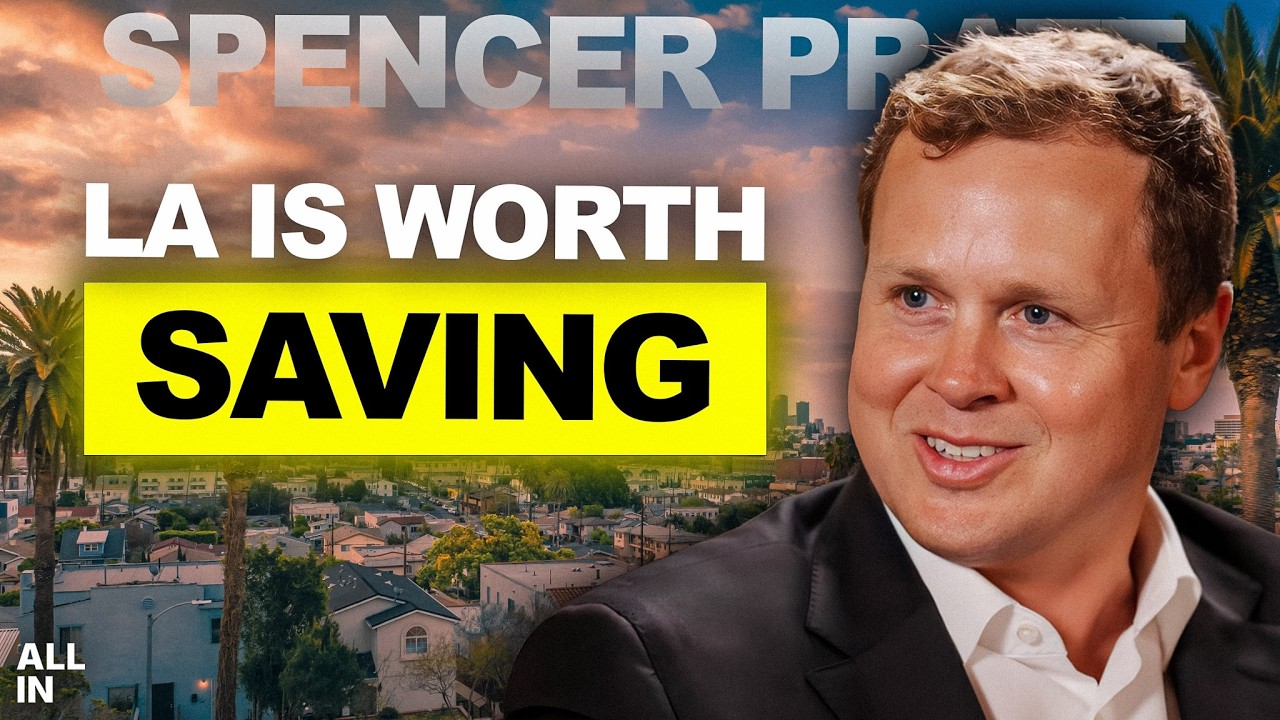
Spencer Pratt on Fixing LA: Wildfires, Homelessness, Corruption & the Fight to Take It Back
 83 min
Elon’s Anthropic Deal, The Next AI Monopoly?, “FDA for AI” Panic, Trading the AI Boom
Ask anything from this episode.
Save it, chat with it, and connect it to Claude or ChatGPT. Get cited answers from the actual content — and build your own knowledge base of every podcast and video you care about.
Get Started Free