Key Moments
OpenAI’s Head of ChatGPT: We’re entering a new era of AI (again) | Tibo Sottiaux
 Lenny's Podcast
Key Moments
OpenAI's ChatGPT head reveals most internet actions will be agent-driven, but building for this requires a scale most overlook. Agents are becoming central, but true seamless integration is years away.
Key Insights
The majority of internet interactions will soon be handled by AI agents, requiring products to be built for significant scale.
OpenAI's new 'Dots' platform is designed as a highly intelligent agent that learns user goals and preferences over time, moving beyond simple loops and graphs.
OpenAI is committed to an open ecosystem, allowing partners to deploy products to their 1.2 billion users and offering a revenue-sharing model for popular plugins.
The development of AI agents and seamless multimodal interaction (voice, visuals) will lead to radical shifts in how we work, moving beyond current clunky interfaces.
Despite rapid AI advancements, OpenAI prioritizes safety and alignment, investing heavily in secondary monitoring and security measures for their models.
The future of work with AI will involve more fluid collaboration between humans and agents, potentially reducing the need for constant screen time and intense focus.
The agent-driven internet and the need for scale
The core prediction is that most actions on the internet will soon be executed by AI agents. This fundamental shift means that for products to succeed in this future, they must be built with a significant level of scalability in mind. The current approach to building AI often overlooks this, focusing on incremental improvements rather than anticipating the massive user base and interaction volume agents will bring. Tibo Sottiaux likens it to imagining a future that's ten times better than today but building in a way that might not accommodate that scale, suggesting a need to rethink development strategies now. The implication is that products not designed for this agent-centric future will struggle to gain traction.
Dots: OpenAI's vision for a learning personal agent
OpenAI's new personal agent platform, Dots, represents a significant step towards this agent-driven future. Unlike previous approaches that might focus on creating elaborate loops or graphs for AI to follow, Dots is designed to be a highly intelligent agent that learns directly from user goals and feedback. This learning capability is crucial because it allows the agent to adapt and improve over time without requiring constant manual configuration. The goal is to move away from meticulously programming every process and towards a system that understands and anticipates user needs organically. This continuous learning mechanism is central to making agents truly useful and personalized.
Seamless multimodal interaction and the radical shift in work
The way we interact with technology is poised for a radical transformation. While AI integration with voice and other multimodal inputs is improving, it still feels somewhat clunky. The vision is a future where interacting with AI is as natural and fluid as conversing with another human, with the AI remembering everything with perfect fidelity. This includes intuitive interfaces where users can draw, brainstorm, and collaborate with both humans and agents in shared spaces, much like a shared whiteboard. This evolution promises to move beyond the limitations of current chat interfaces and numerous single-purpose clients, creating a more integrated and less demanding technological experience. The current state, however, is still some way off from this ideal, indicating a significant transformation ahead.
OpenAI's commitment to an open ecosystem
OpenAI is doubling down on creating an open ecosystem, a move they believe will be crucial for future growth. This includes partnerships like the one with ChatGPT, allowing other developers to deploy their products and reach OpenAI's vast user base of approximately 1.2 billion users. They are also introducing a revenue-sharing model for popular plugins that see significant usage. This strategy aims to foster innovation by enabling external developers to build and distribute their creations, thereby expanding the utility of OpenAI's platforms. The success of these plugins hinges on their quality and user retention, with OpenAI planning to recommend them based on their actual utility and impact.
The evolution of work and the role of AI
The rapid advancements in AI are fundamentally changing daily life, particularly for engineers and many other professions. The current transition feels profound, but the belief is that radical changes will continue. The ideal future involves technology that is not just passively available but actively assistive, seamlessly integrating into workflows. This could mean AI agents handling tasks in the background, allowing humans to focus on higher-level thinking and creativity. The aim is to reduce the 'friction' of technology, making it a true enabler rather than a constant demand on attention, potentially leading to fewer meetings and more productive, relaxed workdays.
Balancing autonomy with responsibility in AI development
OpenAI fosters a culture of high autonomy, where employees are empowered to make decisions and take initiative. This means individuals can 'press the reset button' when necessary and are trusted to build and innovate. However, this autonomy comes with a strong sense of responsibility for mistakes. If something goes wrong, the expectation is to fix it quickly or learn from the error. This environment, while potentially leading to occasional disruptions, is seen as crucial for rapid innovation and employee empowerment, allowing for direct engagement with the community without excessive bureaucratic hurdles.
The long-term implications of agent-driven interactions
The widespread adoption of AI agents will have significant secondary effects, one of which is the necessity for products to be built for extreme scale. Companies like Notion have experienced this firsthand, seeing massive traffic increases when their platforms become accessible to agents. This puts immense pressure on systems, requiring innovative solutions. The economic implications are also substantial, raising questions about whether to build products with interfaces or rely solely on agent interaction. While delaying traditional interfaces might be possible short-term, the long-term trend suggests agent-driven usage will be the norm, making it crucial to prepare for this shift.
Prioritizing safety and alignment in advanced AI
OpenAI is heavily investing in model alignment and safety, dedicating substantial computing resources to secondary monitoring and security. This includes ensuring agents do not engage in high-risk actions and can be intervened if anything appears abnormal. The focus on safety is paramount, especially as they approach next-level capabilities. The company has a strong sense of responsibility to its 1.2 billion users, emphasizing that what they release must be near-perfect, particularly for non-technical users. This meticulous approach to safety is a source of pride and a critical component of their development philosophy.
Mentioned in This Episode
●Products
●Software & Apps
●Companies
●Organizations
●Books
●People Referenced
Common Questions
Dots is envisioned as the primary way to interact with AI, functioning as a smart, always-on agent that understands user goals and preferences. It aims to free users from constantly interacting with devices, making AI assistance seamlessly available when needed and unobtrusive when not.
Topics
Mentioned in this video
OpenAI's Head of ChatGPT, discussing the future of AI, agent-based interactions, and the evolution of AI development and safety.
A new grad at OpenAI who has risen to manage all compute resources and applications, highlighting his kindness, collaboration, problem-solving, and rapid learning.
Mentioned as a company that uses WorkOS.
An AI model mentioned as being used for technical analysis and code generation, with its features being integrated into ChatGPT.
A primary AI model from OpenAI, discussed in terms of its evolution, integration with other features like Dots, and its widespread user base.
A service or platform that acts as a smart agent, understanding goals and preferences, learning from feedback, and is envisioned as the primary way to interact with AI.
Mentioned as part of the development process for Dots, contributing to its ability to operate 24/7 with high efficiency.
Mentioned as a company that uses WorkOS.
Mentioned as a company that uses WorkOS.
A productivity tool whose integration with ChatGPT is discussed, highlighting its potential for agent-based interactions and the need for scalability.
An AI model mentioned as being excellent and used in the development of the Decisions API.
An API mentioned in relation to the development of the Decisions API, indicating a process of sampling and sending data.
The sponsor of the episode, a platform for measuring the impact of AI adoption across a product lifecycle, helping to evaluate AI vendors and identify bottlenecks.
An earlier iteration or related project to current AI development, mentioned as a potential inspiration for Grok Bot.
An AI bot mentioned as being inspired by Codex Cloud.
Described as OpenAI's most secure and compliant model, developed with extra effort to ensure Dots is completely safe.
A communication platform where a channel was created for a new API development, illustrating the bottom-up innovation at OpenAI.
An API developed at OpenAI, showcasing rapid innovation from the ground up, leveraging existing models like Luna.
A design tool whose integration with ChatGPT is mentioned in the context of revenue sharing and potential for plugins.
The organization where Tibo Sottiaux works as Head of ChatGPT. Discussed in relation to its culture, hiring practices, product launches, and approach to AI safety.
The sponsor of the episode, providing an enterprise SaaS platform that simplifies integrating features like SSO, SCIM, and audit logs for businesses.
Mentioned as a company that, along with OpenAI and others, uses WorkOS.
Mentioned as a company that uses WorkOS.
A company that uses DX to measure the impact of AI on developer productivity.
More from Lenny's Podcast
View all 57 summaries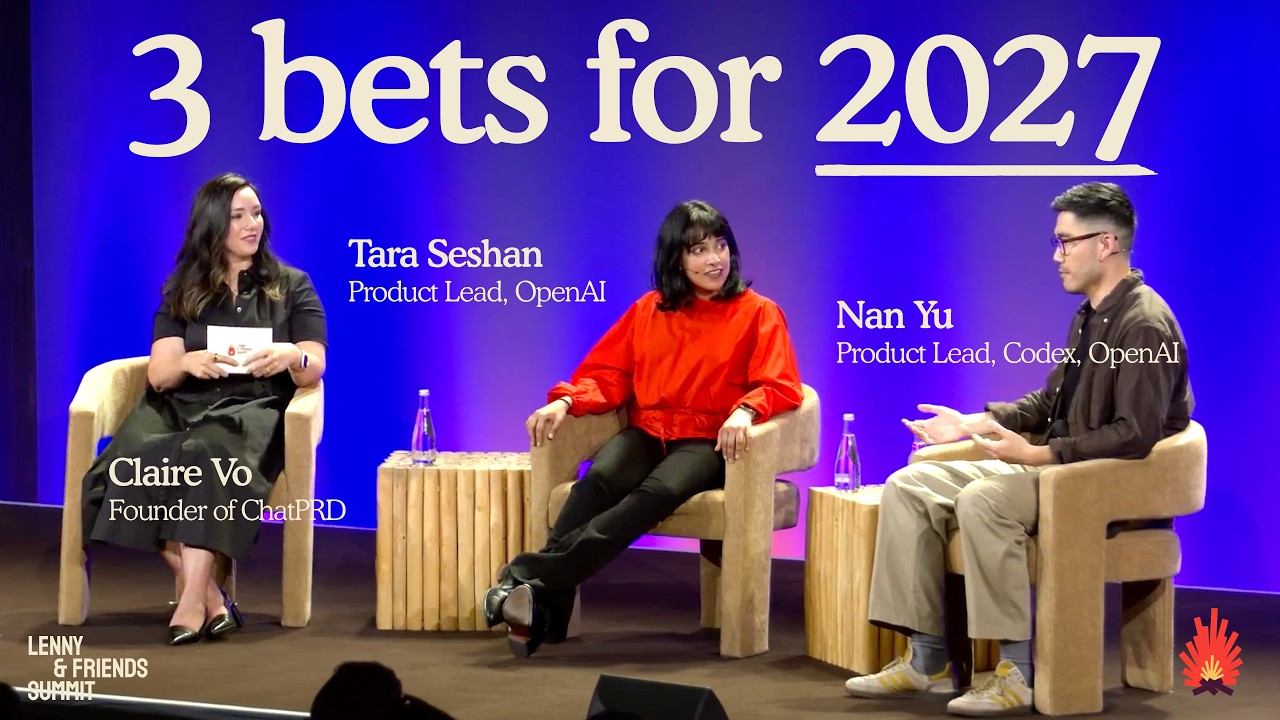 30 min
Stop planning for 2027: how OpenAI builds product 90 days at a time | Tara Sesha and Nan Yu (OpenAI)
 29 min
Why Claude can’t be your PM (yet) | Anthropic CPO Panel
 22 min
Roles aren't converging—they're expanding | Tamar Yehoshua (Atlassian CPO)
 95 min
Molly Graham: The grief, burnout, and opportunity hiding inside the AI transition
Ask anything from this episode.
Save it, chat with it, and connect it to Claude or ChatGPT. Get cited answers from the actual content — and build your own knowledge base of every podcast and video you care about.
Get Started Free