Key Moments
Lisa Randall Interview (Full Episode) | The Tim Ferriss Show (Podcast)
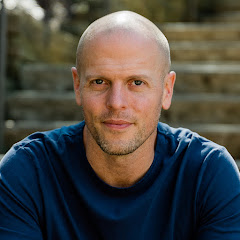 Tim Ferriss
Want to know something specific about what's covered?
We've already dissected every moment. Ask and we will deliver (with timestamps).
Key Moments
Physicist Lisa Randall discusses dimensions, dark matter, and the interconnectedness of the universe.
Key Insights
Physics seeks to understand the fundamental nature of matter and the universe's evolution, with theoretical physics focusing on conceptual frameworks.
Hidden dimensions may exist, not necessarily as tiny spaces, but due to warping of spacetime, making their detection challenging.
Dark matter is matter that interacts gravitationally but not with light, making it invisible; it constitutes a significant portion of the universe's matter.
The universe's expansion is not into anything; rather, space itself is expanding, increasing the distance between objects within it.
Basic science, driven by curiosity, is crucial for uncovering fundamental truths, even if immediate applications are not apparent, often leading to unforeseen advancements.
Effective theories describe phenomena within specific regimes and are not necessarily 'wrong' but are approximations of more fundamental laws.
DEFINING PHYSICS AND THEORETICAL APPROACHES
Physics, at its core, strives to comprehend the fundamental nature of matter, its constituents, and the forces governing them. It probes how the universe evolved to its current state and its overall structure. Theoretical physics, as practiced by Lisa Randall, involves conceptualizing and formulating these principles using tools like mathematics and logic, rather than direct experimentation. This approach focuses on building models and making predictions to understand the underlying connections within the universe.
THE MYSTERY OF HIDDEN DIMENSIONS
The concept of hidden dimensions goes beyond the three spatial dimensions we perceive. These dimensions might be undetectable due to their minuscule size or, as Randall's work suggests, due to the warping of spacetime. This warping can cause gravity to remain localized, effectively hiding extra dimensions from our observations. The title 'Warped Passages' itself alludes to how scaling and geometry can be altered in these additional spatial dimensions, presenting a profound mystery in our understanding of reality.
UNDERSTANDING DARK MATTER AND DARK ENERGY
Dark matter is defined as matter that interacts gravitationally but does not emit, absorb, or reflect light, rendering it invisible. Its name is perhaps misleading, as 'transparent matter' might be more accurate. While we can detect its gravitational influence, its fundamental composition remains unknown. Dark energy, similarly, is a mysterious force contributing to the universe's accelerated expansion. The vast quantities of dark matter compared to ordinary matter suggest profound implications for cosmology and particle physics.
THE EXPANDING UNIVERSE AND THE NATURE OF TIME
The universe's expansion is often misunderstood as an explosion into pre-existing space. Instead, it's the fabric of spacetime itself that is stretching, increasing the distances between galaxies. Regarding time, Randall posits that its flow is a real phenomenon, fundamental to our measurement of change and evolution. While its precise nature and distinction from space remain subjects of deep inquiry, potentially bordering on philosophy, it is intrinsically linked to the universe's progression.
THE INTERCONNECTEDNESS OF EVERYTHING: FROM FUNDAMENTAL PARTICLES TO DINOSAURS
Randall's work, particularly her book 'Dark Matter and the Dinosaurs,' highlights the astounding interconnectedness of the universe. It explores how fundamental forces, like nuclear decay, drive geological processes such as plate tectonics, shaping Earth's surface. Furthermore, it investigates potential connections between astrophysical phenomena like dark matter and significant events in Earth's history, such as the extinction of the dinosaurs, illustrating how cosmic and terrestrial scales are intricately linked.
BASIC SCIENCE VS. APPLIED SCIENCE AND FOSTERING CURIOSITY
Basic science, driven by curiosity and the desire to understand the fundamental workings of the universe, is distinct from applied science, which focuses on practical applications. While basic research may not have immediate uses, it often lays the groundwork for future technological breakthroughs, as seen with quantum mechanics leading to electronics. Fostering curiosity is paramount. Encouraging questions, listening seriously to inquiries, and providing opportunities for exploration are key to nurturing this innate human trait.
THE HIGGS BOSON AND FUTURE FRONTIERS IN PHYSICS
The Higgs boson is crucial evidence for the Higgs mechanism, which explains how fundamental particles acquire mass. Particles interact with a pervasive Higgs field: heavier particles interact more strongly, gaining more mass. While the Higgs boson's mass is surprisingly low, suggesting underlying physics, future research at the Large Hadron Collider aims to understand this anomaly, potentially revealing new symmetries or extra dimensions. Additionally, physicists are actively searching for dark matter particles, hoping for direct detection.
THE SCIENCE OF EMPATHY ANDPERSPECTIVE
Engaging with complex scientific concepts, like those in physics, can foster empathy and broaden one's perspective. By understanding phenomena far removed from our everyday experience, such as quarks or the vastness of the cosmos, we learn to value and consider realities beyond our immediate perception. This ability to step outside one's own viewpoint is as essential in science as it is in social interactions, allowing for a more comprehensive understanding of ourselves and the world.
Mentioned in This Episode
●Products
●Software & Apps
●Companies
●Organizations
●Books
●Concepts
●People Referenced
Common Questions
Theoretical physics aims to understand the fundamental nature of matter, how it works, and the physical processes by which things happen. Unlike experimental physics, it involves thinking about how to tie observed phenomena together in a theoretical sense, often using just pencil and paper to formulate underlying connections and forces.
Topics
Mentioned in this video
A public high school in New York City that Lisa Randall attended, emphasizing the importance of good public schools.
The institution where Lisa Randall was a professor around age 30, and where a friend runs a parish that found her book to make a lot of sense.
The institution where Lisa Randall is a professor of theoretical physics.
The university where Lisa Randall was the first tenured woman in the physics department.
Co-discoverer of the structure of DNA, mentioned alongside Watson to illustrate the point of basic research not having immediate applications.
Professor of theoretical physics at Harvard, who researches particle physics and cosmology. She was the first tenured woman in Princeton's physics department and the first tenured female theoretical physicist at Harvard.
Astrophysicist quoted by Tim Ferriss as saying dark energy is 'the most profound mystery in all of science.'
Physicist mentioned by Tim Ferriss as one of his heroes, and whose books he read extensively.
Physicist quoted by Tim Ferriss, stating 'empty space is not empty' in the context of dark energy.
Podcast guest mentioned by Tim Ferriss for discussing the connection between physical brain injury and changes in personality, relevant to the afterlife debate.
Co-discoverer of the structure of DNA, mentioned as an example of basic science where the researchers were not initially trying to solve specific diseases like cancer.
Author of 'I Capture the Castle,' a book Lisa Randall often gives as a gift.
Physicist whose recognition is cited as an example of how established physicists need to read and appreciate the work of others, even those less known.
A theoretical framework suggesting that the fundamental nature of matter consists of oscillating strings rather than elementary particles, an area where Lisa Randall's work sometimes interfaces.
Experimental evidence confirming the theory of how particles acquire mass, linked to the Higgs mechanism and the Higgs field that spreads throughout space, giving heavier particles more interaction.
Fundamental laws of classical mechanics discussed as an example of an 'effective theory' that works well within a specific regime but is superseded by quantum mechanics and relativity at other scales.
A type of matter that interacts gravitationally but not with light, making it 'transparent.' It constitutes about five times more energy than ordinary matter in the universe.
Described as 'the most profound mystery in all of science' by astrophysicist Michael Turner, it refers to the empty space that is not truly empty.
A theoretical framework mentioned in the context of large programs in physics that don't yet directly connect to the observable universe.
Used as an analogy for understanding and valuing something, where direct experience fosters appreciation more than simply reading about it.
The borough in New York City where Lisa Randall grew up, which she wanted to leave to attend high school in Manhattan.
The New York City borough where Lisa Randall desired to attend high school for the social experience and individual freedom it offered.
Lisa Randall's book, subtitled 'The Astounding Interconnectedness of the Universe,' which explores the connections between dark matter and the extinction of dinosaurs.
A young adult novel by Dodie Smith, highly recommended by Lisa Randall as a gift, for its themes of art, understanding the world, and being surrounded by eccentric people.
A book by Richard Feynman that Tim Ferriss read, initiating his obsession with the physicist.
Lisa Randall's book about extra dimensions of space, with the title referring to the concept of space being warped.
Lisa Randall's book that explores how physics and scientific thinking illuminate the universe and modern world, discussing the relationship between science and religion and the concept of effective theories.
HG Wells' novel, which Tim Ferriss mentions reading, sparking his interest in time and hidden dimensions.
A scientific instrument where physicists hope to gain insight into the Higgs boson's mass and potentially produce dark matter particles.
New climbing shoes that Lisa Randall purchased for under $100, positively impacting her climbing performance.
A dish rack purchased by Lisa Randall that, despite sounding silly, encourages her to be neater in the kitchen due to its clean and efficient design.
More from Tim Ferriss
View all 703 summaries 70 min
Q&A with Tim — The Art of Male Friendship, Reinvention in The Age of AI, & More
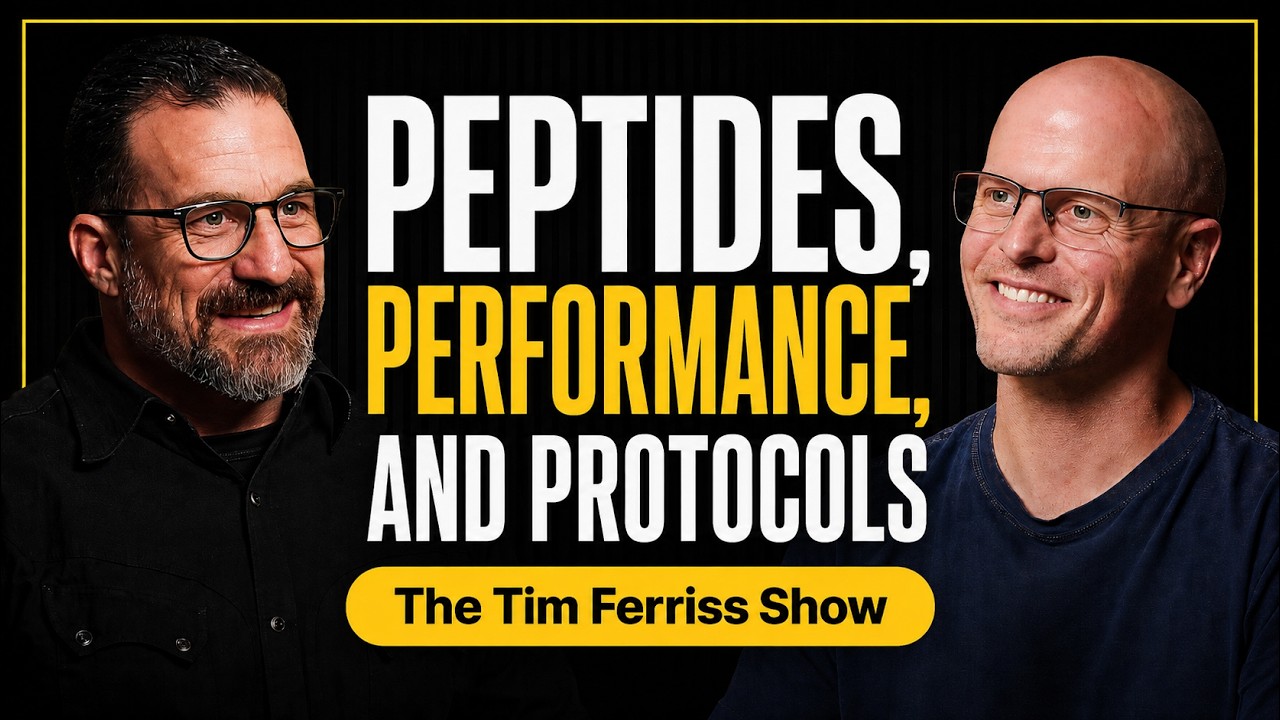 125 min
Dr. Andrew Huberman — Peptides, Performance, and Protocols
 112 min
The Random Show! Mortality, AI, Supplements, Rock Climbing, & More
 88 min
The Legendary Hollywood Power Broker — Guy Oseary on 36 Years of Managing Madonna, 26 IPOs, and More
Ask anything from this episode.
Save it, chat with it, and connect it to Claude or ChatGPT. Get cited answers from the actual content — and build your own knowledge base of every podcast and video you care about.
Get Started Free