Key Moments
Jim Collins — A Rare Interview with a Reclusive Polymath | The Tim Ferriss Show (Podcast)
 Tim Ferriss
Want to know something specific about what's covered?
We've already dissected every moment. Ask and we will deliver (with timestamps).
Key Moments
Jim Collins shares insights on building great companies, leadership, decision-making, and personal productivity.
Key Insights
The 'conceptual vessel' is crucial for developing and communicating ideas, influencing how we understand and process information.
Level 5 leadership combines personal humility with intense professional will, focusing on the company's success over personal ego.
The 'flywheel' concept illustrates how sustained, disciplined effort in the right direction builds unstoppable momentum, rather than relying on single, dramatic breakthroughs.
Effective time management involves tracking creative hours and prioritizing activities that directly contribute to meaningful output.
Personal well-being and sustained creativity are deeply linked to understanding and optimizing sleep patterns.
Finding your 'Hedgehog Concept' – passion, best-in-world capability, and economic engine – is key to directing personal and organizational efforts effectively.
THE POWER OF CONCEPTUAL VESSELS AND LANGUAGE
Jim Collins emphasizes the profound connection between language and thought, suggesting that the 'conceptual vessel'—the framework or model used to understand an idea—is critical. He uses his experience learning Chinese characters and his research into leadership to illustrate how language and structure shape our understanding. The concept of the 'Level 5 Hierarchy' for leaders, for example, emerged from finding the right way to frame the observed duality of extreme humility and fierce resolve, demonstrating that the chosen vessel significantly impacts how an idea is perceived and applied.
DECONSTRUCTING LEADERSHIP: THE LEVEL 5 FRAMEWORK
Through rigorous comparative research, Collins identified 'Level 5 leaders' as a distinct category crucial for transitioning from good to great. These leaders are characterized by a paradoxical blend of profound personal humility and an unwavering professional will. Unlike their comparison group counterparts who might also possess strong leadership qualities, Level 5 leaders subsume their egos for the greater good of the organization, demonstrating a resolute focus on the company's mission rather than personal aggrandizement. This distinction is not about personality but about a deeper commitment to the enterprise.
THE FLYWHEEL EFFECT: CUMULATIVE MOMENTUM OVER SUDDEN BREAKTHROUGHS
The 'flywheel' concept, central to Collins' work, challenges the notion of radical, overnight transformations. Instead, it posits that significant achievements in companies and personal lives are the result of sustained, disciplined effort applied consistently over time. Like pushing a massive flywheel, initial turns are slow and creaky, but persistent pushing in the right direction builds exponential momentum. This contrasts with the 'doom loop' of chasing dramatic, unvalidated initiatives that ultimately lead to stagnation or decline.
OPTIMIZING PERSONAL PRODUCTIVITY AND CREATIVE OUTPUT
Collins advocates for a disciplined approach to personal productivity, including meticulous tracking of 'creative hours.' This goes beyond simple time management to a focus on activities directly leading to new, potentially durable, creative output. He also highlights the critical role of sleep optimization, not just by counting hours but by understanding quality over longer cycles and adapting personal routines, such as the '20-minute rule' for waking periods. This methodical self-observation allows for continuous improvement and sustained high performance.
THE HEDGEHOG CONCEPT: FINDING YOUR CORE FOCUS
Drawing parallels between organizational success and personal life, Collins introduces the 'Hedgehog Concept'—the intersection of what you are deeply passionate about, what you can be the best in the world at, and what drives your economic engine. For individuals, this translates to identifying what you are 'encoded' for, beyond just what you are good at. This focused approach, visualized as a blank canvas rather than a paint-by-numbers scheme, allows for the creation of a personal masterpiece built on clarity and purpose.
THE JOURNEY OF PETER DRUCKER AND THE ART OF USEFULNESS
Collins shares profound personal experiences with Peter Drucker, the influential management theorist. Drucker's enduring question, 'How do you make society both more productive and more humane?', guided his prolific career. Drucker's advice to focus on 'how to be useful' rather than solely on survival or success, deeply impacted Collins, especially during his own 'Thelma & Louise' moment—a high-stakes bet on his entrepreneurial path. This perspective underscores the importance of purpose-driven action and impactful contribution over mere personal gain.
Mentioned in This Episode
●Products
●Software & Apps
●Companies
●Organizations
●Books
●Concepts
●People Referenced
Common Questions
Jim Collins' senior thesis at Princeton was on the phonetic and semantic acquisition of Chinese characters by native English speakers, exploring different methods for acquiring these complex ideograms and understanding associated cultural thought processes.
Topics
Mentioned in this video
A book by Jim Collins that studies the process by which great companies decline and collapse.
A book by John McPhee describing his writing process and struggles, highly recommended by Tim Ferriss.
A book by Peter Drucker for which Jim Collins wrote the foreword to its 50th-anniversary edition, distilling 10 lessons learned from Drucker.
A pamphlet by Thomas Paine cited as an example of a monograph with appropriate length for its impact, influencing Jim Collins' decision to publish 'Good to Great in the Social Sectors' as a monograph.
A book by Jim Collins exploring how some companies thrive even in unpredictable and turbulent times.
A children's book character metaphorically used by Jim Collins to represent the spirit of curiosity in his research team.
A book co-authored by Jim Collins focused on successful habits of visionary companies, emphasizing enduring success beyond a single leader.
One of Jim Collins' seminal books, which investigates why some companies make the leap from good to great while others do not.
A book and movie based on the life of chess prodigy Josh Waitzkin.
Jim Collins' alma mater, where he completed his senior thesis on Chinese language acquisition.
Where Jim Collins began his research and teaching career, receiving a distinguished teaching award in 1992.
A Denver-based hospital with a sleep lab where Jim Collins underwent a sleep study to better understand sleep science.
A business magazine that selected Jim Collins as one of the 100 greatest living business minds in 2017.
A non-profit organization founded by Wendy Kopp, whose journey aligns with the Level 5 Leadership concept.
A healthcare provider mentioned as an example of an organization with a specific flywheel that starts with getting the right medical professionals.
A linear programming algorithm developed by George Dantzig, referenced by Jim Collins as a way to find optimal solutions by iterative local steps.
A psychological theory that Jim Collins referenced as a similar hierarchical structure to his Level 5 Leadership model.
A concept from 'Good to Great' about simplifying focus to one or a few big things, intersecting passion, being the best, and economic engine. Also has a personal analogy.
Founder of Vanguard, whose Princeton senior thesis on mutual funds led to a major creation, analogous to Wendy Kopp's thesis.
Author of 'Common Sense,' mentioned by Jim Collins to illustrate the concept of a monograph having the 'right size' for its message.
A mentor of Jim Collins at Stanford who taught him about the importance of relationships in life.
The mathematician who developed the Simplex Method, a concept Jim Collins applies to navigating life's choices.
The guest on the Tim Ferriss Show, a renowned management expert, author, and Socratic advisor known for his research on great companies and leadership.
A hugely influential management thinker and long-term mentor to Jim Collins, known for his prolific writing and focus on making society both more productive and humane.
Co-founder of LinkedIn, who, like Jim Collins, has an affinity for Wittgenstein's philosophy, demonstrating the value of language studies.
Psychologist known for Maslow's Hierarchy of Needs, used as an analogy for Jim Collins' Level 5 Leadership hierarchy.
Historical figure used in a rhetorical example by Jim Collins.
An Austrian-born British philosopher whose ideas about the limits of language reflecting the limits of one's world are cited by Jim Collins.
A chess prodigy and martial artist mentioned by Tim Ferriss as having similar 'heuristics' to Jim Collins regarding productivity and learning.
A renowned nonfiction writer and professor at Princeton University who taught Tim Ferriss and greatly influenced his writing and structured thinking.
A former professional basketball player and politician, subject of one of John McPhee's books, 'A Sense of Where You Are'.
A close friend of Tim Ferriss and an 'incredible thinker' who does an exceptional job of using short-form content on Twitter for teaching.
A company where Jim Collins worked for a couple of years after graduate school, though he ultimately realized he wasn't suited for a large company environment.
Jim Collins maintains a Facebook page managed by a team member for postings, though it's not currently a primary focus for 'firing bullets' on social media.
An indoor cycling bike offering live and on-demand studio classes, praised for its convenience, motivation, and effectiveness for home workouts.
An e-commerce and cloud computing giant used as an example of a company that successfully implemented the flywheel concept.
A grocery chain acquired by Amazon, demonstrating the extension of Amazon's flywheel.
A professional networking platform mentioned by Tim Ferriss as an effective tool for hiring the right talent.
An investment management company cited by Jim Collins as an example of successful application of the flywheel concept.
An aerospace company used as an example of extending a flywheel by moving from military bombers to commercial jetliners.
A semiconductor company used as an example of a company that broke out to a totally different level through its strategic decisions.
A famous rock formation in Yosemite Valley, which Jim Collins has ascended in a single day.
The city where National Jewish Health, with its sleep lab, is located.
Another iconic rock formation in Yosemite Valley that Jim Collins has climbed.
A glacial valley in California's Sierra Nevada mountains, famous for its rock climbing, where Jim Collins has completed impressive ascents.
The state where recent fires caused Jim Collins to revisit John McPhee's book 'The Control of Nature'.
More from Tim Ferriss
View all 703 summaries 70 min
Q&A with Tim — The Art of Male Friendship, Reinvention in The Age of AI, & More
 125 min
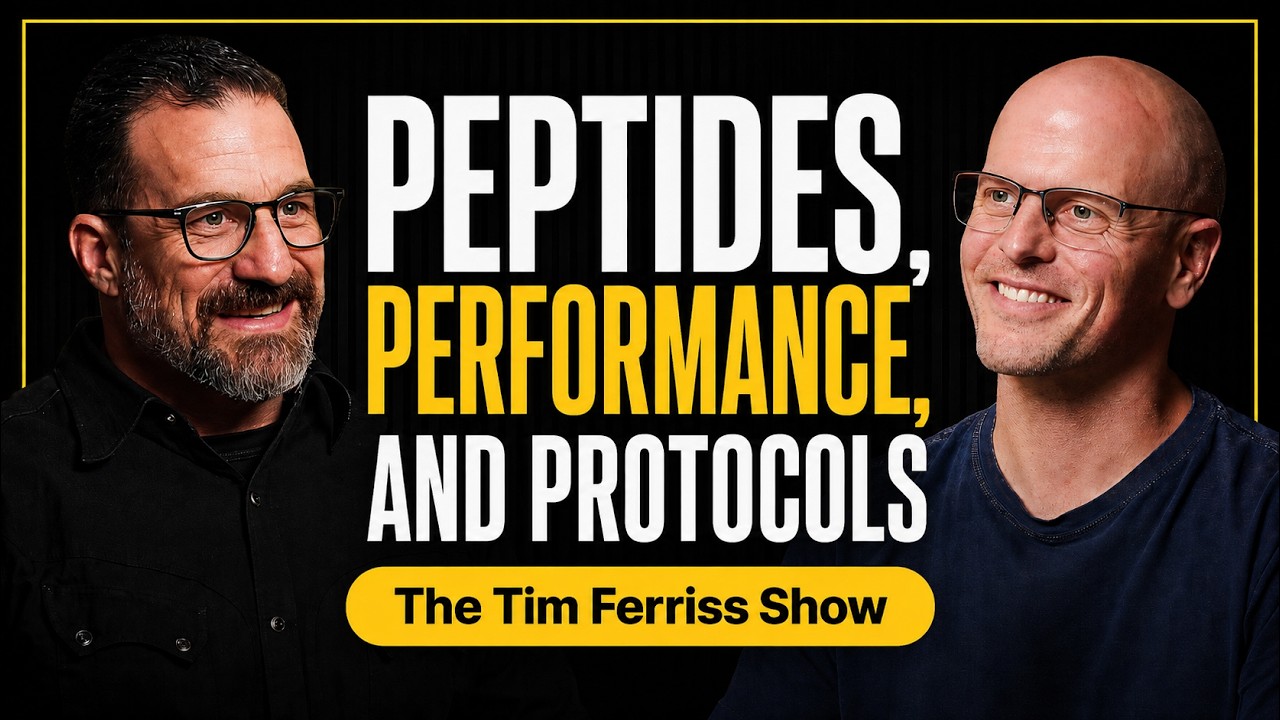
Dr. Andrew Huberman — Peptides, Performance, and Protocols
 112 min
The Random Show! Mortality, AI, Supplements, Rock Climbing, & More
 88 min
The Legendary Hollywood Power Broker — Guy Oseary on 36 Years of Managing Madonna, 26 IPOs, and More
Ask anything from this episode.
Save it, chat with it, and connect it to Claude or ChatGPT. Get cited answers from the actual content — and build your own knowledge base of every podcast and video you care about.
Get Started Free