Key Moments
Jared Isaacman: What went wrong at NASA | The All-In Interview
 All-In Podcast
Want to know something specific about what's covered?
We've already dissected every moment. Ask and we will deliver (with timestamps).
Key Moments
Jared Isaacman discusses NASA's bureaucracy, the space race with China, and his withdrawn NASA nomination.
Key Insights
Isaacman's nomination for NASA administrator was withdrawn due to political factors, not Senate opposition.
NASA suffers from bureaucratic inefficiencies, excessive layers of management, and congressional interference that hinder progress.
The space race with China is a significant concern, as China is rapidly advancing while the US faces internal obstacles.
While Artemis aims for the Moon, a greater focus on developing reusable heavy-lift capabilities and nuclear propulsion for Mars is crucial.
Private industry, like SpaceX, is vital for affordable space exploration, and NASA should leverage these capabilities more.
Budget reductions can be positive forcing functions for change, driving efficiency and focus towards essential, groundbreaking missions.
BACKGROUND AND EARLY PASSIONS
Jared Isaacman, a successful entrepreneur and founder of Shift4 Payments, details his lifelong passion for aviation and space, inspired by 1980s films. His entrepreneurial journey began at 16, leading to a dual career in business and aviation. He pursued a degree at Embry-Riddle Aeronautical University to qualify for the Air National Guard and flew air shows, eventually co-founding Draken International, a company that provided adversary air support for the U.S. military, replicating enemy tactics.
TRANSITION TO COMMERCIAL SPACE
Isaacman's involvement in commercial space began with an early offer to pilot a SpaceX Dragon spacecraft in 2008. This led to the Inspiration4 mission in 2021, the first all-civilian orbital spaceflight, which he commanded and helped raise over $250 million for St. Jude Children's Research Hospital. Following Inspiration4, he continued with the Polaris program, conducting a spacewalk and further scientific experiments, underscoring a commitment to pushing the boundaries of private space endeavors.
NOMINATION AND NASA'S BUREAUCRACY
Nominated by President Trump to lead NASA, Isaacman identified significant bureaucratic issues within the agency. He highlighted excessive layers of management, numerous committees, and a lack of empowered decision-making at lower levels, which impede progress. He proposed streamlining operations to focus on NASA's core mission of achieving near-impossible feats that private industry cannot or will not undertake, such as developing nuclear propulsion and leading ambitious exploration goals.
THE SPACE RACE WITH CHINA AND BUDGETARY CONCERNS
Isaacman expressed serious concern about the U.S. falling behind China in the space race. He noted China's rapid advancement, leveraging a 'second mover advantage' without the historical baggage of bureaucratic processes that slow down American initiatives. He also addressed proposed NASA budget cuts, viewing them as a potential 'forcing function' for greater efficiency. However, he criticized specific proposals like canceling SLS and Orion, advocating instead for a pivot to more sustainable and advanced technologies like nuclear electric propulsion.
THE FUTURE OF LUNAR AND MARS EXPLORATION
Regarding NASA's Artemis program, Isaacman acknowledged the commitment to returning to the Moon but emphasized the need to do so efficiently. He argued that while the Moon is important for potential resources and national security, the ultimate goal should be Mars. He stressed that NASA should focus on enabling factors that commercial companies like SpaceX cannot achieve alone, such as developing nuclear propulsion for faster interplanetary travel and supporting in-situ resource utilization, thereby creating options for humanity's expansion into the solar system.
THE WITHDRAWAL OF HIS NASA NOMINATION
Isaacman detailed the abrupt withdrawal of his nomination for NASA administrator. While stating he doesn't fault President Trump, he indicated that political pressures and potentially an 'anti-Elon' sentiment from certain factions within the administration played a role. He clarified that his past political donations were publicly known and not a new revelation, suggesting other motivations were at play. He remains committed to contributing to national goals, potentially refocusing on his entrepreneurial and philanthropic endeavors.
Mentioned in This Episode
●Supplements
●Products
●Companies
●Organizations
●Studies Cited
●Concepts
●People Referenced
Common Questions
Jared Isaacman was nominated for NASA Administrator due to his extensive experience as an entrepreneur, fighter jet pilot, and commander of pioneering civilian space missions like Inspiration4 and Polaris Dawn. His background was seen as aligning with a vision for a more efficient and innovative space agency.
Topics
Mentioned in this video
An aerospace company focusing on launch vehicles and space technology. Mentioned as part of the robust commercial space industry.
A payment processing company founded by Jared Isaacman, which has grown into a multi-billion dollar public company.
A Chinese rocket company that completed its first sea recovery test, indicating progress in reusability.
A foundation for which Isaacman flew around-the-world record flights and air shows to raise funds.
A potential department where Isaacman was considered for a role during the administration transition.
A branch of the U.S. Armed Forces focused on space operations, created during the Trump administration.
The U.S. federal department responsible for the military. Its budget was cited by Elon Musk in relation to the national debt.
A potential department where Isaacman was considered for a role.
A Russian spacecraft that Isaacman observed launching from Baikonur Cosmodrome.
The specific SpaceX spacecraft used for the Inspiration4 mission, the first all-civilian spaceflight.
NASA's heavy-lift expendable launch vehicle, criticized by Isaacman for being expensive, based on repurposed shuttle hardware, and a 'disposable rocket'.
A World War II fighter aircraft used as an analogy to criticize the continued use of outdated hardware like SLS.
A follow-up mission to Inspiration4, commanded by Isaacman, which included a spacewalk.
The first all-civilian spaceflight mission commanded by Isaacman, using SpaceX's Crew Dragon.
A proposed NASA mission to return samples from Mars, which Isaacman suggests could be done better by human astronauts.
Robotic science missions to Venus that were proposed to be terminated in the budget proposal.
More from All-In Podcast
View all 424 summaries 85 min
World's First Trillionaire, Anthropic Fable Banned, The New Oligarchs, Iran Peace Deal
 102 min
Anthropic's Fable Backlash, Nationalizing AI, Inflation Heats Up & California’s Broken Elections
 68 min
All-In's Best Ideas Pitch Competition: 4 Investors Present Their Top Trades Live
 44 min
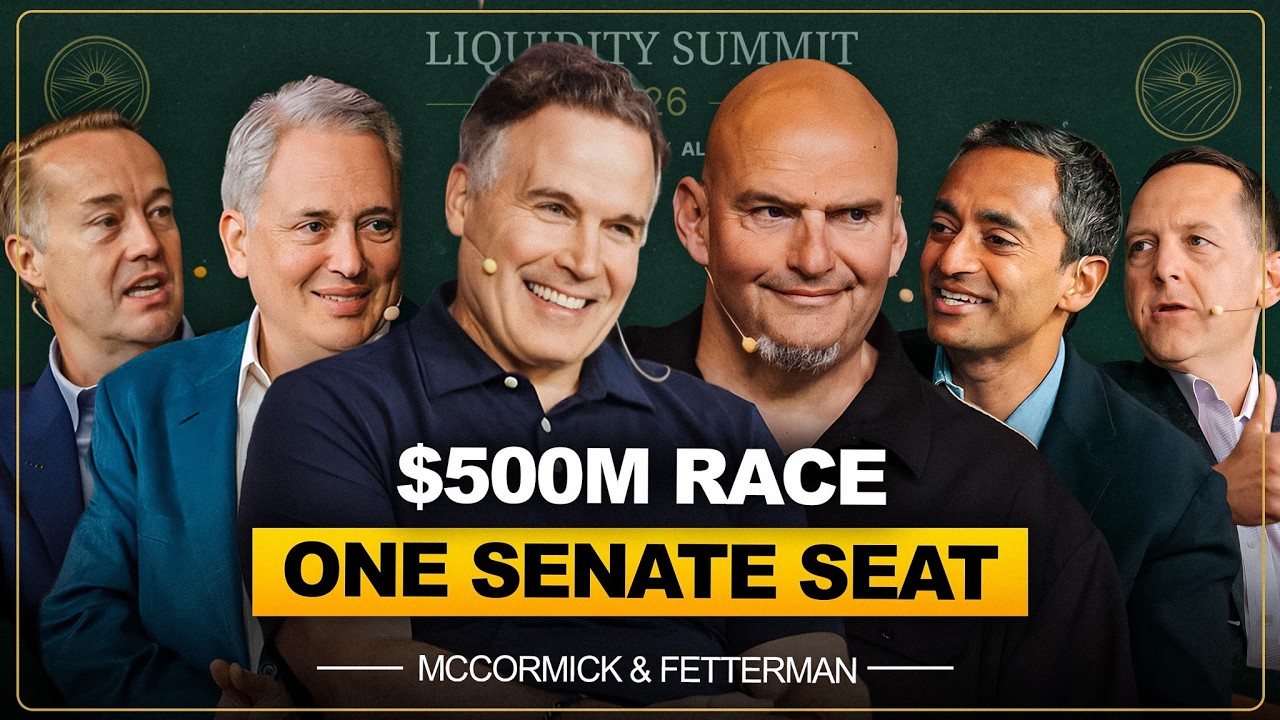
Senators John Fetterman and Dave McCormick: Bipartisanship, Money in DC, Datacenters, Graham Platner
Ask anything from this episode.
Save it, chat with it, and connect it to Claude or ChatGPT. Get cited answers from the actual content — and build your own knowledge base of every podcast and video you care about.
Get Started Free