Key Moments
Is Dark Energy Changing Over Time? | Saul Perlmutter
 Closer To Truth
Want to know something specific about what's covered?
We've already dissected every moment. Ask and we will deliver (with timestamps).
Key Moments
Dark energy may not be constant, with new data hinting it's changing over time, potentially requiring entirely new physics beyond Einstein and current theories.
Key Insights
Dark energy constitutes approximately 68.5% of the universe's energy budget, significantly outweighing ordinary matter.
The discovery of cosmic acceleration (universe speeding up) contradicted the expected deceleration and led to renewed interest in Einstein's cosmological constant.
The discrepancy between the theoretically predicted vacuum energy (10^120 times larger) and observed acceleration is a major challenge known as the 'biggest embarrassment in theoretical physics'.
New, highly precise measurements from Baryon Acoustic Oscillations (BAO) in the last two years suggest dark energy may not be constant, showing a potential 3-sigma disagreement with the cosmological constant.
If dark energy is time-varying, it may not fit existing 'quintessence' models (thawing or freezing) and could represent a completely new phenomenon.
Upcoming instruments like DESI, the Nancy Grace Roman Space Telescope, and the Vera C. Rubin Observatory aim to refine measurements of the universe's expansion history to confirm or refute time-varying dark energy.
The unexpected discovery of cosmic acceleration
The prevailing expectation in cosmology was that the expansion of the universe should be slowing down due to gravity. However, experiments in the late 1990s, utilizing supernovae as standard candles to measure cosmic distances and expansion rates, revealed a startling opposite trend: the universe's expansion is actually accelerating. Saul Perlmutter, a Nobel laureate for this discovery, explains that the data indicated the universe had been slowing down for the first half of its history and has been speeding up for the latter half. This phenomenon, attributed to 'dark energy,' immediately posed a profound mystery: what is driving this acceleration, and why is it happening now? The initial realization came from meticulous measurements aiming to confirm deceleration, underscoring how scientific inquiry can lead to unexpected but transformative findings.
Revisiting Einstein's cosmological constant
The acceleration of the universe brought renewed relevance to Einstein's cosmological constant (Lambda), initially introduced to counterbalance gravity and maintain a static universe, which he later abandoned. This constant can be interpreted as a 'vacuum energy' – a constant background energy inherent to empty space that exerts a negative pressure, effectively pushing spacetime apart. This concept aligns surprisingly well with predictions from quantum mechanics, which suggest that empty space is teeming with virtual particles and fluctuating energy fields. The issue, however, is a colossal disagreement in magnitude: theoretical calculations of vacuum energy predict a value that is staggeringly larger, by a factor of 10^120, than what is observed to be driving cosmic acceleration. This vast discrepancy has been termed 'the biggest embarrassment in theoretical physics,' suggesting that our understanding of vacuum energy or the underlying physics is fundamentally incomplete. For decades, the assumption was that some unknown natural mechanism must perfectly cancel out this overwhelming vacuum energy, leaving only the minuscule observed effect. The discovery of acceleration implies this cancellation is not perfect, or the cause is something else entirely.
The challenge of constant versus time-varying dark energy
The simplest explanation for cosmic acceleration is that dark energy is a constant, akin to Einstein's cosmological constant. In this scenario, as the universe expands, space grows, and with it, more of this constant dark energy, leading to an ever-increasing acceleration. However, recent highly precise measurements, particularly from Baryon Acoustic Oscillations (BAO) combined with supernova and cosmic microwave background data over the last two years, are beginning to suggest something more complex. These updated measurements indicate a potential disagreement (around 3-sigma) with the idea of a constant dark energy. The implication is that dark energy might be changing over time. If dark energy is indeed weakening as the universe expands, it would fundamentally contradict the simplest cosmological constant model. This possibility opens the door to entirely new physics beyond current theoretical frameworks.
Alternative explanations and theoretical pressures
The acceleration of the universe has spurred a torrent of theoretical ideas, with papers published at an astonishing rate. Beyond the cosmological constant, other models like 'quintessence' propose that dark energy is a dynamic field that can change its properties over time. These models typically fall into two categories: those where the dark energy starts strong and weakens ('thawing') or those that start weak and strengthen ('freezing'). However, the latest observational hints suggest that dark energy might not fit neatly into either of these categories, potentially pointing to a completely novel form of dark energy or a different underlying phenomenon. Some theorists have also explored modifying gravity itself at cosmic scales, suggesting that perhaps general relativity, while incredibly successful, might need adjustments on the largest scales to explain the acceleration without invoking a new substance. While the elegance and success of general relativity make this a challenging avenue, it remains an area of exploration.
The role of observational precision and new instruments
Confirming whether dark energy is truly time-varying requires pushing observational precision to unprecedented levels. For 25 years, cosmologists have been striving to make more accurate measurements of the universe's expansion history. Key techniques include studying supernovae, which act as standard candles, and Baryon Acoustic Oscillations (BAO), which are fossilized sound waves in the early universe imprinted on the distribution of galaxies. The Cosmic Microwave Background (CMB) provides a crucial anchor for these measurements. Now, next-generation instruments are coming online to dramatically enhance these capabilities. The Dark Energy Spectroscopic Instrument (DESI) has mapped millions of galaxies, providing a detailed map of the universe's structure and expansion. Future missions like the Nancy Grace Roman Space Telescope and the Vera C. Rubin Observatory will survey vast numbers of galaxies and supernovae with greater accuracy. These instruments are designed to detect subtle changes in dark energy's behavior, potentially distinguishing between different theoretical models with much higher confidence (aiming for 5-6 sigma confirmations).
Addressing potential observational distortions
Achieving the required precision in measuring dark energy's properties is fraught with challenges. Scientists must meticulously account for potential systematic errors or 'distortions' in their measurements. For example, with supernovae, researchers need to ensure that the explosions are truly 'standard candles' and not influenced by factors like the composition of their progenitor stars (which can change over cosmic time due to element enrichment) or their embedding environment. Detailed spectral analysis of supernovae is crucial, as the light emitted during the explosion can act like a 'cat scan,' revealing subtle differences that affect their brightness and thus their distance measurements. While some debate exists on whether such detailed spectral information is essential or if brightness measurements across different filters suffice, the goal is to minimize any potential drift in understanding supernova behavior over cosmic history. Similarly, assumptions about the universe's large-scale homogeneity and isotropy must be continuously re-tested, though strong evidence from the CMB currently supports these principles.
The speculative future: 19 years from now
Looking ahead 19 years, the hope is for an unprecedentedly detailed map of the universe's expansion history back to about 10-12 billion years ago, with error bars so small that 'wiggles' indicative of changing dark energy models can be clearly discerned. This would allow theorists to test catalogable dark energy models against robust data. The success of upcoming observatories like Roman and Rubin, potentially augmented by specialized instruments like the planned private Lazuli telescope to capture high-quality supernova spectra, could provide multiple, converging lines of evidence. Beyond refining current techniques, there's optimism that entirely new methods, such as more advanced strong lensing time-delay measurements or improved weak lensing analysis, might also come into play. The greatest challenge remains ensuring these instruments function flawlessly and yield data that can definitively differentiate between competing theoretical explanations for cosmic acceleration, moving beyond philosophical debates to concrete physical understanding.
Unresolved theoretical challenges
Even if a time-varying dark energy is confirmed, the profound problem of the cosmological constant's magnitude—the 10^120 discrepancy—will likely persist. Some theoretical frameworks, particularly in particle physics and string theory, propose mechanisms, like specific symmetries, that might lead to a perfect cancellation of vacuum energy. If dark energy is not a constant but a dynamic field, it might simplify this problem by not requiring an *almost* perfect cancellation, but rather a complete one, or it might alter the nature of the problem entirely. However, the fundamental question of why the vacuum energy is so precisely zero (or nearly zero) remains a significant hurdle. While new data might guide theorists toward solutions, the underlying theoretical challenge of reconciling quantum field theory with general relativity on this fundamental aspect of empty space will likely continue to be a central puzzle.
Mentioned in This Episode
●Products
●Software & Apps
●Companies
●Organizations
●Concepts
Investigating Dark Energy: Key Considerations
Practical takeaways from this episode
Do This
Avoid This
Common Questions
Dark energy is a mysterious force causing the universe's expansion to accelerate. It constitutes about 68.5% of the universe's energy budget, significantly more than ordinary matter, making it a crucial component in understanding the cosmos.
Topics
Mentioned in this video
The standard model of cosmology, which includes cold dark matter and dark energy, with dark energy comprising about 68.5% of the universe's energy budget.
A technique used alongside supernova measurements and the cosmic microwave background to study the expansion history of the universe and dark energy.
Dark Energy Spectroscopic Instrument, an experiment that has mapped millions of galaxies to represent the universe's expansion history and provided data on dark energy's properties.
A private space telescope being built with the goal of obtaining high-quality spectra of supernovae for cosmological measurements.
More from Closer To Truth
View all 35 summaries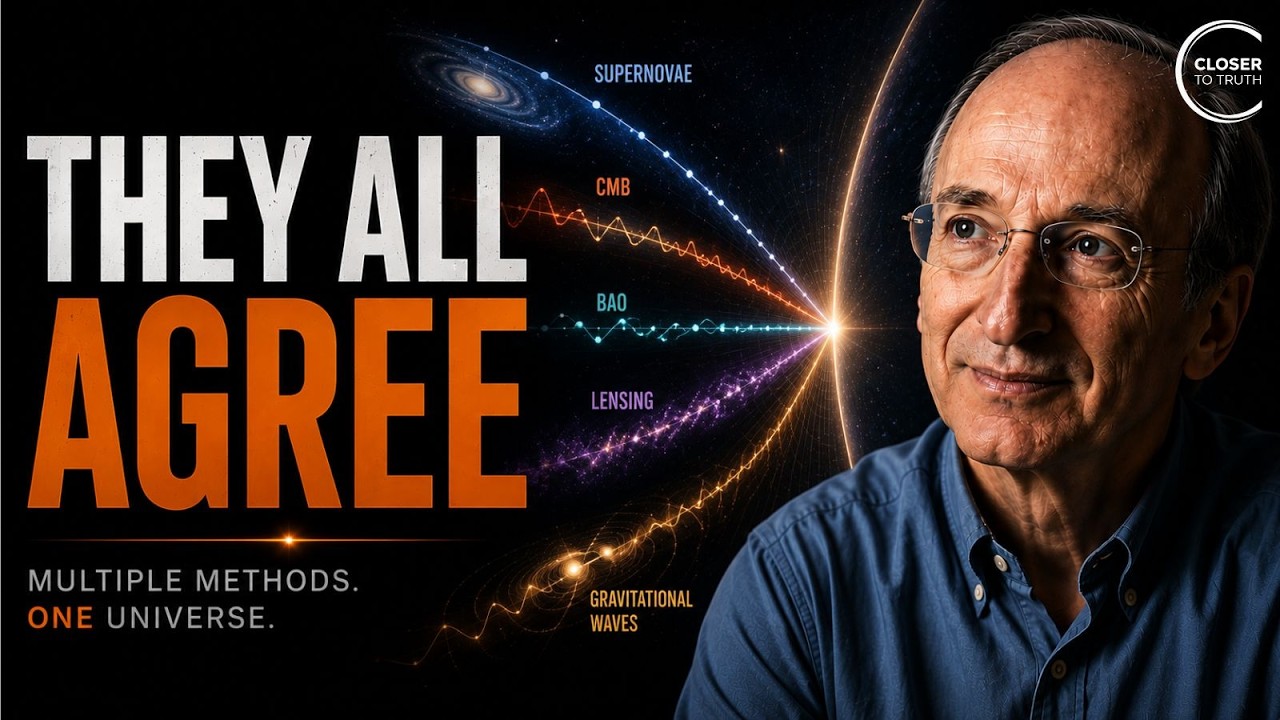 36 min
The Dark Matter Puzzle | Saul Perlmutter
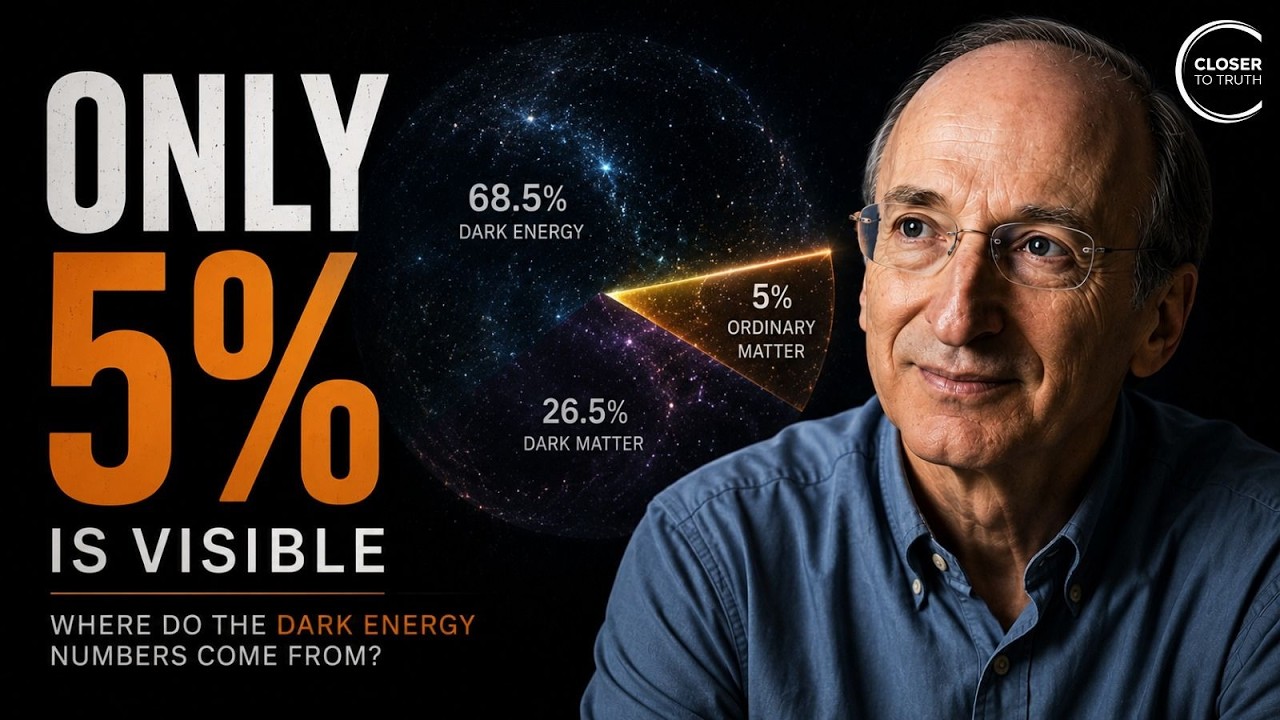 24 min
Where Do the Dark Energy Numbers Come From? | Saul Perlmutter
 30 min
Can Laws Exist Without Instances? | Michael Tooley
 24 min
Consciousness, God, and Causation | Michael Tooley
Ask anything from this episode.
Save it, chat with it, and connect it to Claude or ChatGPT. Get cited answers from the actual content — and build your own knowledge base of every podcast and video you care about.
Get Started Free