Key Moments
The Dark Matter Puzzle | Saul Perlmutter
 Closer To Truth
Want to know something specific about what's covered?
We've already dissected every moment. Ask and we will deliver (with timestamps).
Key Moments
Supernovae and cosmic microwave background radiation provide multiple ways to measure the universe's expansion, but new observatories are needed to confirm findings.
Key Insights
Type 1A supernovae are used as "standard candles" because they explode with a consistent brightness, allowing astronomers to measure distances and cosmic expansion.
The cosmic microwave background (CMB), a glow from the early universe, contains subtle lumpiness (1 in 100,000 parts) that explains the formation of galaxies and cosmic structures.
Baryon Acoustic Oscillations (BAO) use the statistical average distance between early universe 'lumps' as a ruler to measure cosmic expansion over time, offering a geometric alternative to supernovae.
Gravitational lensing, where massive objects bend light, can create multiple views of distant galaxies, with time delays between these views offering a potential new method for distance measurement.
Gravitational waves from merging black holes or neutron stars could act as "standard sirens" for distance measurement, but require simultaneous detection of an electromagnetic signal to confirm the source galaxy.
New observatories like DESI, Vera C. Rubin Observatory, Nancy Grace Roman Space Telescope, and James Webb Space Telescope are crucial for developing precision cosmology by collecting vast datasets and observing across different wavelengths and fields of view.
Supernovae as standard candles trace cosmic history
Type 1A supernovae, explosions of white dwarf stars, serve as crucial "standard candles" in cosmology. Their consistent peak brightness, recognizable by their spectral signature, allows astronomers to calculate their distance by observing how faint they appear. By measuring many supernovae across different cosmic epochs, scientists can plot the universe's expansion history. This method is fundamental for understanding how the universe's rate of expansion has changed over time, including the pivotal discovery that the expansion is currently accelerating. While effective for tracking changes, accurately determining the absolute expansion rate (Hubble Constant) requires a well-calibrated "distance ladder" of all measurement techniques.
The cosmic microwave background reveals the universe's early structure
The cosmic microwave background (CMB) is the afterglow of the Big Bang, originating from a time when the universe cooled enough for electrons and nuclei to form neutral atoms, allowing light to travel freely. Initially a high-energy photon, this light has stretched into microwaves due to cosmic expansion. The CMB is remarkably uniform but contains tiny temperature fluctuations, or "lumpiness," on the order of one part in 100,000. These slight variations are critical, as they represent the seeds of gravitational collapse that eventually led to the formation of galaxies, stars, and all large-scale cosmic structures. Analyzing the precise pattern and distribution of this lumpiness allows cosmologists to determine fundamental parameters of the universe and test theoretical models, including those rooted in quantum mechanics that predicted this initial unevenness.
Baryon Acoustic Oscillations provide a geometric ruler
Baryon Acoustic Oscillations (BAO) offer an alternative, geometric method for measuring cosmic expansion. This technique uses the characteristic scale of the "sound waves" that propagated through the early hot, dense plasma of the universe as a cosmic "ruler." These waves left an imprint on the distribution of matter, creating a preferred separation distance between the overdense regions that would later form galaxies. By observing the distribution of millions of galaxies today and measuring the average distance between them, astronomers can see how this original ruler has stretched due to cosmic expansion. Unlike supernovae, which rely on understanding intrinsic brightness, BAO is considered a more direct geometric measurement, offering a valuable cross-check against other methods and avoiding some of their systematic uncertainties. However, it requires meticulously mapping the positions of vast numbers of galaxies.
Gravitational lensing bends light to reveal distant objects and time delays
Massive objects, such as galaxies and galaxy clusters, warp spacetime, causing light from background objects to bend – a phenomenon known as gravitational lensing. 'Weak lensing' studies the subtle distortions of the shapes of numerous background galaxies to understand the distribution of matter and cosmic expansion. More direct is 'strong lensing,' where a foreground mass bends light so severely that multiple images of the same background object are formed, often with visible distortions. Intriguingly, these multiple light paths can have different lengths, leading to slight time delays in when the light arrives. If the lensed object is variable, like a supernova or quasar, these time delays can be measured, providing an independent method for calculating distances to these distant objects, potentially offering a third leg to the cosmic distance ladder and revealing multiple points in cosmic history with a single lens system.
Gravitational waves offer a new 'standard siren' but require multi-messenger confirmation
The detection of gravitational waves by observatories like LIGO has opened a new window into the cosmos, primarily by observing the mergers of black holes and neutron stars. While these events provide insights into extreme physics, their potential for cosmology lies in becoming "standard sirens." If a gravitational wave event's distance can be reliably determined, and if an associated electromagnetic signal (like a gamma-ray burst or optical afterglow) can pinpoint the host galaxy and its redshift, it provides a direct measure of cosmic expansion. However, thus far, such "multi-messenger" events yielding both gravitational wave and electromagnetic signals at sufficient distances for cosmology have been rare. Statistical methods are being explored to infer distances from large populations of gravitational wave events, but direct confirmation remains a key goal for this technique.
Next-generation observatories enhance precision and explore new frontiers
The quest to precisely measure cosmic expansion relies on increasingly sophisticated instruments. The Dark Energy Spectroscopic Instrument (DESI) is designed to map millions of galaxies and quasars, enabling highly precise BAO measurements by capturing spectra from thousands of objects simultaneously. The Vera C. Rubin Observatory will conduct a wide-field survey, crucial for weak lensing studies and continuously monitoring the sky for supernovae. The Nancy Grace Roman Space Telescope will extend wide-field observations into the near-infrared, overcoming atmospheric limitations to study distant objects. The James Webb Space Telescope (JWST), with its deep-field and infrared capabilities, allows detailed examination of the earliest galaxies and phenomena at high redshifts, revealing unexpected early structure. Together, these observatories, along with ongoing gravitational wave and lens studies, are building a comprehensive, multi-modal picture of the universe's expansion and evolution.
Mentioned in This Episode
●Products
●Organizations
●Concepts
Common Questions
Astronomers use several methods to measure cosmic expansion, including standard candles like supernovae, the cosmic microwave background radiation, baryon acoustic oscillations, cosmic lensing, and gravitational waves.
Topics
Mentioned in this video
A space telescope used to observe the universe, capable of detecting light stretched into the redder parts of the spectrum, useful for studying very early galaxy formation.
A space telescope designed for wide-field infrared observations, complementing ground-based surveys and enabling statistical studies of the whole sky.
A space telescope providing early wide-field imaging capabilities, now surpassed in field of view by instruments like the Roman Space Telescope.
The glow left over from the Big Bang, a remnant of the hot, dense early universe, which provides crucial information about its uniformity and lumpiness.
A measurement technique that uses the average distances between lumps in the early universe as a 'ruler' to track cosmic expansion forward in time by observing galaxy distribution.
A technique that studies the statistical effect of mass on the shapes of distant galaxies to understand cosmic expansion and material clustering.
Ripples in spacetime caused by massive cosmic events like merging black holes or neutron stars, which can potentially be used as 'standard sirens' to measure cosmic distances.
A hypothetical standard candle derived from gravitational wave events, intended to measure cosmic distances once paired with electromagnetic signals to determine redshift.
The Laser Interferometer Gravitational-Wave Observatory, a facility that detects gravitational waves from astrophysical events like merging black holes and neutron stars.
An observatory designed for wide-field astronomical surveys, crucial for techniques like weak lensing and tracking supernovae across large areas of the sky.
More from Closer To Truth
View all 34 summaries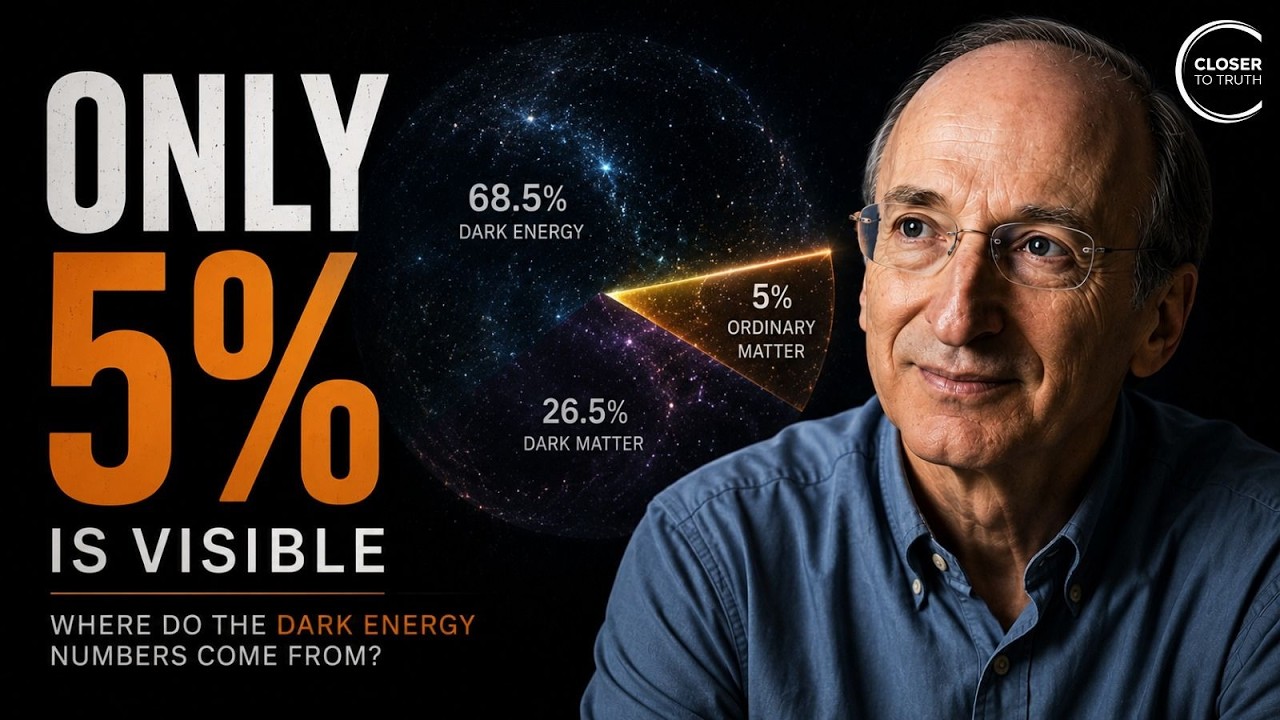 24 min
Where Do the Dark Energy Numbers Come From? | Saul Perlmutter
 30 min
Can Laws Exist Without Instances? | Michael Tooley
 24 min
Consciousness, God, and Causation | Michael Tooley
 21 min
Why Abrahamic Faith Is About Justice, Not Escape | James TaboR
Ask anything from this episode.
Save it, chat with it, and connect it to Claude or ChatGPT. Get cited answers from the actual content — and build your own knowledge base of every podcast and video you care about.
Get Started Free