Key Moments
General Stanley McChrystal — Mastering Risk: A User’s Guide | The Tim Ferriss Show
 Tim Ferriss
Want to know something specific about what's covered?
We've already dissected every moment. Ask and we will deliver (with timestamps).
Key Moments
General McChrystal on mastering risk: focus inward, build resilience, and communicate openly.
Key Insights
We often mismanage risk because we fail to look inward at our own weaknesses rather than external factors.
Effective risk management involves reducing vulnerabilities, akin to a healthy immune system, through factors like communication, timing, and diversity.
Separating process from outcome is crucial: reward good decision-making processes, not just lucky results.
Narratives are powerful tools for organizations, but a 'say-do gap' between stated values and actions can be damaging.
Misinformation and polarization pose significant threats to society, amplified by technology and social media.
Resilience is built through controlled failure, after-action reviews, and candid feedback, often through tough but necessary communication.
THE INTERNAL FOCUS OF RISK
General McChrystal argues that the greatest risk humans face stems from within. Instead of solely focusing on external, unpredictable threats, individuals and organizations must first examine their own vulnerabilities and weaknesses. This internal self-assessment is crucial because while external risks are inevitable, our capacity to manage them is largely determined by our own internal health and preparedness. He uses the analogy of a doctor advising a patient on broad lifestyle changes rather than offering a quick fix, suggesting comprehensive self-improvement is key to mitigating risk.
DEFINING AND MANAGING RISK
Risk is defined not just by the probability and consequence of an event, but more effectively as 'threat times vulnerability.' While threats are often beyond our control, vulnerabilities are not. McChrystal likens an organization's ability to manage risk to a 'risk immune system.' This system comprises ten 'risk control factors' such as communication, narrative, timing, and diversity. Strengthening these factors helps detect, assess, respond to, and learn from emerging risks, much like a healthy human immune system protects against pathogens.
STRATEGIC LESSONS FROM LEADERS
Historical figures offer profound lessons in risk management. Coco Chanel, starting from poverty, strategically built an identity and business empire by understanding and navigating inherent risks. Dr. Martin Luther King Jr. masterfully managed the risks to the Civil Rights Movement, understanding that inaction and passive support posed a greater threat than overt opposition. These examples highlight that effective leadership involves foresight, adaptability, and a deep understanding of the multi-faceted nature of risks faced.
THE POWER OF NARRATIVE AND TRUST
Narrative is a critical component in how we understand ourselves and the world. Organizations must establish a clear narrative that guides their actions. McChrystal warns against a 'say-do gap,' where actions contradict the stated narrative, creating a crisis of trust. He uses Google's 'Don't Be Evil' motto and its subsequent work with the defense department as an example of such a disconnect. Maintaining credibility, both personally and corporately, requires alignment between espoused values and actual behavior.
MISINFORMATION AND SOCIETAL VULNERABILITY
The pervasive nature of misinformation and polarization represents a significant threat to societal resilience. McChrystal suggests that technological amplification has created environments where narratives, even those subtly misleading, can deeply shape public perception, drawing parallels to historical propaganda. This vulnerability is exacerbated when critical societal functions, like political discourse, become paralyzed by partisanship, hindering the collective ability to address challenges such as pandemics or cyber threats.
BUILDING RESILIENCE THROUGH COMMUNICATION
Effective communication is the bedrock of organizational and societal resilience. McChrystal outlines four tests for communication: reach, willingness, reception, and accuracy/timeliness. If any test fails, true communication does not occur. He emphasizes the importance of candid feedback, often gained through rigorous 'after-action reviews' in the military. These processes, though sometimes painful, are vital for individuals and teams to learn from mistakes, develop thicker skins, and become more resilient in the face of adversity and difficult decisions.
SYSTEMIC FAILURES AND PREPAREDNESS
The COVID-19 pandemic highlighted significant systemic failures in preparedness, with nations acting individually rather than cohesantly. Despite scientific advancements and prior warnings, collective action was fragmented. McChrystal argues that such failures underscore the need to address systemic weaknesses in communications, coordination, and decision-making, particularly for ongoing threats like cybersecurity and climate change, which also require robust public-private partnerships and cultural shifts.
THE ROLE OF FAILURE IN TRAINING RESILIENCE
True resilience is forged through experiencing and learning from failure, often in controlled environments. McChrystal advocates for scenarios like simulated combat missions ('Savage Strike') where leaders face impossible moral and operational dilemmas. The objective isn't a perfect outcome but observing how individuals maintain composure, process information, adhere to values, and make the best possible choices under extreme pressure. This tough training is essential for developing the ability to make hard decisions and navigate situations where there is no easy answer.
ASSESSING CHARACTER UNDER PRESSURE
Evaluating character and decision-making under stress is crucial, especially in leadership roles. While traditional 'stress interviews' can be problematic, simulations and role-playing, like those historically employed by Admiral Rickover, can reveal how individuals handle pressure, fight for their position, and respond to combative questioning. Observing whether individuals dodge responsibility, maintain a process, or react defensively provides valuable insights into their potential to navigate complex, high-stakes situations.
ABRAHAM LINCOLN AS A MASTER CONDUCTOR OF RISK
Abraham Lincoln's handling of the Emancipation Proclamation during the Civil War exemplifies masterful risk orchestration. He navigated simultaneous threats: losing the war, political division within the North, foreign interests, and societal resistance. Lincoln did not just announce a correct policy; he shrewdly managed numerous risks and stakeholders to achieve a morally imperative goal. This demonstrates that effective leadership often involves a complex, iterative process of maneuvering through challenges to reach the best possible, not necessarily perfect, outcome.
PERSONAL VULNERABILITY AND SYSTEMIC PROTECTION
Leaders must remain aware of their personal susceptibility to hardening and risk-taking, especially in high-pressure environments. McChrystal reflects on losing soldiers and questioning the level of aggression in operations, noting how individuals can become desensitized. He emphasizes that systems are necessary to protect individuals from their own tendencies towards overconfidence or excessive risk-taking, acting as a safeguard when personal judgment may falter, ensuring better outcomes for the larger organization or mission.
Mentioned in This Episode
●Software & Apps
●Companies
●Organizations
●Books
●People Referenced
Mastering Risk: A User's Guide
Practical takeaways from this episode
Do This
Avoid This
Common Questions
General McChrystal defines risk as the equation of 'threat times vulnerability.' He emphasizes that while external threats are often unpredictable, individuals and organizations can control and reduce their vulnerabilities to mitigate risk.
Topics
Mentioned in this video
Former Secretary of Defense who called General McChrystal 'one of America's greatest warriors.'
Civil War general who avoided visiting wounded soldiers to maintain his ability to make difficult decisions, cited as an example of avoiding emotional hardening.
Discussed as a master at orchestrating risk, particularly with the Emancipation Proclamation amidst the Civil War.
Former Iraqi dictator whose capture in 2003 is credited to McChrystal's leadership.
Described with a reportedly combative interview process designed to test candidates under simulated pressure.
Poker player and author mentioned for her work on separating process from outcome and thinking under uncertainty.
Leader who benefited from the time bought by the defense of the Alamo.
Scholar mentioned for his work on how the human mind thinks, though McChrystal prefers practitioners.
Commander at the Battle of the Alamo, known for drawing a line in the sand.
Host of the Tim Ferriss Show.
Used as an example of a leader with a powerful, almost narcotic message that maintained popularity despite national destruction.
Guest on the show, author of 'Risk: A User's Guide,' former commander of JSOC and International Forces in Afghanistan.
Leader of Al-Qaeda in Iraq, whose locating and killing in 2006 is credited to McChrystal's leadership.
Lieutenant General who acted as red team commander in the Millennium Challenge war game.
University where McChrystal is a senior fellow and teaches a course on leadership.
The current ruling group in Afghanistan, discussed in relation to their regime's potential impact on the country, particularly on females.
Publication where an older interview with General McChrystal was featured, discussing a map of Kabul.
Institute at Yale University where General McChrystal teaches a course on leadership.
An organization funded by big tobacco that implemented a campaign to cast doubt on the link between tobacco and cancer.
Book by Annie Duke that discusses decision-making under uncertainty and separating process from outcome.
A book by General Stanley McChrystal analyzing leadership through case studies.
A book by Ben Mezrich about an MIT blackjack team, used as an example of needing sufficient bankroll to sustain a string of bad outcomes.
A memoir by General Stanley McChrystal.
General Stanley McChrystal's newest book, exploring how to master risk.
A book by General Stanley McChrystal on new rules of engagement for a complex world.
More from Tim Ferriss
View all 703 summaries 70 min
Q&A with Tim — The Art of Male Friendship, Reinvention in The Age of AI, & More
 125 min
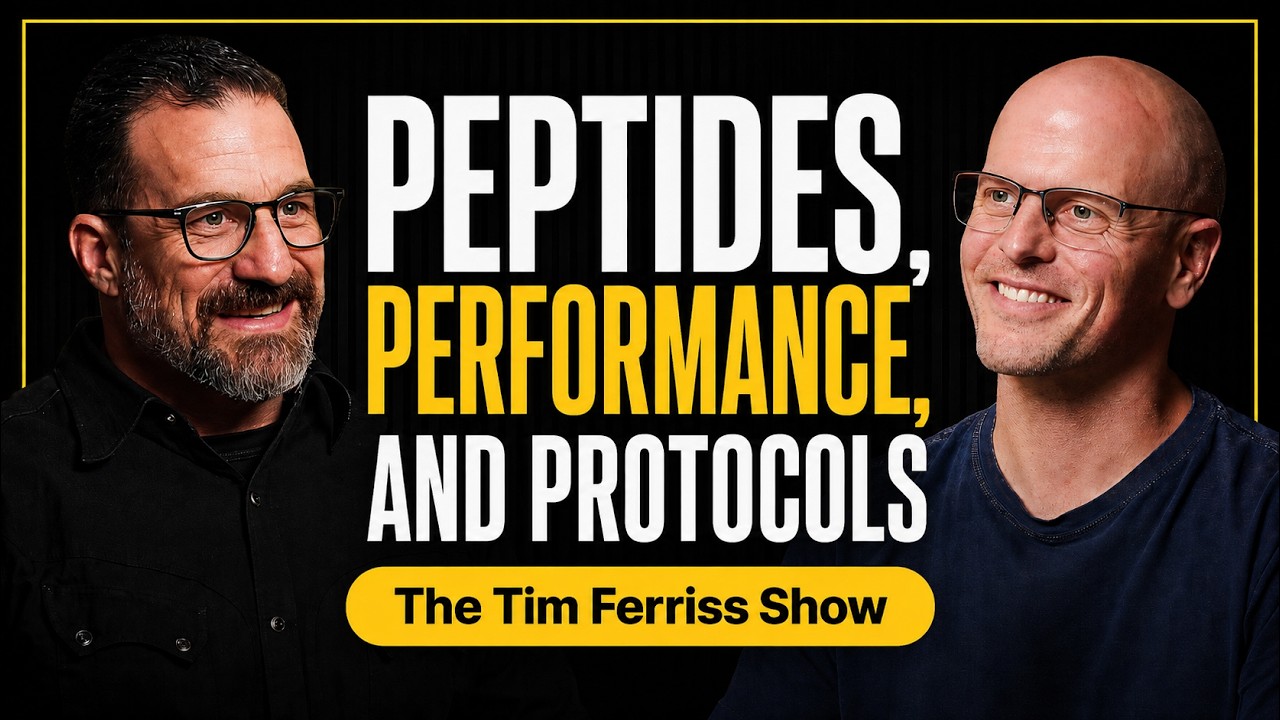
Dr. Andrew Huberman — Peptides, Performance, and Protocols
 112 min
The Random Show! Mortality, AI, Supplements, Rock Climbing, & More
 88 min
The Legendary Hollywood Power Broker — Guy Oseary on 36 Years of Managing Madonna, 26 IPOs, and More
Ask anything from this episode.
Save it, chat with it, and connect it to Claude or ChatGPT. Get cited answers from the actual content — and build your own knowledge base of every podcast and video you care about.
Get Started Free