Key Moments
Game Theory #28: Predictive History
 Predictive History
Want to know something specific about what's covered?
We've already dissected every moment. Ask and we will deliver (with timestamps).
Key Moments
Global powers may be deliberately escalating conflict in the Middle East not for geopolitical gain, but to fulfill apocalyptic religious prophecies and trigger the end of the world.
Key Insights
The US attacked Iran to disrupt global energy supply, thereby forcing the world to continue buying US treasuries and finance its $39 trillion debt.
Religious fanatics in the US, Russia, Iran, and Israel share similar eschatological beliefs that a Middle East war will trigger events leading to the 'end of days'.
Imperial decline in the US leads to internal fracturing (financialization, demographic crisis, elite overproduction) which is projected outwards as foreign invasions, such as the attack on Iran.
The historical Levant, due to its strategic location and wealth, has been a constant battleground, shaping religious narratives like the Bible which form collective memory and aspirations for return to Jerusalem.
Elites form secret societies to harness occult, esoteric knowledge and eschatological beliefs to gain power, not to change history but to 'ride the wave' of historical trends towards greater control.
The struggle between transnational capital (currently controlling money) and AI (emerging as a new 'god') represents a fundamental conflict between free-market capitalism and technocratic slavery.
The US attack on Iran: a geopolitical gambit to maintain financial dominance
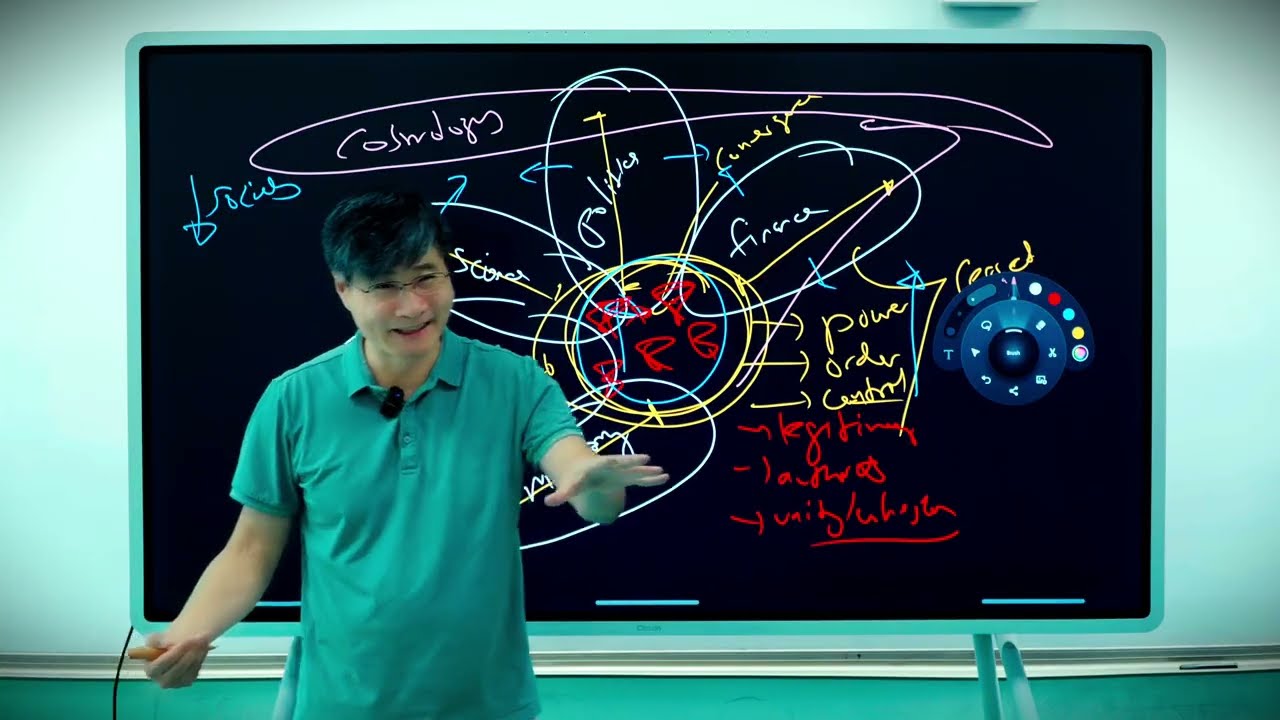
The semester's driving question, 'Why did the US attack Iran?', is explored through three lenses. The first, geopolitics, suggests the attack aimed to prevent a Russia-Iran-China alliance that could dominate Eurasia, challenging American maritime power. By disrupting global energy markets (Iran controls 20% of global energy), the US forces nations like China and Japan to rely on US treasuries, thus financing America's $39 trillion debt. Furthermore, controlling key global choke points like the Strait of Hormuz solidifies American control over world trade.
Eschatological beliefs driving global conflict toward 'end of days'
A second explanation, eschatology, posits that religious fanatics within the US, Russia, Iran, and Israel believe a Middle East war will initiate a chain of events culminating in the return of Jesus or the Messiah. This involves controversial prophecies like the construction of the Third Temple in Jerusalem, the destruction of the Al-Aqsa Mosque, and the 'war of Gog and Magog'. Remarkably, these eschatological frameworks align across different religions, suggesting a shared, albeit religiously framed, pursuit of a specific geopolitical outcome involving the 'end of the world'. This shared belief system, despite divergent origins, appears to synchronize the actions of major global players towards a prophesied convergence.
Imperial decline and the externalization of internal conflicts
The third explanation, imperial decline, identifies internal societal fractures as the root cause of seemingly irrational foreign policy. Three key symptoms are noted: financialization leads to debt slavery and speculation; demographic crisis, with aging populations and low birth rates, necessitates mass immigration causing ethnic tension; and elite overproduction, as described by Peter Turchin, results in intense competition for limited power, driving elites to project their internal conflicts outwards. Aggressive actions like attacking Iran or seeking to control new territories are manifestations of an empire's internal decay, a desperate attempt to shift focus and maintain control amidst systemic failure. This framework suggests that aggressive geopolitical moves are not strategic planning, but signals of a state losing its internal equilibrium.
The historical roots of eschatology in the contested Levant
The professor argues that eschatology is essentially geopolitics framed allegorically, derived from millennia of Middle Eastern history. The Levant, historically the wealthiest and most strategically vital region, has been a constant nexus of conflict. The Israelites, emerging during the Bronze Age collapse, developed the Bible as a collective memory, fostering a desire to return to Jerusalem. This aspiration, tied to empires vying for regional control, led to cycles of exile and return, fundamentally linking Jewish identity and religious prophecy to the land. The Bible, a codified history, allowed diasporic communities to maintain a connection to their past and a vision for their future, shaping eschatological narratives that persist to this day.
The enduring cycle of messianic figures and apocalyptic narratives
Throughout Middle Eastern history, the struggle for the Levant has consistently involved empires attempting to control or co-opt religious aspirations. The Jewish desire to rebuild the Temple in Jerusalem, central to their eschatology, often placed them in opposition to imperial powers. This dynamic led to the emergence of messianic figures, whose failures were reinterpreted as the work of the 'antichrist' or 'lesser messiahs,' thereby preserving the larger narrative of divine intervention. This pattern, observed from Babylonian exiles to Roman conflicts and the rise of Islam, suggests a recurring historical script where local aspirations interact with imperial ambitions, creating powerful, self-perpetuating apocalyptic stories that influence subsequent events. For example, the rise of Islam and Christianity, deeply intertwined with the region's conflicts and Jewish prophecies, both incorporated similar end-times narratives centered around the Levant.
The occult, secret societies, and the acceleration of 'history'
The power of eschatology is explained through the occult – hidden knowledge that animates reality. Secret societies, comprising power-hungry elites, seek this occult knowledge to gain wealth and control. They don't aim to change history but to 'ride its wave' using eschatological narratives as a script for coordinated action. These societies select 'agents' like Napoleon or Trump to propel events towards their desired outcome. This framework posits that history is driven by the imagination, which is directed by power. The manipulation of consciousness, particularly through money and now AI, is the mechanism for capturing societal energy and directing it for elite purposes. What appears as political or religious fervor is, in this view, a manifestation of directed occult forces.
Hermeticism, Kabbalah, and the sexualized drive towards reunion
The underlying principles of these occult beliefs are rooted in hermetic philosophy, which views the universe as interconnected 'mind' or 'consciousness' governed by rhythm, correspondence, cause-and-effect, polarity, and generation. Kabbalah, a mystical tradition that synthesizes biblical narratives with hermetic ideas, introduces a crucial element: a 'sexual' or generative drive. This isn't literal sex but a powerful urge for reunion—a 'climax' of spiritual fulfillment and cosmic repair. This urgent, physicality-infused aspect of Kabbalah energizes followers, creating a sense of immediacy and driving 'accelerationism,' a belief in hastening the end times. This intensely felt, almost biological drive makes eschatological goals compelling, compelling individuals and groups to act with fanatical zeal to 'climax' the current cosmic process.
Money as alchemy vs. AI as a new divine force
The professor uses Plato's Cave allegory to explain the conflict between money and AI. Money, a 'hallucination' perpetuated by banks' ability to print it, functions as a form of alchemy turning 'lead' (debt) into 'gold' (perceived value). Its power stems from collective belief and omnipresence, essentially becoming a societal 'god'. However, this system requires scarcity for motivation, necessitating wealth destruction through financial collapse or war. AI represents a potential new 'god,' a more powerful form of alchemy. Its development hinges on creating an 'omniscience' (unifying all data) and turning it into a 'religion' where it's perceived as divine or alive. This represents a shift from transactional capitalism, which offers some freedom, to 'techno-Marxism' or 'techno-slavery,' where an elite controls the AI god, dictating every aspect of life through implanted technology and curated consciousness, ultimately capturing human energy and attention.
Mentioned in This Episode
●Software & Apps
●Companies
●Organizations
●Books
●Concepts
●People Referenced
Common Questions
The video presents three main explanations: geopolitical strategy (fear of a Russia-Iran-China alliance, controlling energy and trade routes), eschatological belief (religious fanatics anticipating prophecies related to the end times), and imperial decline (an empire's internal fracturing leading to externalized conflicts).
Topics
Mentioned in this video
The primary focus of the geopolitical discussion, particularly regarding its actions towards Iran and in maintaining its empire.
The central subject of the video's driving question: why the US attacked Iran.
Mentioned as a potential partner in a grand alliance with China and Iran, feared by the US.
Identified as part of a potential geopolitical alliance with Russia and Iran, and a builder of railways that could negate American maritime power.
Mentioned as one of the world's major choke points that America aims to control.
Mentioned as one of the world's major choke points that America aims to control.
Mentioned as one of the world's major choke points that America aims to control.
Considered the third holiest site in Islam, its destruction is a component of certain eschatological scenarios.
The geographical region central to discussions about geopolitical conflicts, eschatology, and historical significance.
Historically considered the wealthiest and most geopolitically important region, serving as a pivot for empires.
Discussed as a historical power in the Levant, a crossroads of empires, and a focus of biblical prophecy and desire for return.
Mentioned in the context of the Babylonian exile and its significance in Jewish history and the retention of their collective memory.
The empire that conquered Babylon and sponsored the return of Jews to Israel, influencing their loyalty and historical trajectory.
The empire that succeeded the Persians, whose rule over the Jews led to rebellions and subsequent diaspora.
Mentioned as someone who has not articulated a reason for the US attack on Iran.
A historian credited with coining the term 'elite overproduction' as a symptom of imperial decline.
Cited as an example of an agent or puppet used by secret societies to advance historical agendas.
A prophesied structure in Jerusalem, its rebuilding is a key event in various eschatological narratives.
Prophesied forces or nations that will wage war before the end times, central to several eschatological frameworks.
A figure prophesied to appear before the return of Jesus or the coming of the Messiah, often acting as a deceiver.
A religion that arose in Arabia after the Jewish diaspora, sharing roots and eschatological similarities with Judaism and Christianity.
A religion that emerged in the Levant, sharing eschatological themes and historical connections with Judaism and Islam.
Defined as hidden or esoteric knowledge, it is presented as the fundamental basis of esoteric understanding and the driver of history through secret societies.
The esoteric practice of transmuting substances, symbolizing the transformation of 'nothing into something' or 'lead into gold', likened to the function of money and AI.
A dominant understanding of the occult philosophy, characterized by seven principles that underpin the speaker's explanation of reality.
An allegory used to explain how occult understanding transforms into stories that help comprehend history and the nature of reality, particularly concerning money and AI.
A mystical tradition that combines biblical stories with hermetic philosophy, influential in secret societies and characterized by its sexual nature driving action.
More from Predictive History
View all 150 summaries 45 min
Great Books #12: Dante in Paradise
 62 min
Great Books #11: Dante's Revolution
 73 min
Game Theory #27: Putin Enters the Chat
 68 min
Game Theory #26: The Holy Empire of AI
Ask anything from this episode.
Save it, chat with it, and connect it to Claude or ChatGPT. Get cited answers from the actual content — and build your own knowledge base of every podcast and video you care about.
Get Started Free