Flow matching
A simplified and elegant approach to diffusion models proposed by Meta, focusing on global velocity instead of intermediate steps.
Build a research pod on Flow matching.
7 expert discussions. Save them all to your own pod, ask any question, get cited answers.
Common Themes
Videos Mentioning Flow matching
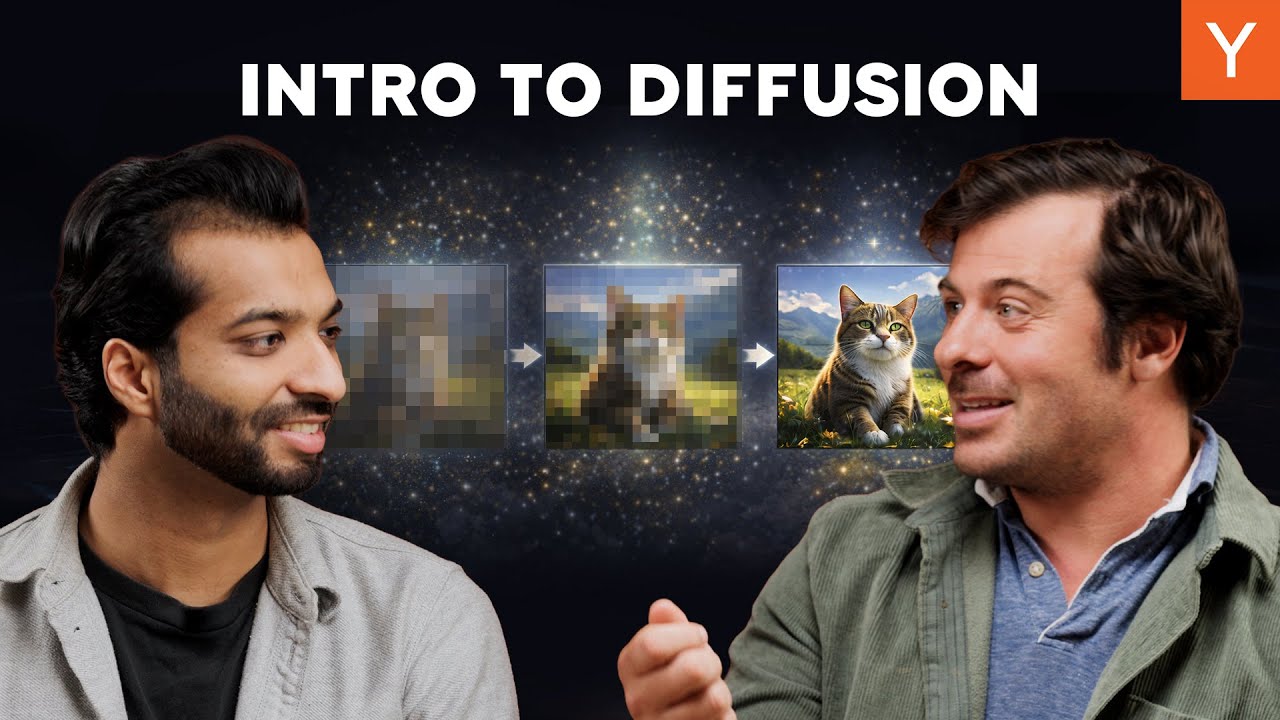
The ML Technique Every Founder Should Know
Y Combinator
A simplified and elegant approach to diffusion models proposed by Meta, focusing on global velocity instead of intermediate steps.

Mistral: Voxtral TTS, Forge, Leanstral, & Mistral 4 — w/ Pavan Kumar Reddy & Guillaume Lample
Latent Space
A machine learning technique used in Voxal TTS, offering an alternative to autoregressive methods for modeling distributions in audio generation.
Stanford CME296 Diffusion & Large Vision Models | Spring 2026 | Lecture 1 - Diffusion
Stanford Online
One of the main image generation paradigms covered in lectures one, two, and three.
Stanford CME296 Diffusion & Large Vision Models | Spring 2026 | Lecture 3 - Flow matching
Stanford Online
The primary generation paradigm discussed in this lecture, which aims to transport an initial data distribution to a target distribution by learning a vector field.

Stanford CME296 Diffusion & Large Vision Models | Spring 2026 | Lecture 4 - Latent Space & Guidance
Stanford Online
A generation paradigm that views the process as transporting probability mass from an initial to a target distribution by predicting a vector field or velocity.
Stanford CME296 Diffusion & Large Vision Models | Spring 2026 | Lecture 6 - Model Training
Stanford Online
A third perspective that interprets the problem of going from noise to a target distribution as a transport problem, focusing on the vector field which can be solved using an ODE solver like Euler method. It is now widely preferred for its loss function characteristics.

Stanford CME296 Diffusion & Large Vision Models | Spring 2026 | Lecture 8 - Trending Topics
Stanford Online
A paradigm for image generation that frames the problem as moving probability density from an initial distribution to a target distribution via a vector field. It is highlighted as the default method used by most models in 2026.