Key Moments
E101: Ye acquires Parler, Snap drops 30%, macro outlook, VC metrics, valuing stocks & more
 All-In Podcast
Want to know something specific about what's covered?
We've already dissected every moment. Ask and we will deliver (with timestamps).
Key Moments
Podcast discusses Ye's Parler acquisition, Snap's stock drop, macro outlook, VC metrics, and stock valuation.
Key Insights
Kanye West's acquisition of Parler highlights the ongoing debate about platform monopolies and the demand for alternative voices in social media.
Snap's significant stock decline is attributed to corporate misgovernance, particularly its dual-class share structure, which disconnects user growth from shareholder value.
The current macroeconomic environment, characterized by higher interest rates, is forcing a reckoning in the tech industry towards cost control, profitability, and more prudent VC metrics.
Active stock picking remains challenging, with a strong emphasis on valuation and understanding a company's fundamentals, as passive investing, like index funds, often outperforms.
Venture capital returns are heavily skewed towards a few successful deals, and high entry prices during the zero-interest-rate era may lead to significant markdowns.
California's Proposition 30 faces opposition due to concerns about its impact on businesses and the state's tax burden, reflecting a broader debate on taxation and economic policy.
YE'S PARLER ACQUISITION AND SOCIAL MEDIA LANDSCAPE
The acquisition of Parler by Kanye West is discussed as a symptom of the evolving social media landscape. The conversation touches upon West's mental health struggles and the ethical considerations of platforming individuals during such crises. It also reinforces the idea that social media platforms are not monopolies but application layers subject to competition, with users ultimately coalescing around desired standards. This trend suggests a healthy competitive market where alternative voices can find a platform.
SNAP'S STOCK PERFORMANCE AND CORPORATE GOVERNANCE
Snap's dramatic stock drop is examined as a prime example of corporate misgovernance. The discussion highlights how its IPO structure, which left founders with near-total voting control, created a lack of accountability to common shareholders. This governance model, where only founder shares carry voting power, prevents effective feedback loops and constructive criticism from investors, ultimately impacting long-term business decisions and stock performance despite steady user growth.
MACROECONOMIC SHIFTS AND VC METRICS
The podcast delves into the macro outlook, noting the significant adjustment from a zero-interest-rate environment to higher rates. This shift is pressuring tech companies to focus on cost control and profitability, moving away from the 'growth at all costs' mentality. Venture capital is experiencing a recalibration, with increasing scrutiny on metrics like TVPI and DPI, and a recognition that high entry prices during the zero-rate era may result in significant future markdowns, challenging the unsustainable valuations seen previously.
THE CHALLENGE OF STOCK PICKING AND VALUATION
The difficulty of active stock picking is a central theme, emphasizing that even good companies are not always good investments if the price is too high. The discussion stresses the importance of understanding a company's financial statements, its future earning potential, and the myriad of external factors that can impact its performance. It's highlighted that while narrative can be powerful, it often overpowers the fundamental analysis, leading many individual investors, particularly retail traders, to underperform the market.
VENTURE CAPITAL AND THE ROLE OF ENTRY PRICE
The discussion turns to the venture capital industry, with a focus on the TVPI vs. DPI metrics and the impact of entry price. The charts presented illustrate that while many funds show high paper valuations (TVPI), the actual cash returned to investors (DPI) often lags significantly. The high entry prices paid during the recent market peak are seen as a primary driver for potential future markdowns and a reversion to the mean, suggesting that significant capital may be revalued downwards.
THE INDUSTRIALIZATION OF VENTURE CAPITAL AND PORTFOLIO CONSTRUCTION
The industrialization of venture capital, with large funds and increased correlation among portfolios, is debated. The idea is that high correlation can lead to greater susceptibility to market downturns, as many investors are chasing the same deals. The conversation emphasizes that while alpha generation is still possible, it requires exceptional stock selection, disciplined portfolio management, and strategic time arbitrage. The increasing number of VCs and the competitive landscape suggest that differentiating oneself and finding true alpha is more critical than ever.
THE FUTURE OF TECH AMIDST MACRO HEADWINDS
Looking ahead, the podcast posits that the tech industry will likely see a period of consolidation and a focus on efficiency. Companies that can adapt to a higher interest rate environment by controlling costs and demonstrating profitability will be better positioned. The conversation also touches on the potential for seismic shifts in the industry, from the rise of AI to the long-term implications of semiconductor innovation, all within the context of a more challenging macroeconomic climate that prioritizes sustainable growth over hyper-growth.
CALIFORNIA'S PROPOSITION 30 AND TAXATION DEBATES
California's Proposition 30, a tax on high earners to fund clean energy initiatives and wildfire prevention, is analyzed. The measure faces opposition from some prominent tech figures and Governor Newsom himself, who views it as a 'grift' by Lyft to subsidize its transition to electric vehicles. This debate highlights broader concerns about California's tax policies, the potential impact on businesses and wealthy residents, and the complex interplay between environmental goals and economic incentives.
THE LONG-TERM FISCAL CHALLENGES AND TAXATION TRENDS
The discussion expands to the United States' long-term fiscal health, with a focus on debt-to-GDP ratios and the inevitability of higher taxes. Panelists suggest that entitlement spending and defense budgets are unlikely to be significantly cut, leading to the conclusion that increased taxation, particularly on higher earners, will be necessary to bridge the fiscal gap. This perspective contrasts with the idea that high taxes drive wealth out of states, suggesting a complex balancing act for policymakers.
THE EVOLVING FOOD AND BEVERAGE INDUSTRY
A notable diversion occurs when discussing the default use of oat milk at Blue Bottle Coffee. This leads to a broader conversation about evolving consumer preferences, the rise of plant-based alternatives, and the future of food production through methods like precision fermentation. While acknowledging concerns about ingredients and consumer choice, the panel also touches on the ethical considerations of animal products and the potential for 'identical to cow's milk' alternatives to become commonplace.
Mentioned in This Episode
●Software & Apps
●Companies
●Organizations
●Books
●Concepts
●People Referenced
Top Quartile VC Fund Returns (TVPI vs. DPI) by Vintage Year (1997-2020)
Data extracted from this episode
| Vintage Year | TVPI (Median) | DPI (Median) |
|---|---|---|
| 1997 | 4.0x | 3.0x |
| 1998 | 4.0x | 3.0x |
| 1999 | 3.0x | 3.0x |
| 2000 | 2.0x | 2.0x |
| 2001 | 2.0x | 2.0x |
| 2002 | 1.5x | 1.5x |
| 2003 | 2.0x | 1.5x |
| 2004 | 2.0x | 2.0x |
| 2005 | 2.0x | 2.0x |
| 2006 | 2.5x | 2.0x |
| 2007 | 2.5x | 2.0x |
| 2008 | 3.0x | 2.5x |
| 2009 | 3.0x | 2.5x |
| 2010 | 4.0x | 3.5x |
| 2011 | 4.0x | 3.0x |
| 2012 | 4.0x | 3.0x |
| 2013 | 4.5x | 3.0x |
| 2014 | 5.0x | 2.5x |
| 2015 | 5.5x | 2.0x |
| 2016 | 6.0x | 1.5x |
| 2017 | 6.0x | 1.5x |
| 2018 | 5.5x | 1.0x |
| 2019 | 5.0x | 0.5x |
| 2020 | 4.5x | 0.5x |
VC Firm Portfolio Overlap Coefficient (Select Firms)
Data extracted from this episode
| Firm 1 | Firm 2 | Overlap Coefficient |
|---|---|---|
| Benchmark | Greylock | High |
| Benchmark | Sequoia | High |
| Benchmark | Founders Fund | Medium |
| Founders Fund | Khosla Ventures | High |
| Index Ventures | Benchmark | Very High (following) |
| Altimeter | Other Top Firms | Low |
Common Questions
Kanye West acquired Parler, a social network, while making highly controversial anti-semitic statements, leading to concerns about his mental health. Social media platforms like YouTube have pulled his interviews, raising ethical questions about platforming individuals during a mental health crisis.
Topics
Mentioned in this video
CEO of Snap, implicitly criticized for the company's corporate governance structure that gives founders disproportionate voting power.
Prominent venture capitalist, mentioned for advocating against excessive hiring and investment in a zero-cost-of-capital environment.
Business partner of Warren Buffett, quoted for his observation that 'nobody likes to get rich slow.'
Board member of Lyft, whose political sophistication was questioned in the context of Lyft's support for Prop 30.
Venture capitalist whose movements between Khosla Ventures and Founders Fund led to high correlation in their portfolios.
CEO of Apple, praised for adopting strategies (cost management, stock buybacks) that led to Apple's strong performance, influenced by Carl Icahn.
Investor mentioned for his concept of 'negative reflexivity' in response to high market volatility.
Co-founder and CEO of Netflix, opposed Prop 30, aligning with Governor Newsom's stance against the measure.
CEO of Uber, praised for not engaging in the 'corporate governance initiatives guised as referendums' like Lyft did with Prop 30.
Public figure and artist who acquired Parler amidst a social media tour where he was making anti-semitic statements, leading to concerns about his mental health.
Mentioned as a public figure who sought alternative platforms after being editorialized out of existing networks.
CEO of Meta, who initially focused on VR/AR (metaverse) but capitulated to investor pressure for more traditional financial discipline.
Renowned investor, cited for his famous bet against hedge funds in favor of the S&P 500 ETF, and his philosophy of 'getting rich slow.' Also noted for his significant holdings in Apple.
CEO of OpenAI, opposed Prop 30, aligning with Governor Newsom's stance against the measure.
Husband of Candace Owens and creator of Parler.
Investor mentioned for engaging in a Twitter debate with Elon Musk about passive versus active investing.
Acquirer of Twitter, mentioned as an example of an owner creating alternative platforms and as a proponent for stock picking over index funds.
Financial TV personality, whose style of content creation around markets is criticized for lacking depth and potentially causing harm to individual investors.
Venture capitalist at Sequoia, opposed Prop 30, aligning with Governor Newsom's stance against the measure.
Comedian, humorously quoted in response to the idea of synthetic protein.
Activist investor credited with influencing Tim Cook to implement cost-cutting and shareholder-friendly policies at Apple.
Commentator criticized for interviewing Kanye West during what was perceived as a manic episode to gain ratings.
Political commentator whose husband, George Farmer, created Parler.
CEO of Mailchimp, described as a 'kind, great CEO' who was reportedly ousted.
Governor of California, who opposed Prop 30, calling it a 'cynical scheme' by Lyft, and is concerned about the exodus of wealthy individuals from the state due to high taxes.
Co-founder of Apple, whose initial ousting and subsequent return and company turnaround serve as an example of a great CEO relying on performance rather than protective control mechanisms.
Tech company that has successfully adopted cost management and shareholder return strategies, serving as a model for Meta.
Rideshare company mentioned as a market leader whose economics were hurt by excessive funding of competitors. Also cited as an early angel investment that yielded high returns.
Cloud data warehousing company, cited as an incredible company that was invested in coming out of the 2008-2009 period.
Social media platform experiencing a significant stock decline despite steady user growth, attributed to corporate misgovernance and Apple's IDFA changes.
Company facing significant stock decline and challenges due to Apple's privacy changes, but expected to eventually adopt cost control and management strategies similar to Apple and Microsoft.
Tech giant mentioned in comparison to Meta regarding dual-class stock structures and the need for cost management.
Venture capital firm that participated in the $101 million funding round for Stability AI.
An example of a low-cost ETF representing the S&P 500, used by Warren Buffett in his famous bet against hedge funds.
Social media platform noted for its explosive growth and impact on other social networks.
Venture capital firm with a high correlation to Khosla Ventures, due to Keith Rabois moving between the firms.
Streaming service, mentioned as an example of a stock based on subscriber growth and narrative-driven investing.
Streaming platform mentioned as an emerging alternative network to YouTube for different voices.
Company whose Q3 earnings were reported as being up year-over-year, challenging the conventional wisdom of a broad earnings decline.
Financial data and software company from which data on venture capital firm correlations was pulled.
Coffee chain criticized for making oat milk the default for lattes, signaling frustration with perceived over-liberal defaults and 'chemical composite stuff.'
Investment company mentioned as an example of 'free capital' that hurt good companies by funding excessive competition (e.g., in rideshare), leading to lower margins for market leaders like Uber.
Early social networking site, mentioned as part of a historical lineage of social media platformsshowing how monopolies are displaced.
Fitness equipment and media company, mentioned as an example of a company needing to demonstrate earnings potential to avoid market punishment.
Venture capital firm whose portfolio overlap coefficient was used in an analysis of venture firm correlations.
Brad Gerstner's firm, mentioned in the context of venture capital firms and their investment strategies.
Social media platform, mentioned along with other platforms experiencing user growth and being impacted by Apple's privacy changes. Also discussed for its hiring practices and need for cost control.
A for-profit company built on the open-source project Stable Diffusion, which received $101 million in funding at a $1 billion valuation despite having no revenue or product.
Venture capital firm with a high correlation to Founders Fund, due to Keith Rabois moving between the firms.
AI research company co-founded by Sam Altman, whose CEO opposed California's Prop 30.
Investment firm mentioned in the context of the 'industrialization of venture' and the myth that venture can be indexed.
Rideshare company that provided significant funding for California's Prop 30, due to concerns about future regulations requiring zero-emission vehicles for ride-sharing miles.
Social media platform mentioned in the context of Kanye West's anti-semitic statements and discussions about who should be platformed. Also discussed regarding Elon Musk's acquisition and potential staff reductions.
Company whose Q3 earnings were reported as being up year-over-year, challenging the conventional wisdom of a broad earnings decline.
Oat milk company, whose product is criticized as 'chemical composite stuff.'
Chamath Palihapitiya's venture capital firm, mentioned as an example of a firm that broke into Silicon Valley despite incumbents.
Social media platform, mentioned as an incumbent platform with sticky usage despite TikTok's growth, facing monetization challenges.
Described as the 'apex predator' of the market due to its IDFA changes, which significantly impacted advertising revenue for social media companies. Also cited for its cost management strategies under Tim Cook.
Company whose Q3 earnings were reported as being up year-over-year, challenging the conventional wisdom of a broad earnings decline.
Video platform that pulled Kanye West's interviews due to anti-semitic content.
Automotive and energy company, whose Q3 earnings were reported as being up year-over-year, challenging the conventional wisdom of a broad earnings decline. Also cited as a company with 'one person one vote' governance.
Neurotechnology company mentioned with a humorous reference to translating cow emotions.
Food and beverage company that owns Blue Bottle Coffee, mentioned in the context of the oat milk debate.
Venture capital firm whose portfolio overlap coefficient was used in an analysis of venture firm correlations, with some firms appearing to 'ape' or follow their investments.
Investment firm whose data is widely used in the venture industry to analyze returns, specifically regarding TVPI and DPI.
Investment firm that led the $101 million funding round for Stability AI.
Group opposing Prop 30, indicating a conflict over tax revenue allocation.
Venture capital firm whose portfolio overlap coefficient was used in an analysis of venture firm correlations.
Venture capital firm whose portfolio overlap coefficient was used in an analysis of venture firm correlations.
Venture capital firm whose portfolio overlap coefficient was used in an analysis of venture firm correlations.
University endowment mentioned for its strategy of looking for 'emerging managers' for venture capital investments.
Email marketing service whose CEO, Ben Chestnut, was reportedly ousted.
A social network app acquired by Kanye West, described as a 'shitty version of Twitter' that never worked well, having raised $56 million in funding.
Early social networking site, mentioned as part of a historical lineage of social media platforms showing how monopolies are displaced.
An open-source project that Stability AI is built upon.
Apple's update to its ad policy post-IDFA, allowing advertisers to target individuals with more attributes, potentially realigning advertising effectiveness.
State noted as a destination for wealthy individuals leaving California due to lower tax rates and a more business-friendly environment.
State noted as a destination for wealthy individuals leaving California due to lower tax rates.
Country cited as an example where high wealth taxes led to an exodus of wealthy individuals, resulting in lower net tax dollars, which was later reversed.
The setting for discussions on Prop 30, high tax rates, and an alleged exodus of wealthy individuals to states like Texas and Florida.
More from All-In Podcast
View all 437 summaries 49 min
China Outbuilds America 230-to-1. Saronic Has a Plan
 97 min
Chip Stocks Crash, $20B Fund Margin Called, Frontier Labs: SLOW DOWN AI, Mamdani's Grocery Stores
 69 min
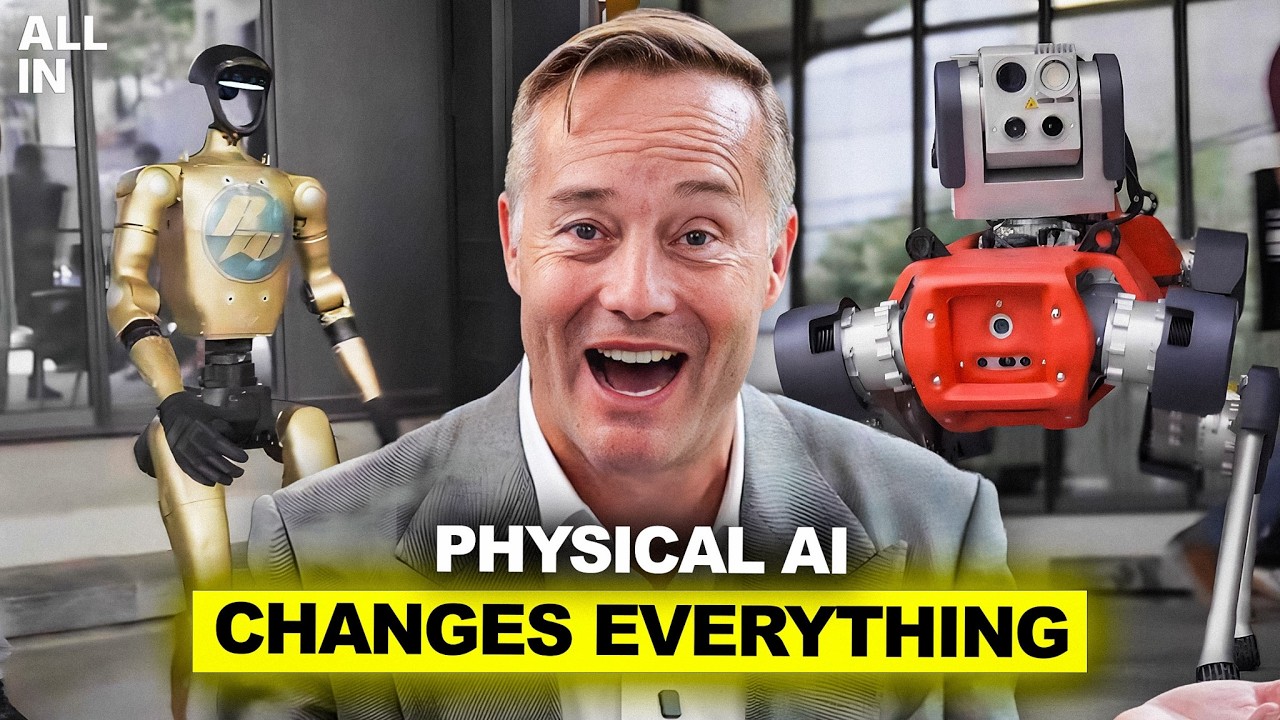
The $1/Hour Robot Is Coming: Four Industry Leaders Explain What’s Next
 94 min
The Fight Over Open Source AI, Anthropic's $1.5B Payout, NYC Socialists: Evictions = Violence?
Ask anything from this episode.
Save it, chat with it, and connect it to Claude or ChatGPT. Get cited answers from the actual content — and build your own knowledge base of every podcast and video you care about.
Get Started Free