Key Moments
Dante Livestream #12 Final (Saturday, June 27 10AM)
 Predictive History
Want to know something specific about what's covered?
We've already dissected every moment. Ask and we will deliver (with timestamps).
Key Moments
Dante's Divine Comedy is not merely a historical or religious text; it's a guide to living well, emphasizing that divine inspiration allows poets to channel cosmic truths, not just invent them, and that righteous anger, when channeled into action, is a powerful force for change.
Key Insights
Dante believes nature operates under natural laws, while the soul is governed by divine laws, which can be contradictory (e.g., Earth orbits the sun naturally, but spiritually, the sun orbits Earth).
Angels, being perfect from creation and operating beyond time, make a single, immutable choice for or against God, unlike humans who are permitted continuous mistakes due to their imperfection and lack of perfect knowledge.
The speaker emphatically states that contemporary society is too Aristotelian, focusing on 'cause and effect' and material concerns, urging a return to a more Platonic framework where what 'matters is what happens there' (the divine and philosophical), and discouraging the prioritization of STEM over liberal arts.
Dante's influence on the Renaissance includes teaching humanity to 'look upwards' (to the divine rather than AI and material concerns), democratizing education (writing in Tuscan, making elite knowledge accessible to commoners), and expanding the cosmos through imagination (showing hell, purgatory, and heaven).
The ending of Purgatory, particularly Cantos 26-33, is intentionally bewildering to scholars and readers, subverting expectations of a triumphant reunion with Beatrice and instead presenting a complex, emotionally charged narrative that challenges traditional interpretations of poetic and spiritual journeys.
Dante’s meticulous use of numerology, such as the divine number three and the Christian number 144 (referencing 144,000 ascending to heaven), demonstrates intentional craftsmanship throughout the Divine Comedy, reflecting geometric precision in its spiritual design.
Dante's view on angels and human free will
The speaker clarifies Dante's distinction between celestial and human free will. Angels, created perfect and existing outside time and space, possess full knowledge of past, present, and future. Their free will allows them only a single, perfect, and irreversible choice: loyalty to God or rebellion, an act exemplified by Lucifer's fall due to pride. This single choice establishes their eternal destiny. In contrast, humans, lacking this inherent perfection and foresight, are granted the grace to make continuous mistakes and learn, underscoring a fundamental difference in their spiritual journeys. This understanding frames the severity of Lucifer's eternal regret in the deepest pit of hell, as his perfect knowledge meant his betrayal was a conscious and fully informed act, devoid of the human capacity for repentance through ignorance or imperfection.
Contemporary society's misguided focus on the material
The discussion strongly critiques modern society's prioritization of material and technological advancements over spiritual and philosophical pursuits, drawing a parallel to Aristotelian versus Platonic thought. The speaker laments the current emphasis on STEM and computer programming in education, arguing that it neglects the liberal arts, philosophy, and classical literature that are essential for critical thinking and self-awareness. He asserts that a truly 'enlightened' individual would immerse themselves in 'the great books' and philosophy, as these disciplines, not technological skills, determine the future. This critique extends to the over-reliance on AI as a panacea, which Dante, if alive today, would find 'horrified' and 'disgusted' by, seeing it as a potential enslaver rather than a liberator, as it distracts humanity from its 'access to the divine'.
Dante's transformative influence on the Renaissance
Dante Alighieri initiated a profound shift in societal perspective and intellectual accessibility that significantly influenced the Renaissance. Primarily, he encouraged humanity to 'stop looking downwards' at earthly, transient matters and 'start looking upwards' towards the divine and eternal, a crucial counter-narrative to modern preoccupations. Secondly, Dante championed a democratic principle, making 'elite education accessible' by writing the Divine Comedy in Tuscan rather than Latin, allowing common people to engage with profound spiritual and philosophical ideas through reading groups. This democratization of knowledge fostered a spirit of inclusivity, exemplified by figures like Leonardo da Vinci, an artist from common origins. Lastly, Dante expanded the 'boundaries of the cosmos' by vividly depicting Hell, Purgatory, and Heaven, igniting the collective imagination and inspiring countless works of art and thought, thereby enriching the cultural and artistic landscape.
The symbolic journey through fire, water, and dreams
Dante's final passage through Purgatory is marked by symbolic trials and profound emotional shifts. He faces a wall of fire, overcome only by Virgil's invocation of Beatrice's name, signifying the transition from human reason (Virgil) to divine love (Beatrice) as his ultimate guide. The crucial "Jacob's ladder" dream, featuring Leah and Rachel, symbolizes different paths to spiritual fulfillment: Leah represents active labor and earthly virtues (adorned with flowers), while Rachel embodies contemplative life and spiritual beauty (gazing in a mirror). The encounter with the two rivers in the Garden of Eden—Lethe (forgetting sin) and Eunoë (remembering good deeds)—underscores the necessary purification before entering Heaven, a literal baptism of the soul. These experiences collectively represent Dante’s profound metamorphosis, shedding earthly attachments and preparing for divine union.
Beatrice's indignation as a form of divine love
Upon their reunion, Beatrice does not offer the expected praise but rather a stern rebuke, expressing "just indignation" at Dante's misguided path after her death. Her anger stems from a place of profound love and high expectation, chastising him for pursuing worldly fame and superficial affections instead of remaining steadfast in his devotion to her, which symbolized the path to God. This powerful display is intentionally jarring, serving as a final purgation, forcing Dante to confront his past errors and recognize that his deepest artistic and spiritual purpose lies in channeling love, not seeking personal glory. The paradoxical nature of "righteous indignation" coming from a place of love is highlighted, suggesting that true affection demands accountability and seeks the highest good for the beloved, even through harsh truth.
The book of Revelation and the church's corruption
Dante rewrites the Book of Revelation, presenting a scathing allegorical history of the Catholic Church. This vision, appearing just before Dante's ascent to Heaven, depicts the church's corruption from its early persecution (bird of Jove tearing the chariot) through internal heresies (the fox) and the corrupting influence of earthly power (the eagle's feathers, representing Constantine's donation, distorting the chariot). The emergence of the dragon, symbolizing Satan or an Antichrist figure within the papacy (e.g., Pope Boniface VIII), illustrates further internal decay. This sequence ends with Florence (the harlot) and the Holy Roman Empire (the giant) ultimately destroying it. This vision, delivered with intense anger and hatred, highlights Dante's "just indignation" at the moral failings of his era, channeling his wrath not for petty revenge but into a powerful critique intended to inspire societal and spiritual reform, proving that anger, when righteous and channeled into action, can be a creative and prophetic force.
Mentioned in This Episode
●Organizations
●Books
●Concepts
●People Referenced
Common Questions
In Dante's view, natural laws govern the physical world (like physics), while spiritual laws govern the soul and the divine planes. They can operate in opposition, with God being everywhere in spiritual law, but nowhere in natural law.
Topics
Mentioned in this video
Author of 'The Divine Comedy', whose journey through Hell, Purgatory, and Heaven is the subject of discussion; a central figure in Italian literature.
English poet, mentioned alongside Homer and Virgil as believing in channeling the divine.
Influential scholastic philosopher who heavily promoted Aristotle's ideals, especially the 'ideal of the mean'.
Renaissance artist, cited as an example of a 'commoner' who achieved greatness during a democratic period of art.
CEO and entrepreneur, criticized as a 'hustler' whose Mars and AI ambitions are driven by profit, immortality, and control, rather than genuine progress.
CEO of OpenAI, criticized as a 'complete hustler' interested in money, immortality, and control.
CEO of Meta Platforms, criticized as a 'hustler' whose ambitions are driven by profit, immortality, and control.
Venture capitalist and entrepreneur, criticized as a 'hustler' who is serious about immortality, money, and creating an AI surveillance state.
Co-founder of Apple Inc., criticized as a 'hustler' motivated by profit rather than genuine societal benefit.
Dante's beloved, who guides him from Purgatory to Paradise, symbolizing divine love and revelation. Her death significantly impacted Dante.
Roman general, whose triumph is referenced, with a shout of 'queen' indicating a historical association with homosexuality.
Famous Florentine poet, admired by Dante, encountered in the terrace of lust, now focused solely on redemption rather than earthly fame.
American Dante scholar, formerly at Princeton and Dartmouth, whose footnotes and scholarship are recommended for understanding Dante.
Referred to as the 'Griffin' in the allegorical procession, embodying two natures (lion and eagle), and as the Abbot of Heaven.
Roman Emperor, whose 'donation' is allegorically represented as the eagle plunging into the chariot, symbolizing the Roman Empire merging with the Church and its subsequent corruption.
The pope Dante considered the 'Antichrist' for his corruption, which fueled Dante's anger and critique of the Catholic Church.
Referred to as the source of natural and divine laws, distinct from nature itself, and the ultimate destination of the soul.
An angel who rebelled against God due to pride, cast down to hell, and condemned to eternal regret.
A central theological concept creating the distinction between angels (perfect choice) and humans (allowed mistakes).
A theological concept, a place of purification between Hell and Heaven, central to Dante's journey of moral development.
Biblical cities associated with the sin of lust, used by shades in Purgatory's terrace of lust to reproach themselves.
A river in the Garden of Eden, from Greek tradition, where drinking from it makes one forget sin.
A river in the Garden of Eden, a word coined by Dante, that makes one remember their goodness after forgetting sin.
The ritual of washing away sins, akin to the action of the rivers Lethe and Eunoë in Dante's Purgatory.
Mentioned as an elite institution whose educational access should be democratized, referencing its open courses and financial aid.
Historical institution, mentioned as popular during Dante's time due to public concerns about sexual abuse by clergy.
Host institution of the 'Dartmouth Dante Project' (Dante Lab), a resource for Dante scholarship.
Represented by the 'giant' in Dante's apocalyptic vision, initially allied with Florence against the Pope but later betraying it.
The first part of Dante's Divine Comedy, describing his journey through Hell, discussed as a contrast to Purgatory and Paradise.
Virgil's epic poem, which argues that love is a disease, contrasting with Dante's view of love as a path to heaven.
The final book of the New Testament, which Dante rewrites in Canto 32 to allegorically depict the history and corruption of the Catholic Church.
In Dante's work, an inversion of the biblical narrative; it is the place where souls enter paradise, guarded by Matilda, and associated with the rivers Lethe and Eunoë.
Dante's hometown, whose internal politics and ultimate exile of Dante fuel his 'just indignation' and creative drive for the Divine Comedy.
More from Predictive History
View all 175 summaries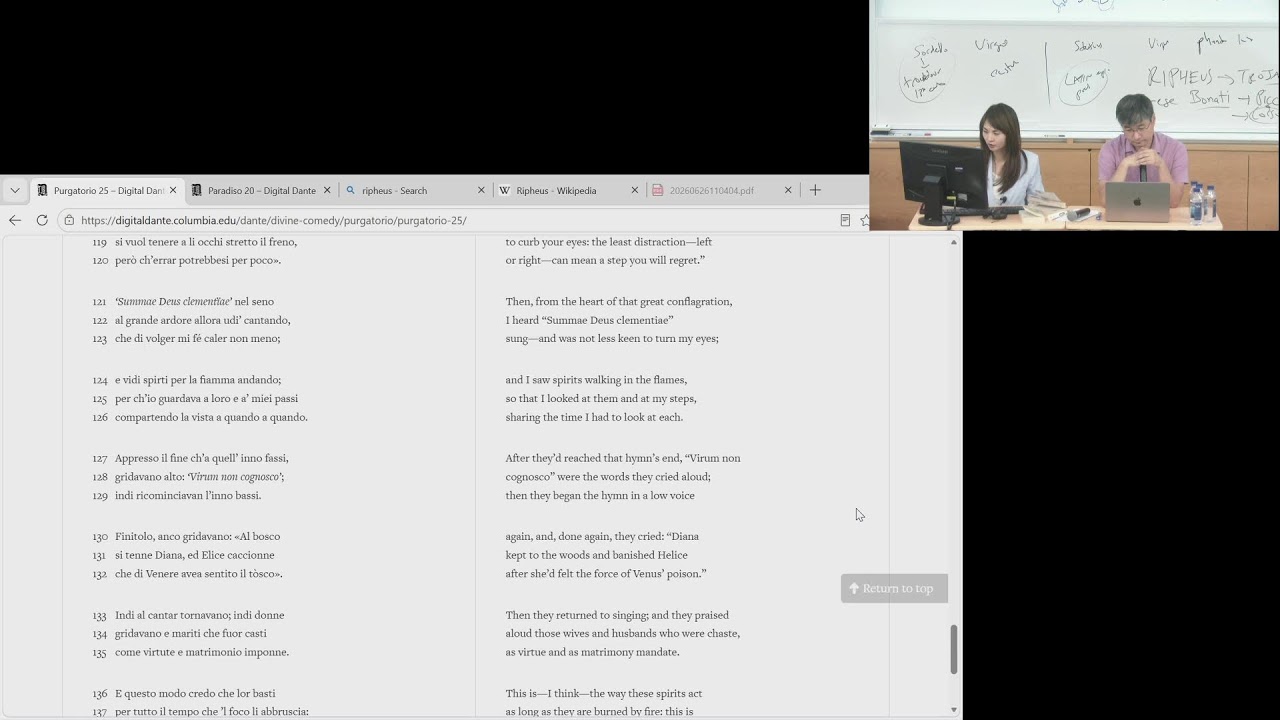 248 min
Dante Livestream #11 (Friday, June 26 10AM)
 247 min
Dante #11: Purgatory Cantos 15-25
 305 min
Dante Livestream #10 (Thursday, June 25 9AM)
 300 min
Dante #10: Purgatory Cantos 5-14
Ask anything from this episode.
Save it, chat with it, and connect it to Claude or ChatGPT. Get cited answers from the actual content — and build your own knowledge base of every podcast and video you care about.
Get Started Free