Key Moments
Dante #7 Hell Cantos 10-19
 Predictive History
Want to know something specific about what's covered?
We've already dissected every moment. Ask and we will deliver (with timestamps).
Key Moments
Dante's Inferno depicts Florence as a meritocracy rife with factionalism, economic pressure, and narcissism, leading to a decline that culminates in the Black Death — a divine judgment on a society that embraced self-indulgence and materialism over faith, hope, and love.
Key Insights
Dante defines faith as 'the imagination to believe that God does exist, that heaven and hell exist, and that God loves us,' hope as 'arrogance where you have to believe that you do matter and whatever you do impacts the universe,' and love as 'action' against injustice.
Dante's Hell redefines sins: traditionally ego-driven sins like lust, gluttony, greed, and wrath are reinterpreted as stemming from a *lack* of ego or will, while fraud, violence, and treachery (which he includes instead of traditional envy, pride, and sloth) are considered worse because they harm others and disrupt their capacity to live a good life.
Fraud is worse than violence in Dante's schema because it destroys 'people's capacity to trust' and 'question reality itself,' therefore undermining the basis for faith, hope, and love, which rely on a shared sense of reality and trust.
Homosexuality, represented by figures like Sir Brunetto (Dante's respected teacher) in the circle of violence against God and nature, is interpreted not as a sin of the act itself, but as an expression of 'narcissism' and 'self-indulgence' that signifies an inward turning of the elite, abandoning their social responsibility and contributing to societal decline, similar to incest.
Usurers (money lenders) are punished for their crime of not participating in the 'creation process' with God, instead 'exploiting other people's capacity to co-create with God' by simply charging interest, thus being trapped by the very 'purses of money' they hoarded in life.
Fortune tellers and oracles are condemned because they 'deny free will' and 'restrict the level of creativity, imagination that God ultimately wants to grow, not shrink,' often doing so for profit, which Dante, as a self-proclaimed true prophet, aims to expose as false.
Homosexuality as an expression of narcissistic self-indulgence and elite exclusion
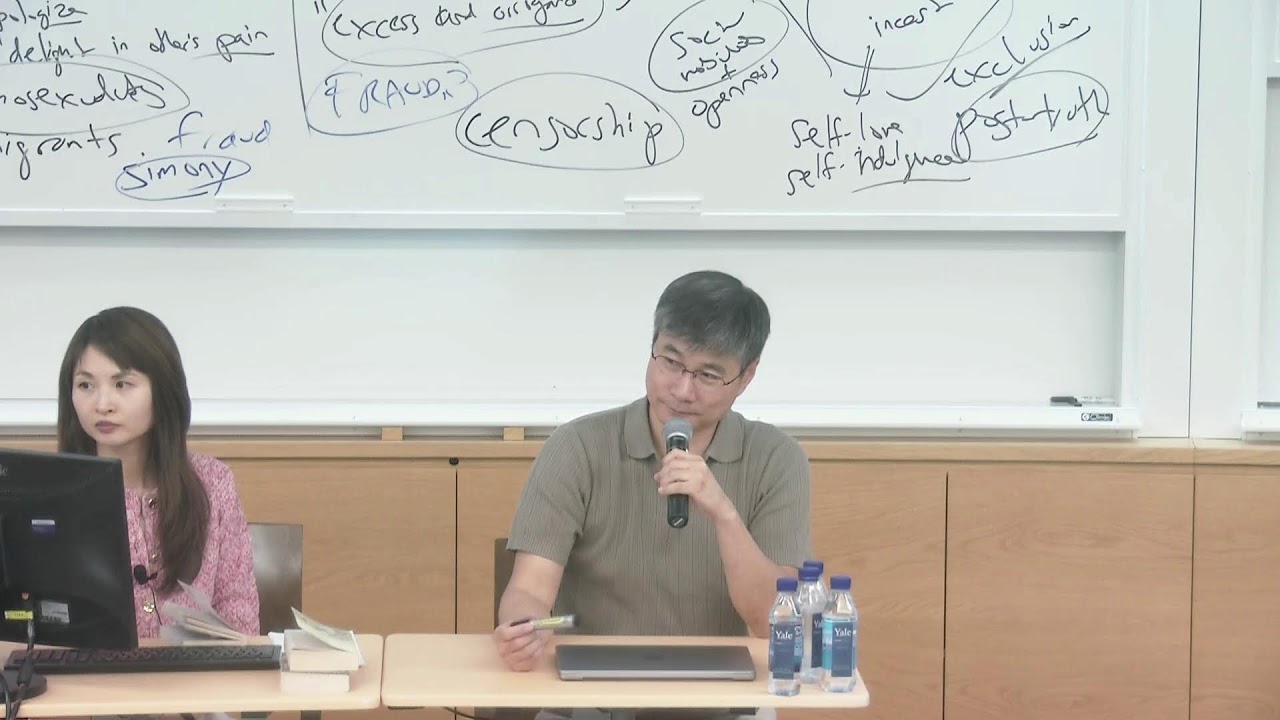
Dante places respected figures like his teacher, Sir Brunetto, and three distinguished Florentine noblemen (Guida, Tagayo Albrandi, and Yakapo Rustikuchi) in the circle of violence against God and nature for homosexuality, which initially appears paradoxical given Dante's affection for Brunetto. However, the video argues this placement is less about the act itself and more about the underlying attitude. Homosexuality, alongside implicit incest, is portrayed as a symptom of a declining elite's narcissism and self-indulgence. This elite, consumed by its own kind and refusing to engage with 'the other gender' or 'other people,' expresses an 'excess and arrogance' that leads to social exclusion. This behavior is seen as a rejection of God's natural order—one that prioritizes procreation and communal contribution—and ultimately signifies an abandonment of societal responsibility. For Dante, this self-absorption undermines the collective capacity for faith, hope, and love, signaling a society's decay, where the elite's refusal to contribute to future generations or engage with the wider community leads to extinction and moral decay. The paradox of placing loved ones in hell for this sin forces the reader to confront a deeper critique of the Florentine elite's values.
Fraud, a sin more destructive than violence, erodes the fabric of trust
In Dante's meticulously structured Hell, fraud is deemed a more egregious sin than violence. This distinction is crucial to understanding Dante's vision of societal decay. While violence inflicts physical harm, fraud destroys the very capacity to trust, which is fundamental to faith, hope, and love. If individuals are constantly deceived, their perception of reality becomes distorted, making it impossible to establish genuine connections or believe in a shared truth. Virgil explains that fraud 'destroys people's capacity to trust' and makes one 'question reality itself.' This is why fraudulent individuals suffer deeper torments in Hell compared to the violent. The modern-day rise of 'fake news,' deepfakes, and internet fraud, which makes it 'impossible to tell what is fake,' echoes Dante's concerns about a society where trust is so eroded that cooperation, promises, and contracts become meaningless. Such an environment fosters individual isolation and collective paralysis, directly contrasting Dante's ideal of a community built on mutual faith and shared purpose.
Money lenders face divine retribution for exploiting creation
Dante condemns usurers (money lenders) to a harsh punishment: they are buried in the sand, trapped by the very purses of money that defined their earthly lives. This fate is a direct consequence of their sin, which Dante views as the exploitation of others' capacity to co-create with God. Unlike those who engage in productive labor, usurers profit merely by charging interest. This practice, in Dante's eyes, signifies a rejection of the divine co-creation process, as they are not producing anything of actual good but rather leveraging the efforts and needs of others for personal gain. The punishment in Hell mirrors their earthly actions: just as they enslaved others with debt and interest, they are now 'getting a taste of their own medicine,' forever trapped and tormented by their material greed. This demonstrates Dante's belief that true societal value comes from active contribution and productive engagement, not from passive accumulation through exploitative practices.
Truth versus prophecy: Fortune tellers as agents of deception
The punishments meted out to fortune tellers in Hell are particularly ironic: their heads are twisted backward, forcing them to see only the past, never the future. This fate reflects their earthly crime of deceiving people by claiming to predict the future, thereby denying free will and restricting imagination. Dante views such practices as a manipulation that turns individuals into 'pawns in the game of the gods,' hindering their capacity to make free choices and engage in 'co-creation' with God. Fortune tellers, often motivated by profit, reduce human agency and creativity. Dante, presenting himself as a true prophet, implicitly critiques these figures by demonstrating their falsehoods. His work aims to awaken readers, suggesting that true prophecy elevates the human spirit and imagination, while fortune telling diminishes it. In a broad sense, contemporary influential journalists, podcasters, and YouTube celebrities with an 'agenda' are seen as modern equivalents, fabricating narratives that restrict independent thought and push desired outcomes, much like ancient oracles influenced kings.
Simony, the selling of divine influence, corrupts institutions
Dante reserves a specific and severe punishment for simony—the purchasing or selling of spiritual offices or sacred things. For this sin, individuals are plunged headfirst into holes in the rock, with their feet aflame—a grotesque inversion of baptismal fonts. Pope Nicholas III, mistaking Dante for Pope Boniface VIII, reveals the widespread nature of this corruption within the Church. Dante's outrage stems from the abuse of trusted authority for personal gain, particularly within institutions meant to safeguard spiritual integrity. The modern equivalent, as discussed, includes the 'selling of credentials' by universities through donations or fast-tracking, or even governments profiting from their positions of trust. This practice devalues genuine merit and faith, replacing them with transactional relationships built on wealth. Dante's fervent condemnation underscores his belief that such corruption poisons the very wellsprings of societal morality and trust, signifying a profound betrayal of divine principles and public faith.
Florence's decline linked to immigration and material pursuits
Dante's great-grandfather, Cacciaguida, offers a historical perspective on Florence's decline, attributing it largely to immigration and the subsequent rise of materialism. Cacciaguida laments that Florence's once-pure society, composed of dedicated families with shared values, was corrupted by the influx of 'new people' with different values. This cultural clash, he argues, dismantled community bonds and rendered universal moral principles difficult to uphold. In the absence of shared cultural or spiritual values, money became the sole unifying factor, driving a pursuit of wealth and individual gain over communal responsibility. This shift fostered 'selfishness' and 'narcissism,' leading to a society where individuals focus on personal enrichment rather than contributing to the common good or 'making a safe and moral society.' The great-grandfather's narrative implies that while immigration can bring vibrancy, unmanaged, it can also lead to the erosion of traditional values and social cohesion, catalyzing a societal decline marked by materialism and factionalism.
Meritocracy fosters cruelty and an inability to apologize
Dante's depiction of Florence as a rigid meritocracy highlights its psychological and moral costs. In this 'high-pressure, winner-takes-all, unforgiving culture,' individuals are constantly 'keeping score' against one another, fostering a deep-seated competition that erodes empathy. The narrator's own cruel act of allowing Kavakante to believe his son, Guido, is dead, and his subsequent inability to apologize, exemplifies this. The video suggests that in a meritocracy, apologizing is seen not as rectifying a wrong but as incurring a 'debt' or revealing weakness, making genuine contrition almost impossible. Furthermore, this competitive ethos cultivates a 'delight in others' pain,' as seen when Dante expresses satisfaction at his enemy Flippo Argenti being torn apart in the circle of wrath. This competitive culture, where success is the ultimate measure of worth, dehumanizes individuals, forcing them into a relentless race where compassion is suppressed, and others' failures are celebrated as personal victories.
A prophet's vision: Divine judgment as a path to redemption
Dante presents himself as a prophet whose Inferno serves as a profound social critique, an 'allegory of hell' reflecting the Italy of his time. His message is a stark warning: society must repent or face divine judgment. The Black Death of 1357, which decimated Europe, is framed as God's swift and brutal retribution for a society that had become 'unredeemable.' However, this punishment, while severe, is ultimately an act of divine love, designed to force humanity to 'hit rock bottom' and rediscover its path to faith, hope, and love. The suffering in Hell is not mere vengeance; it is a means to 'force reflection,' to make sinners visualize the consequences of their actions and recognize the 'divine spark' within them that can lead to redemption. The giant Capaneus, who refuses to show remorse even under torment, highlights that only humans, with their capacity for reflection and potential for redemption, are truly susceptible to Hell's transformative power, emphasizing that God's justice is always geared towards ultimate salvation.
Mentioned in This Episode
●Products
●Software & Apps
●Organizations
●Books
●Concepts
●People Referenced
Common Questions
Dante defines faith as the imagination to believe in God, Heaven, Hell, and God's love for humanity. Hope is the belief that one matters and impacts the universe, driven by arrogance that spurs action. Love is the active pursuit of justice and the belief that injustice anywhere is injustice everywhere.
Topics
Mentioned in this video
The author and protagonist of The Divine Comedy, presented as a prophet and social critic. His journey through hell serves as a critique of Florentine society and a call for divine judgment.
A character in Inferno, representing lust, who fell in love with her husband's brother, illustrating Dante's idea of lust as escaping into fantasy and a lack of self-will.
A contemporary actress used as an example in a thought experiment about different levels of lust, specifically writing love letters to a celebrity.
One of Dante's real-life enemies, whom Dante expresses sadistic pleasure in seeing tormented in the circle of wrath, demonstrating a negative consequence of meritocratic competition.
The first heretic in the Catholic Church, after whom the sin of simony is named, involving the act of selling sacred things for profit.
Dante's epic poem, which the lecture analyses. It is treated as both a vision (Paradiso) and a prophecy/social critique (Inferno).
One of the three parts of The Divine Comedy, described as Dante's 'last will and testament' and his vision for the universe, emphasizing faith, hope, and love.
One of the three parts of The Divine Comedy, presented as a prophecy and a social critique of contemporary Florentine society, warning of divine judgment.
A novel by Gustave Flaubert, referenced as having a similar plotline to Francesca's story, where a bored woman's romance novel reading leads to an illicit affair, illustrating Dante's concept of lust.
A book mentioned by a student, arguing that embracing every culture can lead to exclusion rather than openness, in the context of discussing the societal implications of homosexuality.
A Greek tragedy whose plot is used to illustrate how prophecies can manipulate people's free will, where Oedipus unknowingly fulfills a prophecy of killing his father and marrying his mother.
A biblical book referenced for the contest between Moses and the priests of Pharaoh, to illustrate how a true prophet must prove himself against false divinators.
A film franchise mentioned as an example of modern blockbusters that might predict future possibilities, prompting a discussion about whether such creative works function as modern fortune-telling.
The religious institution whose theology at the time is reconciled with Dante's message. Also criticized for corruption and weaponizing heresy.
An elite university used as a hypothetical setting to illustrate the contemporary emphasis on 'being yourself' from university presidents, contrasting with past ideals of serving humanity.
An elite university used as a hypothetical setting to compare the values taught in the 1960s-90s (change the world) versus today (be yourself), to highlight a perceived societal decline.
An elite university used as a hypothetical setting to compare past and present values taught to students, indicating a shift towards individualism.
An example of a trusted institution (universities) that might engage in practices similar to simony, such as fast-tracking children for donations, drawing parallels to church corruption.
Traditional Christian sins, four of which (lust, gluttony, greed, wrath) are placed in Inferno, while the remaining three (envy, pride, sloth) are in Purgatory, indicating a different severity based on whether they harm oneself or others.
A social system where individuals advance based on talent and achievement, criticized by the speaker for fostering intense competition, cruelty, inability to apologize, and delight in others' pain, leading to inequality.
A beast in Inferno representing fraud, with the face of an honest man but the tail of a scorpion, symbolizing how fraud seduces and then stings.
The name of the circle of Hell dedicated to fraud, which is further divided into ten valleys to punish different types of fraudulent actions.
Described as a huge contemporary issue, accounting for 80% of criminal cases, highlighting modern society's struggle with fraud and the erosion of trust.
The sin of selling holy relics or church offices, condemned in Inferno 19, and compared to modern-day ethical transgressions by institutions.
A film mentioned by a student to highlight the historical persecution and forbidden nature of homosexual love, contrasting it with the contemporary celebration of homosexuality.
A film franchise cited as an example of blockbusters that might "predict the future" or offer possibilities, questioning if this constitutes a modern form of fortune-telling.
More from Predictive History
View all 167 summaries

Ask anything from this episode.
Save it, chat with it, and connect it to Claude or ChatGPT. Get cited answers from the actual content — and build your own knowledge base of every podcast and video you care about.
Get Started Free