Key Moments
Accelerating Your AI Career
 DeepLearning.AI
Want to know something specific about what's covered?
We've already dissected every moment. Ask and we will deliver (with timestamps).
Key Moments
AI isn't just for engineers; it's transforming every role, and the key to career acceleration is intentional learning and practical application, not just degrees.
Key Insights
The AI field is experiencing rapid innovation with new S-curves of technology emerging constantly, making lifelong learning essential.
The World Economic Forum and Microsoft reports indicate a significant emergence of new digital jobs in the next 3-5 years, with data analysts, AI/ML specialists, and big data specialists being the top three in-demand skills.
AI is not exclusive to technical roles; it is increasingly vital for non-technical positions like product management, business development, legal, finance, marketing, and customer support.
A strong foundation in basic math (high school level arithmetic and algebra) is sufficient to start learning AI, with more advanced math concepts to be learned as needed.
Project work, whether through guided projects, personal passion projects, or Kaggle competitions, is crucial for applying learned skills and building a portfolio, complementing formal education.
AI transformation in organizations requires a shift towards data-driven decision-making culture, starting with quick pilot projects and ensuring all levels, including leadership, embrace the change.
The evolving landscape of AI and career opportunities
The field of Artificial Intelligence is in a constant state of rapid innovation, characterized by sequential "S-curves" of technological development. While foundational concepts remain relevant, new technologies emerge frequently, necessitating continuous learning. Reports from organizations like the World Economic Forum and Microsoft highlight a significant surge in digital job creation, with data analysis, AI/ML specialization, and big data expertise leading the demand. Importantly, AI's impact extends far beyond traditional engineering roles, permeating business, finance, marketing, and even creative fields. This broad applicability means that AI skills are becoming increasingly valuable across all sectors, offering a pathway for career acceleration for professionals regardless of their initial technical background.
Getting started: Foundational knowledge and the role of math
For individuals aspiring to enter the AI field, the prerequisite math knowledge is often less intimidating than perceived. High school level arithmetic and basic algebra are generally sufficient to begin learning core AI concepts. While advanced mathematics like linear algebra and probability become more important for deeper specialization, the advice is to start learning AI first and then delve into specific mathematical topics as they become necessary. This approach prevents potential learners from being deterred by the perceived complexity of the math involved. Platforms and courses often provide clear outlines of required prerequisites and introduce mathematical concepts in context, making the learning process more accessible and less daunting.
AI's pervasive influence beyond core engineering
The conversation emphasizes that AI is not solely the domain of ML engineers or companies built entirely around AI. A significant portion of AI's impact lies in its ability to "AI-ify" existing roles and industries. This means professionals in fields like product management, business development, legal, finance, marketing, and customer support can leverage AI to enhance their work. By understanding how AI can be applied within their specific domain, these individuals can differentiate themselves, improve efficiency, and drive innovation. The key is to gain familiarity with AI concepts and to proactively explore how these technologies can augment their current skill sets, making them more valuable in the evolving job market.
The importance of continuous learning and practical application
In the rapidly evolving AI landscape, continuous learning is paramount. The concept of AI as a series of stacked "S-curves" illustrates that as older technologies mature, new ones emerge, creating ongoing opportunities for skill development. Beyond theoretical knowledge, practical application is crucial. This involves hands-on projects, which can range from personal passion projects to guided courses with applied exercises. Building a portfolio through these projects demonstrates proficiency and allows individuals to showcase their ability to solve real-world problems. This practical experience is often more impactful than formal degrees alone, especially for those seeking to transition into AI-related roles or enhance their current positions.
Navigating career paths and building a community
The journey into AI can be approached from various angles, whether through formal courses, self-study, or by leveraging existing industry expertise. For those considering entrepreneurship or consulting, focusing on solving a genuine problem and identifying the paying customer are critical steps. Building a community, whether through formal networks or informal study groups, can provide essential support and accountability. The speakers also stress the importance of intentional action and self-reflection to determine the best learning path, whether it's a structured program or a more self-directed approach. The overarching theme is that proactive engagement and a focus on continuous skill development are key to navigating and accelerating one's career in the AI space.
AI transformation within organizations
For companies, becoming AI-enabled requires a strategic organizational shift rather than just technical implementation. Andrew Ng advises starting with quick, small pilot projects to gain learning experiences that pave the way for larger successes. Fostering a data-driven decision-making culture, where data informs choices over intuition alone, is vital. This transformation necessitates buy-in from all levels, including leadership and non-technical staff. The integration of AI changes traditional project management, requiring an understanding of data exploration, potential timeline adjustments based on findings, and the unique complexities of AI development. Project managers who can navigate these AI-specific challenges become highly valuable assets.
Mentioned in This Episode
●Software & Apps
●Companies
●Organizations
●Books
●Concepts
●People Referenced
Common Questions
The new Machine Learning Specialization is an updated and expanded version of Andrew Ng's original machine learning course, which was the first course on Coursera. It recently went live and is designed to provide comprehensive and current machine learning education.
Topics
Mentioned in this video
Ryan Keenan is the director of product at deeplearning.ai. Andrew Ng is the founder of deeplearning.ai.
Ali Miller got her MBA from Wharton and launched an AI initiative there, which is now a full AI curriculum.
Shravan Goli served as President and CEO of Dictionary.com, where they built a machine learning-based vocabulary building application.
Shravan Goli references their report on emerging in-demand skills to highlight the growth of digital jobs.
Andrew Ng notes that almost all computer science undergraduates at Stanford take multiple AI classes. He also mentions Stanford Engineering Everywhere, his first foray into online education.
Andrew Ng leads AI Fund, a venture studio that supports entrepreneurs in building AI companies.
Andrew Ng mentions Wikipedia as a resource for looking up specific math terms like Gaussian distribution, but notes it's not ideal for learning complex subjects like calculus comprehensively.
A platform for data science competitions, seen as useful for honing skills but with limitations regarding project scoping and data engineering.
Ali Miller is a co-founder of Girls Who Code, an organization focused on increasing the number of women in computer science.
Ali Miller serves as a national ambassador for this organization.
The new machine learning specialization recently went live on Coursera. Shravan Goli is Coursera's Chief Product Officer, and Andrew Ng is a co-founder of Coursera.
Ali Miller previously ran machine learning for startups and venture capital at AWS.
Ali Miller worked at IBM Watson as a lead product manager.
Mentioned as a tool for data visualization in Coursera's guided projects.
Mentioned as a tool for building pivot tables in Coursera's guided projects.
Mentioned as a language used a decade ago for exercises in the previous machine learning specialization, now replaced by Python.
Mentioned as a language used a decade ago for exercises in the previous machine learning specialization, now replaced by Python.
Described as the modern language of choice for machine learning developers, used in the updated machine learning specialization.
Mentioned as one of the latest tools in modern machine learning covered in the updated specialization.
Founder of deeplearning.ai, co-founder of Coursera, and well-known for his work in AI innovation, entrepreneurship, and education. He started his career thinking about automation and was influenced by his father's early work in medical AI.
An artificial intelligence leader, advisor, and investor. She was previously global head of machine learning business development for startups and venture capital at Amazon Web Services. She is a co-founder of Girls Who Code.
Author of 'Thinking, Fast and Slow', mentioned by Ali Miller as influencing her early career path in cognitive science and AI.
Mentioned in a joking context regarding the S-curve for self-driving cars, implying overly optimistic predictions.
CEO of a company supported by AI Fund that uses AI for shipping route optimization to reduce fuel consumption and improve environmental impact.
Curriculum architect and product lead for the new machine learning specialization at DeepLearning.AI, who led the team of developers.
Part of the team that worked on the updated machine learning specialization.
Part of the team that worked on the updated machine learning specialization.
Part of the team that worked on the updated machine learning specialization.
Part of the team that worked on the updated machine learning specialization.
Director of product at deeplearning.ai and host of the event. He was previously an astrophysicist.
Coursera's Chief Product Officer. He previously served as President of Dice and CEO of Dictionary.com. He brings a product and business perspective to AI discussions.
Ali Miller is excited about transformers and large language models, noting the recent advancements in these areas.
Ali Miller is excited about large language models and transformers, highlighting their recent innovation.
Shravan Goli mentions the Gartner hype cycle in relation to AI's current position, suggesting AI is past the peak hype and disillusionment phases and is now in a reality phase with many applications.
A popular dataset of handwritten digits, recommended as a starting project with an answer key for beginners in machine learning.
Shravan Goli mentions Microsoft's data science report on emerging digital jobs, citing a prediction of 150 million new jobs in the next three years.
A tech job marketplace where Shravan Goli previously served as President.
A high-impact company where Shravan Goli previously led product and business teams.
More from DeepLearningAI
View all 105 summaries 62 min
Full Course: Spec-Driven Development with Coding Agents
 26 min
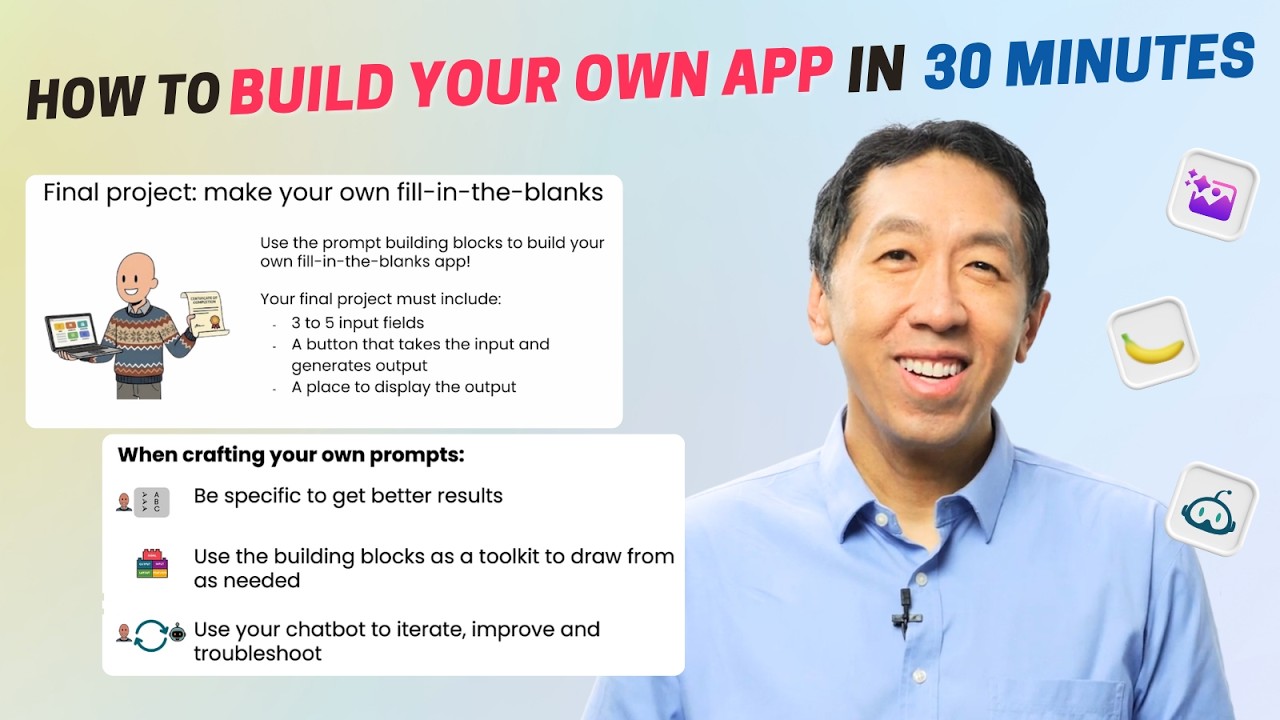
Build Your Own App In Just 30 Minutes! Full Course with Andrew Ng
 26 min
AI Dev 26 x SF | Brandon Waselnuk: Building the Context Engine AI Agents Need
 26 min
AI Dev 26 x SF | João Moura: Building Recurring, Governed, and Embedded Enterprise Workflows
Ask anything from this episode.
Save it, chat with it, and connect it to Claude or ChatGPT. Get cited answers from the actual content — and build your own knowledge base of every podcast and video you care about.
Get Started Free