Key Moments
Tobi Lütke: Empowering a World of Rebels | Knowledge Project Podcast
 The Knowledge Project
Want to know something specific about what's covered?
We've already dissected every moment. Ask and we will deliver (with timestamps).
Key Moments
Tobi Lütke discusses Shopify's growth, innovation, combating bureaucracy, and the future.
Key Insights
Prioritize the core mission (North Star) to navigate volatility and maintain focus.
Founders possess unique legitimacy that allows for "subtraction" and bold pivots.
Best practices often equate to avoiding risk; true innovation requires doing things differently.
Businesses can learn immensely from programming principles, especially systems design and computational thinking.
Internal innovation is crucial; companies shouldn't solely rely on acquisitions.
Decision-making requires rigorous input analysis, considering long-term effects and potential blind spots.
Sleep hygiene is trainable and a fundamental element of peak performance, often solvable with simple, consistent routines.
Technology augments human potential, replacing drudgery rather than people.
The future is optimistic, driven by rapid technological progress in areas like ML and AI, offering unprecedented opportunities.
NAVIGATING VOLATILITY WITH A CLEAR NORTH STAR
Tobi Lütke emphasizes the importance of clinging to a company's core mission or "North Star" during times of rapid change and market swings. For Shopify, this means empowering entrepreneurs by simplifying the technological and internet aspects of running a business. This unwavering focus allows the company to adapt to unforeseen obstacles, such as shifts in customer behavior or logistical challenges, by constantly recalibrating actions towards the overarching goal, rather than getting lost in the immediate turbulence. This approach transcends tactics and anchors the company's strategy, ensuring that progress is sustained despite external disruptions.
THE UNIQUE LEGITIMACY OF FOUNDERS
Lütke distinguishes between founder-led and professionally managed companies, highlighting the unique resource of 'legitimacy' founders possess. This legitimacy, born from the company's origin story and cumulative experiences, grants founders the authority to make drastic changes, including "subtraction"—removing or pivoting from initiatives. While professionally managed companies rely on stakeholder alignment and planning, founders can draw on their historical perspective to justify difficult decisions, even if initially unpopular. This ability to subtract is crucial for maintaining agility and preventing companies from becoming bogged down by accumulated, once-valid but now obsolete, processes.
CHALLENGING 'BEST PRACTICES' AND EMBRACING INNOVATION
Lütke is critical of 'best practices,' viewing them as a proxy for risk aversion and a path towards mediocrity. True innovation, he argues, stems from doing things differently, even if it entails the risk of underperforming initially. Companies should foster an environment where experimentation is encouraged, and failures are seen as learning opportunities rather than definitive setbacks. This requires a deliberate creation of psychological safety, allowing individuals and teams to explore novel approaches without fear of reprition, thereby enabling sustainable competitive advantage and pushing the boundaries of what's possible.
RECALIBRATING COMPENSATION AND FOSTERING HUMAN POTENTIAL
Shopify has moved away from complex, financially-driven compensation models toward a simpler system that offers flexibility and treats employees as adults. Lütke believes that compensation should not be overly tied to market fluctuations or external events impacting stock prices. The focus is on enabling human potential through technology, augmenting creativity and replacing toil and drudgery. This involves providing tools and platforms that empower individuals, allowing them to focus on higher-value contributions and fostering a culture where people are valued for their innate capabilities and adaptability, rather than just their job title or specific skill set.
LEARNING FROM PROGRAMMING PRINCIPLES FOR BUSINESS
Lütke advocates for deriving business principles from programming, emphasizing applied computational philosophy and systems design. He argues that technology, particularly computation, offers a more resilient and auditable framework for organizing and operating than traditional business methods like bureaucracy and storytelling. By applying engineering discipline, businesses can build more adaptable systems, make better decisions based on data, and foster a culture of continuous improvement. This shift allows for more precise understanding and management of complex organizational dynamics, moving beyond arbitrary decisions toward executable, model-driven approaches.
THE INFINITE GAME AND STRATEGIC DECISION-MAKING
Lütke distinguishes between finite games with clear winning conditions and 'infinite games' that are about continuation and adaptation, like fitness or true education. He suggests structuring life and business decisions around these infinite games, where change is embraced as clarifying information. Strategic decisions should consider long-term benefits and secondary/tertiary effects, rather than immediate expediency. By asking what the company in 10 years would wish they had done, leaders can balance short-term pressures with enduring goals, fostering innovation and resilience in a constantly evolving landscape.
OPTIMISM DRIVEN BY TECHNOLOGICAL PROGRESS
While acknowledging challenges, Lütke expresses strong optimism for the future, driven by rapid advancements in technology, particularly machine learning, transformer models, and open-source initiatives like Stable Diffusion. He sees these as tools that augment human creativity and problem-solving capabilities, enabling unprecedented progress. Lütke believes these are formative years for humanity, where technology will continue to offer solutions to complex global challenges, emphasizing the critical role of engineered systems and computational thinking in navigating this exciting and transformative era.
Mentioned in This Episode
●Products
●Software & Apps
●Tools
●Companies
●Organizations
●Books
●Concepts
●People Referenced
Common Questions
During periods of rapid market shifts, Shopify maintained its North Star: to make entrepreneurship simpler on the internet. This involved constantly evaluating ongoing projects, canceling approximately 60% of planned work, and adapting quickly to new challenges, such as enabling retail stores to move online during the pandemic.
Topics
Mentioned in this video
More from The Knowledge Project Podcast
View all 107 summaries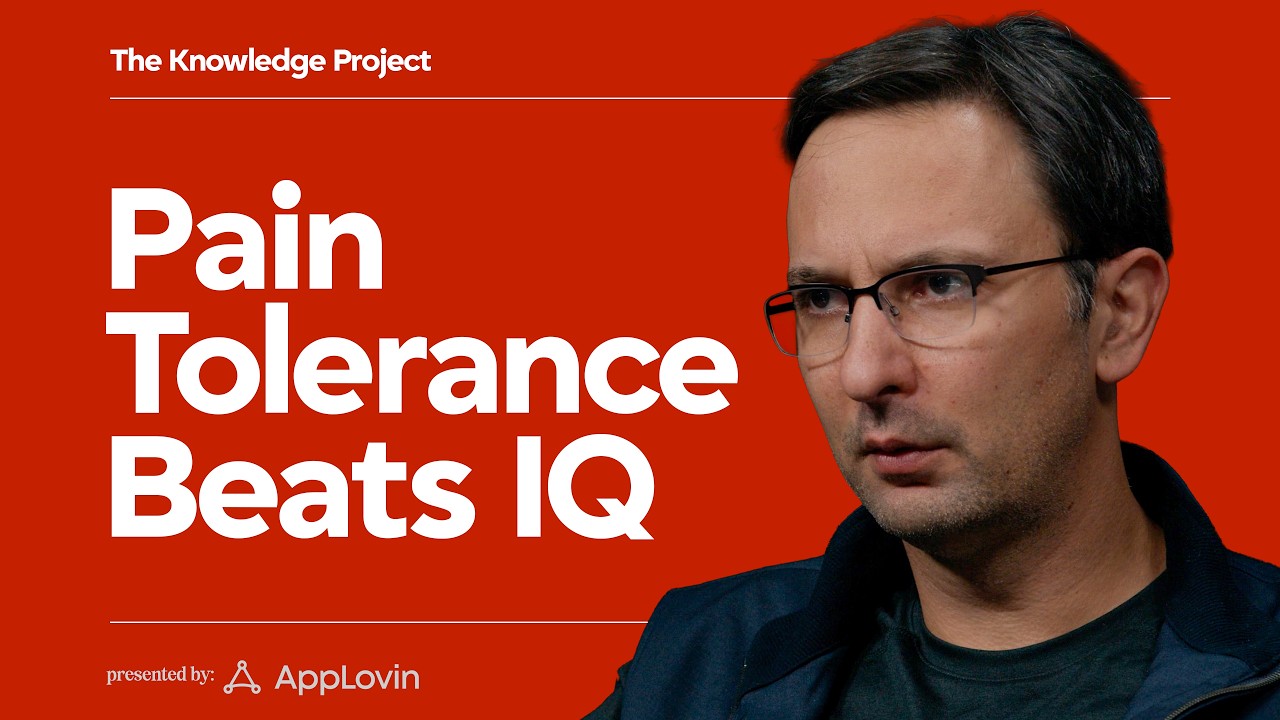 54 min
$4.6B CEO: Excellence Is the Capacity to Take Pain
 55 min
Microbiome Expert: Revealing the Biggest Myths About Your Gut, Diet, and Health
 62 min
Mental Models That Change How You Think | Bill Gurley
 70 min
The Hidden Pattern Behind Winning Products | Farmville creator Mark Pincus
Ask anything from this episode.
Save it, chat with it, and connect it to Claude or ChatGPT. Get cited answers from the actual content — and build your own knowledge base of every podcast and video you care about.
Get Started Free