Key Moments
The Elite Are Using AI to Take Everything You Own | Simon Dixon
 Impact Theory
Key Moments
Global elites are leveraging AI and a complex financial system to extract wealth, creating a K-shaped economy where the rich get richer and the poor poorer, with AI accelerating this trend.
Key Insights
The global financial, military, and tech industrial complexes are merging into a single entity, driven by the increasing technological nature of warfare and economic control.
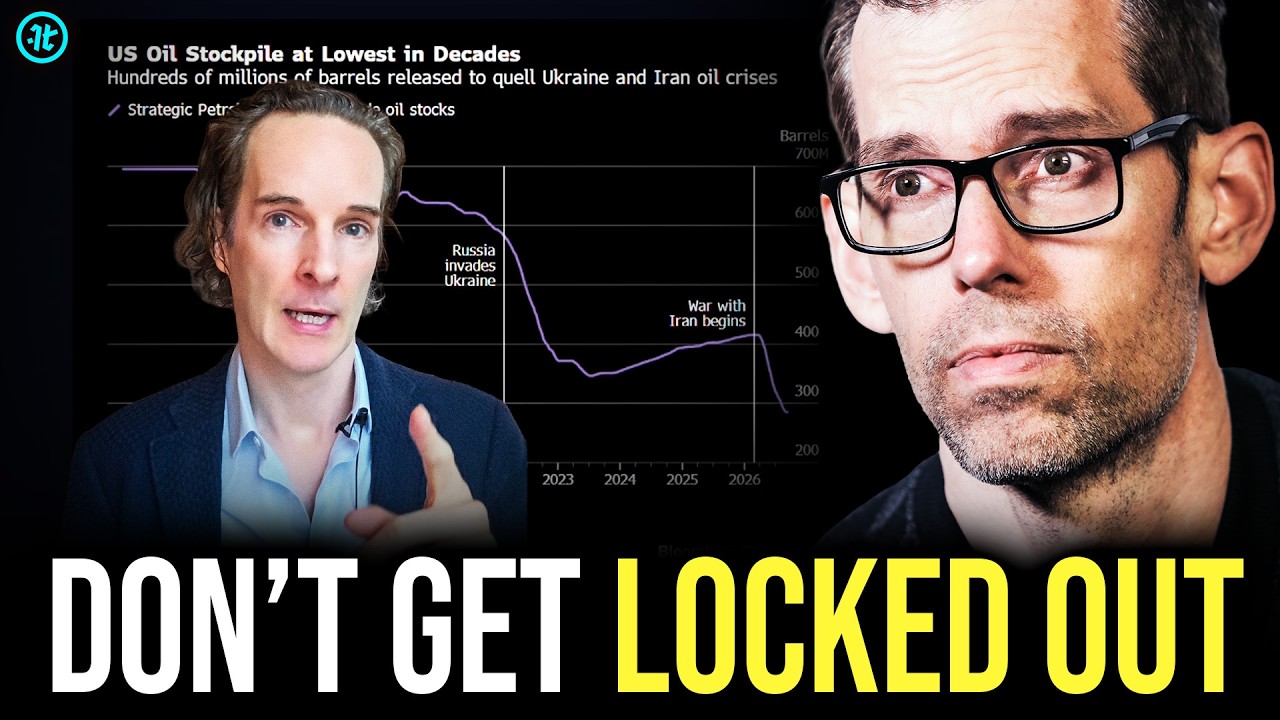
AI requires significant energy, and with high energy prices due to geopolitical events like the Strait of Hormuz closure, this creates a feedback loop benefiting financial institutions that can create money and acquire assets cheaply.
The current financial system, where banks create money through lending and the Federal Reserve is owned by these banks, incentivizes debt accumulation and asset inflation, benefiting those who can borrow against existing assets.
AI is projected to significantly increase productivity, particularly for businesses, but this could lead to widespread job displacement in sectors like transportation, necessitating a discussion around universal basic income.
The shift towards a multipolar world is characterized by the formation of regional blocs and a rebalancing of global power, challenging traditional Western financial and military dominance.
Individual sovereignty in this new landscape requires financial independence, controlling one's own assets, data, and narrative, rather than being controlled by centralized systems and algorithms.
The merging of industrial complexes and the rise of AI
The conversation highlights a significant shift in global power structures, with the traditional financial, military, and tech industrial complexes converging. Historically, these were distinct entities, but now they are merging into a singular force. This evolution is driven by the increasing technological nature of warfare and economic control. AI is becoming a central tool in this new paradigm. The ongoing conflicts around the world, particularly the Russia-Ukraine war, serve as experimental grounds for AI technologies, which are then increasingly deployed. This technological shift is key to understanding how wealth is being extracted on a global scale.
AI's energy demands and the financial feedback loop
A critical aspect of AI's proliferation is its immense energy consumption. The current geopolitical climate, including disruptions like the closure of the Strait of Hormuz, has led to soaring energy prices. This has a direct impact on the cost of running AI data centers. Paradoxically, this situation benefits financial institutions, particularly those at the core of the 'money printing' mechanism. They can acquire assets at lower prices by creating money freely, thus capitalizing on the rising costs that burden others. This dynamic explains why wealth is concentrating in the hands of a few, with approximately 10% of households owning 88% of the stock market, and the top 1% of those owning half of the total market value. This is happening while the general population grapples with debt and rising interest rates.
The debt cycle and asset inflation
The confluence of rising energy prices and increasing demands from financial institutions for higher interest rates on government debt is creating a significant burden for everyone. Mortgage payments and credit card debt are escalating, forcing individuals and businesses to either default on their debts or refinance at much higher rates. This pressure compels them to sell assets. These assets, in turn, are acquired by the elite who control the money supply, further concentrating wealth. The system is designed to continuously create debt, which fuels asset inflation. The Federal Reserve's actions and bondholder demands are pushing interest rates up, making it more expensive to service debt. This cycle ensures that those with access to capital can acquire assets at reduced prices, while those without are forced to sell, perpetuating a wealth transfer from the many to the few.
AI as a productivity enhancer and job displacement
On the business side, AI presents an unprecedented opportunity for productivity gains. Companies can leverage AI to automate tasks like email management, integrate systems, and amplify the capabilities of their existing workforce. This allows small businesses to potentially operate with leaner teams and even foster new entrepreneurial ventures with AI agents. However, this surge in productivity also signals potential job displacement. While current job market data doesn't show massive unemployment, the future of jobs like taxi and truck drivers is uncertain due to AI advancements. This scenario raises questions about the need for systems like universal basic income to support those displaced by automation.
The evolution of global power structures and financial control
The discussion delves into the historical evolution of global financial control, from the Dutch and British empires to the current American-led system. The core mechanism of this system, often termed 'financialization,' involves central banks nationalizing losses and privatizing profits. Banks create money through lending, and this debt-based system is perpetuated by the need for continuous refinancing. The emergence of entities like BlackRock signifies a more decentralized, yet equally powerful, form of control, with these asset managers playing a crucial role in shaping market trends and influencing corporate governance through their vast holdings and board seats. This system thrives on debt and asset inflation, ensuring that wealth continues to concentrate among those who can manipulate or benefit from these financial mechanisms.
The rise of a multipolar world and regional blocs
The current global landscape is undergoing a significant transformation towards a multipolar world. The established Western-centric financial and military order is being challenged by emerging regional powers and alliances. Organizations like BRICS, along with regional blocs like ASEAN and the Shanghai Cooperation Organisation (SCO), are forming, indicating a shift in economic and political influence. Countries are seeking greater economic independence and establishing alternative trade and financial systems, moving away from the dollar's dominance. This multipolar environment, while potentially fostering competition, also presents opportunities for greater regional autonomy and resource control.
Navigating individual sovereignty in a shifting world
In the face of these massive global shifts, individual sovereignty becomes paramount. The advice is to focus on what one can control: one's own mind, body, and spirit. Financially, this translates to living below one's means, investing consistently in assets outside the traditional system, and safeguarding one's wealth and data. The rise of AI and centralized control networks necessitates a proactive approach to self-reliance, whether through decentralized technologies, personal asset management, or community building. The key is to understand the evolving rules of the game, make conscious choices about compliance and control, and strive for financial independence to navigate the coming economic and geopolitical transformations.
Mentioned in This Episode
●Software & Apps
●Companies
●Organizations
●Concepts
●People Referenced
Common Questions
The speaker argues that AI is becoming a central tool for wealth extraction by merging industrial complexes (financial, military, tech) into a single entity. AI data centers consume vast energy, driving up oil prices, which in turn raises interest rates and debt burdens for ordinary people, forcing them to sell assets that elites, who control money creation, then acquire cheaply.
Topics
Mentioned in this video
BlackRock's assets under management increased from $14 trillion to $15.3 trillion since the Strait of Hormuz closure. They control the largest AI database in financial markets.
Controlled by banks and determines the cost of borrowing based on economic data, ultimately enabling banks to create money and buy government debt.
Known for the phrase 'You'll own nothing and be happy,' which the speaker interprets as a drive for elite control over all assets.
An AI company looking to IPO at a valuation of $2 trillion, requiring significant capital.
Valued at $1.75 trillion, indicating the high valuations in the tech sector.
A free cash flow company that can acquire other AI companies and is protected from various financial scenarios.
An AI company with high valuation, expected to go public soon.
A free cash flow company that can acquire other AI companies and is protected from various financial scenarios.
Represented the stock market of its era, linking colonial expansion with government debt and the financial system.
A university founded to teach founders principles of building a lasting business, including maintaining presence in the AI era.
Issued 'Greenbacks' (Treasury currency) to fund the Civil War, bypassing the central bank.
Issued an executive order for Treasury currency fully convertible to silver, demonstrating governmental power to create its own money.
The guest speaker, who publishes regularly on X and YouTube, and created a self-hosted environment on his website.
More from Tom Bilyeu
View all 186 summaries 51 min
AI Safety Is In More Trouble Than People Realize. Experts Attack Each Other in Viral AI Debate
 57 min
Did the AI Bubble Just Pop?! Anthropic's Leaked Numbers are INSANE
 105 min
THIS is What Happens When AI Gets Smarter Than Humans
 47 min
The Japan Playbook Is Coming to America — The Big Reset Is Here
Ask anything from this episode.
Save it, chat with it, and connect it to Claude or ChatGPT. Get cited answers from the actual content — and build your own knowledge base of every podcast and video you care about.
Get Started Free