Key Moments
The 50-Year Economic Collapse That Created Socialism Is Happening Again Right Now
 Impact Theory
Want to know something specific about what's covered?
We've already dissected every moment. Ask and we will deliver (with timestamps).
Key Moments
Economic shifts driven by technology and currency devaluation are devaluing skills, leading to a 'K-shaped economy'. The solution isn't socialism, but rather adapting to new economic paradigms.
Key Insights
The 'Engels pause' was a 50-year period where economic productivity rose, but worker wages fell, a phenomenon that birthed socialism and communism.
A K-shaped economy describes a bifurcation where a small group with access to leverage (like technology) excels, while the majority fall behind.
The fairness reflex, observed in primates, drives anger and potential violence when perceived inequalities arise, exacerbated by social media's exposure to lavish lifestyles.
Capitalism's success relies on competition; monopolies, whether corporate or governmental, stifle innovation and consumer benefit.
The Nordic model, often cited as successful socialism, is more accurately a 'time-shifting' redistribution (peak earning years to dependent years) rather than wealth redistribution, and relies on high competence and value alignment.
Technological advancements, particularly general-purpose technologies like AI, create power-law distributions, disproportionately benefiting early adopters and potentially disadvantaging those who don't adapt.
The historical echoes of economic disparity: The Engels pause and the rise of socialism
Daniel Priestley draws a parallel between current economic conditions and the 'Engels pause,' a 50-year period in the 19th century where industrialization boosted productivity but stagnated or lowered wages for workers. This period of growing inequality and worker hardship, exemplified by skilled artisans losing their livelihoods to mechanization, was the fertile ground from which socialism and communism emerged. The fundamental dynamic was that while the economy was growing due to new technologies and industrial methods, the benefits were not shared equitably, creating a 'K-shaped economy.' In this scenario, a small elite understanding the new industrial methods (factories, steam, coal) became immensely wealthy, while the majority experienced declining economic fortunes. This historical parallel suggests that when technological progress outpaces equitable distribution, social unrest and calls for radical change, like socialism, become more pronounced.
The K-shaped economy and the danger of falling behind
The concept of a 'K-shaped economy' is central to understanding the current discontent. It visualizes an economic bifurcation where one path (the top of the K) shows significant growth and success, typically for those who can leverage new technologies or assets, while the other path (the bottom of the K) shows stagnation or decline. This isn't just about inequality; it's about the growing gap in purchasing power. When the cost of essential goods and services outpaces wage growth, individuals at the bottom of the K find it increasingly difficult to make ends meet. This creates a sense of unfairness and desperation, which can be amplified by social media's constant showcasing of extreme wealth, triggering a primal 'fairness reflex'. This perceived injustice, rather than inequality itself, is seen as the dangerous catalyst for social instability and resentment.
Lessons from historical shifts: revolutions in power, skills, and ownership
The end of historical periods of economic disparity, like the Engels pause, often involved significant societal shifts. Priestley highlights three key 'revolutions': a revolution in ownership, leading to new asset classes and widespread democratization of asset holding; a revolution in skills, necessitating the creation of mass education and reskilling systems; and a revolution in political power, demanding broader suffrage and representation. These shifts weren't always peaceful. While Britain saw more democratic evolution through movements like the Chartists advocating for political reforms, France experienced violent upheaval. The French Revolution, however, was notably led by disgruntled elites rather than solely by workers. These historical examples underscore that profound economic inequality can necessitate fundamental changes in how political power, education, and wealth are distributed, through either gradual reform or more disruptive means.
The limitations of socialism as a solution
Socialism, with its intuitive appeal of redistributing wealth from the ultra-rich to the needy, is presented as a surface-level 'fix' that doesn't address the underlying economic game. Priestley argues that simply altering the score (redistributing wealth) without changing the rules of the game leads to productive individuals disengaging, relocating, or expending creative energy on tax avoidance rather than innovation. He points to a '40% rule,' suggesting that when a significant portion of productivity is taken, individuals become highly motivated to game the system. Furthermore, the global nature of modern business and the geographical limitations of governments create an uneven playing field, with multinational corporations adept at navigating international tax laws, often paying little tax in the countries where they operate. This dynamic makes direct wealth redistribution from billionaires highly challenging and potentially counterproductive.
The true nature of the Nordic model: time-shifting, not wealth-shifting
The Nordic countries, particularly Sweden, are often presented as modern examples of successful socialism. However, Priestley reframes their model as 'time-shifting' rather than 'wealth-shifting.' Instead of primarily redistributing from the wealthy to the poor, the Nordic model emphasizes high taxation during an individual's peak earning years to fund services during their dependent periods (childhood and old age). This is achieved through a high-tax, high-service environment. While this approach has merits, it relies heavily on cultural homogeneity, shared values, and a high degree of competence within government institutions. Historical attempts at pure socialism in Sweden led to economic decline, prompting a shift towards market-oriented reforms. The success of the Nordic model is therefore contingent on specific cultural and governance factors that may not be easily replicable elsewhere.
Technology as a double-edged sword and the rise of power-law economies
A significant driver of the K-shaped economy is the uneven impact of technology. General-purpose technologies, from the internet to AI, act as 'bicycles for the mind,' offering immense leverage. Early adopters who master these tools can achieve exponential growth, leading to a power-law distribution where a small percentage of users capture a disproportionate share of benefits. This contrasts with the more evenly distributed outcomes from the later stages of the industrial revolution, which tended towards a bell curve. Many individuals, particularly older generations, struggle to adapt, seeing these technologies primarily as consumption devices rather than tools for productivity. This, coupled with the devaluing of traditional skills that can be automated or outsources, contributes to economic stagnation for a significant portion of the population. This technological disparity is estimated to be a third of the cause for the current economic split.
The future of AI, common assets, and potential solutions
Looking ahead, AI is poised to accelerate many of these trends, potentially creating an 'Engels pause' on a grander scale. Priestley suggests that traditional economic paradigms may need radical reform. He posits that digital companies are becoming like 'new continents' with immense power, blurring the lines between corporate and governmental functions. One potential avenue is to treat data as a common asset, with companies leveraging it paying into a pool for redistribution, akin to a sovereign wealth fund derived from digital resources. This could fund initiatives like UBI, but not through indiscriminate money printing, which exacerbates inflation. A key proposal is to nationalize or heavily tax critical digital infrastructure like data centers, treating them as public utilities or common goods, funded by tech companies and potentially leading to government ownership and leasing. This approach, focusing on value and trade rather than pure redistribution, could offer a more sustainable path forward.
Sovereign wealth funds and the critical role of competence and values
The discussion touches on sovereign wealth funds, particularly in comparison to Norway's success with its oil revenues. Priestley distinguishes between natural wealth (finite resources) and digitally generated wealth. While natural wealth benefits from sovereign funds, the digital economy presents new challenges. The success of any state-run or publicly-owned enterprise, including sovereign wealth funds or data centers, hinges critically on competence and leadership. Models like Norway, Switzerland, or Dubai, despite varying approaches, demonstrate that effective governance, investment in skills and infrastructure, and a focus on fostering productive citizens are crucial. The 'curse of resources' highlights how an over-reliance on natural wealth without diverse economic development can lead to unproductive populations. Ultimately, whether through public or private means, the ability to create value, adapt to new technologies, and foster a culture of productivity based on shared values seems paramount for navigating future economic landscapes.
Mentioned in This Episode
●Products
●Software & Apps
●Companies
●Organizations
●Books
●Concepts
●People Referenced
Government Spending as Percentage of GDP by Economic System
Data extracted from this episode
| Economic System / Policy | Government GDP Percentage |
|---|---|
| Anarchist Capitalism | < 15-20% |
| Normal Range Capitalism | 20-35% |
| Socialist State | 40-60% |
| Socialism Plus | 60-80% |
| Communism | 70-100% |
Social Services Spending in Sweden vs. USA (as % of GDP)
Data extracted from this episode
| Country | Social Services Spending (% GDP) |
|---|---|
| Sweden | 24% |
| USA | 22% |
Primary Causes of K-shaped Economy
Data extracted from this episode
| Cause Category | Estimated Contribution Percentage |
|---|---|
| Money Printing/Currency Debasement | 33% |
| Technology Adoption & Devaluation of Skills | 33% |
| Unproductive Choices & Market Distortions | 33% |
Common Questions
The Engels' Pause was a 50-year period during the Industrial Revolution where economic productivity increased, but workers' wages decreased. This growing disparity between a tiny elite benefiting from new technologies (factories, steam) and the struggling majority led to widespread inequality and became the birthplace of socialism and communism.
Topics
Mentioned in this video
Mentioned as part of Amazon's strategic monopoly that should be broken up for more fair competition.
100% grass-fed and grass-finished beef sticks with zero sugar, no artificial preservatives, soy, gluten, or corn, providing 6g of protein per stick as a healthy whole-food snack.
A ceremonial cacao nootropic product praised for its taste, calm energy, elevated mood, sharper focus, and cellular support, containing full-spectrum reishi.
Mentioned as the person who called personal computers 'bicycles for the mind', emphasizing their role as tools for leverage.
An Australian gazillionaire whose wealth came from mining rights inherited from her father, used as an example of wealth derived from natural resources.
Cited for her statement that billionaires 'shouldn't exist,' in the context of questioning whether wealth accumulation is achievable through fair means or only with technological advantage.
Mentioned as a US presidential candidate who reportedly visited the Soviet Union in 1988, prior to its collapse due to socialist policies.
Mentioned as the historical figure whose 'best buddy' Engels was, related to the origins of socialism and communism during the Engels' Pause.
Mentioned as an example of a billionaire whose wealth is often targeted by those advocating for redistribution, and used in an analogy about governments combating corporate monopolies.
Mentioned for his belief that property ownership is crucial for human survival and that taking it away would lead to global starvation.
Author of 'Wealth of Nations' (1776) and a book on morality, emphasizing competition as the lifeblood of capitalism.
Referred to as 'Mam Dani' (a mishearing of 'Joe Biden') and mentioned as calling out Ken Griffin and criticizing billionaires.
Mentioned as someone called out by Joe Biden, exemplifying how wealthy individuals may choose to leave areas that implement punitive taxation or publicly criticize them.
Analogized as 'King Larry' on the 'continent' of Google, signifying the immense power and influence of tech founders.
Analogized as 'King Sergey' on the 'continent' of Google, signifying the immense power and influence of tech founders.
The guest speaker, author of 'Lifestyle Business Playbook', discusses economic disruptions, socialism, capitalism, and the impact of technology and AI.
Hypothesized as a 'new continent' in the digital economy, having power and scale comparable to countries, and blurring lines between government and corporate functions (e.g., education, security).
A professional services network that independently verified Incogni as an effective data removal service.
Cited as a company that avoids UK taxes by technically being in Luxembourg, and argued to have a strategic monopoly that should be broken up (e.g., separating AWS from its retail arm).
Used as an example of a technology company that devalued skills (like taxi drivers' 'knowledge' of London streets) by making them ubiquitous with GPS.
Presented as a dangerous platform that fuels resentment by providing insight into wealthy lifestyles, creating a constant comparison and triggering the fairness reflex.
The brand that produces Nandika, a ceremonial cacao nootropic.
Mentioned as a company that doesn't pay tax in the UK due to international tax structures.
Hypothesized as a 'new continent' in the digital economy, having power and scale comparable to countries, and blurring lines between government and corporate functions.
Specifically mentioned for its ad business being routed through Ireland to avoid UK taxes, despite serving a UK audience.
Mentioned as an AI company that few people are directly paying for, highlighting the economic disconnect between data center investment and consumer usage.
A large UK retailer used as an example to illustrate how labor laws and minimum wage should be adjusted based on company size to favor small businesses and encourage competition.
Mentioned as a big bank that is 'freaking out' about data center debt and repackaging/reselling it to pension funds, suggesting a looming financial crisis similar to 2008.
The Host's former company, mentioned as starting 100% via e-commerce and being tech-enabled, suggesting leverage with technology helped its success.
Hypothesized as a 'new continent' in the digital economy, having power and scale comparable to countries, and blurring lines between government and corporate functions. Also mentioned as a company whose GPUs are a short-lived, high-capex component of data centers.
A 50-year period during the Industrial Revolution where economic productivity rose but worker wages fell, leading to inequality and the birth of socialism/communism.
An economic scenario where some people are doing incredibly well while the vast majority are trending downward or falling behind, often driven by technological leverage.
Critiqued as an insufficient solution for future economic problems, risking meaninglessness if universal and failing to address underlying issues of purpose and wealth accumulation.
A massive movement in the UK that sought political change through peaceful protest, demanding free and fair elections, property-independent voting rights, secret ballots, and paid MPs.
Used as an example of an incredibly competent part of the US government, though the speaker questions if such competence translates to financial distribution.
Mentioned as a part of Amazon that arguably gives Amazon a strategic monopoly and should be spun out to compete independently.
Implied as the type of AI that helps a CFO delegate math homework, making education systems need to adapt to leveraging such tools.
A data removal service that tracks down and removes personal data from hundreds of data broker sites, verified by Deloitte, offering 60% off an annual plan with code IMPACT.
Mentioned for its competent government institutions and hard work in building industries beyond oil and gas, leveraging sovereign wealth funds wisely.
Cited alongside Sweden regarding its government officials asking people to stop calling it socialist, and later mentioned as experiencing breakdowns due to integration issues with immigrants.
Differentiated from Sweden due to its resource-rich oil in the North Sea and large sovereign wealth fund, making its economic model more akin to Saudi Arabia.
Mentioned as another example of a country with competent government institutions.
Mentioned in the context of global economic superpowers, and later suggesting a future economic landscape divided more by tech/AI vs. traditional economy rather than geographical countries.
Initially the fourth wealthiest country per capita, it became a socialist country, experienced runaway inflation and economic decline (dropping to 25th wealthiest), then reformed its socialism to 'time-shift' rather than 'wealth-shift'.
Mentioned as a country whose economic operation is similar to Norway due to its natural resource wealth.
Mentioned as a historical example of a socialist system that collapsed due to 'bad socialist policies' around 1988.
Cited as an example of government incompetence, failing to build a railroad for $8 billion after spending $20 billion and not completing a single mile.
Discussed as an example of a city where a socialist experiment with wealth redistribution is being attempted, but faces challenges due to decoupling of wealth from physical geography.
Cited as an example of a country with intense cultural values, illustrated by the lack of trash cans in Tokyo streets and people carrying their trash willingly.
The capital city of Japan, used as an example for its unique cultural value seen in the absence of public trash cans and general cleanliness.
Mentioned hypothetically as a location where wealthy individuals might base their servers or businesses to avoid aggressive taxation.
Mentioned as an example of a country with competent government institutions, though noted as having small government and not being socialist.
Mentioned hypothetically as a location where wealthy individuals might base themselves to avoid aggressive taxation and wealth redistribution.
Described as being run by 'idiots' for subsidizing other countries to take its natural gas rather than building a sovereign wealth fund, illustrating the 'curse of resources'.
More from Tom Bilyeu
View all 75 summaries 123 min
Trump's IRS Settlement, Massie Loses His Seat, & Zuck Caught On Hot Mic AI Layoff Plans
 34 min
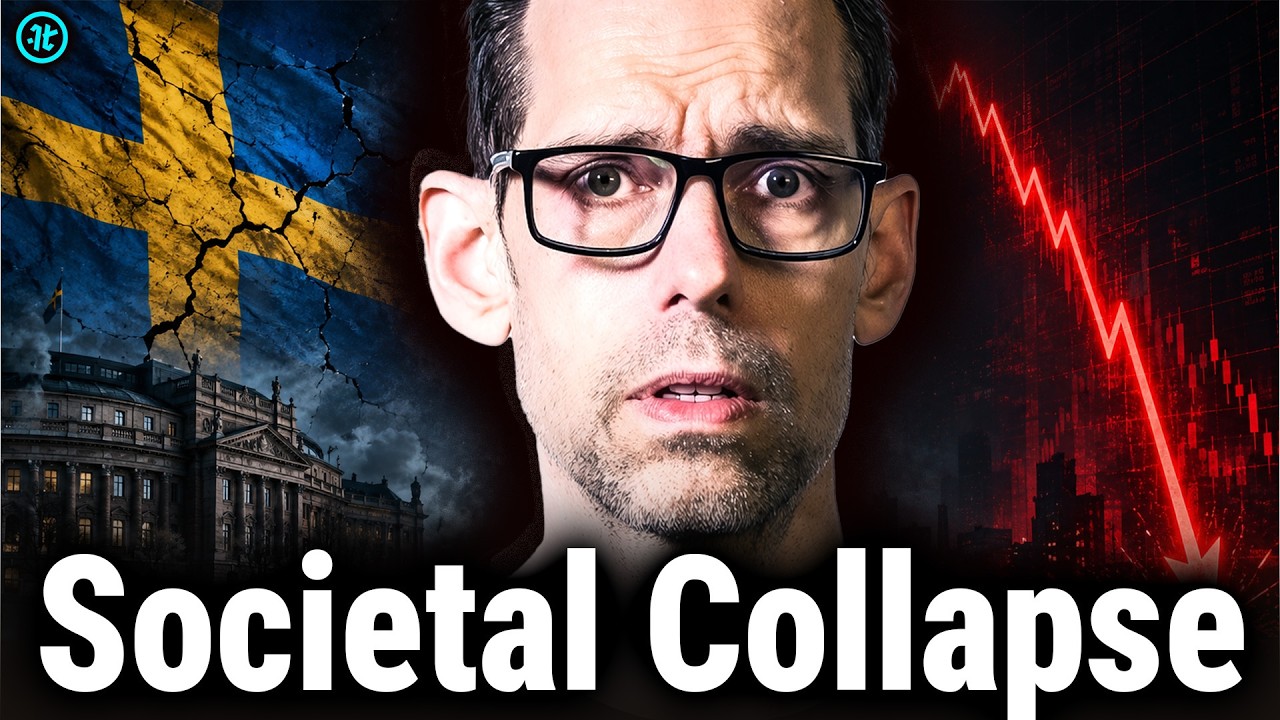
Sweden's Finance Minister Said Socialism Was Impossible — Then The Economy Collapsed
 124 min
Trump Under Scrutiny For Insider Trading & Cryptic Alien Memes + Thomas Massie & Lone Star Ticks
 101 min
What's Outside The Simulation w/ Donald Hoffman?
Ask anything from this episode.
Save it, chat with it, and connect it to Claude or ChatGPT. Get cited answers from the actual content — and build your own knowledge base of every podcast and video you care about.
Get Started Free