Key Moments
Stanford Robotics Seminar ENGR319 | Spring 2026 | Ingredientsfor Long-Horizon Robot Autonomy
 Stanford Online
Key Moments
Robots are gaining memory and generalization abilities crucial for complex, long-horizon tasks, but achieving this requires advanced techniques that compress information and leverage diverse learning data. Current systems can perform intricate sequences like cooking or cleaning, yet still lack human-level dexterity and intuitive problem-solving for truly open-world autonomy.
Key Insights
Robots can now perform complex, long-horizon tasks by integrating memory and generalization, moving beyond simple dexterous actions that were previously the limit.
To overcome the latency and computational costs of processing extensive historical data, a compressed multi-modal memory system (dense visual for short-term, abstracted language for long-term) is employed.
The PIO 7 model significantly improves generalization and performance by utilizing rich conditioning metadata, including subgoals and task descriptions, allowing a single checkpoint to perform various tasks with high fidelity without extensive post-training.
A novel approach trains policies using a mix of high-quality and lower-quality data, leveraging metadata to ensure high performance and generalization, which was previously a trade-off.
Skills can be transferred across different robot platforms (e.g., from a compact arm to a larger industrial UR5) by conditioning on learned subgoals, enabling new tasks without explicit training data for that specific robot.
Future robotics will likely integrate high-level reasoning with low-level manipulation, enabling robots to perform novel, long-horizon tasks through language instructions and emergent emergent intelligence, reducing reliance on direct teleoperation for complex sequences.
Current robotic capabilities versus future aspirations
Robotics has made significant strides in teaching robots complex, dexterous tasks, such as precise manipulation for tasks like unlocking a lock. However, these achievements are typically short-horizon, meaning they are brief, self-contained actions. The true value for human assistance lies in long-horizon tasks like cleaning an apartment or assembling complex structures, which require robots to operate autonomously for extended periods without human intervention. Current limitations in robotics stem from a lack of fundamental ingredients necessary for such autonomy, primarily primitive memory and robust, generalizable behaviors.
The critical need for memory in robotic operations
Memory is a fundamental requirement for robots undertaking long-horizon tasks. This is evident in scenarios like preparing a recipe, where a robot must remember which ingredients have already been gathered, or in partially observable environments like unpacking groceries. Without memory, a robot might repeatedly attempt an action it has already completed or entered into an endless loop, such as continuously washing a plate because it 'forgets' the task's duration or state. Existing robot models typically lack this capability, often being conditioned only on the current time step and failing to account for past actions or states. This deficiency leads to unintuitive failures, like indefinite task execution or improper handling of time-sensitive processes such as cooking.
Addressing memory limitations with multi-modal compression
Directly incorporating historical observations into robot policies, akin to extending the context window in language models, presents significant challenges. It drastically increases latency and computational cost, rendering real-time control infeasible. Furthermore, policies with extended history become acutely aware of their own shortcomings, often encountering distribution shifts from imperfect training data, which paradoxically degrades performance. To combat this, the proposed solution, 'Multi-Scale Embodied Memory' (MEM), leverages a compressed, multi-modal memory system. This approach employs dense visual memory for short-horizon details and abstracted language representations for long-horizon, semantic memory. This distinction mirrors human memory, allowing robots to retain crucial details for immediate tasks while capturing broader progress over extended periods without overwhelming computational resources. The visual memory uses sparse temporal attention and token reduction to maintain manageable input sizes, while language memory utilizes compressed summaries of past actions to track semantic progress over longer durations.
Enhancing generalization and performance with PIO 7
Beyond memory, achieving long-horizon autonomy requires policies that are both highly generalizable and performant. Traditionally, these two attributes have been at odds: broad datasets lead to generalization but dilute performance, while fine-tuning on narrow, high-quality data boosts performance but sacrifices generalization. The PIO 7 model tackles this by training a single policy with rich conditioning. Instead of unconditional training, PIO 7 incorporates metadata such as task type, subgoals, and quality/speed expectations. This allows the model to learn from diverse data, including lower-quality demonstrations, by understanding the context of each data point. At inference, this conditioning allows the user to steer the policy towards desired behaviors, such as high-speed or high-quality execution, effectively absorbing the benefits of post-training without losing generalization. This approach proves essential for tasks demanding both adaptability and precision, such as complex manipulation like screwing in a small screw.
Enabling skill transfer and novel task acquisition
A significant advancement demonstrated by PIO 7 is the ability to transfer skills across different robot platforms. By conditioning on learned subgoals, a robot can be guided to perform new tasks even without specific training data for that robot or task. For instance, a UR5 industrial robot, not trained on laundry folding, could execute the task by being guided by predicted subgoals for a folded shirt, leveraging its existing manipulation primitives to achieve the desired state. This capability is crucial for broader robot adaptability and reduces the need for exhaustive, robot-specific retraining. Furthermore, the model's ability to learn from rich conditioning paves the way for 'coaching' robots through language, enabling them to learn new, long-horizon tasks by stringing together known manipulation primitives, thereby reducing the reliance on extensive teleoperation for complex sequences.
The future of robot autonomy: integrating high-level intelligence
The ongoing research aims to bridge the gap between high-level reasoning (like language understanding and task planning) and low-level manipulation intelligence. Even without explicit training data for specific objects like an air fryer, robots equipped with PIO 7 can exhibit basic manipulation intelligence, responding to visual cues and known primitives. The next frontier is integrating sophisticated high-level intelligence that can effectively guide these robots through novel, complex, long-horizon tasks using language instructions. This integration promises to unlock truly autonomous systems capable of performing a wide array of everyday and industrial jobs, moving beyond the current limitations of task-specific dexterity towards general-purpose physical intelligence.
Mentioned in This Episode
●Products
●Software & Apps
●Books
●Concepts
Common Questions
Current robots excel at short-horizon, dexterous tasks but struggle with long-horizon tasks. In contrast, AI agents like Claude can handle tasks that span hours without human intervention, showcasing superior long-horizon autonomy.
Topics
Mentioned in this video
Mentioned as an example of an agent capable of long-horizon tasks in the digital realm, contrasting with the physical world needs of robots.
An earlier model from PI (Physical Intelligence) used as a baseline for discussing the naive approach to adding memory to robot policies.
A real-world robot benchmark developed for evaluating policies in a practical setting.
More from Stanford Online
View all 35 summaries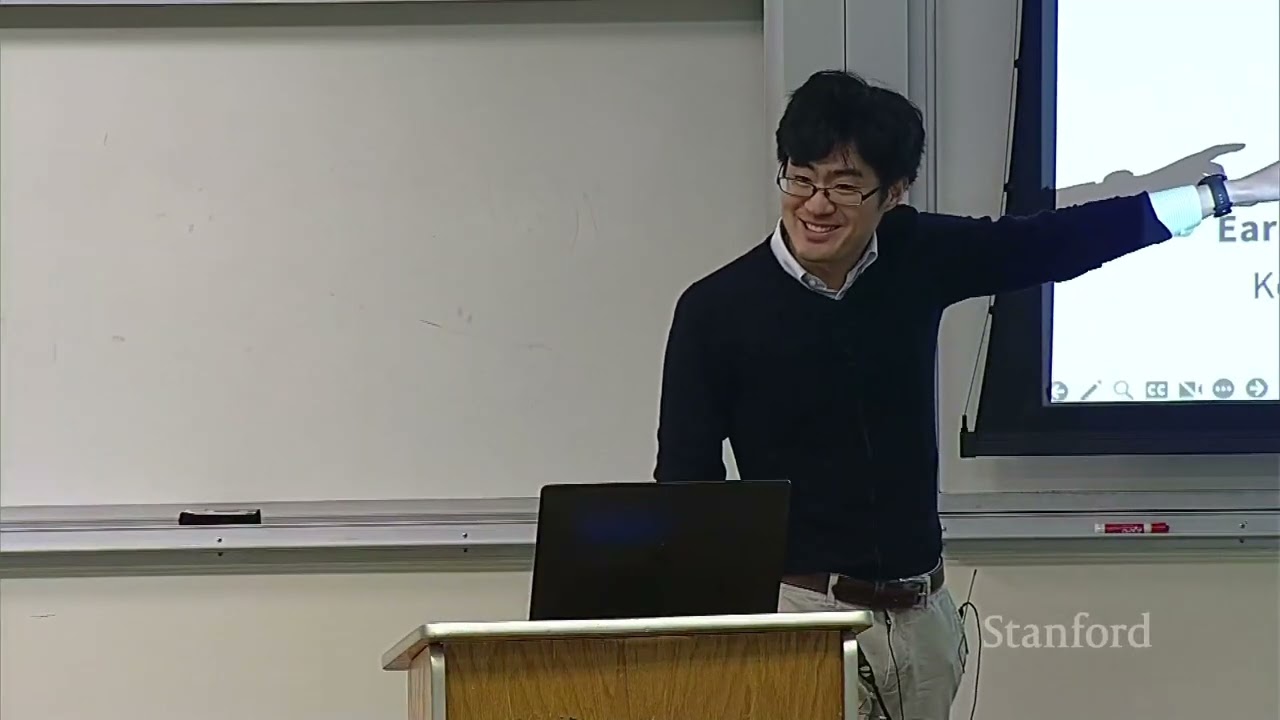 78 min
Stanford CS336 Language Modeling from Scratch | Spring 2026 | Lecture 9: Scaling Laws
 62 min
Stanford CS547 HCI Seminar | Spring 2026 | Observing the User Experience in 2026
 101 min
Stanford CME296 Diffusion & Large Vision Models | Spring 2026 | Lecture 4 - Latent Space & Guidance
 81 min
Stanford CS336 Language Modeling from Scratch | Spring 2026 | Lecture 8: Parallelism
Ask anything from this episode.
Save it, chat with it, and connect it to Claude or ChatGPT. Get cited answers from the actual content — and build your own knowledge base of every podcast and video you care about.
Get Started Free