Key Moments
Is America Heading for a Debt Crisis? An Economist Explains
 Sam Harris
Want to know something specific about what's covered?
We've already dissected every moment. Ask and we will deliver (with timestamps).
Key Moments
The US national debt is reaching crisis levels, driven by rising interest rates and a potential loss of global confidence, leading to warnings of capital flight and hyperinflation.
Key Insights
The US is now a high-debt country compared to other rich nations, a significant shift from its past position.
If confidence in US debt collapses, a stampede of capital flight could occur, leading to an apocalyptic economic event.
Modern Monetary Theory (MMT) is criticized as lacking a coherent framework, with its proponents changing their stance on debt and inflation.
Interest on the US national debt is projected to exceed Medicare spending by 2028.
Fiscal austerity, a combination of tax increases and spending cuts, is presented as the most effective long-term solution to manage the debt.
While inflation can reduce the real value of debt, sustaining it long enough to significantly impact the national debt would likely cause widespread public anger and potential revolts.
The US is becoming a high-debt country, shifting from historical norms
Historically, the U.S. has not been considered a high-debt country compared to European nations or Japan. However, following the Great Recession, the COVID-19 pandemic, and a subsequent lack of fiscal restraint, the U.S. has accumulated significant debt. This shift carries inherent dangers, though the exact point at which debt becomes problematic is unknown. As debt levels rise, private investors may become unwilling to purchase government bonds, forcing the government to offer higher interest rates. When this debt needs to be rolled over at these new, higher rates, the government faces escalating interest costs, which must be paid to avoid default. This dynamic can lead to a cycle where the government borrows more to cover interest payments, a situation considered unsustainable.
The perilous cycle of rising interest rates and debt servicing
When private investors and other entities demand higher interest rates to buy government debt, the government is compelled to offer them. As the total stock of debt rolls over, these higher interest payments become a larger portion of the national budget. To manage this, the government can either implement fiscal austerity (raise taxes and cut spending) or borrow more to cover the interest. The U.S. is currently in a position where it is borrowing more to cover increased interest payments, partly due to Federal Reserve rate hikes and market demands for higher yields on long-term bonds. This creates a precarious situation, as it signals a potential inability to truly repay the debt without further borrowing, which can erode confidence in the long term.
Inflation as a potential, albeit dangerous, debt reduction tool
One potential, though perilous, outcome of a debt crisis is inflation. If people perceive that the government might resort to the central bank printing money to pay off debt, they may anticipate inflation. This expectation can become a self-fulfilling prophecy. While inflation can devalue debt and make it easier to pay back in real terms, it also impoverishes citizens as the cost of goods and services rises. The period of high inflation in 2021-2022, with rates reaching around 8%, serves as a recent example of the negative consequences. Sustained high inflation over many years, necessary to significantly impact the national debt, would likely lead to widespread public anger, social unrest, and potentially political instability, making it an undesirable solution.
The risks of hyperinflation and the 'American Maduro' scenario
While moderate inflation can erode debt, hyperinflation—inflation rates in the thousands of percent—is a distinct and catastrophic event. Experts believe hyperinflation occurs when a central bank directly prints money to purchase unlimited government debt, essentially giving the government a blank check. This could happen if a political leader, like Donald Trump, were to prioritize populist spending without regard for fiscal consequences, by instructing the central bank to buy government debt indefinitely. Such a path could lead to an economic collapse akin to Venezuela's, where a successor leader, like JD Vance, would inherit a devastated economy. While this scenario is not imminent, the potential for such an outcome is a grave concern.
Modern Monetary Theory's controversial stance on debt
Modern Monetary Theory (MMT) is highly criticized for its perceived lack of a coherent and modern framework. MMT proponents, such as Warren Mosler and Stephanie Kelman, are accused of changing their pronouncements and lacking an independent basis for their claims, requiring followers to consult gurus for understanding. Historically, MMT advocated that debt was not a problem and inflation was not a danger. However, as inflation rose, their stance shifted, with Warren Mosler eventually stating that debt was too high, a pronouncement not based on any transparent formula or system. This perceived inconsistency has led to a loss of intellectual currency for MMT among many economists, who generally advise against relying on MMT's guidance regarding debt levels.
Long-term debt management requires fiscal austerity and growth
The discussion identifies several potential 'escape routes' from the debt crisis, including growing out of it, inflating it away, austerity, financial repression, and default. Fiscal austerity, defined as a combination of tax increases and spending cuts, is presented as the most effective and advisable strategy. Historically, the U.S. implemented fiscal austerity in the 1990s following a period of debt concern. While it may take a decade or two, consistent austerity, coupled with economic growth, can significantly address the debt problem. Growth can be aided by factors like immigration, which expands the economy and tax base. The U.S. missed an opportunity to lock in lower long-term interest rates on its debt during periods of low interest rates, which would have provided more financial flexibility.
Austerity involves broad-based tax increases and spending restraint
Austerity requires not only spending cuts but also tax increases across a wider segment of the population, not just the wealthy. This means raising taxes on the middle class, who currently comprise a significant portion of taxpayers and whose contributions would substantially increase government revenue. While progressive taxation on the wealthy is supported, broad-based tax increases are seen as necessary for meaningful fiscal health. On the spending side, austerity involves restraining the growth of government expenditures, particularly in areas like healthcare. Simply slowing the rate of spending growth, from, say, 4% to 1% annually, can yield significant long-term savings. This approach, while politically challenging, is deemed essential for long-term fiscal stability.
The role of technology in societal and economic shifts
The conversation touches upon the broader societal impacts of technology, particularly smartphones. Three significant negative impacts are highlighted: first, the erosion of genuine human happiness by replacing in-person interactions with online ones; second, the degradation of democracy by amplifying the voices of less informed individuals; and third, the acceleration of fertility decline, which has profound long-term economic and social implications. These technological effects are presented as serious issues that society has yet to adequately address, adding another layer of complexity to future economic and social planning.
Mentioned in This Episode
●Products
●Software & Apps
●Companies
●Organizations
●Concepts
●People Referenced
Navigating a Debt Crisis
Practical takeaways from this episode
Do This
Avoid This
Common Questions
There is no precise hard line for when national debt becomes a crisis. It typically occurs when private investors, or even foreign governments, become unwilling to buy government debt, forcing higher interest rates. This is often driven by shifting expectations about the government's ability to repay.
Topics
Mentioned in this video
Noah Smith worked as a finance professor here.
Where Noah Smith completed his PhD in economics.
Mentioned as a type of private investor that buys US government bonds.
The central bank mentioned in the context of raising interest rates and potentially printing money to buy government debt.
Government debt issued by the US, bought by private investors and foreign countries, with interest rates that are crucial to national debt management.
The period during which the US debt-to-GDP ratio reportedly fell due to higher inflation.
Used as an analogy to criticize the naming of Modern Monetary Theory.
A major government expenditure, mentioned alongside Social Security as an area that interest on the debt is projected to exceed.
Mentioned as someone whose instinct might be to print money to buy government debt for populist initiatives, leading to inflation.
Mentioned as a potential 'American Maduro' if extreme inflation occurs due to monetary financing of debt.
The guest on the podcast, an economist who writes about economics on his Substack 'Noah Opinion'.
Former President of Venezuela, associated with the economic policies that led to hyperinflation.
A proponent of Modern Monetary Theory, mentioned alongside Warren Mosler.
More from Sam Harris
View all 302 summaries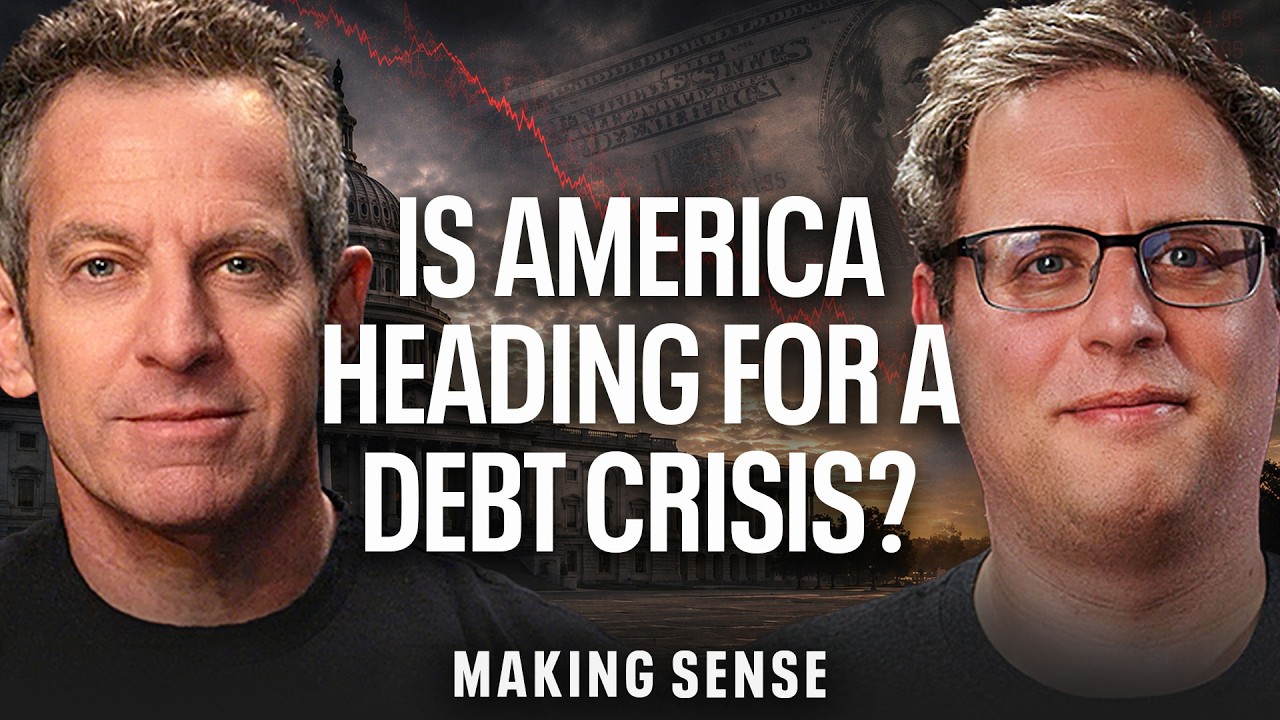 27 min
Is America Heading for a Debt Crisis? An Economist Explains
 34 min
Is Psychedelic Therapy Ready for FDA Approval?
 26 min
You Lose Interest the Moment You Realize It's AI
 28 min
Michael Pollan on Consciousness, Psychedelics, and the Limits of Neuroscience
Ask anything from this episode.
Save it, chat with it, and connect it to Claude or ChatGPT. Get cited answers from the actual content — and build your own knowledge base of every podcast and video you care about.
Get Started Free