Key Moments
EXCLUSIVE: CZ Zhao, Binance co-founder, first public Q&A since huge Binance hack.
 Oxford Union
Key Moments
Binance's CZ reveals that while quantum computing poses a risk to Bitcoin, the company's resilience after a major hack and their ongoing development of quantum-resistant algorithms suggest the industry will adapt.
Key Insights
The next wave of mainstream crypto adoption might not come from speculative bubbles like NFTs or meme coins, but from practical daily use cases for payments, though innovation in this area is still 1-2 years away.
Central Bank Digital Currencies (CBDCs) offer high authority and surveillance capabilities, while stablecoins provide blockchain flexibility and dollar-pegging, and true cryptocurrencies like Bitcoin offer limited supply and volatility.
Quantum computing presents a risk to Bitcoin's cryptography, but it's a developing technology that could also be used for encryption, with quantum-resistant algorithms being explored.
Binance users did not lose money due to the platform's hack, with withdrawals resuming and net inflows turning positive post-incident, demonstrating user trust in the platform's ability to handle crises.
Tokenizing traditional assets like US stocks on platforms like Binance could bring new users to crypto, potentially increasing overall liquidity in the long run, despite short-term liquidity shifts.
The evolving landscape of cryptocurrency adoption
CZ, co-founder of Binance, addressed the shifting focus in cryptocurrency adoption, moving from early retail fascination with Bitcoin, ICOs, and NFTs towards increased institutional interest in ETFs, real-world assets, and tokenized equities. He acknowledged that while institutional adoption is growing, there's a significant gap in consumer-facing innovation, particularly in daily use cases like payments. CZ anticipates that new projects addressing these gaps will emerge and mature over the next one to two years, suggesting a potential for a new wave of mainstream adoption driven by utility rather than pure speculation. He also touched upon the rise of meme coins and periods of governmental hostility towards crypto, indicating a dynamic and cyclical nature to the market's trends.
Understanding the spectrum of digital currencies
The discussion delved into the distinctions between various forms of digital currencies. Central Bank Digital Currencies (CBDCs) are characterized by their centralized nature, issued by governments, offering significant control, surveillance, and potentially unlimited supply, akin to traditional fiat currency. Stablecoins, issued by private entities, occupy a middle ground, offering blockchain-based transferability and often pegged to fiat currencies like the USD, though they carry risks if the issuing company errs. CZ highlighted their importance for cross-border transactions and ease of use, especially when traditional banking systems are hesitant to handle crypto firms. Finally, 'true cryptocurrencies' like Bitcoin are seen as volatile but potentially valuable assets with limited supply and their own ecosystems, appealing to investors looking for future growth. The choice among these depends on the user's specific needs, whether for investment, transaction, or hedging.
Quantum computing: a looming threat or manageable challenge?
Addressing the concern that quantum computing could break Bitcoin's cryptography, CZ admitted he is not a quantum computing expert but acknowledged the potential risks. He noted that technology, including quantum computing and AI, is advancing rapidly, possibly outpacing human comprehension. While Google's repeated statements on the topic might be part of engineering marketing, CZ sees merit in their concerns and believes these technologies will accelerate. He posited that quantum computing, while capable of breaking current encryption, could also be used for enhanced encryption. The existence of quantum-resistant algorithms is known, but their effectiveness remains to be fully tested. CZ suggested that the transition to quantum computing will likely be gradual rather than a sudden leap, providing the industry time to adapt. He concluded that while the threat should not be ignored, the industry will develop solutions, making excessive worry unnecessary.
Rebuilding and maintaining trust in Binance
CZ addressed the crucial question of trust in Binance, particularly following a significant hack. He emphasized that while the crypto industry aims to be trustless, it heavily relies on trust in practice, especially for centralized exchanges. Trust, he analogized to an onion, is built layer by layer over time and can be destroyed quickly. Binance's commitment to user protection, established from its inception, has remained a priority. He highlighted that despite past incidents, no user has lost funds due to Binance's platform issues. Following the recent hack, where withdrawals were temporarily suspended, the platform experienced a rapid recovery, with only 2% of funds remaining unrecovered and net inflows quickly turning positive. This demonstrated user confidence, indicating that trust extends beyond his personal influence to the platform's operational integrity and crisis management capabilities. The hack, he clarified, was an attack on the centralized exchange system, not on cryptocurrency itself, and Binance is committed to sharing its learnings to improve industry-wide security.
Navigating life and business partnerships
When asked for advice on choosing a life partner, CZ acknowledged it as one of the most difficult questions with no single right answer. Drawing parallels to business partnerships, he noted the challenge in finding good partners in both domains. He shared a personal experience of divorce, indicating that life's journey involves changes and challenges, even in seemingly good relationships. While he couldn't offer definitive advice, he stressed the importance of effort and wished the audience well in their endeavors. The question itself highlighted a unique aspect of the interview, being the first time such a personal question was posed to him during an official engagement.
Clarifying Binance's fund allocation for user protection
Responding to a rumor about Binance using personal funds for user payouts, CZ clarified the use of their insurance funds. He stated that the SAFU (Secure Asset Fund for Users) had approximately $1.1 to $1.2 billion, with about half of it utilized. The Insurance Fund (IF) for futures also saw a significant portion used. He confirmed that beyond these dedicated funds, the remaining cover comes from Binance's general treasury. Additionally, he mentioned $3 billion currently frozen due to ongoing legal proceedings, which Binance expects to recover. This multi-layered approach, combining dedicated insurance funds with treasury support, underscores Binance's commitment to covering user assets and liabilities.
US government's ability to freeze crypto assets
CZ explained the mechanism by which the US government can freeze cryptocurrency assets, citing an example of Iran's Bitcoin holdings. He clarified that if crypto assets reach any centralized exchange or custodial point, the US government has the authority to issue freeze orders or seizure requests through law enforcement and judicial warrants. This process allows them to intercept and confiscate assets that are linked to illicit activities or sanctioned entities, demonstrating the reach of government regulatory power over digital assets held on centralized platforms.
The impact of tokenized traditional assets on crypto liquidity
The final question explored the trend of tokenizing traditional assets like US stocks and commodities on platforms like Binance, and its effect on crypto liquidity. CZ presented a nuanced view: while tokenization might cause a short-term, immediate draw on liquidity as users trade newly accessible assets, it also broadens access to high-quality assets globally. Many individuals, particularly in Asia, face barriers to accessing US stock markets directly due to account opening difficulties and trading hour limitations. By tokenizing these assets, Binance makes them available 24/7 worldwide, potentially attracting new users to the broader crypto ecosystem. He believes that in the long run, increased access to diverse assets will lead to greater overall liquidity and network effects, benefiting both traditional markets and the cryptocurrency space. His philosophy aligns with free market principles, advocating for providing a wider array of assets to more people, allowing them to choose the best options.
Mentioned in This Episode
●Software & Apps
●Companies
●Organizations
●Concepts
●People Referenced
Evolution of Crypto Trends and Market Focus
Data extracted from this episode
| Year/Period | Dominant Trend/Focus |
|---|---|
| 2013 | Bitcoin Boom |
| 2017 | Altcoin ICOs |
| 2019-2020 | DeFi |
| Recent Past | NFTs |
| Current/Recent | Meme Coins, Institutional Adoption (ETFs, Real Assets, Stock Tokenization, Stablecoins) |
| Future (1-2 years) | Payments and Daily Use Cases (Individual Focus) |
Comparison of Digital Currencies
Data extracted from this episode
| Type | Characteristics | Pros | Cons |
|---|---|---|---|
| CBDCs | Issued by Central Banks, Not fully open-source, Less freedom, Unlimited supply potential, Higher surveillance/control (freezing), Potentially restricted access (institutions first) | High authority, Backed by government | Less freedom, Potential for surveillance and control, Restricted access |
| Stablecoins (e.g., USDT, USDC) | Issued by companies, Pegged to USD, Tradeable on blockchain, Easy cross-border transfers, Less restricted | Ease of use, Global accessibility, Facilitates crypto transactions | Higher risk if company errs (mitigated by regulation) |
| Traditional Cryptocurrencies (e.g., Bitcoin, Ethereum) | High value volatility, Limited supply, Own blockchain/ecosystem | Potential for investment, Limited supply can be a feature | High volatility, Not ideal for daily payments/remittances |
Binance Insurance and Reserves Post-Hack
Data extracted from this episode
| Fund/Source | Value/Details | Usage |
|---|---|---|
| SAFU Fund | Approx. $1.1-1.2 billion | Partially used (approx. half) |
| IF Fund (Futures) | Started with $3-4 billion, reduced to approx. $2 billion | Partially used (approx. $1-2 billion) |
| Company Balance Sheet | Remaining funds | Covered remaining losses |
| Frozen Funds | $3 billion | Not yet recovered, pending legal action |
Common Questions
The focus has shifted towards institutional adoption with products like ETFs. For individual mainstream adoption, there's a perceived gap in innovation for daily use cases like payments, which may take another 1-2 years to develop significantly.
Topics
Mentioned in this video
Quoted for his statement that choosing a life partner was the most important decision of his life, setting a precedent for the discussion on life partners.
Referenced for building the Binance brand and community publicly, and maintaining user trust, in the context of discussing life partners and their impact on business.
Cited for his perspective on seeking a partner capable of managing their own affairs, emphasizing the significance of partner selection.
Identified as the US Treasury Secretary who stated that the US government had seized Bitcoin related to Iranian transactions.
Mentioned as an example of someone making a significant decision about a life partner, highlighting the importance of such choices.
Mentioned as a past trend in cryptocurrency growth, alongside Bitcoin and NFTs, contributing to public adoption.
Discussed as a potential threat to Bitcoin due to its computational power, with the acknowledgment that technology evolves rapidly and countermeasures may be developed.
Highlighted as a major focus in the cryptocurrency space between 2019 and 2020, indicating a shift in market trends.
Discussed in comparison to traditional digital currencies like Bitcoin, highlighting their nature as centrally issued, less open-source, potentially unlimited in supply, and with greater surveillance capabilities.
Referred to as a significant trend in cryptocurrency adoption, following ICOs and preceding current institutional focus.
Mentioned as a cryptocurrency with a large market cap, suitable for investment in the future of crypto.
Included as a cryptocurrency with a large market cap, recommended for investment in the crypto space.
Mentioned as a historical focus of crypto booms, a potential target for quantum computing, and an asset that can be frozen by the US government. Also discussed in the context of market capitalization and as an example of a traditional asset being tokenized.
Cited as an example of a stablecoin that is widely used in the crypto space due to its ease of deposit and transaction capabilities.
Mentioned as a cryptocurrency with a significant market cap, suitable for investment in the crypto market.
Its frequent statements on quantum computing are noted, with the speaker suggesting they might be partly marketing but also hold significant truth.
The core subject of discussion, focusing on its security, trust, handling of a recent hack, insurance funds, and its role in tokenizing traditional assets.
Mentioned in the context of the US government seizing Bitcoin related to Iranian transactions.
Mentioned in the context of government hostility towards crypto, regulatory clarity for stablecoins, accessibility to US stock markets, and the Treasury Secretary's actions regarding Iranian Bitcoin.
More from OxfordUnion
View all 111 summaries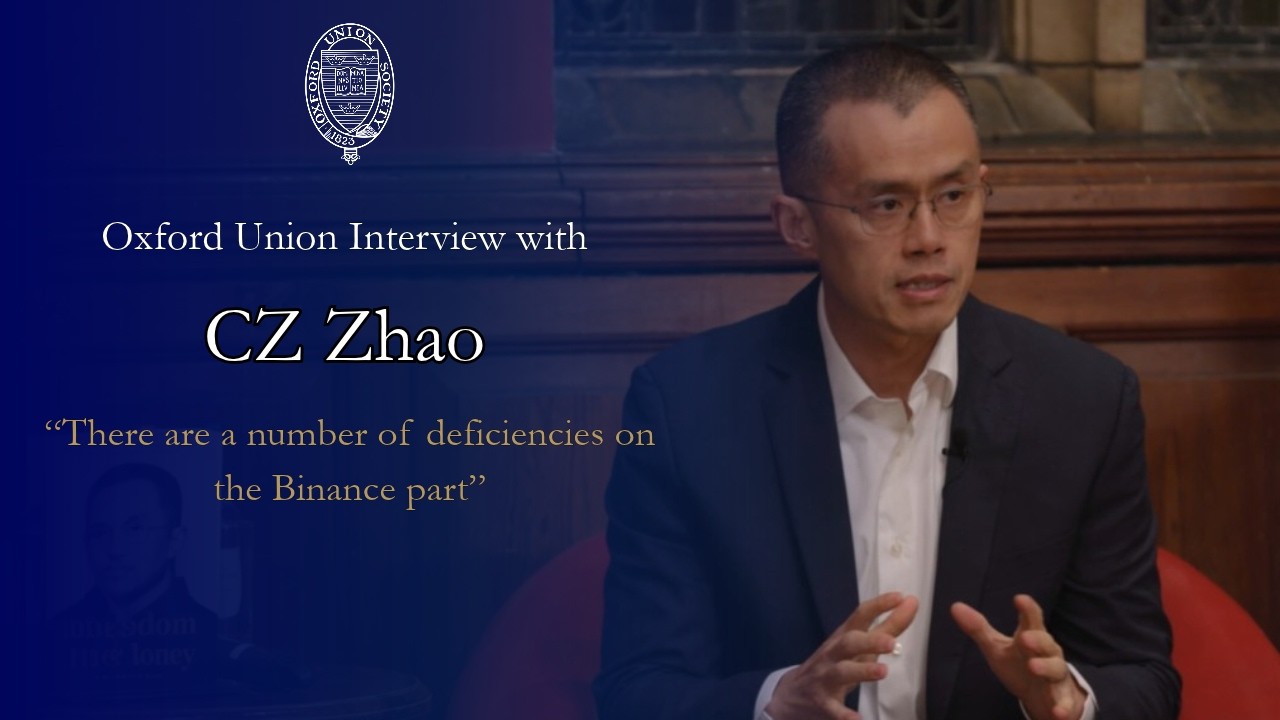 41 min
EXCLUSIVE: CZ Zhao, Binance co-founder, first public address after huge Binance hack.
 35 min
Oxford Union Interview with Bridgewater CEO Nir Bar Dea
 33 min
Oxford Union Q&A with Bridgewater CEO Nir Bar Dea
 53 min
Oxford Union Interview with Alan Dershowitz
Ask anything from this episode.
Save it, chat with it, and connect it to Claude or ChatGPT. Get cited answers from the actual content — and build your own knowledge base of every podcast and video you care about.
Get Started Free