Key Moments
EXCLUSIVE: CZ Zhao, Binance co-founder, first public address after huge Binance hack.
 Oxford Union
Key Moments
Binance experienced a massive $6 billion hack, but covered all user losses. While this incident was preventable due to basic security lapses, AI is poised to both escalate future attacks and provide stronger defenses.
Key Insights
The Binance hack, involving a loss of $6 billion, was preventable due to basic operational security lapses by internal staff.
Binance has committed to covering all user losses resulting from the hack, ensuring no user funds were impacted.
The frequency of crypto platform hacks has increased dramatically, with three to four incidents daily, a trend exacerbated by AI's capabilities.
AI is a double-edged sword: it enables hackers to analyze systems rapidly, but also provides the tools to identify and fix vulnerabilities, making systems safer long-term.
The adoption of blockchain technology is projected to follow a curve, with slow initial growth, a rapid acceleration after a 20% adoption threshold, and a long tail to reach full adoption, potentially taking around 100 years.
The rise of AI is significantly lowering the barrier to entry for software development, leading to a surge in startups and innovation, but also intensifying competition.
Binance hack highlights preventable security failures and user protection
The recent $6 billion hack on Binance, described as one of the largest in history, stemmed from preventable security lapses. Changpeng Zhao (CZ) acknowledged that basic operational security procedures were not followed by some internal staff, a critical failure for a platform handling such vast sums. Despite the sophistication of the attack, which took an estimated five to six months to assemble, CZ emphasized that all such breaches are ultimately preventable. The key takeaway for users and the public is that Binance's commitment to covering all user losses, a principle CZ established as founder, ensures financial protection. While the platform is thus deemed secure from a user-loss perspective, the incident underscores the ongoing need for robust security measures. The transparency of the blockchain, allowing transactions to be visible in real-time, aids in monitoring but does not prevent the initial breach. This incident, though painful, is seen as a catalyst for improving security across the entire sector. The immediate consequence of such large-scale breaches is a heightened focus from national security agencies and industry stakeholders, facilitating faster resolution and resource allocation. This collaborative effort is crucial for rebuilding trust and fortifying defenses against evolving threats.
The escalating threat landscape and AI's dual role
The cryptocurrency space is witnessing an alarming increase in security breaches, escalating from one or two per year to several per day. This trend is significantly influenced by the advancement of Artificial Intelligence (AI). Hackers are leveraging AI for sophisticated social engineering, detailed system analysis, and rapid exploitation of vulnerabilities. AI allows attackers to understand complex systems with unprecedented speed and precision, accelerating the timeline for successful breaches. However, AI is also a crucial tool for defense. It can identify these same vulnerabilities much faster than human analysis, enabling developers to patch them proactively. CZ views AI as a double-edged sword: a short-term transitional phase that will be painful, but ultimately leading to more secure systems in the long run. The defense side must catch up to the offensive capabilities enhanced by AI. This necessitates a sector-wide effort, involving AI labs, law enforcement, regulators, and security experts, to develop more robust defense mechanisms and foster collaboration to counter these sophisticated threats.
Founding Binance: A mission driven by the freedom of money
CZ's journey to founding Binance in his late thirties was driven by a profound mission: to champion the freedom of money. He believes that a strong mission, not just profit, is essential for long-term business success. Having experienced different cultures and witnessing the evolution of freedom from physical liberty to freedom of expression and information, CZ saw the emergence of the internet and later Bitcoin as pivotal moments. He recognized blockchain technology as the future, capable of bringing immense positive impact by liberating money. This vision, though fraught with challenges and resistance—common to all transformative technologies like the printing press or journalism—was clear to him. He asserts that blockchain and cryptocurrencies empower individuals by providing tools to protect themselves from arbitrary inflation and systemic financial exclusion, particularly in developing regions where traditional banking access is limited. This pursuit of financial freedom became the core purpose behind Binance's creation.
Blockchain's potential to revolutionize global finance
CZ elaborated on the concept of 'freedom of money,' highlighting how blockchain and cryptocurrencies offer tangible solutions to global financial challenges. For individuals in regions with limited banking access, a smartphone with crypto capabilities can enable instant transactions, overcoming the logistical hurdles of traditional finance, where a simple bill payment might take days. Furthermore, in developed economies, blockchain offers a hedge against uncontrolled inflation, which erodes purchasing power. While not all cryptocurrencies are suited for this purpose, some, like Bitcoin, have empowered early adopters. The technology also promises to streamline global payments, which remain complex and slow for cross-border transactions. Beyond payments, blockchain enables the tokenization of real-world assets, potentially allowing markets to operate 24/7, providing liquidity independent of traditional market hours. CZ advocates for a truly global free economy, facilitated by the universal liquidity that blockchain can provide, and even suggests that traditional banks should adopt blockchain technology to enhance their services.
The slow but inevitable adoption of blockchain
The widespread adoption of blockchain technology is expected to follow a predictable curve, mirroring that of other transformative technologies. CZ estimates that the initial phase will be slow, but once a 20% adoption threshold is crossed, the pace will accelerate significantly. Reaching full adoption, however, might take approximately 100 years, with the middle phase (20% to 80% adoption) potentially lasting one to two decades. Key to this acceleration is the shift in global sentiment, particularly the increasing acceptance of crypto by major economies like the United States, which often influences other nations. Despite this, traditional financial institutions are inherently resistant to change, creating friction in integrating blockchain. Moreover, governments' historical control over currency and debt issuance presents a significant hurdle. The inherent self-preservation instinct of governments, coupled with the potential for volatility and new problems arising from a freer financial system, leads to cautious or restrictive policies. However, CZ remains optimistic, believing that the trend towards blockchain adoption is irreversible, driven by its inherent technological advantages and the need for greater efficiency.
AI's profound impact on software development and innovation
The advent of AI, particularly tools like ChatGPT, is revolutionizing software development, making it exponentially easier and faster. CZ, an original developer himself, notes that AI can now generate entire applications with minimal human intervention. This dramatically lowers the barrier to entry for startups and entrepreneurs, fostering an environment where a vastly larger number of new ideas, businesses, and innovations can emerge. This democratization of development is a net positive, leading to an explosion of creativity. However, it also intensifies competition, requiring entrepreneurs to focus more on product design, market analysis, and problem-solving rather than the intricacies of coding. As AI capabilities advance, the nature of work will shift, with humans focusing on conceptualization and strategy while AI handles execution. This trend is expected to lead to a hundredfold, or even a millionfold, increase in startups and innovations.
AI, blockchain, and the future of digital transactions
The synergy between AI and blockchain is poised to reshape the digital landscape. In the crypto space, AI's accelerated programming capabilities will lead to faster development of better applications, faster blockchains, and potentially more secure cryptographic algorithms. A significant implication is the anticipated surge in digital transactions as AI agents begin to interact and conduct business on behalf of humans. This will necessitate high-throughput, blockchain-based digital currencies capable of handling micro-transactions and complex contractual agreements between AI agents. While the specific form of these currencies remains uncertain—whether they will be new, AI-native tokens or existing blockchains—CZ is confident they will be blockchain-based to achieve global adoption. The demand for computing power to support both AI and blockchain is immense, driving innovation in hardware like chips and data centers. While resource constraints are a potential challenge, rapid advancements in materials science and chip design are expected to overcome these limitations, leading to radical changes in hardware capabilities.
Navigating regulatory landscapes and global adoption
The varying regulatory approaches to cryptocurrencies, ranging from outright bans in China to more permissive stances elsewhere, reflect complex national interests. CZ suggests that reduced media hype around crypto, while seemingly a decline in interest, actually signifies its maturation into a foundational technology, much like the internet. The increasing acceptance of stablecoins, largely backed by USD, is seen as beneficial by countries like the U.S., as it reinforces the dollar's global influence. For nations with capital controls, like China, balancing the desire for global currency influence with restrictions on capital outflow presents a unique challenge. Smaller nations might adopt more flexible, case-by-case approaches, while larger countries like China need stricter regulations due to the sheer volume of potential activity. Ultimately, CZ believes that countries cannot afford to reject blockchain and AI, as doing so would lead to technological obsolescence. Therefore, global adoption of digital currencies, in some form, appears inevitable as these technologies become integral to future economies.
Mentioned in This Episode
●Companies
●Organizations
●Concepts
●People Referenced
Common Questions
Binance experienced a significant security hack, which CZ Zhao acknowledged involved operational shortcomings. However, he highlighted Binance's transparent, real-time communication and its commitment to covering all user losses, ensuring no user funds were affected.
Topics
Mentioned in this video
A major cryptocurrency exchange that recently experienced a significant security hack. Zhao discusses the company's response and future security measures.
Mentioned as a company whose AI models could be used to review code written by other AI, such as Anthropic's, highlighting advanced AI collaboration for code review.
Cited alongside Reuters as a major news outlet that provided significant coverage of cryptocurrencies during the 2020-2022 period, before media attention waned.
Mentioned as one of the traditional banks in Hong Kong issuing stablecoins, indicating a cautious approach to digital currency experimentation.
Mentioned as a company that could be used to review code written by other AI models, like OpenAI's, showcasing collaborative AI development.
Mentioned as currently the world's most valuable chip manufacturing company, highlighting the significant investment and rapid development in the AI sector.
Cited as a traditional bank in Hong Kong that is experimenting with stablecoin issuance, aligning with China's broader digital currency strategy.
Discussed as a 'testing ground' for China's digital currency initiatives, with the presence of stablecoins issued by traditional banks.
Mentioned as having banned cryptocurrencies and having specific considerations regarding capital controls and its ambition for the RMB to be a global currency.
Mentioned as a region where limited access to financial services is a significant issue, highlighting the potential impact of cryptocurrencies.
Cited as an example of a region with limited access to financial services, where blockchain and cryptocurrencies can provide significant benefits.
Discussed as a supporter of cryptocurrency, influencing other governments. Also mentioned in the context of its Treasury bonds being a popular investment for stablecoins and its lack of capital controls.
Discussed as a double-edged sword for security, making systems more vulnerable in the short term but safer in the long term. Also discussed as a driver for software development and potential for increased transaction volume in crypto.
Presented as one of the three fundamental technologies of human progress, alongside blockchain and AI, which countries cannot afford to ignore.
Cited alongside AWS as an example of cloud infrastructure that has made it easier to launch tech startups, paralleling the impact of AI on software development.
Mentioned as an example of how cloud infrastructure has simplified starting internet companies, similar to how AI is simplifying software development.
More from OxfordUnion
View all 111 summaries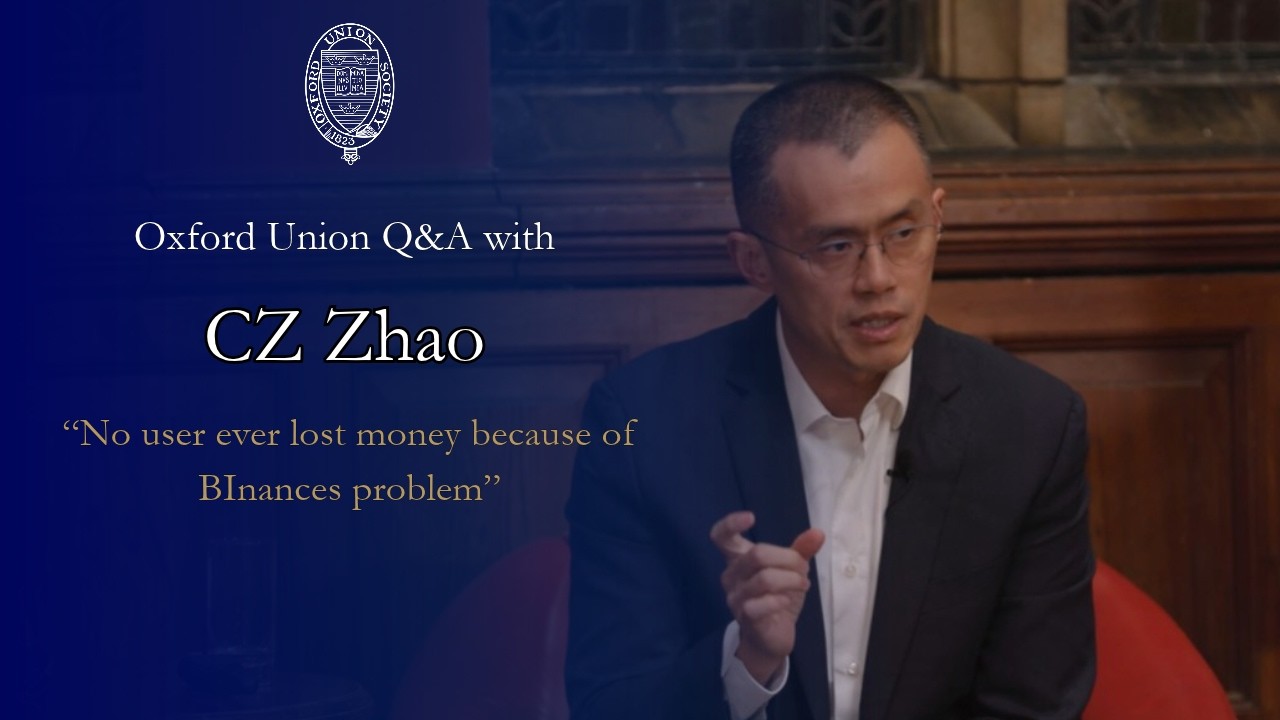 24 min
EXCLUSIVE: CZ Zhao, Binance co-founder, first public Q&A since huge Binance hack.
 35 min
Oxford Union Interview with Bridgewater CEO Nir Bar Dea
 33 min
Oxford Union Q&A with Bridgewater CEO Nir Bar Dea
 53 min
Oxford Union Interview with Alan Dershowitz
Ask anything from this episode.
Save it, chat with it, and connect it to Claude or ChatGPT. Get cited answers from the actual content — and build your own knowledge base of every podcast and video you care about.
Get Started Free