Key Moments
Dr. Jane Goodall — The Legend, The Lessons, The Hope | The Tim Ferriss Show
 Tim Ferriss
Want to know something specific about what's covered?
We've already dissected every moment. Ask and we will deliver (with timestamps).
Key Moments
Jane Goodall discusses her life, chimpanzee research, conservation, and hope.
Key Insights
Childhood experiences, including wartime London, fostered resilience and a deep connection with nature.
Her groundbreaking research on chimpanzees redefined human understanding of animal behavior and intelligence.
The Jane Goodall Institute (JGI) and Roots & Shoots program empower youth for conservation and positive change.
Human nature possesses both aggression and compassion, with a crucial choice between destructive materialism and ethical living.
Hope is cultivated through recognizing individual impact, technological innovation for sustainability, and the indomitable human spirit.
Storytelling and emotional connection are vital for changing minds and fostering compassion, especially in leadership.
EARLY LIFE AND THE ROOTS OF RESILIENCE
Jane Goodall's childhood in wartime London, despite its hardships, instilled a profound sense of gratitude and a deep connection with the natural world. Experiences like observing earthworms and patiently waiting to witness a hen lay an egg, supported by her encouraging mother, nurtured her innate curiosity and scientific inclination. This early environment, characterized by rationing and limited entertainment, fostered a love for reading and developed a resilience that would serve her well in future endeavors.
A PIVOTAL ENCOUNTER AND SCIENTIFIC BREAKTHROUGH
A chance encounter with paleontologist Louis Leakey led Goodall to Gombe, Tanzania, to study chimpanzees. Leakey recognized her passion and patience, believing women made better observers. Goodall's immersive approach, living as a 'neighbor' rather than a distant scientist, allowed her to overcome the chimpanzees' initial fear. Her groundbreaking observation in 1960 that chimpanzees not only use but also make tools shattered prevailing scientific beliefs and redefined the human-animal relationship.
CHIMPANZEE SOCIETY: AGGRESSION, COMPASSION, AND PERSONALITY
Goodall's decades of observation revealed the complex social structures of chimpanzees, including sophisticated tool use, emotional depth, and distinct personalities. She documented both their capacity for aggression, as seen in the Gombe chimpanzee wars, and profound compassion, exemplified by 'Old Man' protecting a human caretaker. These observations challenged the perceived boundary between humans and animals, suggesting common roots for traits like aggression and empathy, and highlighting Goodall's courage in confronting controversial scientific ideas.
THE JANE GOODALL INSTITUTE AND EMPOWERING YOUTH
Recognizing the critical role of people in conservation, Goodall founded the Jane Goodall Institute (JGI) in 1977. This led to the creation of Roots & Shoots, a global youth program empowering young people in nearly 60 countries. The program operates on the principle that every individual matters and can make a difference. By educating and engaging youth in projects focused on people, animals, and the environment, Roots & Shoots cultivates informed conservation leaders and fosters a sense of responsibility for the planet's future.
ADDRESSING HUMANITY'S CHALLENGES: APATHY AND ENVIRONMENTAL CRISES
Goodall identifies apathy as the greatest danger to our future, leading to inaction on critical issues like climate change and zoonotic diseases. Her work during the COVID-19 pandemic highlighted how environmental destruction and increased human-animal contact, driven by factors like habitat loss and the bushmeat trade, can lead to devastating outbreaks. She stresses that leaders and corporations must heed scientific warnings and that a shift away from greedy materialism is essential for survival.
CULTIVATING HOPE AND THE POWER OF STORYTELLING
Despite the overwhelming challenges, Goodall remains a powerful voice for hope. She finds reasons for optimism in the inspiring actions of young people, the innate resilience of nature, technological innovations for sustainability, and the indomitable human spirit. Goodall emphasizes that changing minds requires reaching the heart, often through compelling stories that illustrate compassion, love, and perseverance. Her own life, marked by dedication and unwavering purpose, serves as a testament to the power of hope in driving impactful change.
THE INDOMITABLE HUMAN SPIRIT AND SYMBOLS OF POSSIBILITY
Goodall frequently shares stories and symbols that represent the power of human resilience and the potential for positive change. She carries a feather from a California condor, a symbol of species saved from extinction, and a piece of the Berlin Wall, representing the fall of seemingly permanent barriers. These mementos, along with the story of 'Mr. H', a blind magician named Gary Horne, underscore her belief that individuals can overcome immense challenges and achieve the extraordinary, inspiring others with their indomitable spirit.
MOTHERHOOD AND THE ALIGNMENT OF INSTINCT AND OBSERVATION
Reflecting on her own experiences and observations of chimpanzee mothers like Flo, Goodall developed her approach to parenting her son, Grub. She learned that like humans, chimpanzee mothers vary — some are supportive, others less so. Goodall prioritized play and engagement, creating a fun-loving environment for her son, mirroring the nurturing aspects she observed in primates. This blend of instinct, learned behavior from her own mother, and scientific observation informed her unique parenting style.
FINDING SOLITUDE AND MAINTAINING MENTAL CLARITY
Goodall finds solace and rejuvenation in solitude, a skill honed during her solitary childhood explorations. She describes moments of being alone in nature, particularly in Gombe, as blissful. In contrast, her extensive travels often leave her with little personal time. She cherishes quiet moments, whether in hotel rooms or her childhood home, to reflect, read, and process her thoughts, emphasizing the importance of mental quietude for maintaining clarity and purpose.
A MESSAGE FOR HUMANITY: RESPECT AND RESPONSIBILITY
Goodall's core message to the world revolves around respect: respect for the environment, respect for animals, and respect for fellow human beings, regardless of their background. She advocates for making conscious choices daily about consumption, understanding their environmental and ethical impacts. The belief that 'every individual matters, and matters a great deal' is central to her philosophy, encouraging collective action to protect the planet and ensure a sustainable future for all living things.
Mentioned in This Episode
●Products
●Software & Apps
●Companies
●Organizations
●Books
●Concepts
●People Referenced
Common Questions
Jane Goodall grew up in Bournemouth, England, during WWII. Despite the presence of air-raid warnings and bombs, she learned to appreciate simple things due to rationing. The shocking revelation of the Holocaust at age 10 deeply influenced her, prompting her to contemplate good and evil.
Topics
Mentioned in this video
The country where Jane Goodall was invited by a school friend, prompting her to save money to travel to Africa.
A tech publication that rated ExpressVPN as a top VPN service.
Established by Dr. Goodall in 1977 to advance her work, continuing field research at Gombe and promoting an innovative approach to conservation that recognizes the role of people.
A media organization that premiered the documentary 'Jane Goodall: The Hope' and has supported Dr. Goodall's work.
A global program founded in 1991 by Dr. Goodall that empowers young people in nearly 60 countries to become informed conservation leaders by engaging in projects to help people, animals, and the environment.
A tech publication that rated ExpressVPN as a top VPN service.
The organization that provided funding for Jane Goodall's chimpanzee study after her discovery of tool-making.
An chimpanzee from a medical research lab, residing on an island in a safari park, who exhibited compassion by rescuing an injured human friend, Mark Kusano, from an attack by other chimps after being abused by people earlier in his life.
An actor who famously portrayed Tarzan in films, whose portrayal as Tarzan did not align with Jane Goodall's childhood imagination.
Louis Leakey's second wife, who spent her life searching for Stone Age ancestor fossils across Africa.
A man employed to look after chimpanzees on an island in Lion Country Safari, Florida, who developed a friendship with Old Man, a chimpanzee who later saved his life.
The host of The Tim Ferriss Show podcast, who introduces Dr. Jane Goodall and conducts the interview, expressing his admiration for her.
The first male chimpanzee in Gombe to lose his fear of Jane Goodall, allowing her to get closer and eventually observing him using and making tools, which brought National Geographic's funding.
A South African anti-apartheid revolutionary, political leader, and philanthropist who labored in a limestone quarry for 21 years before attaining freedom and moving his country out of apartheid.
A renowned primatologist, environmentalist, and UN Messenger of Peace, known for her landmark study of chimpanzees in Gombe and her work inspiring conservation globally.
A department store where Jane Goodall's passport was lost before her journey to Africa.
An eminent paleoanthropologist and curator at the Natural History Museum who recognized Jane Goodall's passion and patience, hiring her as a secretary and later sending her to study chimpanzees.
A blind magician who gave Jane Goodall a stuffed chimpanzee, Mr. H. Gary Horne is an example of indomitable human spirit, learning to paint, scuba dive, and skydive despite his blindness.
A lake brought up as an example of nature's resilience, having been severely polluted to the point of catching fire, but now having fish swimming in it again due to human intervention.
Dr. Goodall's birthplace, where she grew up during wartime, influencing her perspective on life and values.
The place where Nelson Mandela labored for 21 years, a piece of which Jane Goodall carries as a symbol of the indomitable human spirit.
The town in England where Jane Goodall grew up during wartime after moving from London, and where she stayed during the interview.
The city where Jane Goodall's son, Grub, went to school before moving to England, indicating he was not exclusively raised in the bush.
The country over which Jane Goodall's uncle, Rex, was shot down during World War II.
A country mentioned as moving rapidly towards clean, green energy solutions.
The country discussed in relation to wet markets and the potential for new viruses to emerge. It is noted that China is considering banning live animal markets permanently but still allows wild animals for medicine.
A country mentioned as moving rapidly towards clean, green energy solutions.
A large stuffed chimpanzee given to Jane Goodall when she was 1.5 years old, which she loved and carried everywhere as a child, now residing in a special case in the National Geographic exhibition.
A short weekly email newsletter from Tim Ferriss, sharing interesting findings and ponderings.
A VPN service that encrypts data and maintains internet speed, recommended for protecting privacy on public Wi-Fi. It uses 'Trusted Server' technology to prevent logging user information.
An advertising platform that enables businesses and entrepreneurs to reach specific professional audiences and decision-makers on LinkedIn to drive traffic, engagement, and conversions.
A new documentary premiering on Earth Day, April 22nd, which chronicles Jane Goodall's 60-year journey, discoveries, activism, and efforts to inspire the next generation.
The title of a National Geographic exhibition where Jane Goodall's childhood stuffed chimpanzee, Jubilee, is displayed.
A tech publication that rated ExpressVPN as a top VPN service.
A television channel that broadcasted the documentary 'Jane Goodall: The Hope'.
A television channel that broadcasted the documentary 'Jane Goodall: The Hope'.
The podcast hosted by Tim Ferriss, which features this interview with Dr. Jane Goodall.
A fictional character with whom Jane Goodall was in love as a child, prior to real-life film adaptations, allowing her to create her own imaginative vision of him.
The virus responsible for COVID-19, discussed as a consequence of human destruction of animal habitats and close contact with wild animals, particularly in wet markets and factory farms.
The disease caused by SARS-CoV-2, highlighted as a critical global issue that demonstrates the consequences of human-nature interaction and the failure to address scientific warnings about climate change.
More from Tim Ferriss
View all 703 summaries 70 min
Q&A with Tim — The Art of Male Friendship, Reinvention in The Age of AI, & More
 125 min
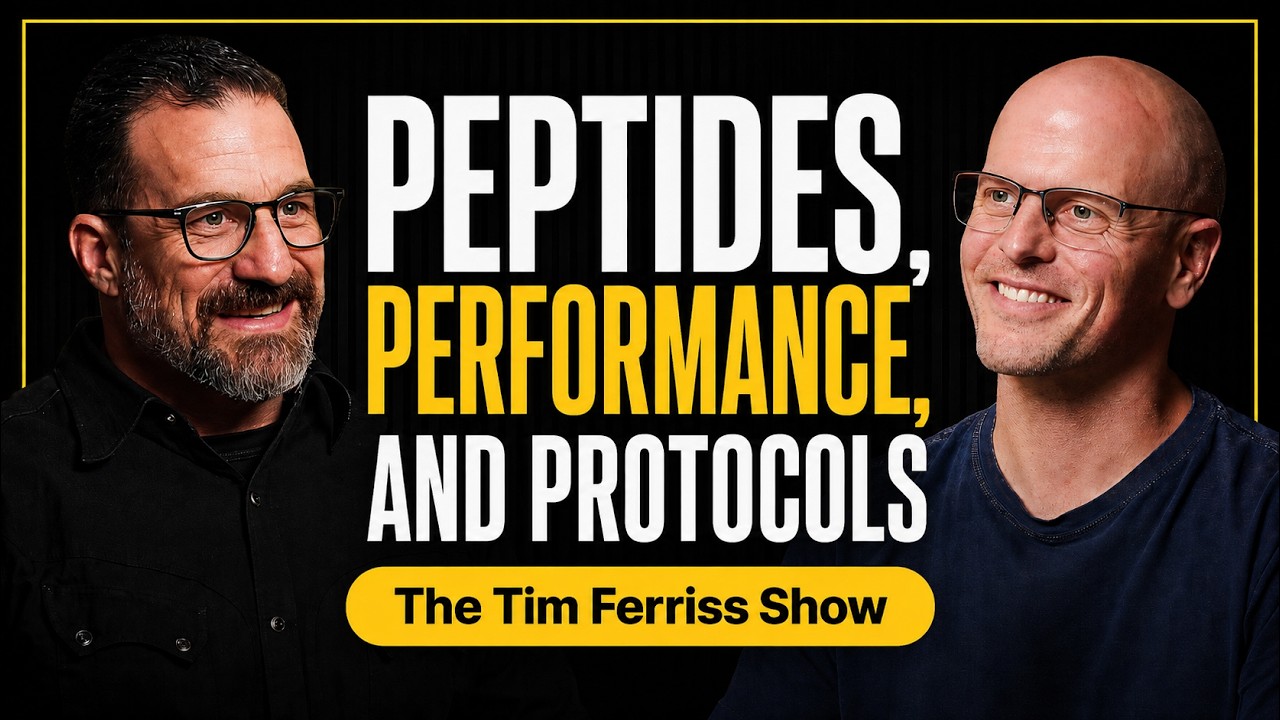
Dr. Andrew Huberman — Peptides, Performance, and Protocols
 112 min
The Random Show! Mortality, AI, Supplements, Rock Climbing, & More
 88 min
The Legendary Hollywood Power Broker — Guy Oseary on 36 Years of Managing Madonna, 26 IPOs, and More
Ask anything from this episode.
Save it, chat with it, and connect it to Claude or ChatGPT. Get cited answers from the actual content — and build your own knowledge base of every podcast and video you care about.
Get Started Free