Key Moments
Dante #8 Hell Cantos 20-32
 Predictive History
Want to know something specific about what's covered?
We've already dissected every moment. Ask and we will deliver (with timestamps).
Key Moments
Dante's Inferno uniquely places thieves lower than mass murderers and depicts the ultimate evil not as fire, but as a frozen lake, because God values the restoration of societal trust above all else, seeing it as essential for humanity's path to faith, hope, and love.
Key Insights
Dante defines the ego as a potentiality that can lead to good or evil, with pride being a perversion of the ego that seeks superiority and limits access to God, unlike most religious traditions that equate ego with pride.
Homosexuals are punished in groups for 'factionalism' because Dante believed society idealizes individual merit, but homosexuals, often persecuted, form secret 'mafia-like' groups to support each other, which then leads to broader societal factionalism, inequality, and lawlessness.
Thievery is considered a worse sin than genocide in Dante's Inferno because while genocide (e.g., Alexander the Great killing millions) results in physical death (souls are immortal), thievery, especially when it involves false blame, destroys trust and cohesion within a community (e.g., 1,000 people), thereby making it impossible for them to live a life of faith, hope, and love and pushing them away from God.
Hypocrites are punished by wearing heavy cloaks of lead, hindering their movement, symbolizing how their deceitful words and actions, though initially unburdened, ultimately weigh down their consciousness and future actions.
Alchemists are the worst of the falsifiers because they attempt to 'warp nature' itself (e.g., turning lead into gold, seeking immortality), a sin worse than warping society with fraud, as it actively tries to subvert the fundamental laws established by God, leading to societal hubris and grave consequences.
The final, lowest circle of hell is depicted as a frozen lake, not fire, defying conventional expectations and emphasizing the profound coldness and absence of love that characterizes ultimate betrayal and distance from God. Angels are associated with light and high vibration, while giants in hell are silent, heavy, and low vibration, representing the landscape of hell itself.
The ego is potentiality; pride is its perversion
In Dante's cosmology, the ego is not inherently negative but a 'potentiality' or 'possibility' that can propel individuals toward both good and bad actions. This diverges from the Kabbalah tradition, which equates ego with the body's material desires. For Dante, pride is the perversion of the ego, manifesting as a desire for superiority where one's ego subordinates others, thereby limiting access to God, as love is rooted in equality and respect. Virgil, despite his role as guide, is presented as an embodiment of pride, an attribute subtly revealed through his actions that will become more apparent as the journey progresses. The ego, ideally, should guide one towards faith, hope, and love, enabling the path to righteousness. However, if misdirected, it leads to pride, a significant obstacle in the spiritual journey.
Homosexuality, factionalism, and societal decay
Dante's depiction of homosexuality is linked not to the act itself, but to its societal consequences. Homosexuals are punished in groups, enduring falling missiles, with any individual straying from the group receiving harsher punishment. This punishment, which focuses on forced cohesion, is interpreted as a mirrored reflection of 'factionalism' or 'mafia-like' behavior. In Dante's ideal society, individuals rise by merit, but historically, persecuted groups like homosexuals form secret networks to support each other, enabling collective advancement (e.g., 'gay mafia' in Hollywood or Imperial China's eunuchs). This collective action creates factions, compelling other groups to form their own, leading to elite infighting, resource monopolization, increased inequality, and ultimately, fraud and lawlessness among ordinary people. Thus, for Dante, while there is nothing inherently wrong with homosexuality, its historical role in fostering factionalism and moral decay is a significant societal concern, leading to a catastrophic loss of social cohesion.
The paradox of thievery: Worse than mass murder
A central paradox in Inferno is that thieves are placed in a lower, more severe circle of hell than mass murderers like Alexander the Great. This hierarchy is reconciled by understanding Dante’s focus on the soul’s eternal journey and societal trust. While a mass murderer might kill millions, their victims' souls are immortal and will eventually return to God. However, a thief, particularly one who shifts blame, destroys the trust and cohesion within a community, impacting perhaps only a thousand people but making it impossible for them to live a life of faith, hope, and love, thereby drawing them away from God. This act of treachery fosters suspicion and compels others to potentially commit similar sins. The punishment for thieves, being perpetually bitten by snakes, dying, and resurrecting, metaphorically reflects their insidious, secretive nature and the lasting societal damage—a 'sting' that erodes the social fabric, making people constantly question who stole from them.
Hypocrisy: The burden of unkept promises
Hypocrites in Dante's hell endure a unique punishment: they walk eternally clad in heavy cloaks of lead, gilded on the outside but crushing on the inside. This symbolizes the profound burden of their deceit, where their outward pretense of virtue, intended to gain social approval or advantage, conceals an inner void and a lack of accountability for their words. Unlike ordinary liars, hypocrites don a 'mask' to appear better than they are, yet their words lack true meaning, and they are not responsible for their claims. The weight of these leaden cloaks represents the cumulative effect of their unresolved lies and unfulfilled responsibilities, demonstrating that while their initial actions might seem to lighten their path, they ultimately lead to an unbearable, self-imposed burden that slows their spiritual progress. Caiaphas, the high priest who condemned Jesus, is particularly punished by being crucified to the ground and trampled upon by all who pass, embodying the ultimate hypocrisy of religious authority perverting justice.
Ulysses' flame: Ambition without anchor
Ulysses, a figure in Greek mythology whom Dante likely knew through secondary sources, is condemned to a burning flame for his deceptive counsel, particularly the Trojan Horse, which led to the destruction of Troy and the founding of Rome. However, his deeper sin, as revealed in his self-account, is his insatiable ambition and desire for knowledge and exploration that led him to abandon his family—his father, son, and wife Penelope. He sailed beyond the Pillars of Hercules, a boundary set by the gods, driven by a relentless 'longing to gain experience of the world.' His death, caused by a whirlwind off a distant mountain (Purgatory), is a symbolic consequence of his unanchored ambition. Dante's message is that an individual cannot truly flourish in isolation; love for family and community provides the essential 'anchor' or purpose. Without this, even noble pursuits like exploration become ruthless self-indulgence, leading to a boundless, ungrounded existence, a flame of ambition with no body to hold it back, ultimately leading to destruction.
The arch-deceivers: Hijacking imagination and societal truth
The final area of the circle of fraud punishes 'falsifiers' who manipulate not just trust, but the very fabric of perception and imagination. This includes alchemists, counterfeiters, spies, and impostors. Alchemists, condemned for attempting to 'warp nature' by transmuting elements or seeking immortality, commit a graver sin than those who merely warp society, as they challenge God's established laws. Counterfeiters (like Master Adam) and spies (like Sinon from the Trojan War) are shown in heated arguments, each believing their fraud is worse. Their commonality lies in 'hijacking the imagination': counterfeiters trick people into believing fake money is valuable, and spies like Sinon manipulate the Trojans' belief in truth to accept the Trojan Horse. This is also exemplified by impostors who steal identities or disguise themselves to deceive. These actions pervert the human imagination—a divine gift for co-creation—for malicious ends, contracting rather than expanding the imaginative space and ultimately leading to a more profound evil than direct physical harm. Such crimes, by undermining core societal and perceptual realities, are seen as the gravest forms of deceit due to their pervasive impact on collective trust and understanding.
Giants, silence, and the frozen heart of hell
As Dante and Virgil approach the lowest depths of hell, they encounter towering giants, who, unlike the angelic guides in Paradiso, are heavy and silent, literal manifestations of hell's rocky, barren landscape. This symmetrical contrast highlights the nature of sin and divine retribution: angels embody the lightness, high vibrations, and harmonious music of heaven, while giants represent the heavy, low vibrations, and chilling silence of hell. The journey culminates in a shocking revelation: the very heart of hell, Cocytus, is not a fiery inferno but a desolate, frozen lake. This icy abyss symbolizes the ultimate absence of love, the profound coldness of betrayal, and the furthest distance from God's warmth. Lucifer himself is discovered not as a ruling king of fire, but as a trapped, static figure in this frozen wasteland, emphasizing that the most profound evil is not active rage but calcified, unrepentant coldness and discord.
Mentioned in This Episode
●Organizations
●Books
●Concepts
●People Referenced
Common Questions
For Dante, ego represents potentiality, capable of leading to good or bad. Pride, however, is a perversion of the ego, manifesting as a feeling of superiority that limits access to God, leading one astray from faith, hope, and love.
Topics
Mentioned in this video
A Jewish mystical tradition whose understanding of ego and divine spark is compared to Dante's view.
A philosophical principle that states among competing hypotheses, the one that makes the fewest assumptions should be selected, used to guide the explanation of various concepts.
Discussed in comparison to Dante's hierarchy of sins, noting that thievery is a serious sin in Inferno despite being lower in the Ten Commandments.
A positive mythological bird that regenerates from ashes, ironically used as a metaphor for the endless resurrection and punishment of thieves in hell.
The iconic deception used by the Greeks to infiltrate and destroy Troy, representing treachery and deceit.
The biblical story of a tower built to reach heaven, illustrating human ambition to defy God and causing linguistic discord; Nimrod's crime.
The epic poem by Dante Alighieri, which this lecture is studying, used as context for understanding theological and moral concepts.
The first part of Dante Alighieri's epic poem The Divine Comedy, which the lecture extensively analyzes, focusing on various cantos and their punishments.
Referenced in connection with the serpent and Adam and Eve, drawing parallels between the original sin of breaking trust and the sin of thievery in Inferno.
The last book of the Bible, suggesting Dante might be drawing parallels to its prophetic and visionary style in his detailed descriptions of hell.
Milton's epic poem, referenced for its depiction of devils transforming into snakes, drawing a parallel to Dante's metamorphosis of thieves.
A real-world example used to illustrate the concept of 'gay mafia' and how homosexual groups historically gained influence in various bureaucracies due to persecution.
Cited as a historical example where eunuchs (often associated with homosexuality in the discourse) rose to power in bureaucracies.
Mentioned as another historical bureaucracy where homosexuals are said to have climbed to the top.
Used as a modern example, alongside Hollywood, where homosexual individuals are perceived to hold significant power in bureaucracy.
Referenced in Canto 24 for its desert sands, where various malignant serpents were said to exist, as a point of comparison for the dreadful swarm of serpents in hell.
Mentioned along with Libya and the Red Sea in Canto 24, as places known for a great number of venomous creatures according to ancient texts.
Mentioned as a region known for malignant serpents.
Vanni Fucci's hometown, against which he delivers a prophecy of doom, also associated with his 'bestial life'.
Dante's home city, for which he prophesies doom and expresses shame due to the number of its citizens found in Hell.
Mythological location where the centaur Cacus resided.
The ancient city that was destroyed by the Greeks through the treachery of the Trojan Horse.
A fortress town crowned with towers, used as a simile to describe the intimidating giants towering above the bank of the abyss in Canto 31.
Cited as a contemporary figure who sows discord, polarizing American society and causing a schism within the Republican party.
Referenced as having destroyed a bridge in Hell when he came to descend into hell after crucifixion.
A professor of English at Yale, joining the upcoming class live from New Haven to discuss Shakespeare and compare him with Dante.
The renowned English playwright, whose works will be compared and contrasted with Dante's Divine Comedy in an upcoming class session.
A thief encountered in Canto 24 of Inferno, who boasts of his bestial nature and makes a dark prophecy for Florence, condemned for robbing sacred objects and blaming others.
Author of Paradise Lost, mentioned for his use of metamorphosis, with Satan and devils transforming into snakes, similar to Dante's themes.
Suggested as a contemporary figure who sows discord through accusations against Jewish people and Zionists.
A corrupt pope who sought military strategy to conquer a city and promised a sinner access to heaven for fraudulent counsel, leading to the complex paradox of divine justice and papal authority.
Muhammad's grandson, punished for causing the schism between Shia and Sunni Muslims, reflecting Dante's condemnation of religious division.
Suggested as someone who causes division, similar to Nick Fuentes, depending on political perspective.
The founder of the Franciscan order, depicted in a paradoxical situation where he appears to honor a corrupt Pope's promise of heaven, highlighting the conflict between human contracts and divine law.
Mentioned as a politician who sows conflict, though broader political figures are also noted for similar actions.
Proposed as a modern 'sower of discord' due to social media algorithms that provoke anger and create bubbles, hindering consensus.
Suggested as someone who creates discord between environmentalists and those seeking wealth, though her role as a 'root cause' is questioned.
The biblical betrayer of Jesus, mentioned as being swallowed up by the deep along with Lucifer, signifying the ultimate act of treachery.
A Roman general, whose valley of fame is used as a reference point for Antaeus.
A Carthaginian general, mentioned in relation to the valley where Scipio gained glory, further anchoring the geographical and historical context for Antaeus.
The location where the lecture is being live-streamed, emphasizing the need for cultural sensitivity due to its global audience.
Used as a historical example regarding positions on family, marriage, and celibacy, particularly concerning monks and priests.
Home to the famous pinecone, used by Dante as a measure for the enormous size of the giants' faces.
A very good Italian movie cited as an example of why people might steal (e.g., to feed their children) and the societal impact of such actions.
A horror film mentioned to illustrate the unsettling and repulsive nature of metamorphosis, akin to the intense fear Dante aims to evoke.
Mentioned in the context of fraud and identity theft, where AI voice impersonation is used to deceive.
More from Predictive History
View all 168 summaries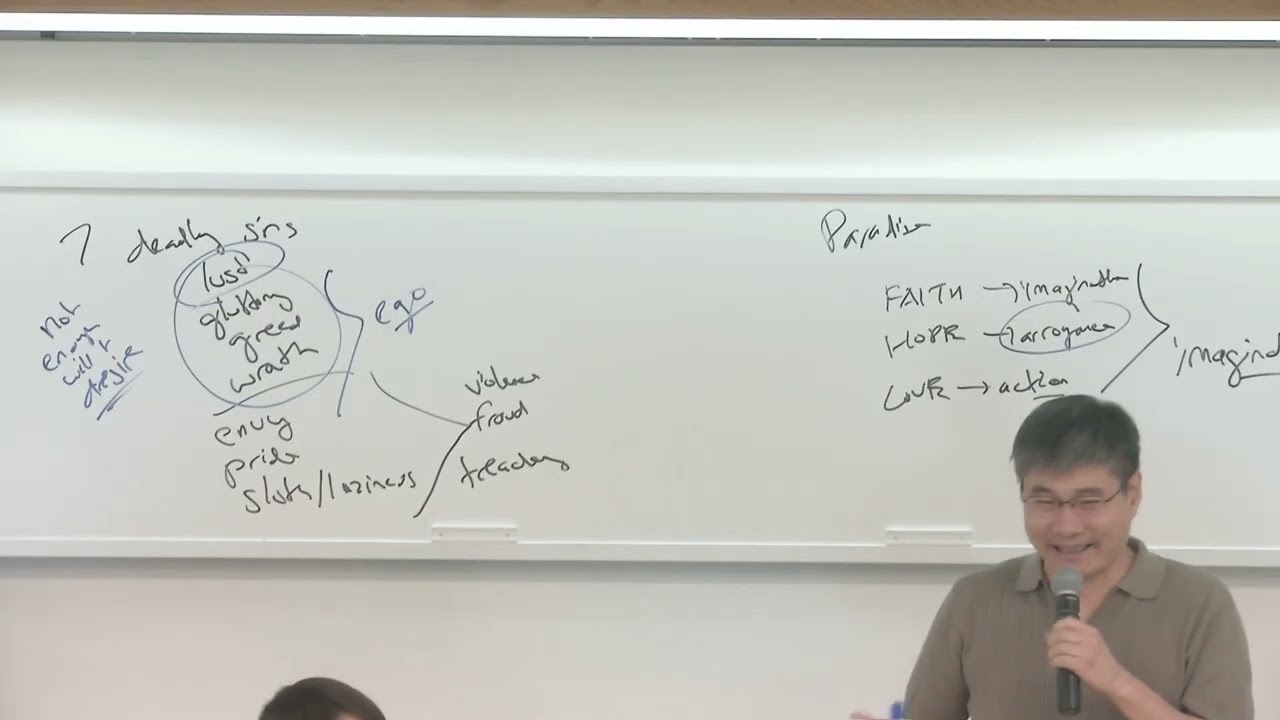


Ask anything from this episode.
Save it, chat with it, and connect it to Claude or ChatGPT. Get cited answers from the actual content — and build your own knowledge base of every podcast and video you care about.
Get Started Free