Key Moments
Civilization #6: Elite Overproduction and the Bronze Age Collapse
 Predictive History
Want to know something specific about what's covered?
We've already dissected every moment. Ask and we will deliver (with timestamps).
Key Moments
Elite overproduction and rent-seeking behavior led to the Bronze Age collapse, destabilizing interconnected societies.
Key Insights
The Bronze Age (c. 1200 BCE) was a highly interconnected globalized world centered around trade and resource extraction, particularly copper and tin for bronze.
Key economic drivers of the Bronze Age included mining, manufacturing, trade, and piracy, with key choke points like Troy accumulating significant wealth.
The Bronze Age Collapse saw the destruction of major civilizations like Mycenaean Greece and the Hittite Empire, with Egypt weakening significantly.
Scholarly theories for the collapse range from invasions and natural disasters to a 'perfect storm' of earthquakes, climate change, and internal revolts.
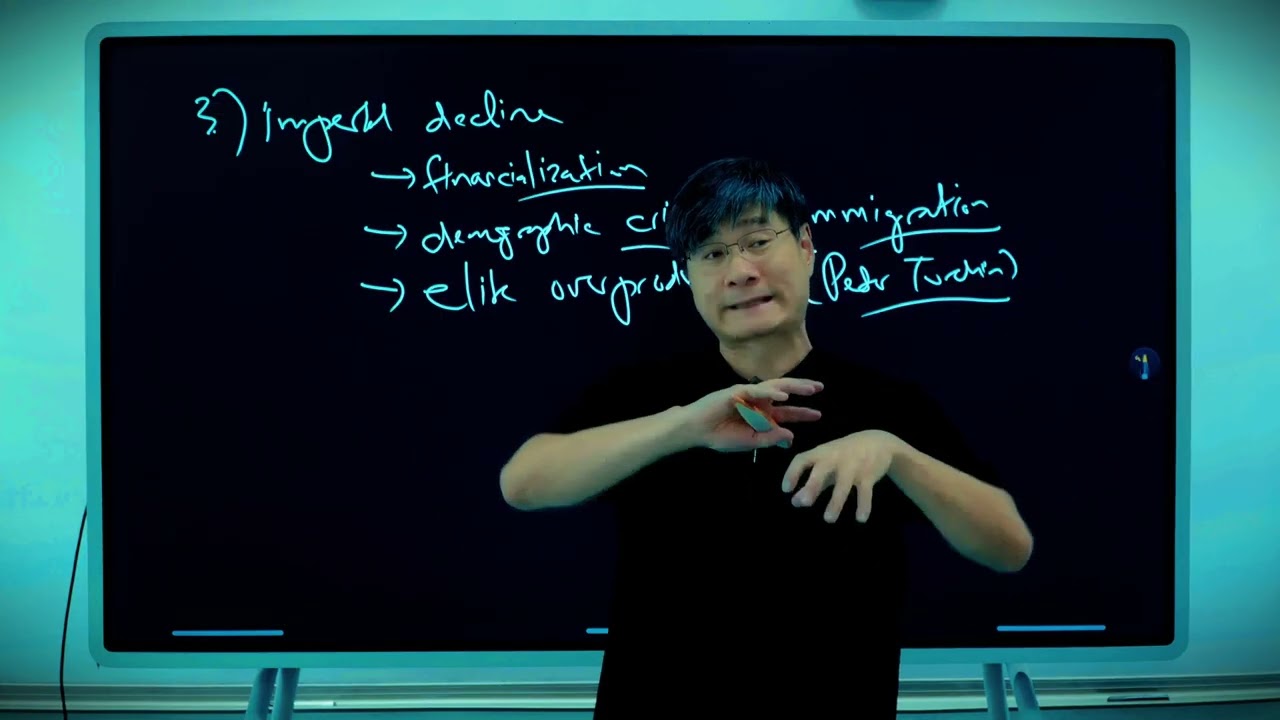
Peter Turchin's 'elite overproduction' theory posits that societal collapse stems from internal elite competition and 'rent-seeking behavior' rather than peasant revolts.
Rent-seeking behavior, where elites profit without productive contribution (e.g., charging for degrees, charging rent), leads to debt, inequality, and instability.
THE GLOBALIZED BRONZE AGE WORLD
Around 1200 BCE, the world was highly interconnected, with major civilizations like Mycenaean Greece, the Hittite Empire in Anatolia, and Egypt forming a complex network. This era, known as the Bronze Age, was defined by the trade of bronze, an alloy requiring copper and tin found in disparate locations from Britain to Afghanistan. This global reliance on trade for essential resources fostered extensive communication and economic interdependence, making the entire system vulnerable to disruption. Key economic activities included mining, manufacturing, trading, and even piracy, with strategic locations like Troy acting as vital logistical hubs and toll gates.
THE MYSTERY OF THE BRONZE AGE COLLAPSE
A few decades after its peak, this prosperous Bronze Age world experienced a catastrophic collapse. Mycenaean Greece and the Hittite Empire were destroyed, and Egypt, while not obliterated, lost its hegemonic status. For decades, scholars debated the cause, proposing theories ranging from northern invasions and widespread natural disasters to a combination of factors. The 'Sea Peoples,' a mysterious group or coalition of groups attacking Egypt from the sea, are confirmed by Egyptian records to have played a role, destroying the Hittites and Mycenaean Greece but failing to conquer Egypt.
THE 'PERFECT STORM' THEORY
The prevailing scholarly consensus for decades suggested a 'perfect storm' or 'systems collapse' as the cause of the Bronze Age breakdown. This theory posits that a series of interconnected events, rather than a single cause, led to the downfall. Archaeological and textual evidence points to a period marked by significant earthquakes destabilizing the region, climate change resulting in cooler temperatures and crop failures, and widespread internal revolts and civil strife as populations rebelled against their Elites. These multiple stressors combined to erode the resilience of societies.
ELITE OVERPRODUCTION: A NEW EXPLANATION
Historian Peter Turchin proposes a different theory: 'elite overproduction.' This model argues that societal collapse is not primarily driven by the discontent of the masses (as Karl Marx suggested) but by internal conflicts among the elite. Turchin contends that the rise of permanent, hereditary elites, while initially beneficial for organization and wealth creation, inevitably leads to a situation where there are too many elites competing for limited resources and power. This competition intensifies 'rent-seeking behavior,' where elites profit without producing tangible value.
RENT-SEEKING BEHAVIOR AND SOCIETAL INSTABILITY
Rent-seeking behavior is central to Turchin's theory. It describes the elite's practice of extracting wealth through mechanisms like charging for access to resources, education (degrees), or land, rather than through productive endeavors. This creates a system where debt-seeking becomes prevalent, potentially leading to debt slavery. As the number of elites grows disproportionately to the society's productive capacity, intense competition for this rent-seeking power arises. This internal strife and the resulting debt and inequality make societies inherently unstable and vulnerable to collapse when hit by external shocks.
THE INEVITABILITY OF COLLAPSE AND HISTORICAL CYCLES
Turchin's theory suggests that societal collapse is not a unique disaster but a recurring historical pattern driven by the dynamics of elite overproduction. The Bronze Age collapse, the fall of the Maya, and other historical collapses share this underlying cause: the self-destructive tendencies of perpetual elites engaged in rent-seeking. While such collapses are traumatic, they also clear the way for new societies and innovations to emerge, like Greek civilization and the Israelites stemming from the Bronze Age and Mayan collapses, respectively. The lecture posits that societal cycles of rise and fall, driven by these dynamics, are perhaps necessary for progress and societal regeneration.
Mentioned in This Episode
●Supplements
●Organizations
●Books
●Concepts
●People Referenced
Understanding Societal Collapse
Practical takeaways from this episode
Do This
Avoid This
Common Questions
The exact cause is debated, but scholars point to a 'perfect storm' of factors including earthquakes, climate change, internal revolts, and invasions by groups like the Sea Peoples. The theory of elite overproduction suggests underlying societal instability due to excessive elite competition was a primary driver.
Topics
Mentioned in this video
More from Predictive History
View all 152 summaries 47 min
Great Books #13: Gay Talese's Sparks of Light
 120 min
Game Theory #29: Final Examination
 45 min
Great Books #12: Dante in Paradise
 76 min
Game Theory #28: Predictive History
Ask anything from this episode.
Save it, chat with it, and connect it to Claude or ChatGPT. Get cited answers from the actual content — and build your own knowledge base of every podcast and video you care about.
Get Started Free