Key Moments
Big Beautiful Bill, Elon/Trump, Dollar Down Big, Harvard's Money Problems, Figma IPO
 All-In Podcast
Want to know something specific about what's covered?
We've already dissected every moment. Ask and we will deliver (with timestamps).
Key Moments
Big Beautiful Bill passes Senate, AI reg moratorium removed, energy subsidies phased out, Elon/Trump feud, dollar drops, Harvard faces financial scrutiny, Figma eyes IPO.
Key Insights
The 'Big Beautiful Bill' passed the Senate with a tie-breaking vote, but a significant amendment removing a 10-year AI regulation moratorium was a major change, leading to potential state-by-state AI regulation.
US energy policy is shifting away from clean energy subsidies, including EV tax credits, potentially favoring traditional energy sources and nuclear power through market forces.
The relationship between Elon Musk and Donald Trump is strained over the new bill, highlighting a potential conflict between tech leaders and political figures crucial for policy.
The US dollar has seen a significant devaluation in early 2025, raising concerns about inflation and the cost of imports, though some argue it's part of a longer-term trend.
Harvard is facing financial pressure and potential federal investigation due to its response to antisemitism, its admissions policies, and its bond offerings, impacting its endowment and funding.
The tech market is experiencing a surge in IPOs and M&A, with companies like Figma preparing for significant IPOs, but the rise of foundational AI models introduces uncertainty into the future valuation of SaaS businesses.
THE 'BIG BEAUTIFUL BILL' AND THE FATE OF AI REGULATION
The 'Big Beautiful Bill' successfully passed the Senate, largely due to Senator JD Vance's tie-breaking vote. A critical development was the removal of a 10-year moratorium on AI regulation. This change means that AI governance will likely be handled at the state level, leading to a complex patchwork of regulations across the US. While national preemption was seen as ideal by some for economic consistency, the absence of it introduces potential challenges for tech companies operating across state lines and for consumers.
ENERGY SUBSIDIES PHASED OUT: A SHIFT TOWARDS MARKET FORCES
The bill signals a significant shift in US energy policy, with the phasing out of clean energy subsidies, including EV tax credits. This move is expected to reduce government financial incentives for solar and wind power. Proponents argue this will create natural market forces that favor traditional energy sources like gas, oil, coal, and nuclear power. There's a stated hope that this will drive further investment and deregulation for nuclear energy, potentially accelerating its proliferation as a scalable energy source.
ELON MUSK, DONALD TRUMP, AND THE FISCAL DEBATE
The interaction between Elon Musk and Donald Trump highlights a potential rift within the pro-business political sphere. Musk has criticized the bill for its spending and impact on the debt, while Trump has responded pointedly. This dynamic underscores the importance of tech leaders aligning with political movements for policy influence. The broader discussion centers on the US debt spiral, with differing views on whether the bill adequately addresses fiscal responsibility or if it exacerbates the problem through spending and tax cuts that may not stimulate GDP growth as intended.
DEVALUATION OF THE US DOLLAR AND INFLATIONARY CONCERNS
The US dollar has experienced a sharper decline than usual in the first half of 2025, raising alarms about potential inflation and making international travel more expensive. Economists point to factors like tariffs and the nation's substantial debt load as contributing elements. While a declining dollar can theoretically boost exports, it also increases the cost of imports, impacting consumers and businesses. This trend raises questions about the long-term stability of the currency and its implications for global investment in US assets.
HARVARD'S FINANCIAL WOES AND THE CHALLENGE TO HIGHER EDUCATION
Harvard University is facing intense scrutiny from the White House, with potential civil rights lawsuits and demands to address antisemitism, cancel DEI initiatives, and permit third-party oversight of admissions. This has led to financial uncertainty, including potential cuts to federal funding and questions surrounding its bond offerings. The university's reliance on its endowment, which has increasingly shifted to illiquid private equity, is also a concern. This situation reflects broader challenges to traditional higher education models, exacerbated by the internet and the impending impact of AI.
THE FUTURE OF SAAS AND IPO MARKET FRENZY AMIDST AI UNCERTAINTY
The tech market is buzzing with IPOs and M&A activity, exemplified by Figma's upcoming IPO and Grammarly's acquisition of Superhuman. Despite strong revenue growth and cash reserves, companies like Figma face a crucial question: how will foundational AI models impact the future of specialized software-as-a-service (SaaS)? The rise of powerful AI platforms like OpenAI and Anthropic could potentially absorb many existing tools, creating uncertainty about long-term revenue durability for companies not directly involved in core AI development. This makes investors cautious about underwriting future revenue streams beyond a few years.
TAX CUTS, GDP GROWTH, AND THE DEBT DEFICIT DILEMMA
The debate over tax cuts and their impact on GDP growth remains contentious. One perspective argues that lower taxes stimulate economic activity, leading to job creation and increased income. The alternative view suggests that tax cuts disproportionately benefit the wealthy, doing little to boost broader economic indicators. This disagreement is central to discussions about managing the national deficit, with proponents of the bill believing it will spur growth and reduce the deficit, while critics remain skeptical, pointing to the nation's high debt levels as evidence of fiscal emergency.
THE ROLE OF STATES VERSUS FEDERAL GOVERNMENT IN AI REGULATION
The question of whether AI regulation should be a federal or state matter is complex. While proponents of state-level control emphasize states' rights and the ability to address unique local concerns, others argue that the national and international implications of AI necessitate a uniform federal approach. A patchwork of state regulations could hinder innovation, create compliance nightmares for businesses, and disadvantage smaller companies that lack the resources to navigate diverse legal landscapes. The consensus among many experts leans towards federal oversight to ensure technological competitiveness and economic stability.
THE URGENCY OF ENERGY PRODUCTION AND SUPPLY CHAIN CHALLENGES
The need for increased energy production in the U.S. is paramount, especially with the projected growth driven by AI and other technologies. However, the focus is shifting from production capacity to supply chain and transmission issues. Even with deregulation, the lead times for critical infrastructure like gas turbines can extend to 2030. This highlights that energy policy must consider not only how energy is made but also how it is delivered and stored. Overcoming these logistical hurdles is crucial to meeting future energy demands and supporting technological advancement.
THE ENDURING VALUE OF AMERICAN ASSETS DESPITE DOLLAR DEVALUATION
Despite the dollar's devaluation, American assets, particularly in equities and real estate, are seen as a 'flight to quality' globally. This continues to create demand for dollar-denominated assets, even as the currency's purchasing power erodes. While a continuous decline poses risks, the strength of American innovation, especially in burgeoning fields like AI, and the attractiveness of its markets can mitigate the negative effects. The question remains whether this trend is sustainable and how it will impact long-term economic stability and the potential for a rise in socialist ideologies if living costs continue to outpace income growth.
DETERMINING TALENT IN A POST-BRAND HIGHER EDUCATION LANDSCAPE
With the declining influence of traditional university brands, employers are exploring new ways to identify talent. Concepts like project-based work, coding challenges, and internal professional development programs are emerging as alternatives to relying on prestigious degrees. This shift recognizes that a university's brand may not always correlate with practical job performance. The challenge lies in developing robust filtering mechanisms that can efficiently assess a wide pool of candidates, ensuring that merit and capability, rather than pedigree, become the primary criteria for employment.
THE INTERPLAY OF TECHNOLOGY AND POLITICS: A NEW ERA OF ENGAGEMENT
The increasing engagement of the tech industry in politics, particularly evident in the past election cycle, signifies a new phase of influence. Figures like Elon Musk are using their platforms, and potentially their investment vehicles, to shape political discourse and support candidates aligned with specific agendas. This fusion of tech and politics is seen as crucial for future policy development, especially concerning emerging technologies. However, maintaining alignment between tech leaders and political movements is vital for continued progress and avoiding the perception of a 'one-party country' or ideological conflicts that could hinder innovation.
THE CRITICAL ROLE OF GDP GROWTH IN MANAGING NATIONAL DEBT
Given the persistent growth of national debt, achieving a targeted federal deficit-to-GDP ratio like 3% is a significant challenge. Many economists believe that simply cutting spending is insufficient and that robust GDP growth is the most viable path to fiscal stability. Advances in technology, particularly AI, are seen as key drivers of this growth by unlocking new industries and increasing productivity. Fostering an environment conducive to AI development, free from overly restrictive or fragmented regulations, is therefore critical for managing the nation's long-term financial health.
THE EMERGING THREAT TO SAAS BUSINESS MODELS FROM FOUNDATIONAL AI
The rapid advancement of foundational AI models from companies like OpenAI and Anthropic poses an existential question for many existing SaaS businesses. These models have the potential to become all-encompassing platforms, integrating functionalities currently provided by numerous specialized applications. This could render some SaaS products redundant or significantly devalue their offerings. The key uncertainty for investors is the rate at which this integration will occur and whether specialized tools will remain distinct and valuable, or become absorbed into broader AI services, fundamentally reshaping the software market.
Mentioned in This Episode
●Software & Apps
●Companies
●Organizations
●Books
●Concepts
●People Referenced
Common Questions
The BBB bill passed the Senate and is awaiting House approval. A significant change was the removal of a 10-year moratorium on AI regulation, allowing states considerable leeway in creating their own AI laws, which some hosts argue could create a chaotic patchwork.
Topics
Mentioned in this video
Director of 'Arrival' and the upcoming new Bond film.
Author of 'Modern Poker Theory', a book on GTO strategy.
Senator mentioned in the context of potentially shifting the discussion on fiscal policy.
Senator who previously stated he would vote no on the BBB unless more spending was cut.
A bill that passed the Senate with a tie-breaking vote and is awaiting House passage. Debates around its spending and policy changes, including AI regulation, are discussed.
Federal civil rights law that prohibits sex-based discrimination in education, mentioned in relation to Harvard's admissions practices.
More from All-In Podcast
View all 424 summaries 85 min
World's First Trillionaire, Anthropic Fable Banned, The New Oligarchs, Iran Peace Deal
 102 min
Anthropic's Fable Backlash, Nationalizing AI, Inflation Heats Up & California’s Broken Elections
 68 min
All-In's Best Ideas Pitch Competition: 4 Investors Present Their Top Trades Live
 44 min
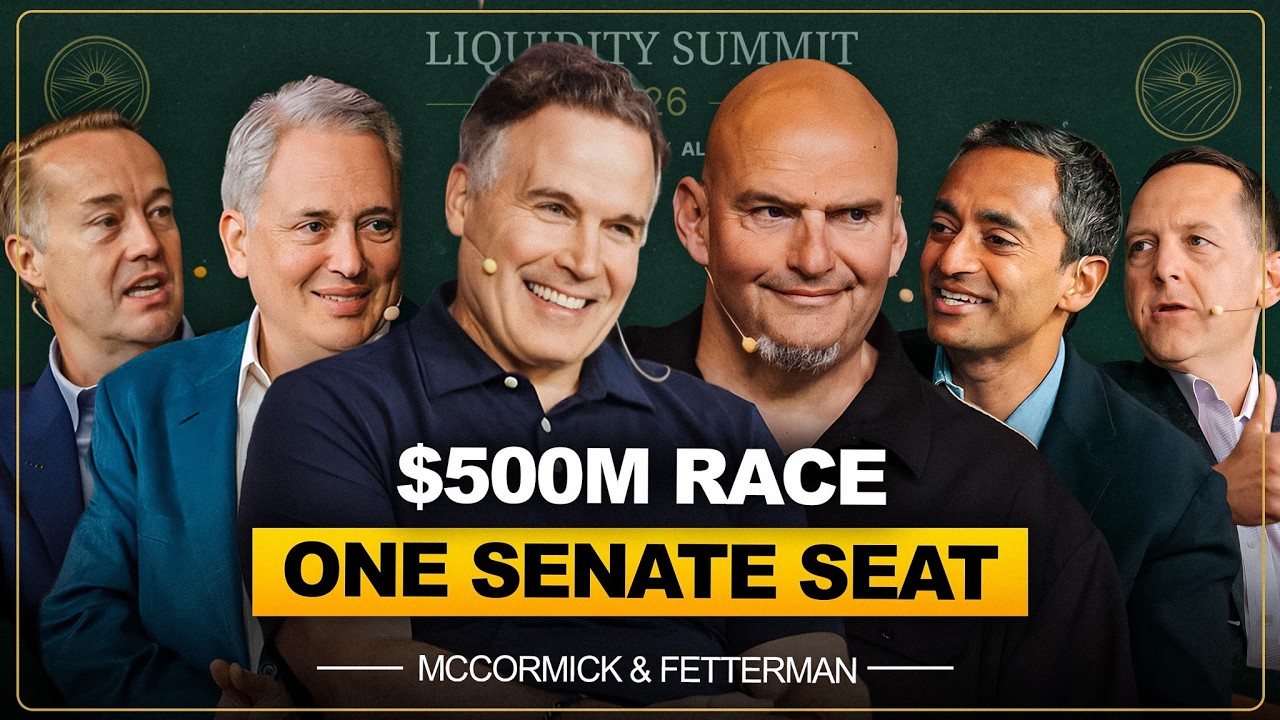
Senators John Fetterman and Dave McCormick: Bipartisanship, Money in DC, Datacenters, Graham Platner
Ask anything from this episode.
Save it, chat with it, and connect it to Claude or ChatGPT. Get cited answers from the actual content — and build your own knowledge base of every podcast and video you care about.
Get Started Free