Key Moments
AI Dev 26 x SF | Panel Discussion: Future of Software Engineering
 DeepLearning.AI
Want to know something specific about what's covered?
We've already dissected every moment. Ask and we will deliver (with timestamps).
Key Moments
AI agents will allow individuals to build complex software, but mastering critical thinking and taste will be crucial for success, potentially leading to a shift away from traditional developer roles.
Key Insights
Software developers have received 'superpowers' from AI coding agents, increasing productivity, with the potential for non-developers (1-2 billion knowledge workers) to build their own software.
Google's AI writes 75% of its code, and at Landing AI, development by agents has reached nearly 100%, indicating a significant shift in code creation.
The concept of memory in AI agents mirrors human memory types (procedural, working, episodic, semantic) and is critical for long-horizon tasks, but it is not yet a solved problem.
Companies are making mistakes by assuming AI agents can simply be 'slapped on top' of existing messy data infrastructure, leading to a need to return to data fundamentals like modeling, quality, and governance.
75% of people in the audience experienced the 'uncanny valley' with AI, highlighting a current struggle with reliability and truth-seeking when trusting AI outputs.
LinkedIn saw 1.2 million new AI-related jobs posted in the past year, indicating a rapidly evolving job market and demand for new skills.
AI agents are revolutionizing software development and democratizing creation.
The advent of AI coding agents has bestowed 'superpowers' upon the estimated 50 million software developers globally, significantly accelerating their productivity. This technological leap is poised to revolutionize the entire software development lifecycle. Beyond aiding existing developers, a more profound shift is anticipated: the remaining 1-2 billion knowledge workers, who previously relied on engineering teams for their software needs, will soon be empowered to build applications themselves. This democratization of software creation, while less flashy than developer speed-ups, represents a substantial revolution that will lead to an avalanche of new software being built in the coming years. As Replit's president, Mika Katasta, enthusiastically states, the future for software creators is a '10 out of 10' for brightness.
AI is raising the bar for developers, compressing the timeline to seniority.
The integration of AI coding agents fundamentally changes the path to becoming a senior developer. Instead of starting with simple, isolated tasks, junior engineers are now exposed to the full complexity of systems from day one. This accelerated immersion, while potentially overwhelming initially, compresses the learning curve, rapidly elevating them to experienced roles. AI is not just a tool but also a mentor, guiding developers through complex challenges. Those with curiosity and adaptability can 'speed run' their career trajectories, achieving senior-level proficiency much faster than in previous eras. This new paradigm necessitates a different approach to learning and development, emphasizing immediate engagement with complex systems and AI-driven guidance.
The increasing role of AI in code generation and the need for new skills.
Companies like Google are already leveraging AI for a significant portion of their code generation, with reports suggesting up to 75% of their code is AI-written, and Landing AI observing nearly 100% development by agents for internal use. This trend indicates a future where an individual developer can accomplish much more, potentially by supervising multiple AI agents. While AI handles more of the routine coding and pull requests, developers can shift focus to higher-level outcomes, bridging the gap between engineering and product management. However, this rapid progress raises questions about overestimating AI's current capabilities. Many are still in an experimental phase, learning the guardrails and optimal ways to interact with these agents. The key takeaway is that getting involved and experimenting with these AI tools is paramount for both junior and senior developers alike.
Memory and data quality emerge as critical bottlenecks in AI systems.
The development of advanced AI agents hinges on robust memory systems and high-quality data. Analogous to human memory, AI requires efficient ways to store, retrieve, and critically, forget information to manage long-horizon tasks effectively. However, as illustrated by personal anecdotes, 'memory is not solved,' with systems failing to update or recall information accurately, indicating significant work remains. Compounding this is the issue of data, where companies are often tempted to 'speed run' into AI adoption without addressing fundamental data quality, modeling, and governance. The rush to implement AI on top of poor data infrastructure leads to predictable failures, shining a harsh light on decades of neglected data hygiene. As Dan Maloney notes, 'garbage in, garbage out' remains a core principle, and AI's speed amplifies the consequences of poor data practices.
The evolving interface, role definitions, and the rise of AI memory engineers.
The landscape of building AI systems is characterized by rapidly changing interfaces, from pure code to low-code and command-line tools, reflecting an unsettled user experience. Alongside this, role definitions are in flux. Positions like 'AI Engineer' are recent, and many professionals are navigating how to upskill and where they fit. Emerging roles include 'AI Memory Engineers,' focused on efficient memory management for agents, and 'Agent Architects,' who design agent workflows using visual tools. These shifts highlight the need for continuous education and adaptation. While the technology itself advances rapidly, the bottlenecks lie in how we interact with it and how we define the human roles within these new AI-driven ecosystems. The current phase is about refining these interfaces and role definitions to harness AI's full potential.
Truth-seeking, taste, and continuous learning are paramount in the AI era.
As AI agents become more integrated into our work, the ability to discern truth and make sound judgments – often termed 'taste' – becomes critically important. The 'uncanny valley' of coding agents, where they are powerful but not always reliable, necessitates a 'truth-seeking' mindset. Complacency with AI outputs can lead to significant errors, making it essential for leaders and individuals to question and verify information, even if it means 'hammering' the AI systems to find contradictions. This skill is hard to teach and develops through experience, often by observing and learning from others. Coupled with truth-seeking is the imperative for continuous learning. The pace of AI advancement means no one can keep up entirely, making the ability to learn effectively, digest new information, and communicate findings crucial. This blend of critical thinking, taste, continuous learning, and truth-seeking will define success in the evolving professional landscape.
The future of work: generalists empowered by AI and the evolution of roles.
The discussion points towards a future where AI empowers individuals to become more versatile generalists. With AI tools handling complex tasks, individuals can more easily acquire broad knowledge and become 'conversation ready' across many domains. While deep technical expertise will remain valuable, especially for specialized, hard technical problems, the ability to leverage AI to fill knowledge gaps is democratizing expertise. Roles are flattening, with engineers potentially taking on product management and design responsibilities. The concept of a 'manager' role may diminish as AI agents become ubiquitous, with individuals taking ownership of problems and managing their own AI workforce. Companies like Oracle see the need for continuous learning not just for humans but also for their AI agents. The trend points towards a future where individuals possess a blend of broad domain understanding, the ability to manage AI systems, and a strong sense of taste and critical judgment.
Predictions for developer numbers in retail and startups.
Looking ahead five years, the need for traditional developers may significantly decrease, particularly in retail. A retail business running its website today with 10 developers might require far fewer, if any, as off-the-shelf SaaS solutions and AI automation handle most operational tasks. For Series A startups, the dynamic is similar: while they will still hire developers, the number may be less than currently anticipated due to AI-driven efficiency. However, the nature of these roles will change. Developers might be re-labeled as 'agent orchestrators' or 'AI solution builders,' focusing on managing AI systems and leveraging them for 100x productivity. These future developers will likely need strong technical backgrounds but also possess broader skills in product management, customer interaction, and domain expertise, becoming more like augmented generalists capable of wielding AI tools to achieve ambitious goals.
Mentioned in This Episode
●Software & Apps
●Companies
●Organizations
●People Referenced
Navigating the Future of Software Engineering with AI
Practical takeaways from this episode
Do This
Avoid This
Common Questions
AI is expected to revolutionize the software development life cycle, with developers shifting focus from writing code to managing multiple AI agents. This will increase productivity and allow developers to focus more on outcomes and downstream aspects of projects.
Topics
Mentioned in this video
Company focused on making the world's documents computable by converting them into structured data.
Mentioned in an article regarding companies blowing through annual budgets in a quarter due to AI-driven spending.
The CEO mentioned that after extensive AI coding, they spent significant time debugging, which led them to pause AI coding efforts.
Mentioned as stating 75% of their code is now written by AI, raising questions about the need for developers in the future.
A programming language that Wes McKenna suggests is the best for agents, even though he is learning it himself.
A web coding platform for knowledge workers, aiming to empower a billion people to create software.
An AI model mentioned in the context of companies attempting to bypass data teams by using it on top of data warehouses, leading to disastrous results.
An online learning platform mentioned alongside Andrew's deep learning event.
A tool mentioned as an example of AI that aids in code development.
A Python library created by Wes McKenna, which contributed significantly to Python's popularity. It's mentioned as an example in the context of knowing what good software looks like.
A programming language that rose to prominence, partly due to libraries like Pandas. Currently considered a top language, with a mention of its use in teaching sales teams.
Host of the podcast 'Silicon Valley Girl', who interviews people building the future of AI and asks about disappearing jobs.
Founder of Replit, who commented that idea and marketing are key, while product building is becoming more automated.
CEO of Landon AI, focused on making documents computable. He rates the future of software development an 8-9.
A legendary investor from Benchmark who predicted that software engineering would die soon, emphasizing the growing importance of 'taste'.
More from DeepLearningAI
View all 105 summaries 62 min
Full Course: Spec-Driven Development with Coding Agents
 26 min
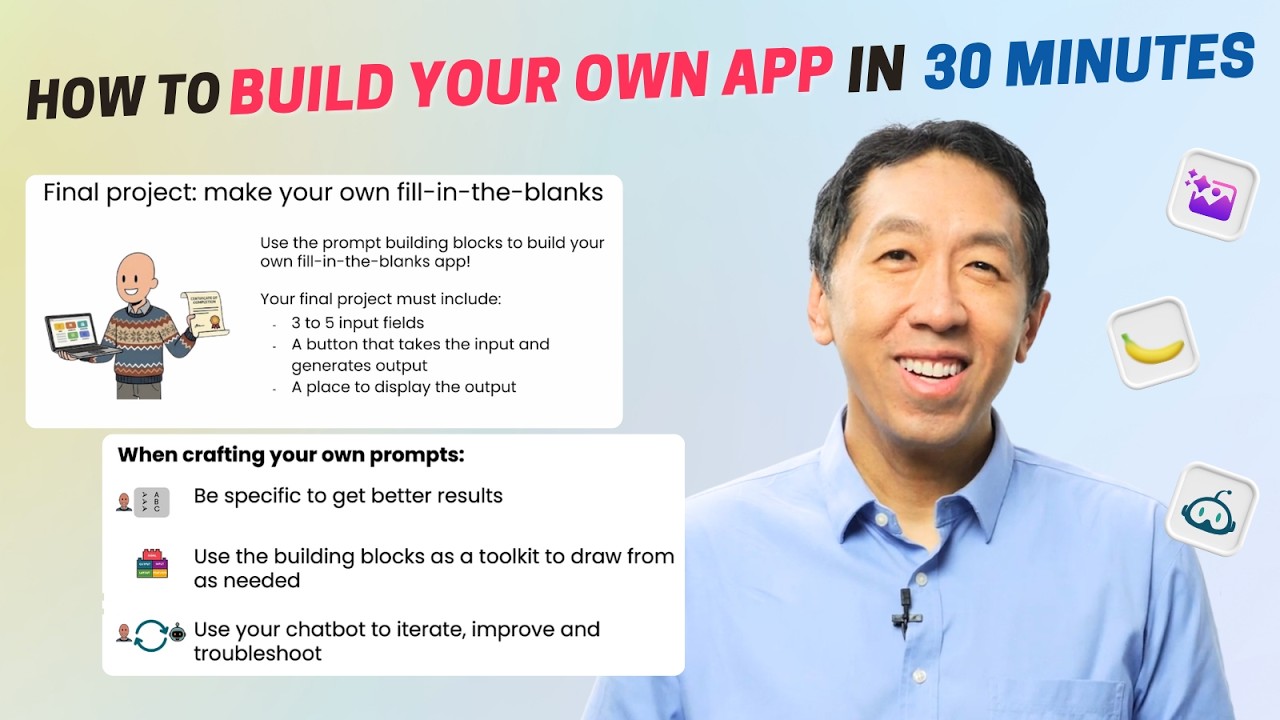
Build Your Own App In Just 30 Minutes! Full Course with Andrew Ng
 29 min
AI Dev 26 x SF | Paul Everitt: The Shift to Agentic Engineering
 26 min
AI Dev 26 x SF | João Moura: Building Recurring, Governed, and Embedded Enterprise Workflows
Ask anything from this episode.
Save it, chat with it, and connect it to Claude or ChatGPT. Get cited answers from the actual content — and build your own knowledge base of every podcast and video you care about.
Get Started Free