Key Moments
AI Dev 25 x NYC | Panel discussion: Breaking the Limits of AI Growth: from Hardware to Application
 DeepLearning.AI
Want to know something specific about what's covered?
We've already dissected every moment. Ask and we will deliver (with timestamps).
Key Moments
AI growth panel discusses hardware, infrastructure, data supply chains, and responsible AI.
Key Insights
Hardware and infrastructure optimization (e.g., Groq's LPUs) are crucial for real-time AI applications beyond GPUs.
The AI supply chain, from model developers to end-users, faces inefficiencies that require better integration.
AI-native development, focusing on current model capabilities, allows for rapid feature deployment.
Google emphasizes a full-stack AI approach, offering models, frameworks, and on-device ML to cater to diverse developer needs.
Customization through fine-tuning and using LLMs as judges is key for product differentiation and quality assurance.
Responsible AI challenges have evolved with generative AI, demanding new technical definitions and solutions for fairness and privacy.
Open-source models offer significant value, and their development is accelerating, challenging proprietary models.
Future excitement lies in AI accelerating AI research, government data sovereignty initiatives, and enabling next-gen scientific discovery through multimodal data.
OPTIMIZING THE AI INFRASTRUCTURE LAYER
The panel highlights the critical need to move beyond traditional GPUs for AI inference. Companies like Grock are developing specialized hardware, such as Language Processing Units (LPUs), to address latency and cost challenges for real-time applications. This shift is driven by the increasing demand for AI agents in production and the limitations of legacy hardware in handling complex, multi-component back-end operations. Accessible via OpenAI-compatible APIs, these specialized solutions aim to diversify AI infrastructure beyond standard GPU offerings, focusing on performance, cost-effectiveness, and enabling new use cases.
THE IMMATURE AI SUPPLY CHAIN
A significant bottleneck identified is the immaturity of the AI supply chain. This encompasses the complex ecosystem extending from cloud providers and model developers to downstream application builders and startups. Inefficiencies arise from the difficulty in anticipating diverse use cases for general-purpose models and the inherent data privacy constraints faced by cloud platforms when fine-tuning models on customer data. Addressing these downstream integration challenges is seen as the next major advance needed for more efficient AI deployment and utilization.
EMBRACING AN AI-NATIVE DEVELOPMENT MINDSET
The discussion emphasizes an 'AI-native' mindset, which focuses on leveraging current, reliable AI capabilities rather than a critical approach of what AI cannot do. This perspective, exemplified by companies like Genspark, allows for rapid adaptation and feature launches as new models and capabilities emerge. By building on the frontier of what models can stably perform, development teams can continuously expand their offerings. Rigorous internal evaluation processes are crucial to ensure the quality and reliability of these rapidly deployed AI features, meeting user expectations in a fast-evolving landscape.
GOOGLES FULL-STACK AI ECOSYSTEM AND DEVELOPER RELATIONS
Google's approach to AI development is characterized by a comprehensive full-stack strategy. This includes offering large models like Gemini as a service, openly available models such as Gemma for fine-tuning, open-source frameworks like Jax and PyTorch support, and enabling on-device machine learning. Developer Relations (DevRel) plays a key role, focusing on developer experience, education, and community building. The challenge lies in making these general-purpose AI tools accessible and understandable to diverse verticals, enabling specialists in fields like healthcare or nutrition to effectively leverage AI without deep programming expertise.
CUSTOMIZATION, EVALUATION, AND THE RISE OF OPEN SOURCE
Moving beyond general-purpose models, customization through supervised fine-tuning and reinforcement learning is essential for creating product differentiation. Companies are developing sophisticated evaluation platforms to assess various outputs, often using LLMs as judges capable of evaluating diverse modalities like text, slides, and images. The open-source model space is also rapidly advancing, with models like DeepSeek and Kim K2 thinking demonstrating impressive capabilities that challenge proprietary options in terms of performance and cost. This democratization of powerful AI tools allows developers to build more specialized and effective AI agents and workflows.
THE EVOLVING LANDSCAPE OF RESPONSIBLE AI AND GOVERNANCE
Responsible AI (RAI) has become significantly more complex with the advent of generative AI. While technical solutions for fairness and privacy existed for targeted models, the open-ended nature of generative outputs presents new challenges. Defining and enforcing fairness in LLMs is particularly difficult, often relying on human annotation and guardrails. Privacy and security also face new hurdles as data is mapped into abstract embedding spaces. The panel notes a gap between academic research offering technical solutions and regulations that often focus more on process and organization rather than specific technical requirements. This necessitates a closer alignment between technical expertise and policy development.
FUTURE HORIZONS: ACCELERATED RESEARCH AND MULTIMODAL SCIENCE
Looking ahead, excitement centers on AI accelerating AI research itself, potentially leading to a tipping point in model development. Initiatives by governments to establish data sovereignty and shape AI roadmaps internationally are also seen as critical developments. Furthermore, the potential for AI to enable next-generation scientific discovery by analyzing complex multimodal data, such as genomics alongside patient records, represents a profound long-term impact. The rapid pace of innovation suggests that breakthroughs previously thought to be years away might emerge much sooner, driven by these converging advancements.
Mentioned in This Episode
●Products
●Software & Apps
●Tools
●Companies
●Organizations
●Concepts
Common Questions
Legacy hardware, including GPUs, is often insufficient for demanding real-time AI use cases, especially those requiring low latency in sectors like finance and healthcare. Specialized hardware like Grock's LPU offers a solution.
Topics
Mentioned in this video
An all-in-one AI workspace aiming to provide a cloud-code-like experience for white-collar workers, with various AI agents.
Used for on-device machine learning, allowing deployment of trained models directly on devices.
Mentioned as part of Google's stack for developing custom models.
An open-sourced benchmarking tool developed by Grock, used internally to evaluate models before public release.
More from DeepLearningAI
View all 104 summaries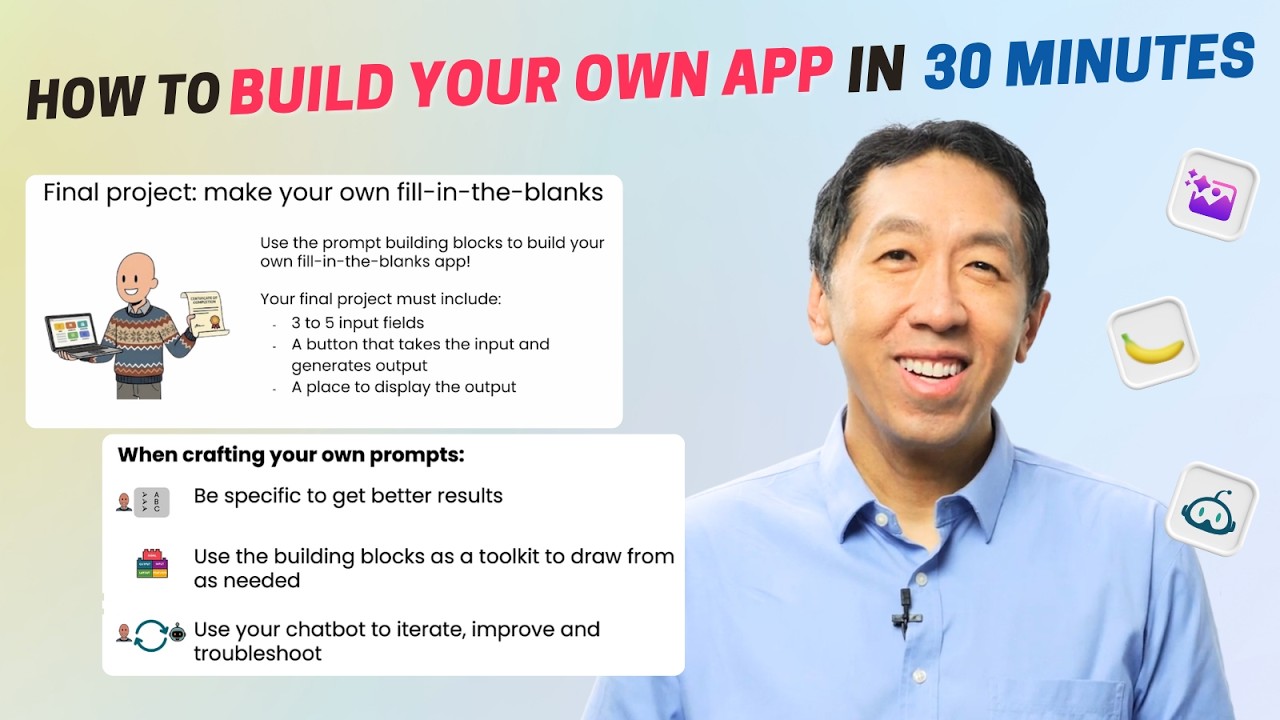 26 min
Build Your Own App In Just 30 Minutes! Full Course with Andrew Ng
 26 min
AI Dev 26 x SF | João Moura: Building Recurring, Governed, and Embedded Enterprise Workflows
 26 min
AI Dev 26 x SF | Brandon Waselnuk: Building the Context Engine AI Agents Need
 26 min
AI Dev 26 x SF | Manos Koukoumidis & Stefan Webb: VibeML: Build your AI model in hours, not months
Ask anything from this episode.
Save it, chat with it, and connect it to Claude or ChatGPT. Get cited answers from the actual content — and build your own knowledge base of every podcast and video you care about.
Get Started Free