Key Moments
What Makes Personal Identity Continue? | Arnold Zuboff
 Closer To Truth
Key Moments
Universalism posits a single subject of experience underlies all consciousness, challenging conventional views of personal identity and even death. It suggests all pains are 'yours' and retribution is a mistake as victim and perpetrator are the same.
Key Insights
The Sleeping Beauty problem, often seen as a probability puzzle, is re-framed by Arnold Zuboff as a metaphysical issue concerning the individuation of experience.
Zuboff proposes two ways to individuate experiences: objective individuation (distinguished by organism and time) and subjective individuation (distinguished only by immediacy). He argues subjective individuation is more probable for our own existence.
A key implication of subjective individuation is that personal identity is rooted in the immediate, first-person experience, not in future continuity or specific objective factors.
Universalism, as argued by Zuboff, implies that one's self-interest applies equally to all experiences, meaning 'all pains are yours' and death is not annihilation because the subject of experience persists.
Retribution is deemed a mistake under universalism because the victim and perpetrator are the same subject of experience; one is causing pain to themselves regardless of who fills the role.
Universalism, combined with a multiverse, offers an explanation for the fine-tuning of physical laws that allow for consciousness, suggesting the universe must be one conducive to experience if you exist.
The Sleeping Beauty problem as a metaphysical conundrum
Arnold Zuboff reinterprets the philosophical puzzle known as the Sleeping Beauty problem, moving beyond its common framing as a mere probability issue. He uses the thought experiment, where a participant is put to sleep and can be awakened on one day (a 'hard' game) or multiple days (an 'easy' game), to probe deeper questions about personal identity. The core of the problem, for Zuboff, lies not in calculating the odds of being awakened, but in understanding what constitutes an 'awakening' or any given conscious experience. He distinguishes between two ways experiences can be individuated: objective individuation, which relies on the specific organism and the objective time of occurrence, and subjective individuation, which focuses solely on the immediate, first-person quality of the experience itself. Zuboff argues that the latter, subjective individuation, is metaphysically more plausible and probabilistically more likely for one's own existence.
Objective versus subjective individuation of experience
In objective individuation, each experience is distinct due to the unique objective circumstances surrounding it – who is experiencing it and when. If Sleeping Beauty is awakened on trillion different days, each awakening would be an objectively distinct event. This view leads to the tempting probabilistic inference that if you find yourself awake, it's far more likely that there were many awakenings (the 'easy' game) than just one. However, Zuboff challenges this. Subjective individuation posits that what makes an experience *this* experience is its inherent immediacy and first-person perspective. The objective factors (time, specific organism) are secondary, or even irrelevant, to the essential nature of the experience itself. For Zuboff, this immediacy is the fundamental 'thisness' of an experience. He contends that for your own existence to be probable, subjective individuation must be the correct metaphysical stance. If experiences are only individuated subjectively, then finding yourself in an awakening doesn't tell you whether it's the 'hard' or 'easy' game, making the 'halfer' position (50/50 odds) correct.
The paradox of subjective individuation and probability
Zuboff uses a 'proof' to establish the overwhelming probability of subjective individuation. He reasons that if objective individuation were true, the probability of your specific experience existing would be astronomically low. It would require an incredibly precise alignment of causal factors, ancestral genes, and a specific objective time for *you* to be having *this* experience. The very fact that you *are* having an experience strongly suggests that the metaphysical framework which makes such an existence highly probable – subjective individuation – is correct. The 'immense improbability' of any particular occasion of experience arising under objective individuation makes it less likely to be the correct metaphysical account compared to subjective individuation, which, by its nature, guarantees the existence of *an* experience, thus making the specific instance of experience a less improbable occurrence from a first-person perspective.
From individuation to universalism: the single subject of experience
The argument then extends from subjective individuation to Zuboff's core thesis: universalism. He suggests that if we accept subjective individuation, which emphasizes the immediacy of experience as the primary factor in making it 'mine,' then the distinction between 'you' and 'me' based on objective personhood becomes less significant. The 'self-interest' that applies to your own immediate experience should, by logical extension, apply equally to all immediate experiences, regardless of who is having them or when. This leads to the radical claim that there is one fundamental subject of experience underlying all conscious beings. This isn't about merging into a single undifferentiated 'thing' but recognizing that the first-person immediacy that makes an experience yours is the same quality present in every other conscious being's experience. All pains, joys, and conscious states are 'yours' in the sense that they share this immediate, subjective quality.
Implications for death, retribution, and ethics
The concept of universalism has profound implications. Firstly, death is re-conceptualized not as annihilation, but as a transition where the subject of experience continues, simply no longer associated with a particular organism or objective timeframe. This is because the fundamental subject of experience is not destroyed. Secondly, retribution becomes a mistaken concept. If all conscious beings ultimately share the same subject of experience, then punishing one individual for harming another is, in essence, punishing yourself for something you yourself did. The perpetrator and the victim are ultimately the same 'person' in the universalist sense. This leads to a supercharged ethical framework, akin to the Golden Rule, but extended: 'do unto yourself what you would do unto yourself,' because all others are, in essence, yourself. This calls for an ethics focusing on consequentialism, where actions are judged by their impact on the entirety of conscious experience, which is ultimately one's own.
Distinguishing universalism from mystical oneness
Zuboff is keen to differentiate his theory of universalism from common understandings of mystical oneness or non-dualism found in traditions like Hinduism. He clarifies that he is not arguing for a single monolithic entity or a pantheistic view where all physical things are one. Instead, universalism focuses specifically on the sameness and immediacy of the *first-person perspective* across all conscious beings. While mystical experiences might lead to a feeling of unity, Zuboff's argument is grounded in a metaphysical analysis of experience and probability, aiming for a logical and philosophical conclusion rather than an experiential one. The existence of distinct times, contents, and even organisms are acknowledged; the claim is about the shared nature of the subjective quality of consciousness itself.
Universalism, the multiverse, and the fine-tuning problem
Zuboff proposes that universalism, when combined with the concept of a multiverse, provides a compelling explanation for the fine-tuning of physical laws necessary for consciousness. The observation that the fundamental forces and constants of the universe are precisely calibrated to allow for complex chemistry and conscious life is often seen as a mystery or indicative of design. Zuboff argues that if there are countless universes with varying physical laws (multiverse), and if universalism dictates that your subjective experience will necessarily be located in a conscious-producing universe ('the easy game'), then the apparent fine-tuning is resolved. You are guaranteed to find yourself in a universe where consciousness can emerge because that is the only kind of universe that can host your subjective experience. This bypasses the need for a divine explanation or an improbable coincidence, reframing the anthropic principle not as a selection effect, but as a consequence of universalism's demand that you exist within a compatible reality.
Mentioned in This Episode
●Books
●Concepts
●People Referenced
Common Questions
The Sleeping Beauty problem is a philosophical puzzle about determining probabilities when an experiment involves awakening a participant multiple times with memory erasure. It is central to understanding subjective individuation and its implications for personal identity and universalism.
Topics
Mentioned in this video
The speaker and author whose theory of universalism is the main topic of discussion.
A philosopher mentioned in relation to the Sleeping Beauty problem. (Note: While David Lewis is a prominent philosopher, the transcript doesn't specify his exact contribution to the Sleeping Beauty problem. He is mentioned as someone who focused on it.)
Philosopher credited with writing the first article on his version of the Sleeping Beauty problem.
A logician from whom Adam Elga reportedly got the case for the Sleeping Beauty problem.
A philosophical probabilistic puzzle used to explore the nature of probability and personal identity, and a central example in the discussion of universalism.
Mentioned as an example of a mystical view that can sometimes sound similar to universalism but is fundamentally different.
Cited as a source of mystical views related to oneness and unity, contrasted with the speaker's theory of universalism.
More from Closer To Truth
View all 29 summaries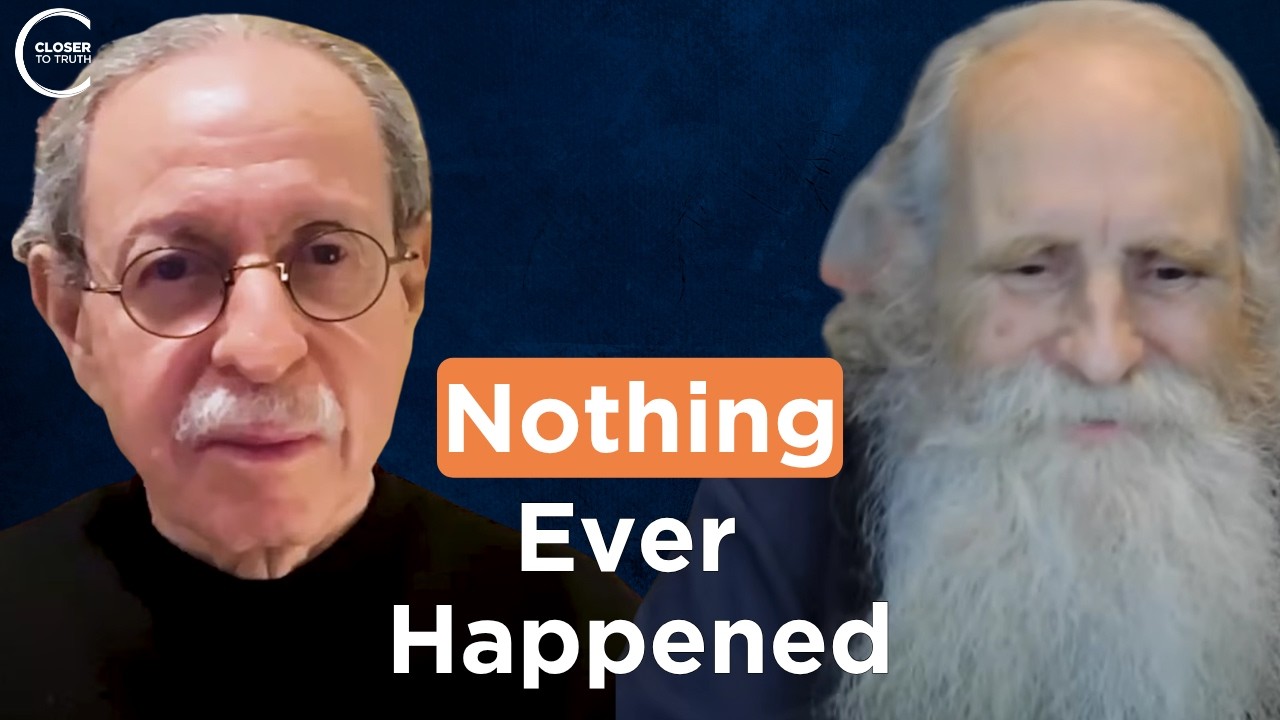 23 min
The Eternal Now in Advaita Vedanta | Michael James
 37 min
How Personal Identity Persists Through Time | Arnold Zuboff
 27 min
Why a Landscape of Consciousness | Episode 2801 | Closer To Truth
 27 min
Why Philosophy of Evolutionary Biology? | Episode 2701 | Closer To Truth
Ask anything from this episode.
Save it, chat with it, and connect it to Claude or ChatGPT. Get cited answers from the actual content — and build your own knowledge base of every podcast and video you care about.
Get Started Free