Key Moments
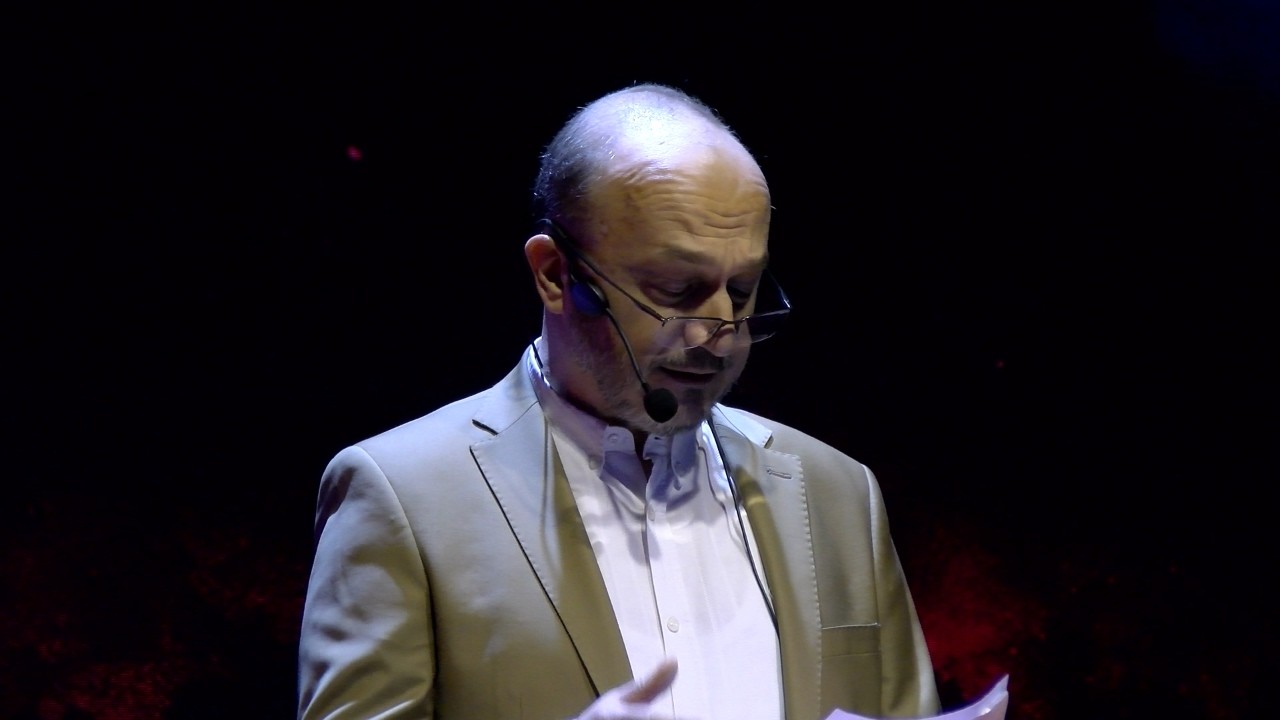
Using Music Technology to Help Children Grow | Thanos Dimitriou | TEDxAthens
 TED
TEDWant to know something specific about what's covered?
We've already dissected every moment. Ask and we will deliver (with timestamps).
Key Moments
Music technology empowers children, especially those with disabilities, to express themselves creatively and grow.
Key Insights
Music technology can be adapted to create accessible instruments for children with diverse learning needs and abilities.
The way educators communicate and foster a supportive, love-filled environment is crucial for a child's imagination to blossom.
Knowledge combined with imagination can lead to self-expression, increased self-esteem, and positive change.
Repurposing existing technologies, like brainwave monitors and eye-tracking devices, can open new avenues for musical creation.
Making music accessible to all children is vital for their personal growth, creativity, and for giving them a voice.
Expression through music is a fundamental right, not a privilege, and technology can be a tool to ensure this right.
UNLOCKING EXPRESSION FOR ALL CHILDREN
Thanos Dimitriou, a music technology educator, shares his mission to help children, particularly those with difficulties in self-expression, find their voice through music. His journey began with a desire to create tools that allow children with different learning styles to express themselves musically. He emphasizes that while tools are important, the way educators communicate and share knowledge, choosing their words carefully, is paramount. A supportive environment contrasting with constant negative reinforcement is key to nurturing a child's imagination.
THE ROLE OF LOVE AND IMAGINATION
Dimitriou highlights that a child's imagination thrives on love and freedom from constraints. When children feel free to imagine without limitations, their creativity blossoms. This nurturing approach is central to his philosophy as a music technology educator, where he connects science, technology, engineering, mathematics, and arts. He believes that knowledge without values, like learning to help and creating to offer, only fills the mind but fails to touch the heart, underscoring the importance of fostering empathy alongside technical skills.
INNOVATIVE MUSICAL EXPLORATION WITH TECHNOLOGY
The presentation showcases innovative ways technology can transform music-making for children. Examples include drawing a sun to produce music, directing music with air movements, controlling sound filters, and playing drums virtually. Children with disabilities can use their voice, conductive materials, cameras, sensors, and microcontrollers to play instruments like pianos and violins. This integration amplifies children's imagination, making music creation an interactive and engaging experience, as demonstrated in a brief video segment.
REPURPOSING TECHNOLOGY FOR ACCESSIBLE MUSIC
Dimitriou details how existing technologies, originally designed for other purposes, are adapted for musical expression. A portable headband for medical brain activity monitoring is repurposed to allow children with paralysis to translate brainwaves into musical controllers. Similarly, an eye-tracking device, typically used in research and gaming, is used to enable children with mobility challenges to play music solely with their eyes. These adaptations democratize music creation, making it accessible regardless of physical ability.
KNOWLEDGE, IMAGINATION, AND SELF-ESTEEM
In educational settings, Dimitriou observes that as children gain knowledge, they begin to express themselves more freely, which in turn builds their self-esteem. He posits that when knowledge converges with imagination, creativity flourishes, leading to the birth of new ideas and characters. This synergy is where true change begins, enabling children to transform their own world and gradually influence the world around them. His ultimate goal is to equip children with a voice, empowering them to confidently declare their capabilities.
MUSIC AS A UNIVERSAL RIGHT
Dimitriou envisions a world where music is universally accessible, allowing every child to express themselves, dream, and believe in their potential. He stresses that music, while a universal language and the language of imagination, is sometimes inaccessible to those who are excluded or deemed unable to participate. By transforming instruments and leveraging technology, music education becomes a source of hope. Dimitriou concludes by asserting that self-expression through music is not a privilege but a fundamental right that technology can help secure for all children.
Mentioned in This Episode
●Products
●Tools
●Concepts
●People Referenced
Using Music Technology for Child Development
Practical takeaways from this episode
Do This
Avoid This
Common Questions
Music technology can be used to adapt tools, originally designed for other purposes, into musical controllers. This allows children with various learning differences or physical challenges to create music using brainwaves, eye movements, or other conductive materials, effectively giving them a new voice.
Topics
Mentioned in this video
A portable headband originally made to monitor brain activity for medical purposes, adapted to turn brainwaves into a musical controller for children with paralysis.
A sensor used in a device that tracks eye movement, detecting where a user is looking and how long they focus. It's adapted to allow children with mobility challenges to play music using only their eyes.
More from TEDx Talks
View all 133 summaries 27 min
What if your pain has a purpose? | Dr. Sunita Punjabi, PhD | TEDxButterfish Cove
 22 min
What If You're Not Delusional Enough? | Karan Mehta | TEDxNKC
 26 min
The Plastic Inside Us: Microplastics Are Disrupting Nature | Dimitri Deheyn | TEDxEncinitas Blvd
 22 min
The Mind's Illusion or the Heart's Truth? | Murad Asiltürk | TEDxNecmettin Erbakan University
Ask anything from this episode.
Save it, chat with it, and connect it to Claude or ChatGPT. Get cited answers from the actual content — and build your own knowledge base of every podcast and video you care about.
Get Started Free